Choosing between ceramic coating and paint protection film (PPF) is one of the most common decisions owners face after buying a new or high-end car. Both protect paint, but they work in different ways and fix different problems. Picking the wrong one can leave the paint exposed to exactly the damage you wanted to avoid. This guide covers what damages car paint in the UAE, how each option works, where each one falls short, and how to choose the right paint protection for your car.
What Damages Car Paint in Dubai
Before comparing products, it helps to know what you are protecting against. A modern factory paint finish has a clear coat on top, usually only 40 to 50 microns thick, which is thinner than a sheet of paper. Once the clear coat is damaged, the only fixes are machine polishing, which removes some of that clear layer, or a professional car painting service.
Paint damage in Dubai usually comes from five sources:
- UV radiation. The UAE sees a UV index of 10 or higher for much of the year. UV breaks down the UV absorbers in the clear coat, which leads to fading, oxidation and eventually clear coat failure. If that process goes on long enough you end up with the kind of damage covered in our guide on why car paint peels and how to fix it.
- Sand and road grit. Silica sand is harder than clear coat. At highway speed, sand and small stones chip the bonnet, front bumper, mirrors and the area behind the wheel arches.
- Bird droppings and insects. Both are acidic. In 45°C heat they etch into the clear coat within hours, not days.
- Water spots. Sprinkler water and poor-quality wash water leave mineral deposits that bake onto hot panels and etch the surface.
- Wash damage. Brush car washes and dirty mitts drag grit across the paint and cause swirl marks. We explain this in detail in car detailing vs car washing.
Ceramic coating and PPF each deal well with some of these problems and poorly with others. That is the core of the comparison.
What Is Ceramic Coating?
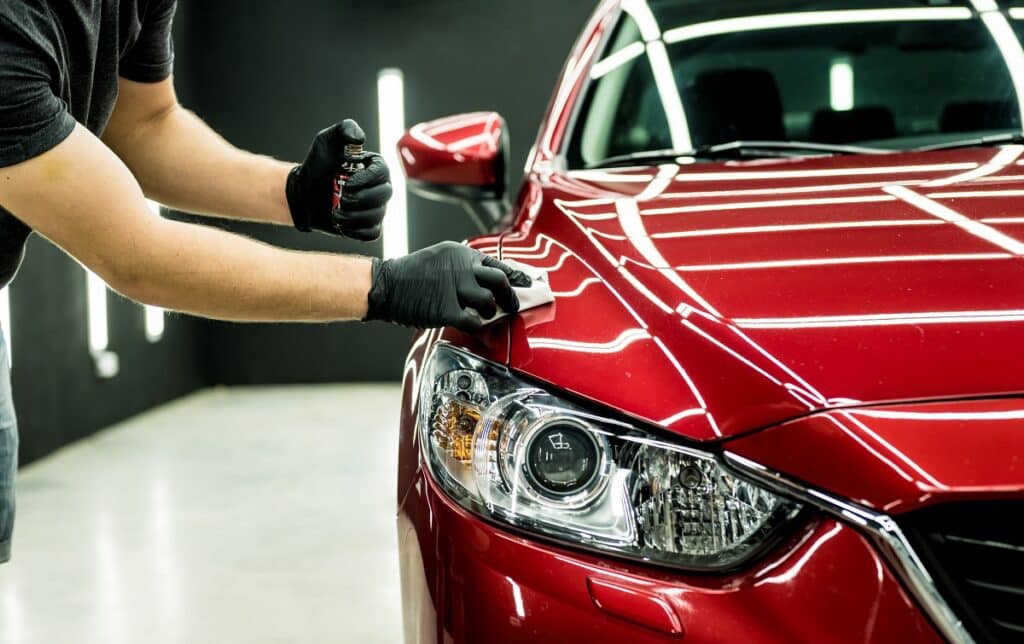
Ceramic coating is a liquid applied to the paint by hand. It is usually based on silicon dioxide (SiO2) or polysilazane chemistry. After curing, it bonds to the clear coat and forms a hard, glass-like layer about 1 to 3 microns thick.
What ceramic coating does well:
- Makes the paint hydrophobic, so water, dust and dirt slide off and the car stays cleaner for longer
- Resists chemical etching from bird droppings, bug splatter and water spots far better than bare clear coat
- Adds UV resistance that slows fading and oxidation
- Gives the paint a deep gloss and makes washing much faster
What ceramic coating does not do is stop stone chips. The “9H hardness” claim used in marketing refers to a pencil hardness test. It describes scratch resistance against light contact, not impact protection. A stone hitting the bonnet at 120 km/h goes straight through a coating that is a few microns thick. Ceramic coating also cannot prevent deep scratches or the swirl marks caused by an aggressive brush wash.
A good professional ceramic coating lasts roughly 2 to 5 years in UAE conditions, depending on the product, the number of layers and how the car is washed.
What Is Paint Protection Film (PPF)?
Paint protection film is a clear thermoplastic polyurethane (TPU) film, typically 150 to 200 microns thick. That is around 50 to 100 times thicker than a ceramic coating. It is cut to the shape of each panel and installed with a slip solution and squeegee, with the edges wrapped where possible.
What PPF does well:
- Absorbs stone chips, sand blasting and minor scuffs. This physical impact protection is the main reason people choose it
- Self-heals light scratches and swirl marks. The top layer reflows with heat, and in Dubai the sun often does this on its own
- Protects against UV and chemical etching
- Can be removed later, leaving the original factory paint underneath, which matters for resale value on luxury cars
Quality aliphatic TPU films no longer yellow the way older films did, and most premium brands now offer warranties of 5 to 10 years. PPF is also available in a matte or satin finish, which can turn a gloss car satin or protect a factory matte paint that must never be polished.
The downside is cost. PPF takes far more labour and material than a coating, so full-body PPF costs several times more than a ceramic coating.
Ceramic Coating vs PPF: Side-by-Side Comparison
| Factor | Ceramic Coating | PPF |
|---|---|---|
| Thickness | 1–3 microns | 150–200 microns |
| Stone chip protection | No | Yes |
| Scratch and swirl protection | Light only | Yes, with self-healing |
| Chemical and bird dropping resistance | Very good | Very good |
| UV protection | Good | Very good |
| Hydrophobic, easy cleaning | Excellent | Moderate unless coated on top |
| Gloss enhancement | High | Good |
| Typical lifespan in the UAE | 2–5 years | 5–10 years |
| Cost | Lower | Higher |
At Carzilla, a ceramic coating starts from AED 899, and a PPF front kit starts from AED 4,999. Full prices depend on the vehicle size and the condition of the paint. You can see current packages on our car detailing services page.
Can You Use Ceramic Coating and PPF Together?
Yes, and for many high-end cars in Dubai this combination gives the best paint protection. The usual setup is:
- PPF on the high-impact areas, which are the front bumper, bonnet, front wings, mirrors, A-pillars, door edges, and the rocker panels and rear arches behind the wheels
- Ceramic coating on the rest of the body
- A coating made for film applied on top of the PPF itself
This gives you chip protection where the car actually gets hit, and easy cleaning and gloss everywhere else, without paying for full-body film. Owners of supercars and SUVs that do long highway runs to Abu Dhabi or Ras Al Khaimah often go for full-body PPF with a coating on top instead.
Which One Should You Choose?
Pick the option that matches how the car is actually used.
Choose ceramic coating if: the car is mostly driven in the city, you want it easier to keep clean, the paint is already in good condition, and your budget is limited. It is also a good choice for older cars where you want to bring back gloss and protect what is left of the clear coat.
Choose PPF if: the car is new or has original factory paint you want to keep, you drive regularly on highways, or the car has a high resale value. This includes most Porsche, Lamborghini, Ferrari, Rolls-Royce and Range Rover owners. Matte factory paints should also be protected with matte PPF, because any damage to matte clear coat cannot be polished out.
Choose both if: you want the full benefits and the car is a long-term keeper.
If you are buying a used car, have a pre-purchase car inspection done first. A paint depth gauge will show which panels have been repainted. That changes what preparation is needed and whether film can safely be removed later.
Why Preparation Matters More Than the Product
Most ceramic coating and PPF problems come from poor preparation, not from a poor product.
Paint correction comes first. Both a coating and a film lock in whatever is underneath. Swirl marks, holograms and water spots left on the paint will be sealed under the protection for years. A proper job involves a decontamination wash, iron and tar removal, a clay bar, and machine polishing matched to the paint. Soft paints, such as many Italian factory finishes, need a gentler approach than hard German clear coats.
Respray panels need time to outgas. Fresh paint releases solvents for 30 to 90 days after it is applied. If PPF or ceramic coating goes on too early, the trapped solvents can cause bubbling, haze or poor bonding. If your car has just come out of the auto body shop after accident repair, wait for the paint to cure fully before you protect it.
Film quality depends on the installer. Look for pre-cut patterns from a plotter or careful hand-trimming off the car. Cutting with a blade directly on the paint can leave scores in the clear coat. Edges should be wrapped wherever the panel allows, and the warranty should be registered against the car’s VIN.
Common Problems with Ceramic Coating and PPF, and How They Are Fixed
Ceramic coating high spots. Excess coating that was not levelled during application cures as dark, smeary patches. They can be removed by machine polishing the area and recoating.
Coating losing its water beading. This usually means a layer of road film is sitting on top of the coating, not that the coating has failed. A decontamination wash and a silica topper often bring the beading back.
PPF edges lifting. This is usually caused by pressure washing too close to the edge, or by poor edge wrapping during installation. Small lifts can be reset with heat. Larger ones require the piece to be replaced.
PPF yellowing or staining. This is common on old or low-grade films. The only fix is to remove and replace the film. Removal should be done with heat and patience, because pulling cold film off repainted panels can lift the paint.
Swirls under the film or coating. This was a preparation fault. The protection has to come off, the paint must be corrected, and new protection applied.
How to Maintain Ceramic Coating and PPF
Good aftercare doubles the life of either option:
- Leave a new ceramic coating free of water for at least 24 to 48 hours. Avoid harsh chemicals for the first week while it fully cures
- Use the two-bucket hand wash method with a pH-neutral shampoo, and pre-rinse thoroughly to remove sand before touching the paint
- Avoid automatic brush car washes completely
- Keep a pressure washer nozzle at least 30 cm from PPF edges
- Remove bird droppings and insects the same day using a quick detailer and a microfibre cloth
- Park in the shade or use a breathable car cover during summer
- Book a professional inspection and decontamination once a year
Get Ceramic Coating and PPF at Carzilla, Al Quoz
At Carzilla, we treat paint protection as part of looking after the whole car, not as a cosmetic add-on. Our detailing team works alongside our car painting and body shop technicians. That means we can correct, repair and protect the paint in one place, including on cars fitted with body kits or carbon fibre kits. We regularly protect high-end vehicles including Porsche, Lamborghini, Ferrari, Rolls-Royce, Mercedes-Benz and Range Rover models.
If you want a temporary colour change rather than permanent protection, our peelable paint service is another option. Before any visual changes to your car, check the car modification rules in Dubai. You can also read why owners choose Carzilla car care, and spread the cost with our pay-later option through Tabby.
Contact Carzilla to book a paint inspection and get a ceramic coating or PPF quote for your car.