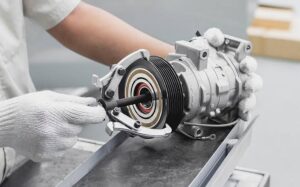

The BYD Atto 3 is one of the most common electric cars on Dubai and Abu Dhabi roads, and its Blade Battery has a strong reputation for safety and stability. What that reputation hides is that the pack’s performance, charging speed and long-term health depend almost entirely on one thing: how well the car can move heat out of the battery and into the air. In a climate where ambient temperatures sit above 45°C for months and road surfaces run hotter still, that heat path is under load every single day.
This guide explains how the Atto 3’s battery cooling system works, why it degrades in UAE conditions, what the failure symptoms look like, how a workshop actually diagnoses and repairs it, and what owners can do to prevent the problem. It applies broadly to BYD’s e-Platform 3.0 cars, so much of it also holds for the Dolphin, Seal and Yuan Plus.
How the BYD Atto 3 Battery Cooling System Works
The Atto 3 uses a liquid-cooled Blade Battery (LFP) pack integrated into the floor. Heat leaves the cells through a chain of handovers, and every link in that chain is a point of failure:
- Cell to cold plate. The blade cells transfer heat into an aluminium cooling plate bonded to the pack with thermally conductive material.
- Cold plate to coolant. A low-conductivity glycol coolant is pushed through the plate by an electric coolant pump.
- Coolant to refrigerant. The battery loop passes through a plate chiller, where the car’s air-conditioning refrigerant absorbs the heat. An electronic expansion valve meters refrigerant into that chiller, and an electric multi-way coolant valve decides whether the battery loop is joined to the motor loop, sent to the chiller, or bypassed.
- Refrigerant to air. The refrigerant dumps that heat at the front condenser, with radiator fans pulling ambient air through the stack.
The important consequence is that the Atto 3 cools its battery using the same air-conditioning circuit that cools the cabin. Anything that weakens the AC system — low refrigerant, a blocked condenser, a failing fan — weakens battery cooling at the same time. That is why BYD battery temperature complaints and car AC repair work so often turn out to be the same job.
Why BYD Atto 3 Battery Cooling Problems Happen in UAE Heat
Heat rejection gets harder as ambient rises. A chiller can only move heat if there is a temperature difference at the condenser. At 20°C ambient there is enormous margin. At 48°C, with the pack already heat-soaked, the system is working near its design limit with nothing in reserve — so any small loss of capacity becomes a visible fault.
The cooling stack packs with sand and dust. This is the single most common cause of BYD Atto 3 overheating symptoms in Dubai. Fine silica, insects and road film build up between the condenser and radiator fins, often from the back where a normal wash never reaches. Airflow drops, condenser pressure rises, and the battery chiller loses capacity long before the cabin feels warm.
Heat soak while parked. The pack sits under the floor, close to asphalt that can exceed 65°C in summer. A car left in open parking absorbs heat from above and below with the thermal system asleep. LFP chemistry is stable, but sustained high cell temperature — especially at a high state of charge — accelerates calendar ageing, which is permanent capacity loss you cannot service back.
DC fast charging in the afternoon. Fast charging is the heaviest thermal load the pack ever sees. Doing it at midday, immediately after a highway run, stacks three heat sources at once. A healthy car handles it by derating; a car with a compromised cooling loop derates far harder.
Coolant and component wear. Corrosion inhibitors deplete over time, and EV packs require low-conductivity coolant to protect high-voltage isolation. Topping up with generic workshop coolant or water is a genuine risk, not a technicality. Electric coolant pumps also wear, and air trapped in the loop after careless servicing creates hot spots the BMS can see but the owner cannot.
Symptoms of a BYD Battery Cooling Fault
Battery thermal problems rarely announce themselves as an overheating warning. They show up as performance the car quietly takes away:
- DC charging speed collapses. The car pulls strong power for a few minutes, then tapers early and sits at a fraction of its rated rate. Summer-only, high-temperature charge derating is the classic first sign.
- Reduced power or a power-limit warning during hard acceleration or long climbs, particularly at the end of a hot drive.
- Range drops noticeably in summer beyond the normal AC penalty, because the thermal system runs continuously to hold cell temperature down.
- Cooling fans run loudly and stay running for long periods after parking or while charging.
- Weak cabin cooling at idle alongside any of the above — evidence the shared refrigerant circuit is the root cause.
- Coolant level or battery temperature warnings, which usually appear late, after the earlier signs were ignored.
Because these overlap with normal hot-weather behaviour, the only reliable way to separate a real fault from expected derating is data. That is what a proper EV repair workshop in Dubai is set up to read.
How BYD Atto 3 Battery Cooling Is Diagnosed and Repaired
A generic OBD reader will not diagnose this. The car needs a BYD-capable scan tool that can display battery-level data, and the diagnosis follows the heat path in order:
- Cell temperature spread. The technician reads the highest and lowest cell temperatures in the pack. A small delta means coolant is flowing evenly. A wide delta points to flow restriction, an air pocket or a partially blocked cold plate.
- Chiller inlet and outlet temperatures. If coolant enters and leaves the chiller at nearly the same temperature, the refrigerant side is not absorbing heat — refrigerant charge, expansion valve or compressor.
- Coolant pump and valve commands. The BMS may be requesting full cooling while the pump is not delivering, or the multi-way valve is stuck in a position that bypasses the battery loop.
- Refrigerant pressures and charge weight. EV thermal systems are sensitive to charge accuracy in grams, not “a top-up”. Low charge starves the battery chiller first, which is why cabin AC can still feel acceptable while the pack overheats.
- Airflow and stack condition. Condenser and radiator inspected from both sides, fan operation and shroud integrity verified.
Repairs follow from the finding: a full cooling-stack clean, coolant drain and refill with the correct low-conductivity specification using a proper vacuum fill to eliminate air, coolant pump or multi-way valve replacement, expansion valve or temperature sensor replacement, refrigerant recovery and recharge by weight after leak testing, cabin filter renewal, and a BMS software update where BYD has revised the thermal strategy. Electric compressors also require the correct POE oil — using standard PAG oil compromises high-voltage isolation, and it is a mistake non-EV workshops still make.
Preventing Battery Cooling Problems on Your BYD in Dubai
- Service the cooling system before summer, not during it. A pre-summer clean of the condenser and radiator stack, a refrigerant and coolant check, and a battery health report is the highest-value maintenance an Atto 3 owner can do in this country.
- Wash the cooling stack after sandstorm season, with low pressure and from the engine-bay side, so debris exits the way it came in.
- Park in shade or a basement where possible, and use a windscreen shade. It lowers the starting temperature of every drive.
- Precondition on the charger. Cooling the car while it is still plugged in uses grid power rather than pack energy and starts the drive with the thermal system ahead.
- Avoid parking for days at a very high state of charge in direct sun. LFP tolerates full charging well, and BYD recommends periodic full charges for balancing and SoC calibration — but sitting fully charged and heat-soaked for a week is the worst combination for calendar ageing.
- Shift heavy DC fast charging to early morning or evening in July and August, and let the car cool briefly before plugging in after a long highway run.
- Never ignore a weak AC. On this platform, an AC complaint is a battery cooling complaint waiting to happen.
- Get a battery health check before buying used. A state-of-health report and thermal system inspection during a pre-purchase car inspection tells you far more about a used Atto 3 than mileage does.
When to Have the Car Checked
Book a diagnostic if DC charging speed has clearly dropped year-on-year, if you see power limiting on hot days, if fans run constantly, or if cabin cooling has weakened at all. These faults are inexpensive to correct early — a stack clean, a coolant service, a valve — and expensive to correct late, because sustained high cell temperature causes capacity loss that no repair recovers.
Carzilla handles Blade Battery diagnostics, thermal system repair and high-voltage work in-house at our Al Quoz workshop. See our full BYD repair Dubai page for Atto 3, Seal, Han, Tang and Dolphin service, our EV repair and electric car garage page for the wider high-voltage bay, or browse all car repair services and brands we specialise in. Related work often booked alongside a cooling service includes car AC repair, regen-aware brake service, battery-weight-adjusted suspension repair, tyre services and RTA vehicle inspection. You can reach the team through our Al Quoz auto garage page or contact us directly.