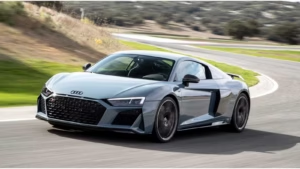

Maserati builds cars that are mechanically closer to Ferrari than to any mainstream German saloon, and that shows up in how they age. A Ghibli, Levante, Quattroporte or GranTurismo can run for years with almost no drama, but the failures that do appear tend to arrive in the same places, in the same order, and far earlier in the UAE than in Europe. Heat cycling, fine airborne sand, short city trips and long summer storage all compress a Maserati’s service life.
This guide covers the ten most common Maserati maintenance problems owners face in Dubai, Abu Dhabi and Sharjah — why each one happens, what a proper repair involves, and what actually prevents it. It applies across the range, from the Ferrari-built 4.2 and 4.7 V8 cars to the 3.0 twin-turbo V6 and 3.8 V8 models and the newer Nettuno engine.
Why Maserati Problems Appear Sooner in UAE Driving Conditions
Mileage is a poor predictor of Maserati wear in this region. Heat cycling is the real clock. Every time an engine bay reaches 100°C and cools back to ambient, rubber seals, plastic housings and bonded joints move against each other, and after a few thousand cycles they harden, shrink and leak. A car that covers 8,000 km a year around Dubai can age its gaskets faster than a European car doing 25,000 km.
Three other local factors matter. Fine silica dust packs the radiator and condenser stack from behind, so the cooling system loses capacity without any visible blockage. Short trips never get the oil hot enough to boil off fuel and moisture, which shortens oil life and loads the crankcase ventilation system. And cars stored for the summer months suffer flat batteries, dry starts, stale fuel and seized brake hardware. Nearly every fault below is accelerated by at least one of these.
1. Cold Start Rattle from Timing Chain Tensioners and Cam Variators
On the Ferrari-built F136 V8 used in the GranTurismo, GranCabrio, Quattroporte V, Coupé and Spyder, a two to four second rattle on first start is the single most reported fault. The engine uses hydraulic chain tensioners and cam phasers that rely on oil pressure. As the tensioner’s internal check valve and the variator’s locking pin wear, oil drains back overnight and the chain runs slack until pressure builds.
The fix is not an oil additive. Tensioners, guides and — where the noise persists after tensioner replacement — the cam variators themselves need replacing, and the chains should be inspected for stretch at the same time. Left alone, a slack chain can jump a tooth on an interference engine, which turns a manageable job into a rebuild.
Prevention is straightforward: shorten the oil interval, use the correct grade and pressure-rated oil, and avoid letting the car sit for weeks at a time. Regular use keeps the oil galleries charged. This work sits with an experienced Maserati engine repair specialist rather than a general workshop, because chain timing on these engines is unforgiving.
2. Coolant Leaks and Overheating in the Ghibli, Levante and Quattroporte
The 3.0 twin-turbo V6 runs a complex cooling circuit with plastic thermostat housings, quick-connect fittings and multiple hoses routed through a hot engine bay. Under UAE summer conditions the plastic becomes brittle, the O-rings take a compression set, and coolant seeps from the housing seam or from a connector rather than bursting dramatically. Owners usually notice a sweet smell or a slowly dropping expansion tank before any temperature warning.
Repair means replacing the failed housing or pipe as an assembly, not just the O-ring, then pressure testing the system cold and hot and bleeding it properly — these engines trap air easily, and a bad bleed causes a second overheating episode that gets blamed on the repair.
Prevention has two parts. Replace coolant on schedule rather than topping it up, because degraded coolant attacks the seals and the water pump. And have the cooling stack cleaned from the engine side at every service, since sand packed between the radiator, condenser and intercoolers is the most common hidden cause of high running temperatures in Dubai.
3. Engine Oil Leaks and High Oil Consumption
Oil leaks affect every Maserati engine family, but from different places. Naturally aspirated V8s typically leak from cam covers, spark plug well seals and cam variator seals. Turbocharged V6 and V8 cars leak from turbo oil feed and drain lines, and lose oil internally through pressure paths. Heat is again the cause — cover gaskets harden, and the crankcase ventilation system builds pressure that forces oil past seals that were previously fine.
The critical point in any repair is testing crankcase pressure before resealing anything. If the ventilation system or oil separator is blocked, a newly fitted gasket will leak again within months, and the owner pays twice for the same job. A correct diagnosis uses UV dye, a full degrease, a drive cycle and a re-inspection, and typically runs AED 600–1,400 before parts.
Prevention is realistic servicing. Stretching a European drain interval in 45°C heat is the most common reason a low-mileage car starts consuming oil. Booking a Maserati oil change service on a UAE-adjusted schedule costs a fraction of a cam cover reseal.
4. Harsh Shifting and Jerking from the ZF 8HP Transmission
Most modern Maseratis use the ZF 8HP eight-speed automatic, and it is a strong unit — but the “fluid filled for life” description is the source of more gearbox failures than any mechanical weakness. In UAE traffic, sump temperatures sit high for long periods, the fluid oxidises, and the friction modifiers break down. The first symptoms are a shudder at light throttle around 60–80 km/h as the torque converter lock-up clutch judders, a delayed engagement from Park to Drive, or a harsh 1–2 upshift when cold.
The proper repair is a fluid and pan-with-integrated-filter change at temperature, with the level set using the correct fluid specification, followed by an adaptation reset so the gearbox relearns clutch fill pressures. Skipping the adaptation is why some cars feel worse after a fluid service. On cars with a worn mechatronic unit or solenoid drift, live pressure data is needed before any parts are quoted.
Change the fluid every 60,000–80,000 km in this climate. Details of the work involved are covered on the Maserati transmission repair page, and the same principles apply to any gearbox repair on a torque-converter automatic.
5. Air Suspension and Skyhook Damper Faults on the Levante and Quattroporte
The Levante’s air suspension and the Skyhook adaptive damping used across the range are both heat-and-dust sensitive. Air spring bellows lose plasticiser as they age, then fine sand trapped in the rolling lobe abrades the rubber until it develops a pinhole. The compressor then runs longer and longer to hold ride height, overheats, and eventually fails — so the compressor is usually a symptom, not the original fault. Skyhook dampers fail differently, weeping oil from the shaft seal until the electronic damping control loses authority and the car reports a suspension fault.
A correct diagnosis checks battery voltage first, then reads live corner pressures and performs a static pressure-hold test to find which corner is leaking, before anything is replaced. Replacing a compressor on a car with a leaking bellows guarantees a repeat failure.
Prevention is mostly about not ignoring early signs: a car that sits lower on one corner after a night parked, or a compressor audibly running at start-up, is already leaking. Both problems are handled under Maserati suspension repair, and the general principles are the same as any car suspension repair on an air-sprung SUV.
6. Weak Air Conditioning and Condenser Failure
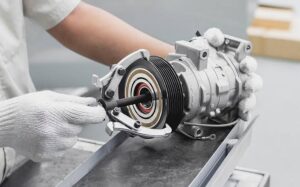
Maserati AC systems are adequate rather than generous, so any loss of efficiency is felt immediately in July. The most common causes are a sand-eroded condenser leaking refrigerant at the tube-to-header joint, a failing expansion valve, or a blend door actuator that leaves one side of the cabin warm. Slow refrigerant loss through hose crimps and O-rings is also normal after six or seven summers.
A proper repair identifies the leak with dye or an electronic sniffer, replaces the failed component, then evacuates the system to a deep vacuum, holds it to confirm no leak remains, and recharges by weight with the correct oil type. A workshop that simply “tops up” the gas has not fixed anything.
Prevention: run the AC briefly even in winter to keep the compressor seals lubricated, change the cabin filter twice a year, and have the condenser cleaned rather than pressure-washed at an angle that bends the fins. Maserati AC repair and general car AC repair both follow this sequence.
7. Battery Drain and Electrical Faults
A large share of “major” Maserati faults turn out to be voltage problems. AGM batteries last 24–36 months in UAE heat rather than the five years quoted in Europe, and as capacity drops the car starts throwing unrelated warnings — suspension errors, gearbox messages, infotainment resets, even no-start conditions. Cars stored over the summer without a maintainer are the worst affected.
The fix begins with a load test and a parasitic drain measurement, not with clearing codes. Where a module has genuinely failed or been replaced, FCA-era Maseratis also need proxy alignment so the car’s configuration file matches the fitted hardware — without it, new modules generate faults of their own.
Prevention is simple and cheap: replace the battery on age rather than waiting for failure, register the new battery where the system requires it, and use a smart maintainer on any car parked for more than two weeks.
8. Carbon Buildup, Misfires and Coil Pack Failure
Direct-injected Maserati engines have no fuel washing over the intake valves, so oil vapour drawn in through the crankcase ventilation system bakes onto the valve backs. The result is a rough idle, a hesitant part-throttle response, cold-start misfires and eventually a stored misfire code. Heat and short trips accelerate the deposit rate, and coil packs living at high under-bonnet temperatures fail alongside them, which confuses the diagnosis.
The proper fix is walnut shell blasting of the intake ports with the manifold removed, combined with new plugs and any failed coils. Chemical intake cleaners poured into the fuel tank cannot reach the valves on a direct-injection engine.
To slow it down, use quality 98 RON fuel, keep the oil interval short so less vapour reaches the intake, service the oil separator, and drive the car properly warm at least weekly rather than in short cold cycles. Diagnostic work of this kind is covered under Maserati engine repair and general car engine repair.
9. Brake Wear, Judder and Carbon-Ceramic Handling
Maserati brake systems wear faster in the UAE for mechanical reasons, not just driving style. Heavy cars, stop-start traffic and repeated hard decelerations from highway speeds put a lot of heat into the discs, and heat plus a car left parked with hot brakes causes uneven pad deposits — felt as a judder through the pedal and often misdiagnosed as a “warped” disc.
Correct repair means measuring disc thickness and runout against the minimum specification rather than replacing on appearance, replacing pads and discs as a set per axle, fitting new wear sensors, and bedding the pads in properly afterwards. Cars with carbon-ceramic discs need particular care: they are damaged by abrasive pads, harsh chemical wheel cleaners and pressure washing directly at the disc face.
Prevention is regular brake fluid changes — fluid absorbs moisture quickly in coastal humidity and loses boiling point — plus a proper cool-down lap before parking after spirited driving. This falls under Maserati brake repair and standard car brake repair services.
10. Interior Trim Peeling, Sticky Buttons and Infotainment Faults
The tenth problem is not mechanical but it affects almost every older Maserati in the region. Soft-touch coated plastics on the console, door handles and switchgear break down under prolonged UV and cabin temperatures above 70°C, turning sticky and then peeling. Leather dries and cracks at the seat bolsters and dashboard top, and the infotainment screen can delaminate or develop touch dead spots from the same heat.
Repair options range from stripping and re-coating trim pieces, to re-trimming panels in leather or Alcantara, to replacing a screen assembly. Retrimming is usually the better long-term answer for a car being kept, since replacement panels degrade the same way.
Prevention is entirely about heat management: park in shade or a basement wherever possible, use a windscreen shade, treat leather with a non-silicone conditioner, and avoid solvent-based cleaners on soft-touch surfaces, which strip the coating faster than sunlight does. Trim and cabin work is handled through car upholstery services.
Adjusting Your Maserati Service Schedule for UAE Conditions
Most of the ten faults above are prevented by the same short list. Halve the European oil interval and use the specified grade. Change coolant, brake fluid and transmission fluid on time rather than on symptoms. Clean the cooling stack at every service. Replace the battery on age. Change the Q4 transfer case and differential fluids on all-wheel-drive Ghibli, Levante and Quattroporte models, despite the “lifetime” description. And drive the car to full operating temperature at least once a week instead of leaving it on short trips or parked for months.
A pre-purchase inspection matters just as much if you are buying used. A car inspection with a proper diagnostic scan and a VIN check will show an unresolved chain rattle, a stored suspension fault or a history of imports far more reliably than a test drive will.
Maserati Repair and Servicing in Dubai
Maserati work needs factory-level diagnostics, not a generic OBD reader — Ferrari-era cars need SD3 or Leonardo class tooling, while FCA-era Ghibli, Levante, Quattroporte and Grecale models need MDVCI or wiTECH-class access for module coding and proxy alignment. Without that, most of the faults in this guide can be seen but not correctly diagnosed or reset.
Carzilla runs a specialist Maserati workshop in Al Quoz Industrial Area 2 covering the full range, with model-specific service for the Ghibli, Levante, Quattroporte, GranTurismo, GranCabrio, Coupé, Spyder and Pininfarina models. Full details of servicing, diagnostics and repair are on the main Maserati repair Dubai page, alongside our wider luxury car garage services, oil change options and the complete service list. You can reach the workshop through the contact page.