
A Maserati cooling fan does more work in Dubai than almost anywhere else in the world. In slow traffic on Sheikh Zayed Road in August, the fan is the only thing moving air through the radiator, and it often runs at full duty for the entire drive. When it stops working, coolant temperature climbs within minutes and the engine is at risk. This guide explains how the system works, why cooling fans fail on Maserati models, how the fault is repaired, and what owners can do to prevent it.
How the Maserati Cooling Fan System Works
The fan does not simply switch on when the engine gets hot. On modern Maserati models — Ghibli, Levante, Quattroporte VI and Grecale — the engine control module reads coolant temperature, intake temperature, vehicle speed and air conditioning refrigerant pressure, then commands a brushless fan assembly through a PWM signal. The fan runs at a variable speed, not just on or off.
Older Ferrari-built V8 cars such as the GranTurismo, GranCabrio, Coupé and Spyder use twin fans driven through relays and resistor packs. The control logic is simpler, but the failure points are different — relays and connectors carry the full current instead of an electronic module.
This matters because a fan that never spins may have nothing wrong with the fan itself. Any part of that chain — sensor, signal, power supply, ground — can stop it.
Common Causes of Maserati Cooling Fan Failure
Fan Motor and Control Module Failure
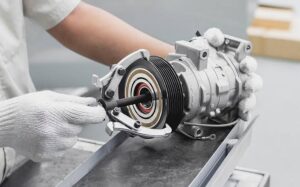
The most common single cause. The brushless motor and its integrated controller sit directly behind the radiator, in the hottest airflow on the car. Heat cycling degrades the solder joints and capacitors inside the controller, and the motor bearings wear from fine dust drawn through the stack. Typical symptoms are a fan that works intermittently, runs at one fixed speed only, or makes a rumbling or whining noise before it stops entirely. On most Maserati models the motor and controller are sold as one assembly and cannot be repaired separately.
Blocked Radiator and Condenser Stack
Sand and dust pack the fins between the AC condenser and the radiator, usually from the engine side where it is invisible during a normal inspection. Airflow drops, coolant temperature stays high, and the ECU holds the fan at maximum duty for far longer than the design intended. The fan then fails early — not because it was faulty, but because it was overworked. This is why cooling fan failure and radiator problems so often appear together.
Coolant Temperature Sensor Faults
If the coolant temperature sensor reports a lower reading than reality, the ECU never asks the fan to run. The fan is healthy, the wiring is healthy, and the car still overheats. A drifting sensor is one of the most misdiagnosed causes of Maserati overheating, and it is only found by comparing live sensor data against actual measured temperature during engine diagnostics.
Wiring, Connectors and Ground Corrosion
Cooling fans draw high current. Over time, connector pins overheat, discolour and lose contact pressure — a burnt fan connector is a common find on high-mileage Ghibli and Quattroporte models. Coastal humidity in the UAE also corrodes chassis ground points behind the front bumper. A poor ground raises resistance, the fan runs slowly or not at all, and replacing the fan alone will not fix it.
Fuses, Relays and Weak Battery Voltage
A blown high-current fuse or a failed relay stops the fan instantly. Weak battery voltage is a quieter cause: AGM batteries in the UAE often last only 24 to 36 months, and low system voltage upsets the electronics that control fan speed. Any cooling fan diagnosis should start with a voltage check, not with parts.
Air Conditioning Pressure Faults
The fan is also commanded by the AC system. If refrigerant pressure is too high or a pressure sensor is faulty, the module may request full fan speed constantly, or refuse to run the fan at all and shut the compressor down instead. Weak cabin cooling combined with a fan that behaves strangely usually points to Maserati AC repair rather than an engine cooling fault.
Broken Fan Shroud and Aftermarket Body Kits
The shroud forces air through the core instead of letting it recirculate. Cracked shroud mounts, missing under-tray panels or a non-standard front bumper all reduce airflow and push the fan to work harder. Cooling performance is one of the first things to check after any front-end body modification.
Why Maserati Cooling Fans Fail Faster in Dubai
Ambient temperature is only part of it. The bigger factors are duty cycle and contamination. In European conditions a cooling fan may run for a few minutes per journey; in Dubai it can run continuously, including for several minutes after shutdown while the turbochargers and engine bay heat-soak. Add fine desert sand loading the cooling stack, short trips that never allow full airflow, and cars that sit unused for months over summer with corrosion building on connectors, and the result is a component that ages by heat cycles rather than kilometres. Heavier models such as the Levante place the highest sustained load on the system.
How Maserati Cooling Fan Failure Is Repaired
Correct repair begins with diagnosis, not replacement. A Maserati-capable scan tool is used to read live coolant temperature, check for fan-circuit fault codes, and command the fan through an actuator test at a set duty percentage. If the fan responds to a commanded test but never runs during normal driving, the fault is in the sensing or control side. If it does not respond at all, the technician then measures supply voltage, ground integrity and current draw at the fan connector before condemning the assembly.
Once the fault is confirmed, the repair may involve replacing the fan assembly, repairing or renewing the connector and harness section, replacing the coolant temperature sensor, or cleaning the radiator and condenser stack from the engine side. The cooling system is then refilled with the correct coolant specification, properly bled, and pressure-tested. A road test under load — with live data logged — is the only way to confirm the fan cycles correctly at the right temperature thresholds. Any Maserati workshop doing this work properly will show you the before-and-after temperature data.
Maserati Cooling Fan Running Constantly
A fan that never switches off is a different fault from a fan that never runs. It usually means the engine is genuinely not cooling — a stuck thermostat, a failing water pump, low coolant, air trapped in the system after a poor bleed, or an AC pressure fault. It can also indicate a control module defaulting to full speed because it has lost a sensor signal. Ignoring it because “the fan still works” is how a cheap sensor fault becomes a cylinder head repair.
How to Prevent Maserati Cooling Fan Problems
Have the radiator and condenser stack cleaned from the engine side at every major service, not just rinsed from the front. Renew coolant at the correct interval instead of topping up — degraded coolant loses its corrosion inhibitors and attacks the radiator and pump internals. Keep the battery healthy and replace it before it becomes marginal. After a hard run on Al Khail Road, allow a short idle before shutdown so the fan can pull the heat down. Avoid pressure-washing the radiator core at close range, which bends fins and reduces airflow permanently. And treat any new noise from the front of the car as a warning: fan bearings almost always become audible before they seize.
Regular Maserati oil change and servicing is the natural point to inspect the cooling stack, hoses, coolant condition and fan operation together, since the same heat that degrades oil also degrades cooling components.
Maserati Cooling Fan Repair in Dubai
Cooling faults are cheap to fix early and extremely expensive to fix late. If your temperature gauge climbs in traffic, the AC weakens at idle, or the fan sounds different from how it used to, get it diagnosed before the next long drive. Carzilla is a specialist Maserati repair centre in Dubai based in Al Quoz Industrial Area 2, handling engine cooling, transmission, suspension and brake work on all models, including the Pininfarina cars. You can also book an inspection or contact the workshop directly.