
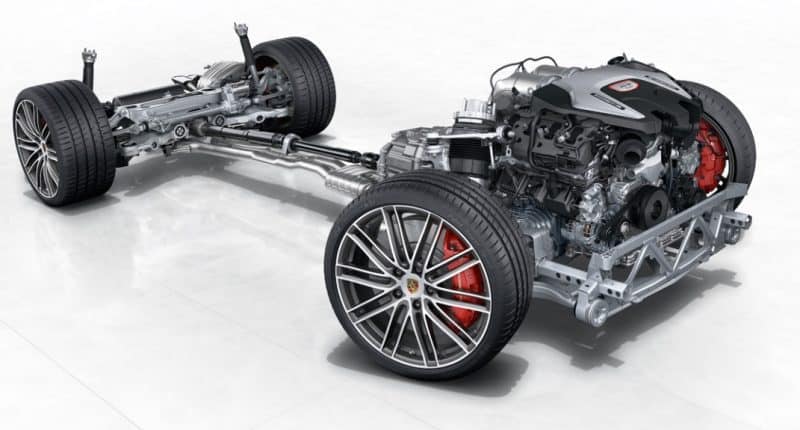
The Porsche Panamera transmission is one of the strongest parts of the car, and also one of the most expensive to replace. In the UAE, most Panamera gearbox failures are not sudden factory defects. They are the end result of heat, ageing fluid, clutch slip and small electrical faults that were left too long. All four are things an owner can control.
This guide explains which transmission your Panamera uses, why Panamera transmission problems happen, what the common fixes are, and how to extend Porsche Panamera transmission life in Dubai conditions.
Which Transmission Does Your Porsche Panamera Have?
Before any gearbox service is booked, confirm which unit is fitted, because each one wears differently and uses a different fluid.
The first-generation Panamera (970, 2010 to 2016) uses a 7-speed PDK dual-clutch transmission, built by ZF, on almost all petrol models, from the base car through the 4S, GTS, Turbo and Turbo S. The Panamera Diesel and the first Panamera S Hybrid were the exceptions. They used an 8-speed Tiptronic S, a conventional torque-converter automatic supplied by Aisin.
The second-generation Panamera (971, 2017 to 2023) and the third-generation Panamera (976, 2024 onward) use an 8-speed PDK across the range. On E-Hybrid models the electric motor works together with the PDK, and on the 976 it is built into the gearbox housing itself, which makes correct diagnosis even more important on hybrid cars.
If you are not sure which gearbox your car has, the model year and VIN will tell a Porsche specialist in seconds.
How the Panamera PDK Transmission Works
A PDK is effectively two gearboxes in one case. One wet multi-plate clutch handles the odd gears and the other handles the even gears. While you drive in one gear, the next gear is already selected, so the shift is simply one clutch releasing as the other engages. That is why a PDK shifts so quickly.
Everything is controlled by the mechatronic unit, which combines the transmission control electronics and the hydraulic valve body. It sits inside the gearbox and works in the transmission fluid. The fluid lubricates the gears, cools the clutches and operates the hydraulic valves all at once. Nearly every Panamera PDK problem comes back to the condition and temperature of that fluid.
The Tiptronic S on diesel and early hybrid cars works differently. It uses a torque converter with a lock-up clutch rather than twin clutches, but it is just as dependent on clean, cool fluid.
Why Porsche Panamera Transmission Problems Happen
Heat is the main cause. Every time a PDK clutch slips, when pulling away, creeping in traffic or holding the car on a slope, it produces heat. That heat goes into the fluid. Hot fluid oxidises, loses its friction properties and loses its ability to cool. Over time the clutch plates glaze and start to judder, and varnish builds up on the mechatronic valves so shift pressure becomes less precise. In a Dubai summer, with ambient temperatures above 45°C and long periods of slow traffic, the gearbox spends much more time at high temperature than it would in Europe.
Old fluid is the second cause. As clutch material wears, fine particles end up in the fluid and the filter slowly blocks. Pressure control suffers, the mechatronic unit works harder, and shift quality drops. Many owners assume PDK fluid is lifetime fill. It is not, especially in this climate.
Clutch slip from driving style and load is the third cause. Constant creeping, holding the car on a hill with the throttle, repeated launch control starts and engine tuning all increase slip and heat.
Electrical faults are the fourth cause. The transmission control unit needs a stable voltage. A weak battery, which in UAE heat can happen within two to three years on an AGM battery, can trigger gearbox fault messages, harsh shifts or emergency mode, especially just after starting. Corroded connectors and faulty speed sensors cause similar faults.
On Tiptronic cars, heat breaks down the fluid in the same way and the torque converter lock-up clutch starts to shudder at steady cruising speeds.
Driving Habits That Extend Panamera PDK Life
The simplest way to protect a Panamera PDK is to reduce clutch slip.
Hold the car on the brake, not the throttle. On a slope or a car park ramp, using light throttle to hold the car still keeps one clutch slipping and heating the fluid. Use the foot brake or Auto Hold where fitted.
In stop-and-go traffic, leave a small gap to the car ahead and move forward in fewer, longer movements. Constant crawling at walking pace is one of the hardest jobs a dual-clutch gearbox can do, because the clutch is partly engaged the whole time.
Always come to a complete stop before selecting reverse or drive. Changing direction while the car is still rolling puts shock load through the clutches and gear set.
On steep ramps, apply the electric parking brake before you select P and release the foot brake. This stops the parking lock inside the gearbox from carrying the full weight of the car.
Use launch control sparingly. An occasional launch is well within the design of the gearbox, but several back-to-back launches heat the clutches quickly. After hard driving, drive gently for a few minutes before switching off so the cooling system can bring fluid temperatures down.
Protecting the Panamera Transmission from Dubai Heat
The PDK fluid is cooled through a heat exchanger linked to the engine cooling system. That means the health of the engine cooling system directly controls gearbox temperature.
The most common problem in the UAE is sand and dust packing the gap between the AC condenser and the radiators behind the front intakes. From the outside the car looks clean, but airflow through the cooling stack drops, and both engine and gearbox run hotter. Cleaning the cooling stack from behind once a year, checking coolant level and condition, and making sure the cooling fans run correctly all protect the transmission as much as the engine. Our guide on car radiator repair cost in Dubai covers the cooling system side in more detail.
Cars that sit for long periods over the summer need attention too. Seals dry out, the battery drains, and the gearbox runs its first few kilometres with fluid that has settled. If your Panamera is stored, use a battery maintainer and drive it to full operating temperature every week or two.
Porsche Panamera Transmission Fluid Change and Service
The factory service schedule sets a long interval for PDK fluid, and many owners take that as lifetime fill. In UAE conditions, a practical Porsche Panamera transmission fluid change interval is around every 60,000 km or four years, whichever comes first, and sooner for tuned cars or cars that spend most of their life in heavy city traffic.
How the service is done matters as much as when. The gearbox must be filled with the Porsche-approved PDK fluid, not a universal dual-clutch fluid, because the friction properties are matched to the clutch material. The filter must be replaced. The fluid level has to be set at the specified temperature, which is read through Porsche diagnostic software rather than guessed. Finally, the clutch adaptation values should be reset and relearned. When this last step is skipped, the car often shifts harshly after the service and the new fluid gets the blame.
The drained fluid also tells a story. Dark, burnt-smelling fluid or visible metallic particles show how hard the gearbox has been working and whether further inspection is needed.
For Tiptronic S cars, the service is an ATF and filter change with the level also set at the correct temperature.
A Panamera transmission fluid and filter service typically costs around AED 1,500 to 3,000 depending on model and gearbox, which is a small fraction of a replacement unit. You can see how we handle this on our Porsche transmission repair page, and it is worth pairing with a regular Porsche oil change so both services stay on schedule.
Panamera Transfer Case, Differential and Tyres
On Panamera 4, 4S, Turbo and other all-wheel-drive models, the gearbox sends power to the front axle through the Porsche Traction Management (PTM) transfer case, which uses an electronically controlled multi-plate clutch. Its fluid is often forgotten. When it degrades in the heat, the car can shudder or bind on tight turns in car parks, clunk when pulling away, or show drivetrain warnings that owners mistake for a gearbox failure. The rear differential oil, and on cars fitted with PTV Plus the electronically controlled rear differential, should be checked at the same time.
Tyres play a bigger role than most owners realise. If front and rear tyres have different sizes, brands or wear levels, the rolling circumference no longer matches. The transfer case clutch then slips constantly to make up the difference, producing heat and early wear. Replace tyres in matching sets, stay with the correct N-rated Porsche specification and keep pressures correct. Our auto tyre services team fits and checks tyres to Porsche specification.
Early Signs of Panamera Transmission Problems
Catching a problem early is often the difference between a fluid service and a replacement gearbox. The early signs of Panamera PDK problems include a judder when pulling away slowly, especially once the car is hot, a delay or clunk when selecting drive or reverse, a harsh 1-2 upshift or a jerky downshift when slowing to a stop, and engine revs flaring between shifts. More serious signs are a transmission fault warning on the instrument cluster, the car refusing to select reverse or staying in one gear (emergency mode), a burning smell after heavy traffic, and fluid leaking from the gearbox seals or cooler lines.
Not every one of these symptoms comes from the gearbox. Worn engine and gearbox mounts, a failing propshaft centre bearing, engine misfires and a weak battery can all feel like a transmission fault. Our Porsche suspension repair and car engine repair teams regularly find that the “gearbox problem” is actually in the driveline or the engine.
A proper diagnosis uses Porsche-level diagnostic equipment to read the gearbox fault memory, clutch adaptation values, clutch temperatures and pressure readings. A generic code reader cannot see most of this.
Common Porsche Panamera Transmission Fixes
The right fix depends entirely on the diagnosis, and a good workshop always starts with the least invasive option.
Many harsh-shift complaints are solved with a transmission software update and a clutch adaptation relearn. Voltage-related faults are fixed by replacing the battery and registering the new battery to the car. A fluid and filter service often cures early judder, provided the clutches are not already glazed. Sensor faults and damaged wiring or connectors can be repaired without opening the gearbox.
When the mechatronic unit itself fails, it can be repaired or replaced, but it must then be coded to the car and adapted, or it will not shift correctly. Worn clutch packs on the PDK, or a failed torque converter on the Tiptronic, require the gearbox to come out of the car. A full gearbox rebuild or exchange unit is the last resort and typically runs into mid five figures in AED, which is exactly why prevention and early diagnosis pay for themselves.
Replacing a mechatronic unit to cure a fault that was really caused by a weak battery is one of the most expensive mistakes we see, so testing comes before parts.
Engine Tuning and Panamera Transmission Wear
An engine tune on a Panamera Turbo or GTS can raise torque above what the PDK clutches were set up to hold. Under full load the clutches slip, heat builds, and the plates glaze long before they should. If you plan to tune your car, the transmission calibration must match the new torque figure, and the fluid service interval should be shortened. Our car modification team can advise on what the gearbox will tolerate before any changes are made.
Porsche Panamera Transmission Service in Dubai
Carzilla, in Al Quoz, services and repairs every Panamera generation, from the 970 PDK and Tiptronic S cars to the latest 971 and 976 PDK and E-Hybrid models. We use Porsche-level diagnostics to read the gearbox properly, carry out PDK fluid services with the correct fluid, temperature-set level and clutch relearn, and handle mechatronic, clutch, transfer case and driveline repairs in-house.
For model-specific work, visit our Porsche Panamera repair Dubai page, or see our full Porsche repair Dubai services and general gearbox repair work. For larger repairs, you can also spread the cost with Tabby. To book an inspection or a transmission service, contact Carzilla.