
Air suspension failure is the single most common reason a Range Rover ends up on a lift in Dubai. The system itself is sound engineering, but almost every part of it — rubber bellows, a small compressor, a desiccant dryer, plastic air lines and a valve block full of solenoids — is being asked to work in 50°C ambient heat, fine silica dust and coastal humidity. This guide explains why Range Rover air suspension fails here, what actually breaks, how it is repaired properly, and what owners can do to make the system last.
How Range Rover Air Suspension Works
Each corner carries an air spring instead of a coil. A compressor feeds pressurised air through a dryer and a valve block into those springs, and ride-height sensors at each corner tell the suspension control module where the body is sitting. The module opens and closes solenoids to add or vent air, holding the car level as load changes and switching between access, normal and off-road heights.
The architecture changes by generation. The L322 runs a WABCO system, the L405 Vogue and L494 Sport use the D7u four-corner setup with a reservoir tank on some builds, and the current L460 and L461 use twin-valve air springs on the MLA-Flex platform with 48V active anti-roll. The Evoque is coil-sprung, so an “air suspension fault” on that model is almost always something else. Knowing which system is fitted matters, because the diagnostic route and the parts are not interchangeable. Our Range Rover suspension repair work always starts by confirming the platform first.
Heat Damage to Air Springs
The rubber bellows is a reinforced composite, and it depends on plasticisers to stay flexible. In Dubai heat those plasticisers migrate out of the rubber far faster than the system was designed for. Wheel-arch temperatures sit well above ambient after a long drive, and the material slowly hardens. A hardened bellows cannot roll cleanly over the piston, so it cracks — almost always at the fold line, where the rubber flexes on every bump.
This is why air springs in the UAE regularly fail at five to seven years regardless of mileage, while the same part lasts a decade in a mild climate. Heat, not distance, is the clock.
Sand and Dust Damage
Fine desert sand is mostly silica, and silica is harder than the rubber it sits against. Dust works its way into the rolling lobe of the air spring, gets trapped between the bellows and the piston sleeve, and then grinds with every compression cycle. The result is a wear line that eventually becomes a pinhole leak.
The same dust packs the compressor intake filter and coats the cooling fins, which makes the compressor run hotter and longer than it should. Cars that see beach runs, construction sites or dune driving collect this damage much faster, and it is worth having the underbody checked during a routine car inspection.
Humidity, Dryer Saturation and Valve Block Failure
The compressor draws in ambient air, and Dubai’s coastal humidity means that air carries a lot of moisture. A desiccant cartridge inside the compressor assembly is supposed to strip that moisture before it reaches the springs. The desiccant has a finite capacity and is regenerated every time the system vents — but on a car with a small leak, the system vents less and fills more, and the desiccant saturates.
Once saturated, moisture passes downstream into the valve block. Solenoid seats corrode, O-rings swell, and the valve block starts leaking internally. At that point the car can drop overnight even with four healthy air springs, which is why replacing a bellows alone often fails to fix the problem.
Compressor Burnout and the Failure Chain
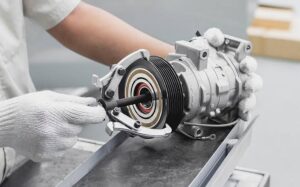
Most Range Rover air suspension failures in Dubai are a chain, not a single event. A small leak in one air spring makes the compressor run more often. Extra run time raises its internal temperature, and in ambient heat the thermal cut-out trips, which is when owners see the suspension fault message appear and then clear itself after a rest. Continued running wears the piston ring and cylinder, so the compressor pushes less pressure and more heat and moisture into the system, which then loads the dryer and damages the valve block.
By the time a compressor is genuinely dead, the original leak has usually been there for months. Replacing only the compressor leaves the leak in place, and the new unit dies the same way.
Weak Battery and Low-Voltage Faults
Batteries in the UAE typically last 24 to 36 months, and the air suspension compressor is one of the highest-current consumers on the car. A tired battery or a poor earth causes voltage to sag when the compressor engages, and the suspension module logs faults that look like hardware failure. Many “air suspension failure” messages on low-mileage Range Rovers are voltage faults, and the first measurement in any honest diagnosis is a load test — a point we apply across all our Range Rover repair work.
Stored and Low-Mileage Range Rovers
Cars that sit for weeks in a Dubai garage fail in their own way. The bellows takes a set in one position, the rubber dries and the fold stiffens, and seals in the valve block stop getting exercised. When the car is finally driven, the spring cracks along the set line within days. If the vehicle is stored, starting it and cycling the ride height through its settings every couple of weeks does more good than any additive or cover.
Impact Damage and Ride-Height Sensor Faults
Speed bumps taken at height, kerbs, and desert driving damage the parts nobody thinks about. Ride-height sensor arms and their plastic link rods bend or snap, and once a sensor reports a false position the module holds a corner too high or too low and may disable the system entirely. Plastic air lines chafe against subframe edges and leak at the push-fit connectors. These faults mimic a failed air spring exactly, so sensor readings must be checked live before parts are ordered. Related complaints such as pulling, uneven tyre wear or vague response often trace back to the same event and belong with suspension and steering inspection rather than air-system work.
Poor Previous Repairs and Aftermarket Parts
A large share of repeat failures are repair-induced. Budget air springs with weak crimp rings leak at the collar. Compressors fitted without a new dryer inherit saturated desiccant. Springs replaced one at a time leave the new unit fighting a tired one on the same axle. And ride height is frequently never recalibrated after the work, so the module keeps working against its own stored values. Coil conversion kits are the worst version of this — they remove the fault message by removing the system, they disable height control, and they damage resale value on a car that was engineered around variable ride height.
How Proper Diagnosis and Repair Is Done
A correct diagnosis follows a fixed order: battery and charging voltage, stored faults read with JLR-level tooling rather than a generic scanner, live corner pressures and sensor values, an overnight static pressure-hold test to identify which corner is dropping, then valve-block isolation to separate a leaking spring from a leaking solenoid, and finally compressor health measured by fill time and current draw.
The repair follows the findings. Air springs are replaced in axle pairs, the dryer is replaced with any compressor, air lines are re-cut and re-seated rather than reused, damaged sensor links are renewed, and ride height is calibrated to specification at the end of the job — not estimated by eye. Because the suspension sits alongside the brakes and driveline, a proper job includes a check of bushes, ball joints and tyre condition through our tyre services while the car is on the ramp.
How to Prevent Air Suspension Failure
Fix small leaks early — an overnight drop of a few millimetres is the cheapest repair the system will ever offer. Replace the battery on time. Keep the wheel arches and underbody washed out after beach or desert driving so sand is not sitting against the bellows. Avoid parking at off-road height for long periods. Drive a stored car regularly and cycle its ride height. And have the system pressure-tested as part of scheduled servicing rather than waiting for a warning message.
Handled this way, air suspension is not a liability. The failures described here are predictable, and nearly all of them are preventable with the right diagnosis and the right parts. For inspection, testing or repair, our Range Rover workshop in Dubai covers the full range including Vogue, Sport and Velar models, and you can reach the team through our contact page.