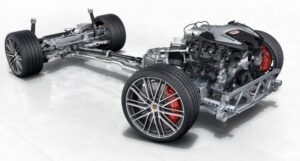

The air suspension on a Range Rover Sport is the single system Dubai owners ask about most, and it is also the system most often repaired badly. A dropped corner, a “Suspension Fault” message or a car that refuses to leave access height is rarely one failed part — it is usually a chain of failures that started months earlier. This guide explains how the system works, why it fails in UAE conditions, and exactly how a proper Range Rover suspension repair is carried out.
How the Range Rover Sport Air Suspension System Works
Every generation of Sport — the L320, the L494 and the current L461 — uses air springs at all four corners instead of steel coils. Compressed air is generated by an electric compressor, dried through a desiccant cartridge, stored in a reservoir tank, and distributed by a valve block with individual solenoids for each corner. Ride height sensors mounted on the suspension arms report the actual height of each corner back to the suspension control module, which opens and closes valves to hold the car level.
That means an air suspension complaint can come from six different places: the air springs, the compressor, the dryer, the valve block, the air lines, or the height sensors and their wiring. On L494 and L461 models fitted with Dynamic Response active anti-roll bars, there is also a separate hydraulic or 48V system that owners frequently confuse with the air system. Diagnosis has to identify which one before anything is replaced. Model-specific work is handled on our Range Rover Sport repair and Range Rover Sport SVR repair pages.
Common Range Rover Sport Air Suspension Problems
The earliest sign is almost never a warning light. It is the car sitting lower on one corner after being parked overnight, then lifting itself back to normal within a few seconds of switching on. That is a slow leak, and at that stage the repair is cheap.
Later symptoms include a dashboard message reading “Suspension Fault” or “Vehicle Too Low”, the car locking into access height and refusing to rise, one corner permanently down, a harsh ride because the system has isolated a corner, the compressor running for far longer than the usual few seconds, or a hissing noise from a wheel arch. On the L320 in particular, a compressor that has been overworked will trip its thermal cut-out and simply stop, leaving the car flat until it cools.
Why Range Rover Sport Air Suspension Fails in Dubai
The failure mechanism here is different from Europe, and understanding it is what separates a lasting repair from a repeat visit.
Air spring bellows are rubber. Sustained 45°C ambient temperatures and constant UV exposure drive plasticiser out of that rubber, so it hardens and loses flexibility years before the mileage would suggest. At the same time, fine silica sand collects inside the rolling lobe — the section of the bellow that folds over itself as the suspension moves — and works as an abrasive on every stroke. The result is a pinhole leak in a spring that still looks intact from the outside.
Once a spring leaks, the compressor runs to compensate. It runs on every start, at every stop, and eventually almost continuously. Piston rings wear, the unit overheats, and the desiccant dryer becomes saturated. Saturated desiccant lets moisture through into the valve block and air lines, where it corrodes solenoid seats and causes further leaks. This is why a car that arrives with one dropped corner often needs the compressor and dryer as well: the leak destroyed them.
Coastal humidity accelerates the moisture side of this. Cars stored for long periods — common with second and third vehicles in Dubai — develop a fold set in the bellows that cracks the first time the car is driven.
How Range Rover Sport Air Suspension Repair Is Done
Diagnosis Before Any Parts Are Ordered
The first check is battery and charging voltage. A weak battery, and AGM batteries in this climate often last only 24 to 36 months, causes the suspension module to log faults it does not have. Replacing air springs on the strength of a code read from a car with 11.6 volts is a wasted repair.
With voltage confirmed, the car is connected to JLR-level diagnostics — Pathfinder on later vehicles, SDD on older ones — to read stored codes and, more importantly, live corner pressures. Live data shows which corner is bleeding down and how fast. A static pressure-hold test is then run with the car left overnight or over several hours, and the individual solenoids are isolated at the valve block so the loss can be traced to a specific corner rather than the shared side of the system. Leaks are confirmed physically with a soap solution at the spring crimp, the top mount, the air line collets and the valve block ports. Compressor health is judged on current draw, run time and how long it takes to build reservoir pressure.
Air Spring Replacement
Air springs are replaced, not repaired. Any patch or sealant sold for them is a temporary fix that fails in this heat. Best practice is to replace both springs on an axle at the same time: a bellow that has spent ten years in Dubai sun is close to failure even if it has not leaked yet, and matching left and right keeps ride height and damping behaviour even.
The corner is depressurised through the diagnostic tool rather than by cracking a line, the strut is removed, the new spring is fitted with fresh clips and mounting hardware, and the arch is cleaned out so accumulated sand is not immediately packed back into the new rolling lobe. The system is then repressurised and the height recalibrated.
Compressor Repair or Replacement
A compressor can sometimes be serviced — piston ring, cylinder liner and desiccant kits exist and are worthwhile on a unit caught early. But a compressor that has been running against a leak for months has usually seen enough heat cycling that a rebuild is a false economy. Whichever route is taken, the dryer must be renewed, and the leak that caused the overwork must be repaired at the same time. Fitting a new compressor to a car with a leaking spring guarantees a second failure. On some models the compressor relay is a known weak point and is checked separately.
Valve Block and Air Line Repair
Valve blocks can often be reconditioned with a solenoid seal and O-ring kit if the internal bores are clean. Where moisture has caused corrosion, the block is replaced. Nylon air lines rarely fail along their length but do leak at the push-fit collets and at points where they have chafed against a subframe or been heat-damaged near an exhaust. A damaged line is cut back to clean material and joined with a proper union rated for the system pressure, never a hose clamp.
Height Sensors and Ride Height Calibration
Height sensors fail mechanically — the plastic link arm snaps or the ball joint wears — or electrically, drifting out of range so the module holds the car at the wrong height. Replacement is straightforward; calibration is not optional.
Every repair that disturbs a spring, a sensor, a control arm or the module ends with a ride height calibration on a level surface, with measurements taken from wheel centre to arch lip and entered through the diagnostic tool. Skipping this is the most common shortcut in the Dubai market. An uncalibrated car sits wrong, wears tyres unevenly, throws off wheel alignment, and can upset steering feel — which is why we recalibrate before any wheel alignment and tyre work or steering repair is signed off.
Why Coil Spring Conversion Is Not a Repair
Conversion kits are widely offered here as a cheap permanent solution. They are not a repair. Removing the air springs leaves the height sensors and control module without the system they manage, so the fault message stays on the dash unless a bypass module is fitted. Ride quality drops sharply, the car loses access and off-road heights, and resale value falls with it, because any buyer’s pre-purchase inspection will find it immediately. Repairing the original system properly costs more once and less over the life of the car.
How to Prevent Range Rover Sport Air Suspension Failure
Act on the first symptom. A corner that sags overnight and self-levels in the morning is a cheap air spring job; ignored for six months it becomes an air spring, a compressor, a dryer and often a valve block.
Have the air springs inspected visually at every service, with the arch liners pulled back so the rolling lobe can actually be seen, and wash accumulated sand out of the arches. Replace the desiccant dryer whenever the compressor is opened or replaced. Keep the battery healthy and replace it before it starts sagging under load. Drive the car regularly if it is a second vehicle, rather than leaving it standing for months. And when work is done, insist that ride height calibration is documented as part of the job.
Air suspension on a Range Rover Sport is not inherently fragile — it is a system that punishes delay. Caught early and repaired in the correct order, it stays reliable in Dubai conditions. For diagnosis or repair, our team at Carzilla works on the full Range Rover range, including Vogue, Velar and Evoque models, alongside engine, transmission and brake work.