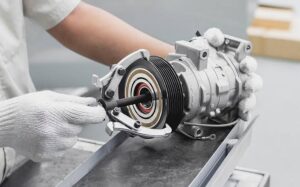

Engine mounts are some of the least expensive parts on a Mercedes-Benz, but when they fail the whole car feels different. The first sign is usually a vibration at a traffic light that was not there before. It is often followed by a clunk when you select Drive or Reverse. Many owners assume the gearbox or the engine is failing. In many cases, the real cause is a worn or collapsed engine mount.
This guide explains how Mercedes engine mounts work and the most common Mercedes engine mount failure symptoms. It also covers why mounts wear out faster in Dubai, how the fault is diagnosed and repaired, what engine mount replacement costs in the UAE, and how to make new mounts last. If you want a general overview that applies to all cars, see our guide on signs your car’s motor mounts need replacement.
What Does an Engine Mount Do on a Mercedes-Benz?
An engine mount has two jobs. It holds the engine and gearbox in position against the twisting force of the engine’s torque, and it stops engine vibration from reaching the body and cabin.
Most Mercedes models use hydraulic engine mounts, often called hydro mounts. Each one has a rubber body with internal chambers filled with fluid. When the engine shakes at idle, the fluid is pushed between the chambers through a narrow channel, and this absorbs low-frequency vibration far better than solid rubber can. When the internal seal fails, the fluid leaks out and the mount collapses. It then behaves like a hard rubber block, and eventually like metal resting on metal.
Longitudinal Engines: C-Class, E-Class, S-Class, GLC, GLE, GLS and G-Class
On rear-wheel-drive and 4MATIC models with a longitudinal engine, there are two engine mounts, one on each side of the block. They sit on the front crossmember, or on the ladder frame on the G-Class. A separate transmission mount supports the rear of the gearbox. On V6 and V8 engines such as the M276, M278, M177 and the OM642 diesel, the engine is heavy. A collapsed mount shows up quickly as vibration and as the engine sitting lower on one side.
Transverse Engines: A-Class, B-Class, CLA, GLA and GLB
On front-wheel-drive-based models, the engine sits sideways. There is an engine mount on one side and a gearbox mount on the other. A torque rod (pendulum support) under the engine stops it rocking forward and back. On these cars, the torque rod bush is very often the first part to wear, and it causes most of the clunking owners notice.
AMG Dynamic Engine Mounts
Certain AMG models use electronically controlled engine mounts filled with magnetorheological fluid. Examples include the AMG GT and the W205 C 63 with the AMG Dynamic Plus package. These mounts stay soft for comfort and stiffen in Sport modes for sharper response. Because they are electrically controlled, a fault can be electrical as well as mechanical, and replacement costs more than a standard hydraulic mount. If you drive an AMG, our Mercedes C63 AMG repair page covers the wider service needs of these cars.
Mercedes Engine Mount Failure Symptoms
Vibration at Idle in Drive or Reverse
This is the classic sign of a bad Mercedes engine mount. You stop at a traffic light with your foot on the brake in Drive, and you feel a shake through the seat, the steering wheel, the pedals or the mirrors. Move the selector to Neutral or Park and the vibration drops noticeably. In gear, the torque converter loads the engine against its mounts. A healthy hydro mount absorbs that load; a failed one passes it straight into the body. The vibration is usually worse with the AC on, because the compressor raises the engine load at idle.
Clunk When Shifting From Park to Drive or Reverse
A single knock or thud when you select Drive or Reverse means the engine is moving further than it should before it hits its limit. On transverse models, a worn torque rod is the usual cause. On longitudinal models, a collapsed engine or transmission mount is more likely.
Jolt When Accelerating or Lifting Off the Throttle
With worn mounts, the engine rocks under load. Pull away firmly or lift off suddenly and you feel a jerk or bump through the car. Many drivers mistake this for a harsh gear change.
Knocking Over Speed Bumps and Rough Roads
A loose engine can move up and down over bumps and knock against its stops. The noise usually comes from the front of the car and is duller than a suspension rattle.
Engine Sitting Lower or Moving Too Much
With the bonnet open, a collapsed mount can leave the engine visibly lower or tilted on one side. Look for signs of contact: the fan shroud rubbing, an intake hose stretched tight, or the exhaust touching a heat shield. Any of these can cause new rattles and damage.
Fluid or Oil Residue Around the Mount
A leaking hydraulic mount often leaves a dark, sticky residue on the mount body and on the subframe below it. Engine oil soaking the mount from above is just as common. Oil leaks are a cause of mount failure in their own right, as explained below.
Engine Mount Symptoms That Get Confused With Other Mercedes Faults
Engine mount problems are often misdiagnosed because the symptoms overlap with other faults.
A misfire also causes rough running at idle. The difference is that a misfire shake stays in Neutral, while mount vibration mostly disappears out of gear. Our guide on Mercedes engine misfire symptoms explains how to tell them apart. Injector faults can cause rough idle too, as covered in common Mercedes fuel injector problems.
Transmission faults cause harsh or delayed shifts and torque converter shudder at cruising speed. However, a worn mount can make a healthy gearbox feel harsh. Before agreeing to gearbox work, read about Mercedes transmission failure symptoms and make sure the mounts have been checked. If the gearbox is genuinely at fault, our Mercedes transmission repair team can confirm it.
Driveline clunks from the propshaft flex disc or the differential feel similar to a mount clunk on and off the throttle, but they come from the middle or rear of the car. See our article on Mercedes rear differential noise.
Suspension knocks over bumps usually come from worn control arm bushes, anti-roll bar links or air struts rather than the engine. Our guide to the common signs your car needs new suspension parts and our article on Mercedes air suspension problems in Dubai cover these faults.
Wheel vibration rises and falls with road speed, not engine speed, and points to wheel balance or tyres rather than mounts.
Why Mercedes Engine Mounts Fail in Dubai
Heat and Rubber Ageing
Rubber hardens and cracks with heat, and the seals inside a hydraulic mount age faster at high temperature. In the UAE summer, engine bay temperatures stay high for months. Cars parked in open sun heat-soak every day. This is one of the main reasons mounts in Dubai often fail earlier than the same mounts in Europe. Our article on how Dubai heat damages car engines explains the wider effect.
Long Idling With the AC Running
Dubai traffic means long periods at idle in Drive with the AC compressor working hard. This is exactly the condition in which an engine mount does the most work. Thousands of hours of loaded idling wear out the internal damping faster than steady highway driving does.
Oil and Coolant Leaks
This is the most overlooked cause. Oil from a leaking oil filter housing, valve cover gasket or oil cooler line drips onto the mount below it. Engine oil softens and swells rubber, so the mount loses its strength and collapses. Coolant leaks do similar damage. Fixing the leak is part of the repair; otherwise the new mount fails the same way. If your car has a known leak, see our Mercedes CLS coolant and oil leakage repair case.
Age and Mileage
Even in good conditions, hydraulic mounts are wear parts. Most Mercedes mounts start to lose damping somewhere between 6 and 8 years or 100,000 and 150,000 km. In the UAE, they often wear out earlier.
Torque and Driving Style
High-torque turbocharged V8s, AMG launches, and shifting into Drive while the engine is revving all shock-load the mounts. Many owners in Dubai drive this way every day, and it shortens mount life.
Speed Bumps, Rough Roads and Off-Road Driving
Repeated speed bumps, desert driving in a G-Class or GLE, and rough construction-zone roads all add movement and stress to the mounts.
Poor-Quality Parts and Previous Repairs
Mounts that never last are often cheap aftermarket units with weak damping, or mounts tightened with the engine in the wrong position. Another common cause is replacing only one side, so the new mount carries the load the worn one can no longer take.
How a Mercedes Engine Mount Problem Is Diagnosed
A proper diagnosis starts with the engine, not the mounts. A XENTRY scan and a check of the smooth-running values for each cylinder rule out a misfire or fuelling fault, because these can feel exactly like mount vibration. If a warning light is on, our guide on why a Mercedes engine warning light comes on explains what the codes usually mean.
Next comes a physical inspection on the lift:
- cracked or split rubber
- rubber separating from the metal plates
- hydraulic fluid residue
- the engine sitting lower on one side
- reduced clearance between the engine and the parts around it
A trained technician then load-tests the mounts. With the brakes firmly applied, the engine is gently loaded in Drive and Reverse while someone watches how far it moves. This should only be done by a professional in a workshop. A pry bar check on the transmission mount and torque rod completes the picture.
Finally, the technician checks why the mount failed. If it is oil-soaked, the source of the leak is found before any parts are ordered. This is why regular car diagnostics prevent expensive repairs. A worn mount found early is a simple job, while a mount left until it breaks can damage the exhaust, hoses and fan.
How Mercedes Engine Mounts Are Replaced
Mercedes engine mount replacement follows the same basic steps on most models, though access varies a lot between a CLA and a G 63.
- The engine is supported from above with a support beam, or from below with a jack.
- Parts that block access, such as the air box, fan shroud or underbody panels, are removed.
- The mount nuts are undone and the engine is raised slightly to release the old mounts.
- The mount brackets and crossmember are inspected for cracks or damage.
- New mounts are fitted, and the engine is lowered so its full weight rests on them.
- The fixings are tightened to Mercedes torque specifications with the engine in its normal resting position, so the rubber is not twisted or pre-loaded.
- On AMG dynamic mounts, the wiring is reconnected and a function check is carried out with XENTRY.
- The car is road-tested, including a check at idle in Drive with the AC on, which is the condition where the original complaint usually showed up.
Mounts should be replaced as a pair. A new mount next to a worn one carries more load and wears faster. The transmission mount or torque rod is replaced at the same time if testing shows wear. Parts should be genuine Mercedes-Benz or a quality OE supplier such as Lemförder or Corteco. Cheap solid-rubber copies remove the hydraulic damping and leave the car with permanent vibration.
If the mounts failed because of an oil leak, the leak is repaired in the same visit. Where the inspection shows wider engine wear, our Mercedes engine repair or rebuild service and general car engine repair team handle the next step.
Mercedes Engine Mount Replacement Cost in Dubai
Engine mount replacement cost in Dubai depends on the model, the engine, how hard the mounts are to reach, and whether genuine or OE parts are used. These are indicative prices at an independent Mercedes specialist, including parts and labour:
- A-Class, CLA, GLA and GLB: about AED 700 to 1,600 for a single engine mount or torque rod
- C-Class and GLC with four-cylinder engines: about AED 1,500 to 3,000 for a pair of engine mounts
- E-Class, S-Class, GLE and GLS with V6 or V8 engines: about AED 2,200 to 4,500 for a pair
- G-Class and G 63: about AED 2,800 to 5,500 for a pair
- AMG dynamic engine mounts: about AED 4,500 to 9,000 for a pair
- Transmission mount, when needed: an extra AED 500 to 1,500
Dealer pricing for the same job is usually much higher. Any oil leak repair needed to protect the new mounts is quoted separately. Model-specific details are on our Mercedes E-Class repair, Mercedes S-Class repair, Mercedes GLE repair, Mercedes GLC repair, Mercedes G-Class service and Mercedes G63 AMG repair pages.
Is It Safe to Drive a Mercedes With a Bad Engine Mount?
A worn mount that only causes extra vibration is not an immediate danger, but it should not be ignored. As it gets worse, the engine moves more, which puts strain on several other parts:
- the exhaust flex pipe, which can crack
- the radiator and coolant hoses
- the wiring harness
- the fan shroud, which the fan can strike
- the driveshafts and CV joints
On transverse models, a broken torque rod lets the engine rock hard on every gear change. Book an inspection within a few weeks of noticing the symptoms. Stop driving and have the car checked straight away in any of these cases:
- you hear a loud bang from the engine bay
- the engine visibly lifts when you accelerate
- something starts rubbing or grinding near the fan
How to Prevent Mercedes Engine Mount Problems
You cannot stop engine mounts from ageing, but you can make them last much longer:
- Fix oil and coolant leaks early. A leak that drips onto a mount will destroy it. Regular servicing such as a professional Mercedes-Benz oil change is a good moment to spot leaks before they reach the mounts.
- Let the engine settle at idle before selecting a gear. Shifting into Drive or Reverse while the engine is revving shock-loads the mounts every time.
- Drive over speed bumps slowly and limit repeated hard launches. This matters most on AMG and V8 models, where the mounts take the most torque. Our guide to maintaining Mercedes-AMG models in Dubai covers this in more detail.
- Park in shade or covered parking where possible, and keep the cooling system healthy. Lower engine bay temperatures slow down rubber ageing.
- Have the mounts inspected at every major service once the car passes 5 years or 80,000 km. Our article on luxury car maintenance schedules in the UAE shows where this fits.
- Replace mounts in pairs with genuine or OE parts. Recheck them after any major engine or gearbox work.
Mercedes Engine Mount Repair in Dubai at Carzilla
Carzilla is a Mercedes repair specialist in Dubai based in Al Quoz. Every vibration complaint starts with a XENTRY scan to rule out engine and gearbox faults. We then test the engine mounts, transmission mount and torque rod on the lift, and repair any oil leak that caused the failure. Replacement uses genuine or OE mounts, tightened to Mercedes specification and covered by a written warranty.
If your Mercedes vibrates at idle, clunks into gear or jolts when you pull away, book an inspection at our Mercedes workshop in Dubai. For advice on what to look for in a garage, read our tips for choosing the right Mercedes-Benz garage in Al Quoz, or contact us to arrange free pick-up and drop-off.