Air suspension rarely fails all at once. On a Bentley Bentayga it fades — quietly, over weeks — and the warning message on the dashboard is usually the last event in a chain that started long before. By the time the car tells you something is wrong, the leak that caused it has often already destroyed a second, far more expensive component.
That is the real reason early identification matters on this car. A single leaking air spring is a contained repair. The same leak ignored for three months becomes an air spring, a burnt-out compressor and a contaminated valve block. This guide explains what the Bentayga’s system is made of, the order in which the evidence appears, why the UAE climate accelerates all of it, and what a correct repair and prevention routine looks like.
What the Bentayga Air Suspension System Actually Contains
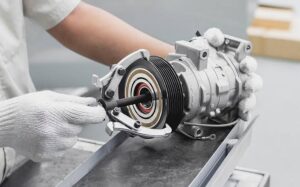
The Bentayga sits on the VW Group MLB Evo platform — the same architecture family as the Audi Q7, Porsche Cayenne and Lamborghini Urus — with Bentley’s own calibration layered on top. The air suspension itself is made up of four air struts (an air spring wrapped around an adaptive damper at each corner), a single-piston compressor with an integrated desiccant dryer, a valve block that directs air to each corner, a pressure reservoir that allows the car to raise itself quickly without running the compressor, four ride height sensors linked to the control arms, and a control module that ties it all together.
One distinction matters before you start diagnosing anything: Bentley Dynamic Ride, the 48-volt active anti-roll system, is not part of the air suspension. It uses electric actuators on the anti-roll bars, not air. Faults there show up as body roll, a clunk during cornering or a separate chassis message — not as a car that sags overnight. Owners and general workshops confuse the two constantly, and it is the single most common reason a Bentayga gets quoted for the wrong repair. A workshop that handles Bentley Bentayga repair regularly will separate these two systems in the first ten minutes.
The Evidence You Can See: Ride Height Changes Before Any Warning
The earliest reliable symptom of a Bentley Bentayga air suspension leak is a stance change that appears only after the car has been sitting.
Park the car on level ground and look at it the following morning. A healthy system holds all four corners overnight and for several days. A developing leak shows as one corner sitting visibly lower than its opposite number, or the whole rear axle dropping while the front stays level. Because the compressor re-levels the car within seconds of unlocking or starting, the sag often disappears before you have finished walking towards the vehicle — which is exactly why so many owners dismiss what they saw.
The way to remove doubt is to measure rather than eyeball it. Take a tape from the centre of each wheel hub straight up to the lip of the wheel arch, on all four corners, with the car in normal ride height. Note the numbers. Repeat the same four measurements after the car has stood overnight. A difference of more than roughly 10 mm on a single corner between the two readings is a leak, even with no warning light and no message on the screen. Repeating this once a month takes two minutes and catches almost every Bentayga air spring failure at the cheap stage.
The Sounds That Arrive Before the Fault Code
Your second source of evidence is the compressor, and it is the one most people already have without realising it.
The compressor lives under the vehicle and is audible as a low mechanical drone. In a healthy Bentayga it runs briefly when the car changes height mode and occasionally to top the reservoir up. The warning sign is not the noise itself but the change in duty pattern: it starts running every time you unlock the car, runs for noticeably longer than it used to, or cycles while the car is stationary and nobody has asked it to change height. That is the compressor compensating for air escaping somewhere else in the system.
Two other sounds are worth knowing. A steady hiss from under the car when it is parked and settled points to a leaking air line union or a valve block that is no longer sealing. A hollow knock over speed bumps or expansion joints — the kind that arrives with the impact rather than after it — usually means the adaptive damper inside the strut has failed, or a top mount has collapsed, which is a different repair from a leaking air spring even though both live in the same assembly.
What You Feel Through the Car
The Bentayga’s ride quality is a diagnostic instrument in its own right, because a car this well isolated makes deterioration obvious.
A slow leak that the compressor is masking usually presents as harshness rather than sag — the air spring is running at a pressure the calibration was not designed around, so sharp joints thump through instead of being absorbed. A failed damper does the opposite: the car floats after a crest, takes a second bounce it never used to take, and feels vague at motorway speed on Sheikh Zayed Road. Another useful check is switching between Comfort, Bentley and Sport modes and paying attention to whether the character genuinely changes. If all three now feel identical, the system has quietly defaulted to a fixed setting because it has already logged a fault it has not yet reported to you.
What the Car Reports — and Why the Message Arrives Late
A Bentayga will eventually display a suspension malfunction message, refuse to leave a set height, or lock itself into a lowered “vehicle too low” state where speed is restricted. That is the point at which most owners book the car in — and it is genuinely late. The module only raises a message when it can no longer hold the target height within tolerance, which means it has already been fighting the leak with compressor duty cycles for weeks.
This is also where proper diagnostics separate a specialist from a general garage. The relevant information is not the fault code, it is the live data: individual corner pressures with the car settled, a static pressure-hold test over a timed period with the compressor disabled, and a valve-block isolation test that determines whether air is escaping through the strut, the line or the valve seat itself. Reading that data on a Bentley requires ODIS-level diagnostic access with Bentley-specific data, which is why our Bentley repair Dubai workshop tests pressures before quoting parts rather than replacing a strut and hoping.
Why Bentayga Air Suspension Problems Happen Earlier in the UAE
Air springs are a rubber-and-fabric component in a country that is hostile to both. Bentley Bentayga air struts commonly begin failing between 60,000 and 80,000 km here, well before the mileage at which the same part fails in a temperate climate. Several mechanisms stack up:
Heat and UV ageing. Sustained ambient temperatures above 45°C, plus radiant heat from the road and the exhaust, drive plasticisers out of the bellows material. The rubber loses elasticity and cracks appear at the fold line — the rolling lobe — where the material flexes on every suspension movement.
Fine silica dust. Airborne desert sand settles inside the wheel arch and works its way into the rolling lobe, where it acts as an abrasive on every compression cycle. It is the reason Bentayga air springs that spend time on unsealed roads or beach parking fail earlier than city-only cars.
Standing time. Many Bentaygas in Dubai are second or third cars that sit for weeks. A parked air spring holds one fold position, and the rubber takes a set at that crease. The first drive after a long rest flexes a hardened crease and tears it. Storing the vehicle in its lowered access height makes this considerably worse.
Humidity and the dryer. The compressor’s desiccant cartridge removes moisture from the air it pumps into the system. In coastal humidity that cartridge saturates faster, and once it does, moisture reaches the valve block and corrodes the valve seats — turning a single-corner problem into a system-wide one.
The compressor cascade. This is the failure that costs owners the most. A leaking air spring forces the compressor to run far beyond its designed duty cycle. It overheats, the thermal protection cuts it out, the piston seal wears, and eventually it fails outright. The compressor did not break on its own — the ignored leak broke it.
How Bentayga Air Suspension Faults Are Properly Repaired
A correct repair follows the evidence rather than the parts catalogue. The system is pressurised and leak-tested corner by corner, air lines and unions are checked where they run through the arch, and only then are components condemned. If the leak is at the strut, the air spring assembly is replaced — and on a vehicle of this weight and age, replacing air struts in axle pairs is sound practice, because the surviving unit has lived through the same heat and dust and is usually only months behind its twin.
Where the compressor has already been damaged, the dryer cartridge and the compressor relay are replaced alongside it. Fitting a new compressor to a system that still contains a leak, or reusing a saturated dryer, guarantees a repeat failure. A corroded valve block is replaced as a unit; height sensors and their plastic drop links, which go brittle in UAE heat and snap, are a cheap and frequently overlooked cause of a car that levels itself wrongly rather than losing air at all.
Every one of these repairs must end with a ride height calibration performed with the diagnostic tool and physical measurement to the wheel arch — the module has to be taught the new geometry, or the car will sit at the wrong height and wear tyres unevenly. A four-wheel alignment afterwards is not optional either, because ride height and geometry on this platform are directly linked; see our wheel alignment and tyre services for how that is set. The same discipline applies across the range, whether it’s a Bentayga or the Bentley Continental GT suspension repair work that comes through the same bay.
Preventing the Next Air Suspension Failure
Prevention on this system is mostly about habits rather than spending.
Drive the car regularly — a short weekly run keeps the bellows flexing through their full range and stops a fold set forming. Store it in normal ride height rather than the lowered access setting. Rinse the wheel arches properly when you wash it, because that is where the abrasive dust accumulates. Have the arch area and the visible section of each bellows inspected at every service, since a crack at the rolling lobe is visible long before it leaks measurably. Replace the dryer cartridge when the compressor is serviced rather than waiting for moisture damage. And take the monthly ride height measurement seriously — it is the cheapest diagnostic tool you own.
Above all, act on the first slow sag. That is the entire lesson of this system: the repair cost is decided not by the failure, but by how long you wait after noticing it.
If your Bentayga is sitting unevenly in the morning, running its compressor more than it used to, or has already put a suspension message on the screen, it is worth having the corner pressures read before anything is replaced. Our team in Al Quoz handles Bentley servicing and repair across the range, along with related car suspension repair, brake service and transmission work — and you can get in touch here to arrange an inspection.