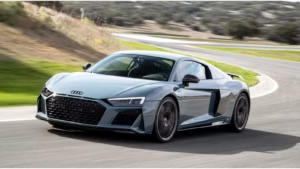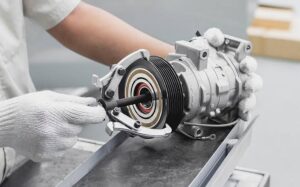
Luxury car denting and painting in Dubai, aluminium panel repair, tri-coat paint matching, ADAS recalibration, real AED costs and insurance steps explained.
A scuffed bumper on a Toyota and a scuffed bumper on a Bentley are not the same job. They do not use the same tools, the same panel material, the same paint chemistry, or the same number of labour hours — and they should never carry the same price.
That distinction is where almost every workshop in Dubai loses the plot. Search “car denting and painting Dubai” and you will find dozens of pages promising “advanced colour matching technology” and “state-of-the-art spray booths” without ever explaining what is actually happening to your car. Meanwhile the owner of an aluminium-bodied Range Rover or a tri-coat pearl Rolls-Royce hands over the keys with no idea whether the shop can even work the metal correctly.
This guide fixes that. It covers what luxury car denting and painting genuinely involves in Dubai — panel materials, paint systems, colour matching, curing, electronics recalibration, insurance procedure, and real AED cost ranges — so you can judge a workshop on evidence instead of marketing.
At Carzilla Auto Service, our auto body shop in Al Quoz handles this work daily on European and exotic machinery. Everything below reflects how the job is actually done.
Quick Answer: Luxury Car Denting and Painting Cost in Dubai
| Repair type | Indicative range (AED) | Typical turnaround |
|---|---|---|
| Paintless dent repair (PDR), single small ding — steel | 250 – 600 | 1–3 hours |
| PDR on aluminium panel | 500 – 1,200 | Half day |
| Localised smart repair (scuff + paint blend) | 600 – 1,400 | 1–2 days |
| Single panel respray — standard metallic | 900 – 1,800 | 2–4 days |
| Single panel respray — tri-coat pearl / candy | 1,800 – 3,500 | 3–5 days |
| Matte / satin panel refinish | 2,200 – 4,500 | 4–6 days |
| Bumper repair + respray (with sensors) | 1,200 – 2,800 | 2–4 days |
| Full respray — luxury saloon or SUV | 9,000 – 22,000 | 2–4 weeks |
| Full respray — exotic / Bespoke finish | 25,000 – 70,000+ | 4–10 weeks |
| ADAS recalibration after bumper work | 600 – 2,000 | Add 1 day |
Treat these as ranges, not quotes. Two identical-looking dents on the same door can differ by a factor of three depending on depth, access behind the panel, and whether the paint has cracked. Any workshop quoting a luxury car over the phone without seeing it is guessing. Get a free inspection and written estimate before agreeing to anything.
What “Denting and Painting” Actually Covers
The phrase bundles together four genuinely different disciplines. Understanding which one your car needs is the single biggest lever on both cost and quality.
Paintless dent repair (PDR) reshapes metal from behind using rods and glue-pull tabs. No filler, no primer, no paint. Only viable when the paint film is completely intact.
Panel beating and filling is traditional bodywork — the panel is pushed, pulled, or hammered back to shape, skimmed with body filler, sanded to contour, then refinished. Necessary when metal is stretched, torn, or creased.
Refinishing is the paint half: primer, basecoat, clearcoat, bake, and polish. This is where colour match lives or dies.
Structural repair covers anything touching the load-bearing shell — chassis rails, spaceframe sections, crash boxes. This is a different competency again, and on modern luxury cars it is bound by manufacturer-specified procedures.
A workshop that only does one of these well will quietly push you toward that one. That is the most common way owners in Dubai end up with a resprayed panel that never needed paint at all.
Panel Material Decides Everything: Aluminium vs Steel vs Carbon vs Composite
This is the section every competing page in Dubai skips, and it is the most important one in this guide.
Aluminium panels do not behave like steel
Steel has shape memory. Work a dent from behind and the surrounding metal helps pull the deformation back toward its original position. Aluminium does not. It is more ductile, work-hardens faster, and once stretched it stays stretched.
The practical consequences:
- Aluminium PDR relies heavily on glue-pull and stud-weld techniques with controlled heat, not push-from-behind rod work. A technician trained only on steel will stretch the panel and turn a repairable dent into a replacement.
- Aluminium requires dedicated tooling and a separate work area. Steel dust settling on bare aluminium causes galvanic corrosion — the two metals in contact with moisture form a cell and the aluminium pits from underneath the paint, often months later. A serious aluminium repair happens in an isolated bay with its own extraction, tools, and consumables.
- Aluminium needs specific filler and etch primer chemistry. Standard polyester filler over untreated aluminium fails.
- Welding aluminium requires pulse MIG or specific spot equipment, not a standard steel welder.
This matters enormously in Dubai because so much of the luxury parc is aluminium-intensive: Range Rover and Land Rover bodies, Jaguar saloons, Aston Martin, current Rolls-Royce and Bentley platforms, Audi A8 and much of the Ferrari range.
Ask any shop directly: do you have a dedicated aluminium repair area? If the answer is vague, walk.
Rivet-bonded spaceframes are not pullable monocoques
Several aluminium luxury platforms are rivet-bonded and adhesive-assembled, not spot-welded steel monocoques. You cannot simply chain a bent section to a jig and pull it straight — the adhesive bond line and rivet pattern define the structure, and manufacturer procedure typically calls for sectioning and replacement of the damaged member rather than straightening it.
Similarly, ultra-high-strength boron steel in B-pillars, roof rails, and door intrusion beams on modern German cars cannot be heated to straighten. Applying heat destroys the heat treatment that makes it strong, and the section must be replaced.
Carbon fibre and composite panels
Exotic bodywork often is not metal at all. McLaren monocells, Lamborghini panels, and many carbon aero components are laminate structures. A dent is not a dent — it is delamination, matrix cracking, or fibre fracture, and each needs a different response. Cosmetic clear-coat damage on exposed weave is repairable; a cracked structural laminate usually is not, and no amount of filler makes it safe.
If you are dealing with carbon panels or want them refinished, that overlaps with our carbon fibre kit work and body kit fitment, where the same laminate handling rules apply.
SMC and thermoplastic bumpers flex rather than dent. They also require flex additive in the paint system — omit it and the clearcoat cracks the first time the bumper takes a knock or the car sits in 48°C sun.
PDR vs Bodyshop Repair: Choosing the Cheaper Option Correctly
The rule is simple: if the paint film is unbroken, try PDR first.
PDR wins on almost every axis when it applies:
- Original factory paint stays intact. No colour match risk, ever.
- No paint-depth-gauge signature. More on why that matters for resale below.
- Hours, not days. No courtesy car, no lost week.
- Typically 40–70% cheaper than a panel respray.
But PDR has hard limits, and honest shops say so:
| PDR works | PDR will not work |
|---|---|
| Door dings, trolley knocks, hail | Cracked, chipped, or scraped paint |
| Shallow to moderate dents with panel access | Dents on panel edges or double-skin areas |
| Body-line dents (skilled hands only) | Sharp creases with stretched metal |
| Multiple dents in one visit | Areas with reinforcement bracing behind |
| Both steel and aluminium (different technique) | Previously filled or resprayed panels |
The red flag runs both directions. A shop that quotes a full respray for an intact-paint door ding is overselling. A shop that attempts PDR on cracked paint is going to lift the clearcoat and hand you a bigger bill.
Never use consumer suction-cup or hot-glue dent kits on a luxury car. They stretch panels and lift clearcoat, and the resulting repair routinely costs three to four times the original job.
Paint Systems: Why Some Colours Cost Triple
Not all paint is the same number of layers, and the layer count drives the price.
Two-stage (basecoat + clearcoat)
The standard modern system: colour basecoat, then transparent clearcoat carrying the gloss and UV protection. Most solid and metallic colours. Straightforward to match and repair.
Three-stage tri-coat (pearl and mica)
A ground coat, a translucent pearl or mica mid-coat, then clear. The final colour depends on how many mid-coat passes were applied at the factory — which means a paint code alone tells you almost nothing. White pearls, champagne golds, and many Rolls-Royce and Lexus finishes are tri-coat.
Matching a tri-coat requires a spray-out let-down card: the painter sprays test panels at two, three, and four mid-coat passes, cures them, and compares against the car in daylight to find the correct pass count. Skip that step and the repair will be visibly lighter or darker at every viewing angle. This is why tri-coat panel work legitimately costs double a standard metallic.
Four-stage candy and specialist finishes
Candy, chameleon, and colour-shift systems layer transparent tinted coats over a metallic base. Repair is extremely unforgiving — any variation in coat thickness changes the colour — and blending is often impossible, forcing whole-panel or whole-section refinishing.
Matte and satin finishes
Frozen, opaco, and satin factory finishes use a matting agent in the clearcoat. The critical fact owners are rarely told: matte clear cannot be polished. Polishing burnishes the surface, creates a glossy patch, and the only remedy is refinishing the entire panel. A matte car cannot have a small scratch buffed out.
Matte repair also demands absolute consistency in spray technique — gun distance, pressure, and overlap all change the sheen level. A slightly heavier pass reads as a shiny patch under Dubai sunlight.
Bespoke and commissioned finishes
Rolls-Royce and Bentley commissioned colours may not exist in any commercial mixing system. These require the manufacturer’s formulation, and hand-applied features like coachlines need a specialist who can lay a single continuous line freehand. A workshop that resprays a coachlined panel without a coachline painter on hand has permanently altered the car.
If your interest is a colour change rather than damage repair, our car painting service covers full resprays, and peelable paint is worth considering as a fully reversible alternative that leaves factory paint untouched.
How Professional Colour Matching Actually Works
“We use advanced colour matching technology” is the emptiest sentence in Dubai’s body-shop marketing. Here is what a competent match involves.
1. Read the paint code, then ignore it as gospel. The code narrows the field. It does not give you the answer, because manufacturers issue variant chips — multiple factory-approved versions of the same code, differing by production plant, supplier batch, and model year. A single code can have six or more variants.
2. Spectrophotometer reading. A camera-based spectro takes multiple readings at different angles from a clean, polished area of the car and returns a formula candidate. Angle-dependent readings matter because metallic and pearl flake shifts colour with viewing geometry.
3. Account for sun fade. This is the Dubai-specific step. A three-year-old car in this climate has measurably faded and its clearcoat has lost UV absorber. The correct match is not the factory formula — it is the car as it exists today. Matching to the original spec on a sun-aged car produces a panel that is obviously newer than everything around it.
4. Spray out and compare. The mixed formula goes onto a test card, gets cured under the same conditions as the real job, and is compared against the car in natural daylight, not under booth lighting. Booth lights flatter everything.
5. Blend into adjacent panels. This is non-negotiable on metallics and pearls. Even a perfect formula will not butt-join invisibly against an aged panel. The painter fades the new colour into the neighbouring panels and clears across the whole area. It is why a “one panel” repair often means paint on three panels — and why a quote that covers only the damaged panel on a metallic car is a quote for a visible repair.
The Full Denting and Painting Process, Step by Step
- Damage assessment and disassembly. Bumpers, lights, trims, and handles come off. Damage hidden behind panels is found now, not halfway through. Any workshop estimating without disassembly is estimating blind.
- Structural check. Panel gaps, door and boot alignment, and where relevant a measuring-jig check against factory dimensions. Structural issues found later mean starting over.
- Metal work. PDR where viable; panel beating, pulling, or section replacement where not. Aluminium moves to its dedicated bay.
- Filling and shaping. Thin, correctly chosen filler, shaped to contour and block-sanded. Filler is a shaping medium, not a substitute for metal work — thick filler over an unstraightened panel will crack and telegraph within a year in this heat.
- Priming. Etch primer where bare metal is exposed, then high-build primer, guide-coated and block-sanded flat. Every flaw in this stage shows through the gloss.
- Masking and booth prep. Full masking, tack-off, and a downdraft booth with positive pressure and filtered air. In Dubai this is not optional — the fine airborne dust here will contaminate an open-shop spray job every time.
- Basecoat. Colour laid in controlled coats with correct flash-off between them. High ambient temperature shortens flash times and forces solvent adjustment; get it wrong and you get solvent pop — trapped solvent blistering through the clearcoat days later.
- Clearcoat and bake. Two to three coats of clear, then a bake cycle — typically around 60°C for 30–45 minutes, with low-bake schedules for aluminium and composite panels to avoid distortion. This is where “same-day painting” offers fall apart. Air-dried paint has not cross-linked, and it will mark, water-spot, and fail early.
- Reassembly and electronics. Trim, sensors, cameras, and lights refitted — followed by the recalibration work below.
- Cut, polish, and quality control. De-nib, compound, refine, and final inspection in daylight for orange peel, dust nibs, and colour match at multiple angles.
The Step Almost Every Dubai Body Shop Skips: ADAS Recalibration
Modern luxury cars carry driver-assistance sensors in exactly the places that get damaged.
- Adaptive cruise radar sits behind the front bumper or grille badge.
- Surround-view and lane cameras sit in mirrors, grille, tailgate, and windscreen.
- Parking sensors (PDC) are bonded into bumper apertures.
- Blind-spot radar sits inside the rear bumper corners.
Remove a bumper and every one of these is disturbed. Refit it a millimetre or two off, or repaint over a radar-transparent grille area with metallic-flake paint — which is exactly what a metallic respray does — and the sensor’s field is altered.
Two consequences most owners never hear about:
Paint thickness and metal content over a radar aperture change its performance. Radar-transparent covers have specified paint build limits. A shop that treats that panel like any other bodywork can degrade adaptive cruise and collision warning without triggering a single fault code.
Recalibration is a defined procedure, not a reset. Static calibration needs manufacturer targets at measured distances on a level floor; dynamic calibration needs a road drive at specified speeds. A workshop without the target boards and the correct diagnostic platform cannot do this properly.
The failure mode is genuinely dangerous: an uncalibrated system usually shows no warning light. It simply reacts later than it should. Always ask for the calibration report with your invoice. A related check worth doing after any significant body repair is a full car inspection, and if structural work was involved, the vehicle may need a fresh RTA test.
What Dubai’s Climate Does to Luxury Car Paint
The damage patterns here are not the same as in Europe, and neither are the failure modes.
UV clearcoat degradation. Clearcoat contains UV absorbers that deplete over time. Dubai’s UV load exhausts them years faster than in temperate climates. Once depleted, the clear turns milky and begins to fail — and clearcoat failure cannot be polished out. The panel must be refinished. Dark colours and horizontal surfaces (roof, bonnet, boot lid) go first.
Sand and dust abrasion. Fine airborne sand at highway speed acts like a mild blast media. It etches leading edges — bumper front, bonnet leading edge, mirror caps — and adds thousands of micro-scratches to the whole car over time. This is why regular detailing and protective coating is genuinely preventative here rather than cosmetic.
Coastal humidity. High humidity during spraying causes blushing — moisture trapped in the film leaving a milky haze. It is a booth-control problem, and it is why humidity management matters as much as temperature.
Heat cycling. Panels reaching 70°C+ in direct sun then cooling overnight cycle the paint film constantly. Poorly cured paint, over-thick filler, and cheap clearcoat all fail faster under this cycling.
Parking damage. Dubai’s mall and tower car parks produce a steady stream of door dings and trolley strikes — the highest-volume category of luxury denting work in the city, and almost always a PDR job if caught before anything cracks.
Insurance, Police Reports, and the Dubai Repair Process
If the damage came from a collision rather than a car park, the paperwork comes before the bodywork.
Repairing accident damage without a police report is not permitted in Dubai, and insurers will not settle without one. If Dubai Police attend the scene, they issue a pink form to the driver found liable and a green form to the affected driver; where no party is at fault, a white form is issued instead. Some insurers use “red” in place of “pink”, with the same meaning.
For minor incidents with no injuries and drivable vehicles, Dubai Police encourage drivers to use the Dubai Police or Dubai Now app rather than calling 999.
Then the claim sequence:
- Notify your insurer quickly — most UAE providers require notification within 24 hours, and many accept app or portal submissions.
- Submit the documents. The garage typically needs the police or SAAED report, vehicle registration, the driver’s licence and Emirates ID, and the claim intimation slip.
- Wait for authorisation. The workshop prepares an estimate, then the insurer surveys and authorises — generally within a day for minor damage and two for major.
- Do not start work early. Beginning repairs or settling in cash before authorisation is one of the most common causes of claim rejection.
Agency repair versus approved garage is the decision that most affects a luxury car owner. Comprehensive policies frequently direct you to an approved network, with agency (dealer) repair often limited to newer vehicles or available only as a paid add-on. Deductibles in Dubai commonly sit at AED 500, 750, or 1,000, and some policies waive the deductible entirely for dealership repair while charging more at independent shops.
When paying out of pocket beats claiming. For cosmetic dents, run the maths first. If the repair costs less than your excess, a claim gains you nothing and may still cost you your no-claims discount at renewal. Most PDR jobs fall below the excess threshold. Insurance is for collision damage; parking dings are usually cheaper handled directly.
Repainting and Resale Value in the UAE
The UAE’s used market is unusually inspection-heavy, and buyers routinely bring a paint depth gauge.
Factory paint typically reads in a consistent band across all panels. A repainted panel reads noticeably higher — often double or more — and, just as tellingly, inconsistently compared with its neighbours. A buyer sweeping a gauge across a car finds refinished panels in under a minute.
Three implications:
- PDR preserves value in a way repainting cannot. Factory paint stays factory. Nothing to find.
- When repainting is unavoidable, quality of blend and thickness control directly affects what a buyer will pay. A properly built, correctly flatted repair reads far closer to factory than a heavy-handed one.
- Keep documentation. A file showing the damage, the police report, and an invoice from a known workshop reframes the repair from “hidden accident” to “documented, professionally repaired”. Buyers pay more for the second story. Running a UAE VIN check before selling shows you what a buyer will see.
How to Vet a Luxury Car Body Shop in Dubai
Use this as a checklist on your first visit. The answers separate specialists from general workshops fast.
Facility questions
- Do you have a dedicated aluminium repair area, separate from steel work?
- Is your spray booth downdraft with heated bake capability? What bake schedule do you run?
- Do you use a spectrophotometer, and will you show me a spray-out card before you paint my car?
Technical questions
- My car is a tri-coat / matte / Bespoke finish. Walk me through how you handle that.
- Which panels will you blend into, and why?
- Will the bumper removal require ADAS recalibration, and can you perform and document it?
Commercial questions
- Is the estimate based on disassembly, or a visual look-over?
- What is the written warranty on paint — and does it cover peeling, blistering, and colour match?
- Are parts OEM, OE-supplier, or aftermarket, and is that itemised on the quote?
Red flags
- Same-day full paint jobs
- A quote for the damaged panel only on a metallic or pearl car
- No spray-out card offered on a tri-coat
- Vague answers on aluminium separation
- Heavy discounting on a luxury respray — the materials alone have a floor price
- No mention of recalibration after bumper work
Aftercare: Protecting a Fresh Repair
New paint is not finished paint. It continues to release solvent and cross-link for weeks.
- First 48 hours: no washing, no covers, park indoors if possible.
- First 30 days: hand wash only with pH-neutral shampoo. No automatic car washes, no pressure washing the repaired area, no bird droppings left to sit — fresh clear is soft and etches easily.
- 30–90 days: do not apply wax, ceramic coating, or paint protection film. Fresh paint needs to finish outgassing. Sealing it early traps solvent and causes blistering and adhesion failure. This is the mistake owners make most often, usually with the best intentions.
- After the outgassing window: ceramic coating or PPF is genuinely worthwhile here — UV and sand are the two things that will age the new finish fastest. Our detailing team handles both.
- Matte finishes: matte-specific shampoo only, and never polish or wax. Matte-compatible PPF or coating exists and is the correct protective route.
- Ongoing: park in shade or covered parking where you can. It is the single highest-return habit for paint longevity in Dubai.
Frequently Asked Questions
How long does luxury car denting and painting take in Dubai? A PDR job on a door ding takes one to three hours. A single-panel respray typically runs two to four days including bake and cure. Tri-coat and matte finishes add a day or two for spray-out testing. Full resprays run two to four weeks for a saloon or SUV and considerably longer for exotic or Bespoke finishes. If bumpers came off, add a day for ADAS recalibration.
Can a scratch be removed without repainting? It depends on depth. If your fingernail does not catch in the scratch, it is likely confined to the clearcoat and can usually be machine-polished out. If the nail catches, it has reached basecoat or primer and needs paint. On matte finishes, polishing is not an option at all — any correction means refinishing the panel.
Will repainting a panel reduce my car’s resale value in the UAE? Some, yes — a paint depth gauge will find a resprayed panel during any serious pre-purchase inspection. The impact is much smaller when the work is high quality, correctly blended, and documented with the police report and workshop invoice. Where PDR is viable, it avoids the issue entirely because factory paint is never disturbed.
Do I need a police report to repair accident damage in Dubai? Yes. Carrying out accident repairs without reporting the incident is not permitted, and no insurer will process a claim without the report. Obtain it at the scene or through the Dubai Police app for minor incidents.
Why is painting my Rolls-Royce or Bentley so much more expensive than my other car? Three compounding reasons: the panels are frequently aluminium and need specialist handling and isolation; the finish is often tri-coat, Bespoke, or hand-detailed with a coachline; and the panel-gap and finish tolerances leave no room for an approximate result. The labour hours are simply higher for the same visible damage.
Can paintless dent repair be done on aluminium panels? Yes, but it is a different technique — glue-pull and stud-based methods with controlled heat rather than pushing from behind, because aluminium has no shape memory. It takes longer and costs more than the equivalent steel repair, and it needs a technician with genuine aluminium experience. It is still far cheaper than refinishing.
Should I claim on insurance for a small dent? Usually not. If the repair cost is below your policy excess, claiming gains you nothing and may still affect your no-claims discount at renewal. Compare the quote against your excess before deciding.
How soon can I apply ceramic coating or PPF after a respray? Wait 30 to 90 days. Fresh paint continues to outgas, and sealing it early traps solvent, causing blistering and adhesion failure. Ask your workshop for the specific window based on the clearcoat system they used.
Luxury Car Denting and Painting at Carzilla, Al Quoz
Carzilla’s body shop in Al Quoz Industrial Area 2 handles denting, panel repair, and refinishing for European and exotic vehicles — including aluminium panel work, tri-coat and Bespoke colour matching, and post-repair electronics recalibration.
We also work across the mechanical side of the same cars, so a body repair does not need to travel between workshops: engine repair, gearbox and transmission, suspension, brakes, AC, and steering all happen under the same roof. Brand-specific pages are available for Mercedes, BMW, Porsche, Maserati, Tesla, and the full brand list.
Free pickup and delivery across Dubai. Written estimates after disassembly. No work starts without your approval.
📞 800-CARZILLA (800-2279 4552) | 📱 +971 56 684 9665 📍 20 C St, Al Quoz Industrial Area 2, Dubai 🔗 Book a free body inspection