BMW rear brake pads change in Dubai costs AED 450–3,200+ depending on model. Full 2026 AED price table, EPB service mode explained, and what garages skip.
A BMW rear brake pads change in Dubai typically costs AED 450 to AED 1,300 for most 3 Series, 5 Series and X3 models, rising to AED 1,100–1,900 on X5, X7 and 7 Series, and AED 1,800–3,200 on M models with M Compound brakes. Carbon-ceramic rear pads sit in a different bracket entirely.
But the price is the least interesting part of this job.
The part that actually matters — and the part almost no garage listing in Dubai explains — is that on most modern BMWs, the rear brake pads cannot be changed the same way the fronts are. The rear calipers contain an electric motor for the parking brake. Push those pistons back with a wind-back tool the way a technician would on a front caliper, and you shear the gearset inside the actuator. That turns an AED 700 pad job into a caliper replacement.
This guide covers the real cost, the real procedure, and the specific questions to ask a garage before you hand over the keys. If you’d rather skip to a quote, our BMW brake repair service in Dubai page has direct booking, or you can contact our workshop in Al Quoz for a same-day inspection.
Why BMW Rear Brake Pads Are a Different Job From the Fronts
On almost any car built before roughly 2008, a rear brake pad change was mechanically simpler than the front. Smaller caliper, smaller pad, less heat.
BMW changed that when it moved the parking brake into the rear caliper.
The EMF electromechanical parking brake, explained
BMW’s system is usually labelled EMF (Elektromechanische Feststellbremse) or, in generic industry terms, an EPB (Electronic Parking Brake). Instead of a cable pulling a lever, each rear caliper carries a small geared electric motor that drives the piston forward against the pad to hold the car.
Two consequences follow, and both cost money when they’re ignored:
- The piston will not retract by force. With the car live, that motor is holding the piston. A technician pressing it back with a G-clamp or a rotating wind-back tool is driving a motor backwards through its own reduction gearing. Attempting to do so will permanently damage the caliper actuator.
- The car has to be told a pad change is happening. The pistons must be commanded into a fully open position via a diagnostic scan tool — commonly called service mode, workshop mode, or EPB maintenance mode. Service mode commands both rear motors to wind fully open and locks the EPB out so it cannot re-apply while your hands are at the caliper.
On BMW’s own dealer software this is a documented service function. The electrical brake unit needs to be retracted using BMW’s ISTA diagnostic system to replace the rear brakes, and it must then be put into a new mode to learn the new pads. Competent independents use ISTA/Rheingold or a capable aftermarket tool — brands such as Autel, Foxwell or Schwaben carry a dedicated brake service or EPB retraction function.
There is a manual fallback: remove the actuator motor from the caliper body and wind the spindle in by hand with a Torx bit. With the actuator removed, the piston can be retracted by turning the spindle clockwise until it stops. It works. It is also slower, and it skips the “learn the new pads” step at the end, which is why we treat it as a fallback and not a default.
The failure mode that turns AED 700 into AED 4,000
The forums are full of the same warning, and it is worth repeating plainly: pushing the piston back without service mode engaged snaps the parking brake spindle inside the caliper. There is no repair for that. The caliper is replaced — and on an X5 or a 7 Series, a single rear caliper plus fitting and bleeding runs well past AED 3,000.
This is the single question to ask any Dubai garage quoting you for BMW rear pads: “Do you put the EPB into service mode with a scan tool, or do you wind the piston back?” If the answer is vague, the quote is not comparable to a proper one. Our workshop runs BMW-compatible ISTA+ diagnostics on every brake job for exactly this reason.
Which Parking Brake Architecture Does Your BMW Have?
Not every BMW uses a caliper-integrated motor, and this catches technicians out. There are effectively three rear parking-brake designs across the BMW range, and the job is different for each.
| Architecture | How it works | What the rear pad job involves |
|---|---|---|
| Cable-operated drum-in-hat | A small set of brake shoes sits inside the “top hat” of the rear rotor, pulled by cables | Conventional piston wind-back. But the shoes themselves are a separate wear item that most garages never inspect |
| Motor-on-cable EMF | An electric motor unit pulls the parking brake cables to the drum-in-hat shoes | EMF unit must be slackened electronically; pistons still wind back mechanically |
| Caliper-integrated EMF/EPB | A geared motor bolted to each rear caliper drives the piston directly | Service mode mandatory. No mechanical wind-back with the actuator attached |
The split does not follow a clean chronological line, which is the trap. Some large chassis kept the drum-in-hat design well into the era when smaller cars had already moved to caliper motors — an F02 750Li, for example, uses a parking brake with shoes riding inside the back drum of the rotor and has no actuator on the caliper at all, while the F10 5 Series of the same period uses caliper-mounted electrical units.
Practical takeaway: the architecture is confirmed by chassis code and build date, not by guessing from the model badge. Any BMW workshop quoting you blind over the phone, without asking what chassis you’re on, is quoting a generic number. You can check your exact build specification against your VIN using our UAE VIN check tool before you call around.
Why BMW Rear Brake Pads Wear Out Faster in Dubai
Two separate effects stack here, and together they explain why BMW owners in the UAE end up replacing rear pads far sooner than the service book suggests.
1. BMW’s rear brake bias is heavier than most owners expect
Modern BMWs run electronic brake force distribution, DSC stability intervention, and — on xDrive models — brake-based torque vectoring. All three apply the rear brakes independently of your foot. Add an EPB that clamps the rear pads every single time you park, and rear pads on many BMW models genuinely reach the wear limit before the fronts. If your last workshop told you “rears look fine, we only did fronts” without measuring, be sceptical.
2. Dubai conditions attack the friction material specifically
- Heat. Summer ambient temperatures above 45°C mean the pad never starts from a cool baseline. Friction material that is repeatedly cycled at elevated temperature glazes and loses bite, and the resin binder degrades faster than it would in a European climate.
- Stop-and-go traffic. Peak-hour Sheikh Zayed Road, Al Khail Road and the Business Bay approaches generate an enormous number of low-speed braking events. Each one is a heat cycle. This is the single biggest wear multiplier for a car that never leaves the city.
- Fine sand. Airborne dust settles between pad and rotor and acts as a mild abrasive, accelerating both pad and rotor wear. It also packs into caliper slide pins, which is why seized guide pins are so common on Dubai cars and why uneven pad wear across one axle turns up so often.
- Hygroscopic brake fluid. Humidity along the coast drives moisture uptake in brake fluid, lowering its boiling point. That doesn’t wear pads directly — but it is why fluid condition should be checked at the same visit.
Realistically, a BMW driven mainly in Dubai city traffic will want a rear pad inspection every 10,000–15,000 km, not at the factory interval. The same logic that shortens BMW oil change intervals in Dubai applies to brake friction material.
Signs Your BMW Rear Brake Pads Need Changing
BMW gives you an electronic warning, but the electronic warning is not the first sign.
Dashboard and iDrive indicators
- Amber brake pad wear warning on the instrument cluster
- Condition Based Service (CBS) entry for rear brake pads showing a low or negative remaining figure in the iDrive service menu
- EPB fault or “Parking Brake Malfunction” — sometimes a genuinely worn pad, sometimes a failing actuator
What you can hear and feel
- Squealing that stops when you brake — the metal wear indicator contacting the rotor
- Grinding from the rear — the backing plate is on the rotor. Stop driving. This is now a rotor job as well as a pad job
- Handbrake holds poorly on an incline — EPB clamping force falling off as rear friction material thins
- Rear-biased judder under light braking — usually rotor runout or thickness variation rather than pads alone
- Longer stopping distances or a pedal that needs more travel
What you can see
- Pad material thinner than roughly 3 mm through the wheel spokes
- Heavy dark dust on rear wheels only, disproportionate to the fronts
- A visible lip on the outer edge of the rear rotor
If you’re already noticing a pull to one side under braking, book a full inspection rather than a pad change — that pattern usually points to a caliper or a suspension geometry issue, and our car suspension repair team checks both together.
BMW Rear Brake Pads Change Cost in Dubai: 2026 AED Price Guide
The figures below are indicative fitted prices — parts plus labour plus VAT — for a rear axle pad change in a specialist independent workshop in Dubai. Dealer pricing typically runs 40–70% higher. Final cost depends on your exact chassis, pad specification and rotor condition, so treat this as a planning range and confirm with a quote.
Rear brake pads only (per axle, fitted)
| BMW model group | Premium aftermarket pads | Genuine BMW / OEM pads |
|---|---|---|
| 1 Series, 2 Series, X1, X2 | AED 450 – 700 | AED 700 – 1,050 |
| 3 Series, 4 Series, X3, X4, Z4 | AED 500 – 800 | AED 750 – 1,300 |
| 5 Series, 6 Series, X5, X6 | AED 650 – 1,000 | AED 950 – 1,600 |
| 7 Series, 8 Series, X7, XM | AED 850 – 1,300 | AED 1,150 – 1,900 |
| M2, M3, M4 (M Compound) | AED 1,200 – 2,000 | AED 1,800 – 2,800 |
| M5, M8, X5 M, X6 M | AED 1,400 – 2,300 | AED 2,100 – 3,200 |
| M Carbon Ceramic (rear) | — | AED 9,000 – 20,000+ |
| Alpina B5 / B7 | AED 1,100 – 1,800 | AED 1,600 – 2,600 |
Associated parts and services
| Item | Typical Dubai cost (fitted) |
|---|---|
| Rear brake pad wear sensor | AED 80 – 220 |
| Rear brake rotors, pair | AED 900 – 2,600 (standard) / AED 2,800 – 6,500 (M) |
| EPB service mode + CBS reset | AED 0 – 250 (should be included in a proper pad job) |
| Brake fluid flush (DOT 4 LV) | AED 250 – 450 |
| Caliper slide pin service and re-greasing | AED 120 – 300 |
| Rear EPB actuator motor, one side | AED 900 – 2,200 |
| Rear caliper replacement (snapped spindle) | AED 1,800 – 4,500 per side |
Read that last row again. It is the entire reason this job costs what it costs when it’s done properly. The difference between a AED 500 quote and a AED 800 quote is often the difference between a technician who owns a scan tool and one who owns a wind-back tool.
What a suspiciously cheap quote usually excludes
Dubai brake advertising leans heavily on “from AED 150” style pricing. That number is real — it’s typically labour only, front axle, on a small car, with your own parts. For a BMW rear axle it almost never applies. Check whether a quote includes:
- Pads themselves, or labour only
- The wear sensor, which is single-use and must be replaced, not reused
- EPB service mode entry and exit, plus the CBS counter reset
- Rotor measurement against the minimum thickness spec
- Caliper slide pin clean and re-grease
- 5% VAT
We publish inclusive figures for the same reason we publish our full service and maintenance packages — an itemised quote that lands where it started is worth more than a headline number that doesn’t.
OEM vs OE vs Aftermarket: Choosing BMW Rear Brake Pads in the UAE
There are four tiers on the shelf in Al Quoz and they are not interchangeable.
1. Genuine BMW (BMW-boxed). Manufactured to BMW’s specification, BMW packaging, BMW warranty. Highest price. The correct choice for cars under warranty, for M models, and for anyone who wants factory noise and dust behaviour exactly as delivered.
2. OE-supplier branded (Textar, Pagid, ATE, Jurid, Zimmermann). These are the companies that manufacture pads for BMW, sold in their own boxes. Frequently the same friction compound and the same production line, 25–40% cheaper. For most non-M BMWs in Dubai, this is the sensible value choice — and it is what we fit by default unless a customer specifies genuine.
3. Quality aftermarket (Brembo, Bosch, Ferodo, EBC). Good performance, sometimes a deliberately different compound — lower dust, or higher temperature tolerance for track use. Legitimate options, but verify the compound suits street driving in heat before you commit.
4. Unbranded low-cost pads. Common in the UAE parts market, often with no verifiable friction rating. In Dubai’s heat these fade early, glaze quickly, and chew rotors. The saving is AED 200. The eventual cost is a set of rotors. Avoid.
One important caveat for rear pads specifically: an under-specified rear pad interacts badly with the EPB. Compounds that glaze reduce the clamping friction the parking brake motor is designed around, which shows up as a handbrake that no longer holds on a Dubai parking ramp incline. This is not a hypothetical — it’s one of the more common complaints we see on cars that arrive after a budget brake job elsewhere.
Do You Need New Rear Rotors With the Pads?
Not automatically — but on BMWs, more often than owners expect.
BMW rotors are relatively thin and are designed with a minimum thickness specification stamped or cast into the rotor hat, usually alongside the new thickness. The rule is simple:
- Measure the rotor at several points with a micrometer
- If it will not stay above minimum thickness through the life of the new pads, replace it now
- If there is measurable thickness variation (the cause of brake judder), skimming may help — but on a rotor already close to minimum, skimming just accelerates the next replacement
In practice, most BMWs in Dubai will be on their second set of rear pads by the time the rotors are due — heat cycling and abrasive dust wear rotors here faster than in temperate climates. A garage that changes rear pads onto a rotor with a pronounced lip and doesn’t tell you is setting up a comeback: the new pad rides on the worn contact band, bites unevenly, and squeals.
Ask for the measured figure and the minimum spec. Both are numbers. A workshop that gives you an opinion instead of a measurement hasn’t measured.
The Wear Sensor and the CBS Reset: Two Steps Garages Skip
The rear wear sensor is single-use
BMW fits one wear sensor per axle, not one per wheel — and typically the front and rear sensors sit on diagonally opposite corners of the car. The sensor works by having its loop physically severed by the rotor once the pad is thin enough. Once triggered, it is scrap.
A garage that reuses a triggered sensor leaves you with a permanent dashboard warning. A garage that reuses an untriggered sensor is gambling that it wasn’t damaged during removal. Neither is acceptable at BMW price points. New sensor, every rear pad change.
The CBS counter must be reset — and reset for the right axle
BMW’s Condition Based Service system tracks front and rear pads as separate counters with separate remaining-life figures in the iDrive service menu. Two failure modes are common:
- The counter isn’t reset at all, so the car keeps counting down from the old pads and warns you again within weeks
- The front counter is reset instead of the rear, because the technician clicked the wrong entry
Neither is dangerous, but both mean your car’s service record is now wrong — which matters at resale, and matters if you ever need to demonstrate a maintenance history. Ask for confirmation that the rear brake pad CBS entry was reset, and check it yourself in iDrive before you leave.
Brake fluid, while the system is open
BMW specifies DOT 4 low-viscosity (LV) fluid on most modern models, with a two-year replacement interval regardless of mileage. That interval exists because brake fluid absorbs atmospheric moisture, and moisture lowers the boiling point. Coastal Dubai humidity does not make that better.
If your fluid is approaching two years old, doing it during a pad change is efficient — the system is already being handled and the labour overlaps. Our general car brake repair service covers fluid flush and full ABS/DSC diagnostics on the same visit.
How Carzilla Changes BMW Rear Brake Pads: The Full Procedure
This is the sequence our technicians follow in our Al Quoz workshop. It is published deliberately — you should be able to compare it against what any other garage tells you.
- Inspection and measurement first. Pad thickness front and rear, rotor thickness against minimum spec, rotor runout, caliper condition, slide pin freedom, fluid moisture content. Photographed, with figures.
- Quote before any work. You approve a number that includes parts, labour, sensor, fluid if needed, and VAT.
- Battery support connected. The EPB motors draw current, and low voltage can abort the retraction cycle mid-way. This is why an EPB job on a car with a marginal battery is a job on a marginal battery first.
- EPB service mode engaged via ISTA+ or equivalent. Both rear pistons commanded fully open, EPB locked out. Confirmed audibly and on the tool before anyone lifts the car.
- Vehicle raised, rear wheels off. Front wheels chocked.
- Wear sensor disconnected and unclipped from its guides — not pulled through them.
- Caliper removed, old pads out. Pad backing plates and rotor faces inspected for the wear pattern, because the pattern tells you whether a slide pin is sticking.
- Caliper carrier cleaned, slide pins serviced and re-greased with high-temperature brake grease. This is the step that prevents the uneven wear so common on Dubai cars.
- Rotors replaced or retained based on the measurement from step 1, not on habit.
- New pads and new wear sensor fitted, correct anti-squeal hardware in place.
- Service mode exited properly. The motors re-clamp to the correct air gap. The pedal is pumped firmly several times and the EPB applied once so the motors set correctly.
- CBS rear brake pad counter reset, fault memory cleared and re-read.
- Bedding-in road test. A structured sequence of moderate decelerations from moderate speed to transfer an even friction layer onto the rotor. Skipping this is why some new brake jobs squeal from day one.
- Handover with the old parts if you want them, and the measured figures on paper.
Steps 3, 8, 11 and 13 are the ones that get skipped when a quote is unusually low.
BMW Rear Brake Pad Notes by Model
Rear brake behaviour varies more across the BMW range than most owners realise. A few patterns worth knowing:
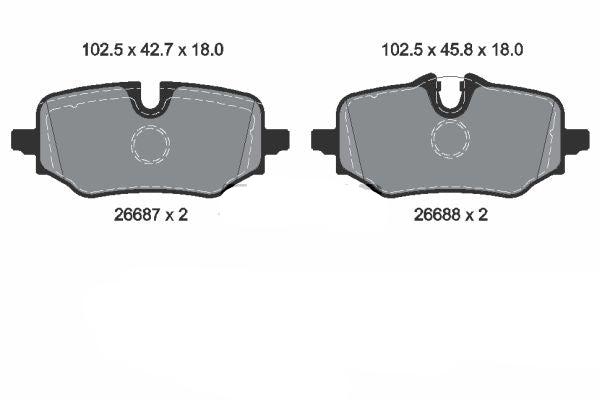
BMW 3 Series and 4 Series — the highest-volume rear pad job in Dubai. Caliper-integrated EPB from the F30 generation onward. Straightforward when service mode is used; expensive when it isn’t. Sport and M Sport brake packages use different pad dimensions to the base car, so the parts lookup has to be VIN-based.
BMW 5 Series — F10 onward uses caliper-mounted electrical units and is one of the chassis most commonly damaged by mechanical wind-back. On 530i and similar variants, rear pads frequently reach the limit ahead of the fronts.
BMW 7 Series — architecture varies by chassis, and F01/F02 cars in particular may use a drum-in-hat parking brake with separate shoes. Those shoes wear too, and almost nobody inspects them. Worth requesting explicitly.
BMW X3, X4, X5, X6, X7 — xDrive brake-based torque vectoring applies rear brakes independently. Combined with vehicle mass, rear pad life on a Dubai-driven X5 or X7 is often noticeably shorter than the owner expects. Larger rotors also mean rotor replacement cost climbs steeply.
BMW M3, M4, M5, X5 M, X6 M — M Compound brakes as standard, M Carbon Ceramic optional. Ceramic rotors are extraordinarily durable but require a specific pad compound and are unforgiving of the wrong one. Never fit a non-ceramic-rated pad to a carbon-ceramic rotor. If your car has gold or grey calipers with the M logo, confirm which system you have before pricing anything.
BMW X1 and X2 — front-biased platforms, so rear pads often last longer here than elsewhere in the range. Still EPB-equipped.
BMW i8 and hybrid models — regenerative braking dramatically reduces friction pad wear, which sounds like good news and partly isn’t. Pads that are rarely used corrode on the rotor surface, especially in coastal humidity, and rust-bonded pads produce noise and uneven bite. Low-mileage-per-year hybrids in the UAE need inspection on time even when the pads look thick.
Alpina B5 and B7 — Alpina-specific brake hardware on some builds. Parts availability in the UAE is limited, so expect a lead time rather than a same-day fit.
Full model coverage is listed on our BMW repair Dubai page, and you can browse every marque we handle on the brands we specialise in index.
How to Choose a BMW Brake Garage in Dubai
Use this as a phone script. It takes ninety seconds and it filters most of the market.
- “Do you have a scan tool that puts the EPB into service mode?” — The single most important question. Anything other than a confident yes is a red flag.
- “Does your quote include the rear wear sensor?” — Should be yes. If they don’t know what you mean, hang up.
- “Will you reset the rear brake pad CBS counter?” — Note the word rear.
- “Will you measure the rotors and give me the figure against minimum spec?” — You want a number, not “we’ll check them.”
- “What brand of pad, and is it genuine BMW or OE-supplier?” — “Original” is a marketing word. Textar, Pagid, ATE and Zimmermann are answers.
- “Is VAT included?” — Dubai quotes frequently exclude 5%.
- “Do you do the bedding-in road test?”
Then check the basics that apply to any luxury car garage in Dubai: a real trade licence, a physical workshop you can visit, verifiable Google reviews from owners of comparable cars, and a written itemised quote before work begins.
Carzilla operates from Al Quoz Industrial Area 2 with free pickup and delivery across Dubai — useful when the whole reason you’re calling is that you’d rather not drive the car. We’re also an approved RTA vehicle inspection and testing centre, so a brake fault found before a registration renewal can be resolved in one visit rather than two.
How to Make BMW Rear Brake Pads Last Longer in Dubai
You will not stop pads wearing. You can meaningfully change the rate.
- Leave more gap in traffic. Every avoided braking event is an avoided heat cycle. On Sheikh Zayed Road this is the largest single variable under your control.
- Coast to decelerate where safe. Engine braking costs nothing and generates no pad heat.
- Don’t ride the brakes on descents — multi-storey car park ramps and the Al Khail flyovers included. Brake firmly, then release, rather than dragging.
- Wash the wheels regularly. Brake dust plus salt-laden coastal humidity is genuinely corrosive to caliper hardware.
- Apply the EPB deliberately, not habitually, on flat ground. Every application clamps the rear pads. On level surfaces in Park, it isn’t always necessary.
- Get the alignment checked. Poor geometry drags the car against itself and increases braking demand. Our wheel and tyre services include four-wheel alignment to BMW-specific tolerances rather than generic settings.
- Inspect at every service, not at every warning. A pad inspection during a routine visit costs nothing extra. A grinding rear pad costs a rotor. Bundling brake checks into a scheduled car inspection is the cheapest maintenance decision available to you.
Frequently Asked Questions
How much does a BMW rear brake pads change cost in Dubai?
Between roughly AED 450 and AED 1,300 fitted for most 3 Series, 5 Series and X3 models depending on whether you choose OE-supplier or genuine BMW pads. Larger models — X5, X7, 7 Series — run AED 850–1,900, and M models with M Compound brakes run AED 1,200–3,200. Add AED 900–2,600 if rear rotors are also due. All figures include labour and are indicative; a written quote after inspection is the only reliable number.
How long does a BMW rear brake pad change take?
Around 60 to 90 minutes for a straightforward rear axle pad change, which is longer than the front axle because of the EPB service mode entry and exit. Add roughly 30–45 minutes if rotors are being replaced, and more if a slide pin is seized or a caliper needs attention. Anyone quoting 20 minutes for BMW rear pads is not using service mode.
Can I change BMW rear brake pads myself?
Technically yes, if you own a scan tool with EPB service mode function or you’re prepared to remove the actuator motors and wind the spindles back by hand. Realistically, no — the failure mode is expensive and irreversible, the torque specifications matter, and the CBS reset requires the tool anyway. The tool costs more than the labour saving on a single job.
Why do my BMW rear brake pads wear out faster than the fronts?
Because BMW’s electronic brake force distribution, DSC stability control and xDrive torque vectoring all apply the rear brakes independently of your pedal input, and the electronic parking brake clamps the rear pads every time you park. On many BMW models the rears genuinely reach the limit first. Dubai’s stop-and-go traffic amplifies the effect.
Do I need to replace rear brake rotors with the pads on a BMW?
Not automatically. It depends on measured rotor thickness against the minimum specification cast into the rotor hat, and on whether there’s thickness variation causing judder. In practice, many Dubai-driven BMWs need rotors by their second set of rear pads because of heat cycling and abrasive dust. Always ask for the measured figure.
What happens if I ignore the BMW rear brake pad warning?
The warning triggers with usable material remaining, so you have time — but not much. Continuing until the backing plate contacts the rotor destroys the rotor, can damage the caliper, and dramatically extends stopping distance. A AED 700 pad job becomes a AED 2,500+ pad-and-rotor job, and in the worst case a caliper as well.
Are genuine BMW rear brake pads worth the extra cost?
For cars under warranty, for M models, and for owners who want factory-exact noise and dust behaviour — yes. For most out-of-warranty BMWs in Dubai, OE-supplier pads from Textar, Pagid, ATE or Zimmermann deliver equivalent performance at 25–40% less, because those companies manufacture the pads BMW sells. Unbranded budget pads are a false economy in this climate.
Does the parking brake still work after a rear pad change?
It should — provided the technician exited service mode correctly so the motors re-clamp to the proper air gap. A handbrake that feels weak after a pad change usually means service mode wasn’t exited properly, or the wrong pad compound was fitted. Both are fixable, and both should be caught before handover.
Do you offer pickup and delivery for BMW brake work in Dubai?
Yes — free pickup and delivery across Dubai, which is particularly relevant for brake work, since the whole reason you’re calling may be that you’d prefer not to drive the car. Contact our Al Quoz workshop to arrange collection.
Book a BMW Rear Brake Pad Change in Al Quoz, Dubai
Carzilla Auto Service is a specialist luxury and European car repair workshop in Al Quoz, Dubai. Every BMW rear brake job we carry out uses BMW-compatible diagnostics for EPB service mode entry and exit, a new wear sensor, correct CBS reset, and a documented bedding-in road test — with the measurements in writing and the quote agreed before we start.
What we cover alongside brakes: BMW engine repair, BMW suspension repair, BMW AC repair, transmission and gearbox work, and full BMW oil change and servicing.
📍 20 C Street, Al Quoz Industrial Area 2, Dubai 📞 800-CARZILLA (800-2279 4552) | +971 56 684 9665 🔧 Free pickup and delivery across Dubai | Free inspection | Written quotes before work begins
Book your BMW brake inspection →