A steering box is one of the strongest parts on a vehicle, and it is built to last a very long time. In the UAE, though, it works harder than it was designed to. Heavy SUVs, big off-road tyres, dune driving and summer heat all add load and temperature to the box. That is why steering box repair in Dubai is a regular job on 4x4s and pickups, and not only on high-mileage ones.
This guide covers what a steering box is, which cars use one, the signs of a failing steering box, why the problem happens, how a proper repair is carried out, and how to prevent it from coming back.
What Is a Steering Box and Which Cars Use One?
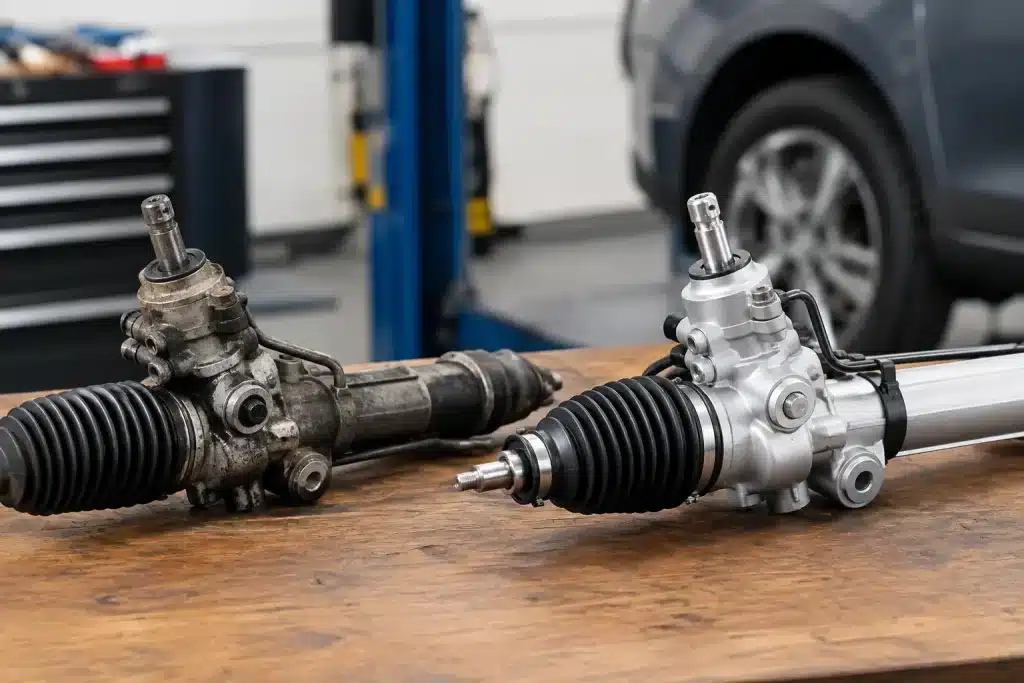
A steering box, also called a steering gearbox or recirculating ball steering gear, turns the rotation of the steering wheel into the sideways movement that steers the front wheels. Inside the housing there are four main parts:
- A worm shaft (the input shaft) driven by the steering column
- A ball nut that runs along the worm on a loop of steel balls that circulate continuously
- A sector shaft (also called the pitman shaft), whose gear teeth mesh with teeth on the ball nut
- A pitman arm on the end of the sector shaft, which pushes and pulls the drag link and steering linkage
On power-assisted boxes the ball nut also acts as a hydraulic piston. A rotary valve on the input shaft senses how hard the driver is turning and sends pressurised fluid from the power steering pump to one side of the piston or the other.
Steering boxes are used where strength matters more than steering sharpness, mainly on vehicles with a solid front axle or a heavy-duty chassis. In Dubai these include:
- Nissan Patrol Y61 (Patrol Safari / Super Safari)
- Toyota Land Cruiser 70 Series
- Mercedes-Benz G-Class W463 up to 2018 (see our Mercedes G-Class service page)
- Jeep Wrangler and Gladiator
- Heavy-duty pickups such as the GMC Sierra HD, Ford Super Duty and Ram HD (see GMC repair, Ford repair and American car repair)
- Hummer H1 and H2 (Hummer repair) and the classic Land Rover Defender
- Many classic cars, including older Mercedes-Benz and Rolls-Royce models
Steering Box vs Steering Rack: Why the Difference Matters
In Dubai garages, “steering box” is often used loosely for any steering gear. Most modern cars and SUVs, including the Nissan Patrol Y62, the Land Cruiser 200 and 300, the G-Class W463A from 2018 onward and almost every sedan, use a rack and pinion instead.
The difference is not just a matter of naming. A rack has its own failure points, such as inner tie rods, rack bushes and electric assist motors, and it is repaired in a different way. Before agreeing to any quote, confirm which type your vehicle has. If it uses a rack, see our car steering repair page, which covers rack and pinion, power steering pump and EPS repair.
Signs of a Bad Steering Box
A worn steering box usually gives several warnings before it becomes dangerous.
Free play or a dead spot at the centre. The steering wheel moves a few centimetres before the wheels respond, and the vehicle wanders on the highway. You have to keep making small corrections to drive in a straight line.
Power steering fluid leaking from the box. Look for an oily, wet film on the box housing, or drips below the pitman arm. A leak at the top usually comes from the input shaft seal, and a leak at the bottom comes from the sector shaft seal.
Heavy or uneven steering. The steering is light in one direction and heavier in the other, or it feels heavy when cold and then eases off. This often means the box is leaking internally past the piston seal or the valve.
A tight or notchy spot when turning. The steering feels rough or catches at one point in its travel. This can mean worn ball tracks, damaged bearings, or a lash adjustment that has been over-tightened.
Steering that does not return to centre. After a turn, the wheel stays where it is instead of coming back straight. A binding box is one cause, but worn ball joints and incorrect caster can cause the same symptom.
Knocking or clunking from the front end. A clunk when you turn the wheel with the vehicle stopped, or over speed bumps, can come from loose box mounting bolts or a cracked mounting point on the chassis.
Shimmy or wobble on a solid-axle 4×4. A loose steering box can contribute to front-end shimmy, but it is rarely the only cause. The track bar, drag link and tie rod ends should be checked alongside it.
What Causes Steering Box Failure in Dubai?
Heat and fluid breakdown
Power steering fluid running close to the hot engine bay in 45°C summers oxidises and thins much faster than in milder climates. Thin fluid wears the piston seal and the valve. Old fluid also makes the shaft seals hard, and hardened seals start to weep. Most steering box leaks in the UAE start this way.
Dune driving and holding the steering on full lock
Holding the steering at full lock in soft sand forces the pump to run against its pressure relief valve. This heats the fluid very quickly and puts maximum load on the box and its mountings. Repeated hard hits against the steering stops also wear the sector teeth and the bearings.
Oversized tyres and lifted suspension
Larger and heavier off-road tyres increase the force the box has to resist every time the wheels hit a pothole or a kerb. On lifted vehicles the drag link angle also changes. Over time this stresses the sector shaft, its bearing and the chassis rail where the box is bolted. Cracked box mounts are a known problem on modified solid-axle 4x4s.
Sand and dirt
Fine sand works its way into the sector shaft seal and the linkage joints. Once the seal lip is scored, it leaks steadily, and dirt in the fluid then speeds up internal wear.
Wrong fluid or mixed fluid
Some systems need ATF, some need a dedicated power steering fluid, and the G-Class and some other European vehicles need a specific hydraulic fluid. Topping up with the wrong fluid, or mixing types, damages the seals and can cause foaming, which leads to noise and erratic steering assist.
A weak power steering pump
A worn pump or a slipping belt reduces pressure, and the driver experiences this as heavy steering. The steering box is often blamed for a fault that actually sits in the pump or the hoses.
Incorrect adjustment
Some owners and garages tighten the sector lash adjuster to remove play from a worn box. This hides the wear for a short time, but it makes the steering tight at the centre, stops it returning properly, and wears the gears and bearings faster.
How a Steering Box Problem Is Diagnosed
A good diagnosis rules out the cheaper causes before condemning the box. The usual sequence is:
- Check the fluid. Look at the level, the colour and the smell. Burnt or foamy fluid tells its own story.
- Inspect the linkage. Check the tie rod ends, the drag link, the pitman arm joint and, on solid-axle vehicles, the track bar. Loose joints are often mistaken for steering box play.
- Do a dry-park test. With the vehicle on its wheels and the engine running, one technician rocks the steering wheel while another watches the input shaft and the pitman arm. If the input shaft turns but the pitman arm does not move, the play is inside the box. If the box responds but the wheels do not, the play is in the linkage. A clunk felt at the column often comes from the intermediate shaft universal joint, not from the box.
- Check the mountings. Check the torque on the box mounting bolts and inspect the chassis rail for cracks.
- Trace the leak. Clean the box first, then run the engine and turn the steering, or use UV dye, to find the exact seal or fitting that is leaking.
- Pressure-test the system. A pressure gauge fitted between the pump and the box shows whether the pump can reach its specified pressure, and whether the box holds that pressure at full lock. Low pressure at lock combined with good pump pressure points to internal leakage in the box.
This sequence matters because a new steering box will not fix worn tie rod ends, a weak pump or a loose track bar.
Steering Box Repair Process Step by Step
When the box is confirmed as the fault, a proper repair follows these steps:
- Remove the box. Disconnect the pressure and return lines and cap them to keep dirt out. Separate the intermediate shaft from the input shaft, then remove the pitman arm with a puller. The pitman arm should never be hammered off, because that damages the sector shaft and its bearings. Then unbolt the box from the chassis.
- Strip and inspect it. Inspect the worm, the ball nut, the sector teeth, the bearings and the housing bore. This inspection decides whether the box can be rebuilt.
- Rebuild or exchange it. Fit a full seal kit and new bearings, or replace the box with a remanufactured or new unit if the internal parts are worn.
- Refit the box. Torque the mounting bolts to specification and check the chassis mounting point. Refit the pitman arm on its master spline with the steering centred.
- Flush and bleed the system. Flush out the old fluid, refill with the correct specification, and bleed the air out. Bleeding is usually done by turning the steering lock to lock, first with the engine off and then with it running. Air left in the system causes groaning and inconsistent steering assist.
- Align and calibrate. Carry out a wheel alignment and centre the steering wheel. On vehicles with stability control or driver-assistance systems, recalibrate the steering angle sensor.
- Road test. Check the vehicle for return to centre, straight-line tracking, noise and leaks once the system reaches full temperature.
Steering Box Repair Options: Adjust, Reseal, Rebuild or Replace
Mounting bolts or linkage only. If the dry-park test shows the box is healthy, the repair stops at tightening the mounts or replacing worn joints.
Lash adjustment. This is acceptable only when the box is in good condition with slight play. The adjustment is set with the steering exactly at centre and to the manufacturer’s preload specification. It is not a cure for a worn box.
Reseal. A reseal suits a box that leaks but has no internal wear. Seals are always replaced as a full kit, not one at a time.
Rebuild. This is the right choice when the seals and bearings are worn but the worm, the ball nut and the housing bore are in good condition.
Replace with a remanufactured or new box. This is needed when the ball tracks are pitted, the sector teeth are damaged, or the housing bore is worn. For G-Class and classic vehicles, it is worth checking supply and quality carefully before choosing a unit.
How to Prevent Steering Box Problems
- Change the power steering fluid regularly. In Dubai’s heat, a yearly check and a shorter change interval than the manual’s “normal” schedule is sensible. The change fits easily into a routine oil change service or a major car service.
- Use only the fluid specified for your vehicle and never mix fluid types.
- In sand, do not hold the steering against full lock for more than a few seconds.
- After off-road trips, wash the sand off the box, the linkage and the suspension.
- If you fit larger tyres or a lift kit, have the steering geometry, drag link angle and box mounts checked, and consider a steering brace on vehicles known for chassis cracking at the box mount.
- Fix small leaks early. Running low on fluid destroys the power steering pump, which turns a seal job into a much bigger bill.
- Have the steering inspected at every service. Worn shock absorbers and suspension parts also increase the load on the steering. Our luxury car maintenance schedule guide explains how to adapt service intervals for UAE conditions.
Some symptoms that feel like steering box faults have other causes. Vibration through the wheel can come from failing engine mounts, as explained in our guide to Mercedes engine mount failure symptoms. Pulling under braking is usually a brake problem; see our brake pad replacement guide. On a Patrol that is also running hot, the power steering fluid suffers as well, so read why a Nissan Patrol overheats and when a Patrol radiator needs replacing.
If you are buying a used 4×4 or pickup, include the steering in a pre-purchase car inspection and run a UAE VIN check for its history. Excessive steering play and fluid leaks can also cause an RTA vehicle inspection failure.
Steering Box Repair at Carzilla in Al Quoz
Carzilla’s technicians diagnose and repair steering boxes on Nissan Patrol, Land Cruiser, G-Class, Jeep, GMC and other heavy-duty and classic vehicles at our auto garage in Al Quoz. Every job starts with a full steering and suspension check, so you only pay for the repair your vehicle actually needs. We offer Free Pickup and Delivery*, a written quote before any work begins, and Warranty on Repair.
To book an inspection, contact Carzilla or explore our full range of car repair services in Dubai and brand specialisations.