
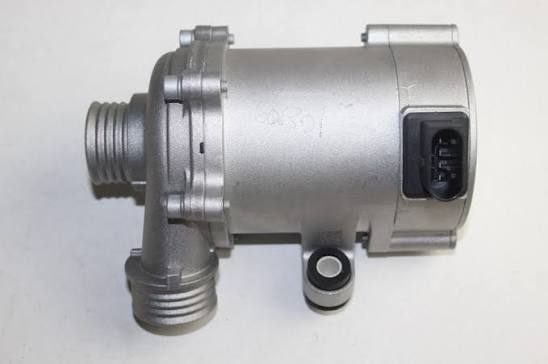
The water pump is the one component in a BMW cooling system that gives very little warning before it takes the engine with it. On most modern BMWs the pump is electric, not belt-driven, which changes both how it fails and what the driver notices first. This guide explains the symptoms of BMW water pump failure, why the failure happens, how it is diagnosed properly, and what prevents it.
How a BMW Water Pump Works
From the N52 engine onwards, BMW moved to an electrically driven coolant pump made by Pierburg. Instead of being turned by the accessory belt, it contains a brushless motor and a control module potted into the pump housing, and the DME commands its speed by PWM signal according to coolant temperature, engine load and after-run demand. It works alongside a map-controlled thermostat, which lets the DME hold coolant anywhere between roughly 85°C and 110°C depending on driving conditions.
This matters for diagnosis. A belt-driven pump usually warns you with noise. An electric pump on an N20, N55, B48, B58, N63 or S63 can simply stop commanding flow with no noise at all, and the first sign is a temperature warning on the dash. Many BMWs also run one or more auxiliary electric pumps for turbocharger after-run and heater circuits, and those fail separately from the main pump.
Engine Overheating and Coolant Temperature Warnings
The clearest symptom is a rising temperature reading or a coolant warning message. Most current BMWs have no conventional temperature gauge, so the car escalates through messages instead: a blue cold-engine light, then a coolant temperature warning, then “Reduce power” and finally an instruction to stop the vehicle. By the time the red message appears, cylinder head and gasket damage is already a risk. If your BMW is running hot without an obvious leak, read our guide on BMW engine overheating causes and what to do alongside this article.
Heater Blowing Cold Air
The heater core sits at the far end of the coolant circuit, so it is the first thing to lose flow when a pump weakens. A pump that still turns but no longer produces full flow will often give lukewarm or cold air from the vents at idle that improves slightly when revs rise. In Dubai almost nobody uses the heater, which is why this early symptom is usually missed and the fault is found later at the overheating stage.
Coolant Leak Under the Front of the Car
A mechanically failing pump leaks from its weep hole or shaft seal, leaving a drip roughly centre-front of the engine, behind the radiator fan. Look for dried blue or blue-green crystallised residue on the pump body, the belt, or the underbody shield — BMW’s G48 coolant dries to a distinctive crust. Not every leak is the pump; the plastic thermostat housing, expansion tank and radiator end tanks crack in the same way. A pressure test tells them apart, which is part of standard diagnosis at our BMW repair workshop in Dubai.
Whining, Humming or Grinding From the Engine
Worn pump bearings produce a whine or growl that changes with engine speed on belt-driven pumps, common on older M52 and M54 engines. On electric pumps the noise is different: a buzz, a rattle from a cracked plastic impeller, or a clicking as the motor tries to start against a seized rotor. Any new noise from the front of the engine that tracks coolant temperature rather than engine load deserves inspection before the next drive. Related noises from the cooling fan and belt drive are covered in our BMW engine repair service page.
Steam or a Sweet Coolant Smell
Coolant escaping onto hot exhaust or turbo components vaporises instantly and produces a sweet, syrupy smell and light white vapour from the engine bay or vents. This is a late-stage symptom. Stop driving at this point — continuing risks warping the aluminium cylinder head, which converts an affordable pump job into a full engine repair.
Repeated Low Coolant Warnings
A BMW that needs topping up every few weeks has a loss somewhere, and the pump seal is a frequent source. Coolant is a closed system; it should not be consumed. Repeatedly adding plain water dilutes the corrosion inhibitor package, accelerates bearing and impeller wear and makes the next failure arrive sooner.
Check Engine Light and Water Pump Fault Codes
Because the electric pump is DME-controlled, its failure sets fault codes rather than just a temperature reading. Codes in the 2E8x family relate to electric coolant pump activation, communication failure or blocked pump, and the DME will often force reduced power to protect the engine. A generic OBD-II reader frequently shows nothing useful here — proper diagnosis needs BMW-level tooling such as ISTA, which can command the pump, read its actual duty cycle and confirm whether the fault is the pump, its wiring, or the thermostat.
Cooling Fan Running Hard at Idle
If flow drops, the DME compensates by driving the electric fan at high speed to move air through the radiator stack. A BMW that sounds like a jet at idle in traffic, or keeps running its fan after shutdown, is telling you the cooling system is struggling. The same symptom appears when the radiator core is blocked, so the radiator and cooling stack should be checked at the same time.
Why BMW Water Pumps Fail in Dubai
Heat cycling, not mileage, is the main cause here. The pump’s control electronics are potted in resin and sit directly on a hot engine; at 45°C ambient with heat soak after shutdown, that module cooks and eventually fails. Plastic impellers become brittle from the same thermal cycling and crack or slip on the shaft. Coolant inhibitors deplete faster in sustained heat, letting bearings corrode, and topping up with tap water accelerates this further. Cars stored for months — common with second and third vehicles in Dubai — also suffer seized rotors and dry starts. In practice, BMW electric water pumps in the UAE tend to fail between 80,000 and 120,000 km, or around six to seven years, whichever comes first.
How the Repair Is Done Properly
Replacement is not simply bolting on a new pump. The thermostat should be replaced with it, because both are the same age and the labour overlaps. The system must be refilled with BMW-approved coolant at the correct concentration, then vacuum-filled or bled using the DME’s commanded bleed routine — an airlock will mimic the same overheating symptom you just paid to fix. On many models the new pump is registered and coded so the DME resets its adaptation and service counter. The plastic thermostat housing, expansion tank and hoses should be inspected while the system is open, since they age at the same rate. Full cooling system work is handled under our BMW service in Dubai and on model-specific pages such as BMW X5, BMW 5 Series and BMW 3 Series repair.
How to Prevent BMW Water Pump Failure
Change the coolant every three to four years regardless of “lifetime fill” claims, using the correct BMW specification rather than a universal green coolant. Never top up with plain water beyond an emergency. Keep the radiator and condenser faces clean, as packed sand restricts airflow and raises system temperature. Have the cooling system pressure-tested at every major service — it is quick and catches seepage early. If your car is approaching 100,000 km or seven years, replacing the pump and thermostat pre-emptively during another front-end job is far cheaper than a roadside failure. Regular servicing, including a correct BMW oil change and a visual cooling system check, is the simplest protection. For other recurring faults, see our guide to common BMW engine problems and solutions.
If your BMW is showing any of these symptoms, stop driving it once temperature warnings appear and have the cooling system tested. You can reach our Al Quoz workshop through the contact page.