
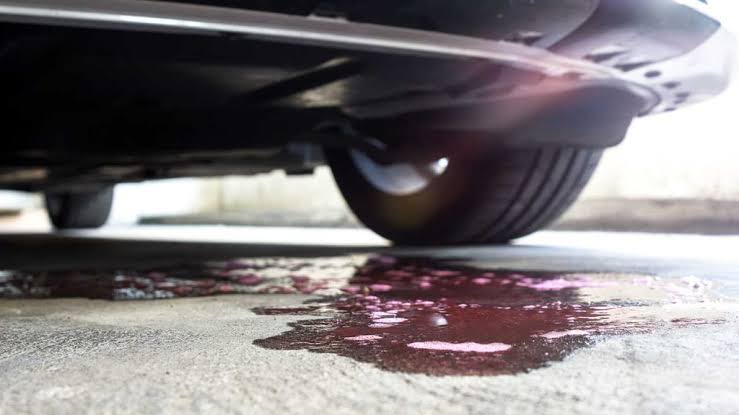
A cooling system is sealed. Coolant does not evaporate out of a healthy engine, and it does not get consumed the way fuel does. So when the expansion tank keeps dropping and there is no puddle under the car, the coolant has not disappeared — it is leaving through a route you cannot see from the driveway.
This guide explains where coolant actually goes when there is no visible leak, why these faults are common in Dubai’s climate, how a workshop finds the loss, and what the correct repair and prevention looks like.
Where Does the Coolant Go If There Is No Puddle?
There are only five possibilities, and every diagnosis comes down to sorting between them: the coolant is being burned inside the engine, it is escaping as vapour, it is mixing into another fluid, it is leaking somewhere that never reaches the ground, or it was never lost in the first place and you are reading the level wrong.
Coolant Being Burned Inside the Engine
This is the cause owners worry about, and it is the one that leaves no trace on the floor. Coolant entering a combustion chamber is burned and leaves through the exhaust as vapour.
The usual routes are a failed head gasket, a cracked cylinder head or block, a porous casting, a failed intake manifold gasket on engines with coolant passages through the manifold, or a leaking oil-to-coolant heat exchanger feeding coolant into the oil. On turbo diesels and some petrol engines, a cracked EGR cooler does the same thing — it puts coolant straight into the exhaust stream, which is why an EGR cooler failure often shows as steady coolant loss with a perfectly clean engine bay.
The tells are white vapour from the exhaust that keeps going after the engine is warm, a sweet smell at the tailpipe, coolant level dropping with no external staining, bubbles rising in the expansion tank at idle, or pressure building in the tank within a few minutes of a cold start. Combustion gases pushing into the cooling system also cause overheating and hot-cold heater output, because gas pockets stop the coolant circulating properly. If you are seeing temperature problems alongside the loss, our guide on engine overheating causes and what to do covers the circulation side of the same fault.
Coolant Escaping as Steam or Vapour
A cooling system runs pressurised, usually between 1.2 and 2.0 bar depending on the car. That pressure raises the boiling point. When the pressure cap’s spring or seal weakens, the system vents early and pushes coolant vapour out of the overflow every time the engine gets hot. Nothing drips, because it leaves as steam. Over a few weeks the level falls noticeably.
The same thing happens with a hairline crack in a plastic expansion tank, a weeping tank seam, a tired radiator cap seat, or a seep at a hose clamp that lands on a hot exhaust manifold or turbo housing and flashes off instantly. A failing cap is one of the cheapest repairs in the workshop and one of the most commonly missed causes of slow coolant loss.
Coolant Mixing With Engine Oil or Transmission Fluid
Coolant can also leave the cooling system without ever leaving the car. Most modern engines use an oil-to-coolant heat exchanger, and many automatic gearboxes use a transmission fluid cooler built into the radiator end tank or a separate plate cooler. When the internal seal or plate fails, coolant crosses into the oil circuit under pressure.
Check the oil filler cap and dipstick for a light brown, milky emulsion, and check the coolant tank for an oily film on the surface. On automatics, coolant in the transmission fluid turns it pink and cloudy and destroys the clutch friction material quickly — that is a gearbox job, not just a cooling job, and it is covered under our gearbox and transmission repair service. Contaminated engine oil must be changed along with the filter once the leak is fixed, since emulsified oil no longer protects bearings; see our oil change service for the correct grade and interval.
Leaks That Never Reach the Ground
Plenty of “invisible” leaks are ordinary external leaks hidden by the car’s own design or by the climate.
Under-body trays and engine covers catch coolant and let it evaporate before it can drip. Leaks that only open under full pressure and temperature seal themselves again as soon as the engine cools, so nothing shows in a parked car. A heater core leak drains into the cabin, not the road — the signs are a sweet smell inside the car, a greasy film on the windscreen, damp passenger carpet, and weak heating. A water pump weep hole leaking slowly will dry on the hot block. And at 45°C ambient, a genuine seep at a quick-connect fitting, a plastic thermostat housing or a radiator end tank often evaporates faster than it accumulates. Cooling-stack faults of this kind are dealt with in our radiator repair cost guide for Dubai.
When the Coolant Was Never Actually Lost
Not every falling level is a fault. After any cooling system work, trapped air slowly works its way out and the level appears to drop for the first few heat cycles — that is why a proper refill uses a vacuum fill or a commanded bleed procedure rather than just pouring coolant in. An overfilled system will also purge itself down to its correct level once and then stop. And the level must always be read on a cold engine on level ground, because coolant expands significantly when hot. If the level drops once and then holds, it was almost certainly air or overfill. If it keeps dropping, it is a fault.
Why Cars in Dubai Lose Coolant Without Visible Leaks
Heat cycling, not mileage, is what kills cooling systems here. Plastic thermostat housings, expansion tanks, radiator end tanks and quick-connect fittings go brittle after years of repeated expansion and contraction, and they crack along moulding lines rather than splitting open. Cap springs fatigue faster under constant high under-bonnet temperatures. Coolant inhibitors deplete sooner in sustained heat, and once depleted the coolant becomes corrosive to alloy heads and radiator cores.
Topping up with tap water is a major local cause of repeat failures: it dilutes the inhibitor package and leaves mineral scale in the heat exchanger passages and heater core. Airborne sand packs the radiator and condenser stack from behind, raising system temperature and pressure, which turns a seep into a vent. Low-mileage stored cars fare worse, not better, because seals dry out without circulation.
How a Workshop Finds an Invisible Coolant Leak
Diagnosis follows a sequence, and guessing costs more than testing. A cooling system pressure test holds the system at its rated pressure cold and hot to expose leaks that only open under load, and the cap is tested separately on the same gauge. A vacuum test on the system finds it holding or losing vacuum without spilling any fluid.
If nothing external appears, the next step is a combustion gas test at the expansion tank, where a chemical block tester or an exhaust gas analyser detects hydrocarbons in the coolant and confirms a head gasket or cracked head. A cylinder leak-down test and a borescope inspection identify which cylinder is involved. UV dye added to the coolant and a drive cycle will show up seeps on hot surfaces and under trays. Oil and transmission fluid are checked for emulsion, and the cabin is checked for heater core wetness. On most luxury cars the scan tool matters as much as the gauge, since live coolant temperature, fan control and thermostat data narrow the search fast. Full workshop diagnosis for cooling faults sits under our car engine repair and vehicle inspection services.
How Each Cause Is Repaired
A failed pressure cap or expansion tank is replaced outright, not resealed. Cracked plastic housings and brittle quick-connects are replaced as assemblies with new O-rings, since reusing an aged fitting is what causes repeat leaks. Water pumps are replaced rather than repaired, and on engines where the pump is driven by the timing belt or chain, the driving component is done at the same time. A leaking oil or transmission heat exchanger is replaced and both fluid circuits are flushed. Head gasket work means machining the head flat, replacing head bolts where they are torque-to-yield, and pressure testing the head before reassembly. A leaking heater core normally requires dash removal, which is labour-heavy but a permanent fix.
Every repair finishes the same way: refill with the correct coolant specification for that manufacturer, bleed the system properly, and pressure test again before the car leaves. Mixing coolant types — or using a generic green coolant in an engine that requires a specific OEM chemistry — causes gelling and is a common reason a car returns with the same complaint.
What Not to Do
Do not top up with tap water, do not add stop-leak products to a modern engine — they clog heater cores, radiator passages and thermostat bypasses and turn a repairable fault into a replacement job — and do not keep refilling a tank that empties every week. Continuous coolant loss with no visible leak usually means combustion gas is entering the system, and driving on it warps heads and cracks blocks. If the temperature gauge climbs or a warning appears, stop, let the engine cool completely, and have the car recovered.
How to Prevent Coolant Loss in the First Place
Check the level cold once a month and note it, because a slow loss is only visible against a baseline. Replace coolant on the manufacturer’s interval rather than treating it as lifetime fill, especially in UAE conditions. Replace the pressure cap whenever the system is opened for major work. Have the radiator and condenser stack cleaned from the engine side during service so airflow is not restricted. Ask for a pressure test at every major service — it is a few minutes of work and catches a weak cap or brittle housing before it becomes a head gasket. And on any luxury or performance car, use the exact coolant specification the manufacturer lists.
Coolant Loss Diagnosis and Repair at Carzilla, Dubai
Carzilla is a specialist luxury and exotic car workshop in Al Quoz, Dubai, handling cooling system diagnosis and repair across BMW, Mercedes-Benz, Audi, Porsche, Range Rover, Ferrari, Lamborghini and Maserati, with pressure testing, combustion gas testing, UV leak tracing and manufacturer-level diagnostics on site. You can view the full range of services, browse our brand specialisations, read more guides on the Carzilla blog, or contact the workshop to book a cooling system inspection.