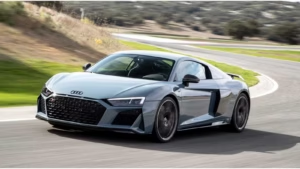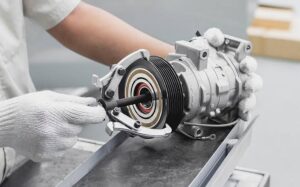
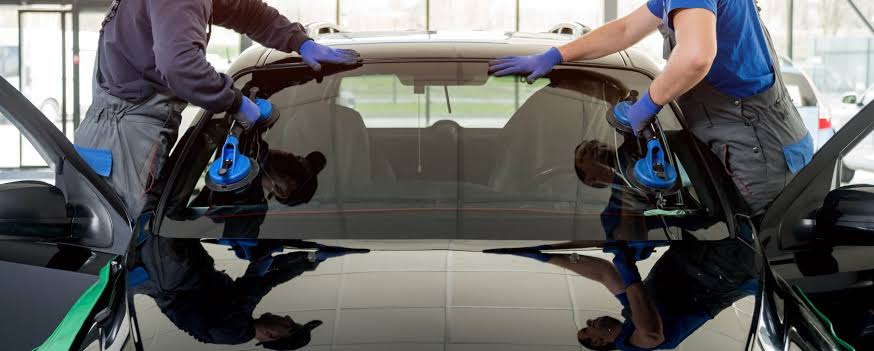
Windshield replacement in Dubai typically costs AED 450 to AED 1,400 for a mainstream sedan with aftermarket glass, AED 1,600 to AED 4,500 for a premium German saloon or SUV with OEM glass, and AED 6,000 to AED 30,000+ for exotic and ultra-luxury models where the glass is dealer-order only.
Add AED 450 to AED 1,200 if your car has a forward-facing camera behind the mirror and needs ADAS calibration after the glass is fitted.
A chip repair, if your damage still qualifies, costs AED 150 to AED 450 and takes about 30 minutes.
The three variables that move the number most are: which glass tier you buy, which feature codes are laminated into your original windscreen, and whether your car needs camera recalibration afterwards. Everything below explains those three in detail, because getting them wrong is how a AED 900 quote becomes a AED 4,000 invoice halfway through the job.
If you drive a Range Rover, Porsche, Mercedes, Bentley or Ferrari and want the number for your exact chassis, talk to our team in Al Quoz with your VIN ready — glass part numbers are VIN-specific on almost every luxury car built after 2015.
Repair or Replace? The Rules That Actually Decide
Most Dubai workshops will tell you “small chips can be repaired, big cracks can’t.” That’s true but useless — it doesn’t tell you which side of the line your damage falls on. Here are the actual criteria a competent technician applies.
When a windscreen chip repair still works
Resin injection restores structural continuity to the outer glass layer. It works when all of the following hold:
- Size: the chip is no larger than a UAE 1-dirham coin (about 25 mm) for a bullseye or star break; a single crack is under roughly 150 mm.
- Depth: the damage is confined to the outer glass ply and hasn’t penetrated the PVB interlayer. If you can catch a fingernail on the inside face, it’s a replacement.
- Location: the damage sits outside the driver’s primary vision area — roughly the wiper-swept zone directly ahead of the steering wheel.
- Edge distance: the chip is more than 50 mm from any edge of the glass. Damage near the bonded perimeter compromises the structural bond line and cannot be safely repaired.
- Frit clearance: it isn’t sitting on the black ceramic band (the frit) around the perimeter.
- Count: you have three or fewer separate impact points. More than that and the glass has lost too much integrity.
- Sensor clearance: it isn’t in the camera or rain-sensor viewing window behind the rear-view mirror. Resin distorts light, and a distorted camera view will throw ADAS faults even after a technically perfect repair.
- Age: the chip is fresh and hasn’t been contaminated with dust, wax or water. In Al Quoz, a chip left open for two weeks has a fine layer of construction dust in it, and resin won’t bond through that. This is the single most common reason a repair looks cloudy afterwards.
When windscreen replacement is the only safe option
Replace, don’t repair, if the damage:
- Crosses into the driver’s line of sight — even a perfect repair leaves faint optical distortion, and RTA inspectors treat obstruction in that zone as a fail
- Reaches or originates at the edge of the glass
- Runs longer than roughly 150 mm, or is spreading (an edge crack in Dubai summer can travel the full width of a windscreen in a single afternoon)
- Penetrates the inner glass ply
- Sits inside the ADAS camera or HUD projection window
- Is a stress crack with no impact point — these come from a body or pinchweld problem and will simply repeat on the new glass unless the underlying cause is found
That last one matters more than people realise. If your windscreen cracked with no stone strike, something in the aperture is loading the glass — a distorted pinchweld after a repair, a seized body mount, or corrosion under the bond line. Fitting new glass without addressing it wastes the glass. Our auto body shop in Dubai checks aperture geometry before we quote a windscreen on any car with accident history, which you can verify beforehand using our free UAE VIN check tool.
Why Dubai’s Heat Turns a Chip Into a Crack in Days
This is the part almost every windscreen guide in the UAE skips, and it’s the reason Dubai chip-to-crack progression is faster than almost anywhere else on earth.
A laminated windscreen is two sheets of glass bonded to a polyvinyl butyral (PVB) interlayer. Glass and PVB expand at different rates when heated. In summer, a car parked outside in Al Quoz reaches a glass surface temperature of 70–80°C. You get in, and the climate control blasts 5°C air directly onto the inside face of that same glass.
You’ve now created a temperature differential of 50°C or more across a 5 mm laminate in under a minute. The inner ply contracts, the outer ply is still expanding, and the shear stress concentrates at exactly the place where the structure is already weakest — the tip of your existing chip. That’s the moment the crack runs.
Three practical consequences for Dubai drivers:
- Get chips repaired within days, not weeks. The heat differential is a daily event here, not a seasonal one.
- Don’t blast cold air at a chipped windscreen. Open the windows for 30 seconds first, direct vents to the footwell, and let the cabin bleed heat before pointing air at the glass. It genuinely buys you time.
- Avoid a cold-water wash on a hot car with existing damage. A pressure-washer jet on 75°C glass is a controlled thermal-shock test.
The same heat load is why we treat car AC performance and glass condition as related problems on Dubai cars — a weak AC system means longer, harsher cool-down cycles, and harsher cool-down cycles are what propagate cracks. If your cool-down is slow, our guide on how much car AC repair costs in Dubai breaks down what’s likely wrong.
What Really Drives Windshield Replacement Cost in Dubai
1. Glass tier: OEM, OE, OEE and aftermarket
Dubai workshops use “OEM” to mean four completely different things. The price gap between them is enormous, so know which one you’re being quoted.
| Tier | What it actually is | Logo | Typical premium |
|---|---|---|---|
| OE / genuine | Bought through the franchised dealer, in manufacturer packaging, with the car maker’s logo etched | Car brand | Baseline ×2.5–4 |
| OEM | Made by the same factory on the same tooling that supplies the car maker, sold under the glass maker’s own brand | Glass maker (Saint-Gobain, Pilkington, AGC, Fuyao, Guardian, Splintex) | Baseline ×1.6–2.2 |
| OEE (OEM-equivalent) | Made to the same dimensional and optical spec by a licensed third party, not the original tooling | Glass maker | Baseline ×1.2–1.5 |
| Aftermarket | Independent manufacture to a copied pattern, variable optical quality and thickness tolerance | Generic | Baseline |
For a mainstream car, quality OEM or OEE glass is genuinely fine. On a luxury car it’s a different calculation, because the tolerance stack matters: an aftermarket windscreen that’s 0.4 mm off in curvature will still fit and seal, but will throw a permanent ADAS camera calibration offset that no amount of recalibration fully resolves. On a car with lane-keep assist and adaptive cruise, that’s not a cosmetic issue.
Be direct with any workshop: “Is this OE from the dealer, OEM branded glass, OEE, or aftermarket — and what’s the manufacturer name etched in the corner?” A workshop that won’t answer that plainly is a workshop to walk away from.
2. The feature codes hidden in your windscreen
This is where Dubai quotes swing wildly for what looks like the same job. Modern windscreens are not plain glass — they’re a stack of options, and each one has its own part number.
- Acoustic PVB interlayer — a thicker, softer sound-damping interlayer. Standard on almost every premium saloon since roughly 2016. Fitting non-acoustic glass to an acoustic car produces a noticeably louder cabin at 120 km/h on Sheikh Zayed Road, and owners always notice.
- HUD wedge interlayer — a head-up display needs a windscreen with a wedge-shaped interlayer, thicker at the top than the bottom, to collapse the double reflection into one image. Fit a non-HUD screen to a HUD car and you get a permanent ghosted double image. It cannot be adjusted out. This single mistake accounts for a large share of windscreen redo jobs in Dubai.
- IR / solar-reflective coating — a metallic-oxide layer that rejects infrared. Extremely common on GCC-spec cars because it’s the difference between a bearable and unbearable cabin in July. Critical detail: this metallic layer blocks RFID. IR-coated windscreens have a small uncoated “delete zone” or black patch behind the mirror where your Salik tag, toll transponder and any GPS tracker must sit. Fit glass without the delete window and your Salik tag stops reading.
- Heated wiper park zone — fine resistive elements at the base of the glass. Rare as a de-icer here, but present on European-spec imports.
- Rain and light sensor — needs a matching optical gel pad or coupling pad. Reusing a hardened old pad is a common shortcut and produces wipers that either never trigger or run constantly.
- Camera bracket — bonded to the glass at the factory on most VAG, BMW and Mercedes products. The bracket often comes with the glass and is not transferable.
- Antenna / GPS elements — embedded conductors in the frit band on some models.
- Shade band, hydrophobic coating, laminated privacy tint — each with its own part number.
Ask the workshop to read your VIN and confirm the exact glass part number before ordering. On most German cars this takes ninety seconds in the parts system. A shop that “eyeballs it” is a shop that will order the wrong screen.
3. ADAS camera calibration
Covered in full below — but budget AED 450–1,200 and don’t let anyone tell you it’s optional.
4. Labour hours and trim complexity
A 2014 Corolla windscreen is two cowl clips and a wiper arm. A current Range Rover or S-Class involves A-pillar trim with one-time-use clips, a bonded camera housing, a rain sensor, an interior mirror with auto-dim wiring, cowl and scuttle panels with drain routing, and on some models a bonded roof-rail interface. That’s 2.5 to 4 labour hours against 1.0 to 1.5 on a mainstream car, before the glass cost even enters the conversation.
5. Glass availability and sourcing lead time
This is the real constraint on same-day service in Dubai:
- Mainstream Japanese, Korean and American models: widely stocked. Same-day is realistic.
- Volume German models (3 Series, C-Class, A4, Cayenne, Range Rover Sport): usually stocked locally in aftermarket and OEM, same-day often possible for the common variants. HUD or IR variants may be a day or two.
- Low-volume luxury (Bentley, Rolls-Royce, Aston Martin, Maserati): typically dealer order. Expect 5 to 20 working days. Some are shipped from Europe on demand.
- Exotics (Ferrari, Lamborghini, McLaren, Pagani): dealer-order only, VIN-matched, and on some models the glass is bonded as a structural element of the tub with a documented factory procedure. Lead time and cost are both in a different category.
If you drive one of these, our brand pages set out how we handle parts sourcing: Bentley repair Dubai, Rolls Royce repair Dubai, Ferrari repair Dubai, Lamborghini repair Dubai, McLaren repair Dubai and Aston Martin repair Dubai.
Windshield Replacement Cost in Dubai by Car Type (2026)
Indicative fitted prices, VAT excluded, glass plus labour. ADAS calibration is listed separately because not every car needs it.
| Vehicle category | Aftermarket / OEE | OEM branded glass | OE from dealer | ADAS calibration |
|---|---|---|---|---|
| Compact & mid-size sedan (Corolla, Elantra, Civic) | AED 450 – 850 | AED 800 – 1,400 | AED 1,400 – 2,400 | AED 400 – 700 |
| Mainstream SUV (Prado, Patrol, Explorer) | AED 700 – 1,200 | AED 1,100 – 1,900 | AED 1,900 – 3,200 | AED 450 – 800 |
| Premium German saloon (3/5 Series, C/E-Class, A4/A6) | AED 900 – 1,600 | AED 1,600 – 2,900 | AED 2,800 – 5,000 | AED 500 – 1,000 |
| Premium SUV (X5, GLE, Q7, Cayenne, Range Rover Sport) | AED 1,200 – 2,200 | AED 2,000 – 3,800 | AED 3,500 – 6,500 | AED 600 – 1,200 |
| Full-size luxury SUV (Range Rover LWB, G-Class, Cullinan-class) | — | AED 3,000 – 6,000 | AED 5,500 – 12,000 | AED 700 – 1,400 |
| Ultra-luxury saloon (Bentley Flying Spur, Rolls-Royce Ghost/Phantom) | — | AED 5,000 – 11,000 | AED 9,000 – 25,000+ | AED 800 – 1,600 |
| Exotic / supercar (Ferrari, Lamborghini, McLaren) | — | — | AED 8,000 – 30,000+ | Model-specific |
| EV (Tesla Model 3/Y, Model S/X) | AED 1,100 – 2,000 | AED 1,800 – 3,500 | AED 3,000 – 6,000 | AED 600 – 1,200 |
Chip repair across all categories: AED 150 – 450.
Notes on reading this table:
- HUD-equipped variants add roughly 30–60% to the glass line on any row.
- IR/solar-reflective GCC-spec glass adds 15–30% over plain laminated.
- Prices for exotics are indicative only. On low-volume models the glass is quoted per VIN and can exceed these ranges considerably.
- Tesla and other EVs frequently use a single bonded glass roof and windscreen assembly interface that raises labour hours — see Tesla repair Dubai for how we handle those, and our EV vs petrol maintenance cost comparison for the wider running-cost picture.
The Windshield Replacement Process, Step by Step
A correct windscreen replacement is nine distinct operations. If a workshop can’t describe all nine, they’re skipping some.
1. VIN decode and glass identification. Read the VIN, pull the exact glass part number, confirm every option code — acoustic, HUD, IR, heated, sensor, bracket, antenna. Confirm the etched manufacturer on the glass being supplied.
2. Pre-scan and damage documentation. Full diagnostic scan to record existing fault codes before any work. This protects both parties. On ADAS cars, note the camera’s current calibration status. Photograph the aperture, the trim and any existing paint damage at the A-pillars.
3. Protection and disassembly. Cover the dash, seats and bonnet. Remove wiper arms (marking their park position), cowl and scuttle panels, A-pillar trim, mirror assembly and any sensor covers. On luxury cars, several of these clips are single-use and should be replaced, not reused.
4. Cut-out. Separate the old glass from the urethane bead using a cold knife, wire tool or fibre-line system. The choice matters: on aluminium-intensive bodies like a Range Rover or a Jaguar, a careless cold knife scores the pinchweld and starts corrosion under the new bond line. Wire or fibre-line is the correct tool there.
5. Pinchweld preparation. Trim the residual urethane down to a thin uniform layer of roughly 1 mm — not bare metal. The old cured urethane is the ideal bonding substrate for the new bead. Any bare metal exposed during cut-out must be primed with the correct pinchweld primer and given its full flash-off time. Skipping this is why some replaced windscreens leak eighteen months later.
6. Glass preparation. Clean the bonding frit, apply glass activator or primer to the frit band with the correct applicator, and observe the manufacturer’s flash-off period (typically 10 minutes). Transfer or fit the rain sensor pad, camera bracket and mirror mount.
7. Urethane bead and set. Apply a continuous, correctly profiled triangular bead of automotive-grade polyurethane meeting FMVSS 212 (windscreen retention) and FMVSS 216 (roof crush). Set the glass with correct decking pressure and verify flush alignment against the body on all four sides. Panel gap should match the opposite side within a millimetre.
8. Reassembly and leak test. Refit trim, cowl, mirror and wipers to the marked park position. Water test the perimeter. Check for wind-noise paths.
9. ADAS calibration and post-scan. Calibrate the forward camera to manufacturer procedure, clear codes, road-test, and issue the written safe drive-away time.
Steps 5, 7 and 9 are where corners get cut in Dubai, because they’re invisible from the driver’s seat. They’re also the three steps that determine whether your windscreen stays in the car in a rollover.
Same-Day Windshield Replacement in Dubai: What’s Real and What’s Marketing
Same-day windscreen replacement genuinely exists in Dubai. It just requires three things to line up, and no honest workshop can promise it before checking all three.
1. The glass is physically in the emirate today. Not “we can get it” — in stock, at a supplier you can call, in your exact option variant. For common German and Japanese models this is usually true. For a Flying Spur with HUD, it is almost never true.
2. The car doesn’t need static ADAS calibration in a bay that’s already booked. Static calibration needs a dedicated level bay with controlled lighting and measured target distances. Most Dubai shops have one, if any. On a busy day, that bay is the bottleneck, not the glass.
3. There’s enough daylight left for cure time. Which brings us to the number nobody quotes you.
Realistic same-day timeline
| Stage | Duration |
|---|---|
| Glass collection from supplier | 45 – 120 min |
| Disassembly, cut-out, prep | 45 – 90 min |
| Prime, flash-off, bead, set | 30 – 45 min |
| Reassembly and leak test | 30 – 45 min |
| Safe drive-away cure | 60 min minimum |
| ADAS calibration (if required) | 30 – 90 min |
| Realistic total, glass in stock | 4 – 6 hours |
So “same-day” is honest. “One hour” or “while you wait” on a modern luxury car is not — not if the urethane is being given its cure time and the camera is being calibrated properly.
If you’d rather not lose half a day, we collect the car from anywhere in Dubai and return it, and we run the same arrangement for Abu Dhabi customers on covered transport.
Safe Drive-Away Time: The Number Nobody Quotes You
Safe drive-away time (SDAT) is the interval after glass installation before the urethane has cured enough to hold the windscreen in place during a crash and to support passenger airbag deployment. It is defined by the adhesive manufacturer, tested against FMVSS 208, 212 and 216, and it is not a suggestion.
Why it matters more than it sounds: on most cars, the passenger airbag deploys upward and reacts against the inside of the windscreen. The glass is its backstop. If the urethane hasn’t reached minimum drive-away strength, a deploying airbag can push the windscreen out of the aperture — and then the airbag doesn’t restrain the passenger, and the roof loses a structural member at exactly the wrong moment. The windscreen is a structural component that also happens to be transparent.
What determines SDAT:
- Adhesive formulation. Fast-cure urethanes can reach drive-away strength in 30–60 minutes. Conventional moisture-cure products take anywhere from 2 to 24 hours.
- Temperature and humidity. Moisture-cure urethane cures faster in warm, humid conditions. Dubai’s coastal humidity and ambient heat genuinely work in your favour here — a bead that needs 4 hours in a European winter may reach the same strength in well under an hour in a Dubai August. This is the one respect in which the UAE climate helps your windscreen.
- Bead size and profile. A thicker bead takes longer to cure through.
- Airbag configuration. Some manufacturers specify extended SDAT for dual-stage passenger airbags.
What to ask for: a written safe drive-away time, on the invoice, naming the adhesive product used. Any workshop that meets ANSI/AGRSS practice will provide this without hesitation. A workshop that says “yeah, give it an hour” without knowing which urethane is in the gun is guessing with your passenger airbag.
What not to do during cure: no car wash, no pressure washing, no slamming doors (pressure spikes push the glass against a soft bead), leave a window cracked 2 cm for the first day to relieve cabin pressure, and leave the retention tape on for 24 hours.
ADAS Calibration After Windshield Replacement in Dubai
If your car has a camera behind the rear-view mirror, replacing the windscreen moves that camera. Even a fraction of a degree of angular error translates to metres of positional error at 100 metres down the road. Recalibration is mandatory, not optional.
Systems that depend on the forward camera: lane departure warning, lane keeping assist, autonomous emergency braking, adaptive cruise control, traffic sign recognition, automatic high beam, and on many cars the driver-attention monitor.
Static vs dynamic calibration
| Static | Dynamic | |
|---|---|---|
| Where | In-workshop, dedicated bay | On the road |
| Requires | Level floor, controlled lighting, brand-specific target boards at measured distances, tyre pressures and fuel level set to spec | 15–30 min drive at 50–80 km/h on clearly marked roads |
| Typical brands | Mercedes-Benz, BMW, Audi/VAG, Land Rover, Volvo | Tesla, some Toyota, some Ford |
| Time | 45 – 90 min | 30 – 60 min |
| Dubai complication | Few workshops have a compliant bay | Lane markings on some Dubai roads and constant roadworks can make it hard to complete a clean dynamic drive |
Many cars need both, in sequence. Some — including several Mercedes and BMW models — will not complete a dynamic calibration at all until a static one has succeeded first.
Questions worth asking any Dubai workshop:
- Does my specific model require static, dynamic, or both?
- Do you have a static calibration bay on site, or is it subcontracted?
- Do you use the manufacturer diagnostic platform, or a generic aftermarket tool?
- Will I get a printed pre-scan and post-scan report?
If a workshop tells you your camera-equipped car doesn’t need calibration because “the glass is in the same place,” they either don’t understand the system or are hoping you don’t. Our car diagnostics and inspection service includes full system scanning, and we can verify calibration status independently if you had glass fitted elsewhere and something doesn’t feel right.
Your Salik Tag and the New Windscreen
Small detail, guaranteed annoyance if it’s missed.
Your Salik tag is an RFID sticker bonded to the inside of your windscreen. When the glass is replaced, the tag goes in the skip with the old screen. Two things follow:
- You need a replacement Salik tag and it must be registered against your plate. Budget the tag cost and a short admin process.
- The new tag must be positioned in the correct zone. If your car has IR/solar-reflective glass, the metallic layer blocks RFID everywhere except the small uncoated delete window, usually behind the rear-view mirror. Stick the tag anywhere else and gates simply won’t read it — and unread crossings become fines.
A workshop that handles a lot of Dubai cars will point out the delete window before fitting. It’s a good proxy for how much local experience they actually have. The same applies to any dashcam, parking transponder, or GPS tracker mounted on the old glass.
Cracked Windscreen and RTA Vehicle Inspection in Dubai
If your registration renewal is coming up, deal with windscreen damage first.
A crack or chip in the driver’s primary vision zone — roughly the wiper-swept area ahead of the steering wheel — is an automatic RTA inspection failure. Damage that obstructs an ADAS camera’s view is also flagged. This is one of the most common and most avoidable failure reasons at Dubai testing centres, alongside tyre tread and burnt-out bulbs.
The mechanics of a failure:
- You get a failure report listing the defects
- You have a 31-day window to fix and re-test
- A re-test on a light vehicle carries a modest fee
- Registration cannot be renewed until you pass, and driving on expired registration attracts its own fines
The practical order of operations: fix the glass, then test. Not the other way round. A 30-minute pre-check covering lights, tyres, wipers and glass eliminates most avoidable failures — which is exactly what our RTA vehicle inspection service is set up to do. If you’re also due for tyres, our auto tyre services page covers the tread-depth and age rules that catch people out, and car brake repair covers the roller-test balance requirement.
Does UAE Car Insurance Cover Windshield Replacement?
Usually yes, if you hold comprehensive cover — but the details determine whether claiming is actually worth it.
Comprehensive policies in the UAE almost always include windscreen and glass cover. Third-party liability policies generally do not; on those, glass cover is an optional add-on you must have purchased before the damage occurred.
What to check in your own policy schedule:
- Glass excess / deductible. Many UAE policies carry a separate, lower excess for glass-only claims than for general accident claims. On a AED 900 aftermarket screen the excess may exceed the repair cost, making a claim pointless. On a AED 12,000 Bentley screen it clearly isn’t.
- Whether a glass-only claim affects your No Claims Bonus. Some UAE insurers ring-fence glass claims so your NCB survives; others don’t. This is the single most valuable line to read before you call. Many policies also cover a chip repair with no excess at all, specifically to stop small damage becoming a full replacement claim.
- Agency vs non-agency repair. If your policy is agency-repair, glass may have to go through the franchised dealer. Non-agency policies let you use an independent workshop, usually from an approved list.
- Approved workshop requirement. Going outside the approved network can void the claim entirely. Confirm before booking, not after.
- Annual glass claim limit. Some policies cap the number of glass claims per year.
Claiming, in order: photograph the damage before anything else → notify your insurer and get a claim or LPO reference → confirm which workshops are approved → get the workshop to invoice against the reference → keep the pre-scan and post-scan ADAS reports, because insurers increasingly ask for calibration documentation on newer cars.
This is general information about how UAE motor policies typically work, not advice on your specific contract. Your policy schedule and your insurer’s terms are what actually govern your claim.
How to Choose a Windshield Replacement Workshop in Dubai: 10-Point Checklist
- Can they read your VIN and state the exact glass part number before quoting?
- Will they name the glass tier and the etched manufacturer — OE, OEM, OEE or aftermarket?
- Do they identify your feature codes — acoustic, HUD, IR, heated, sensor — unprompted?
- Do they provide a written safe drive-away time and name the urethane used?
- Does the urethane meet FMVSS 212 and 216? Ask to see the cartridge.
- Do they perform a pre-scan and post-scan and give you both reports?
- Do they have an in-house static ADAS calibration bay, or is it subcontracted?
- What’s the warranty — is it against leaks and wind noise specifically, and for how long?
- Do they handle Salik tag replacement and delete-zone placement?
- Is the quote itemised — glass, labour, adhesive and consumables, calibration, VAT — as separate lines?
Red flags
- A single flat price quoted over the phone without asking your model year or VIN
- “ADAS calibration isn’t necessary” on a camera-equipped car
- No pre-scan or post-scan documentation
- Cash-only, no VAT invoice
- Aggressive discount framing (“70% off!”) on a safety-critical structural repair
- Mobile replacement in an open car park at midday in July, with an hour’s cure time and no controlled environment
- Reluctance to name the glass manufacturer
That last set is the difference between a workshop and a windscreen shop. At Carzilla in Al Quoz Industrial Area 2, every job is itemised and approved before work begins — the same standard we apply across engine repair, gearbox repair and suspension work. You can read more about how we operate on our about us page.
Brand-Specific Windscreen Notes for Luxury and Exotic Cars
Range Rover / Land Rover — aluminium-intensive bodies. Cut-out technique matters enormously; a scored aluminium pinchweld corrodes under the bond line and the damage is invisible until it leaks. Most models need static ADAS calibration. Full-size LWB screens are large, heavy and awkward — a two-technician job with proper setting tools, not a one-man lift.
Porsche — acoustic laminated glass is near-universal on Panamera and Cayenne, and HUD is a common option. Verify the HUD wedge before ordering; a non-wedge screen on a HUD Panamera produces a permanent double image and has to be redone at full cost.
Mercedes-Benz — heavy ADAS integration, typically static calibration first then dynamic, run through the manufacturer diagnostic platform. G-Class and S-Class screens carry acoustic, IR and often HUD codes simultaneously. Get the option list right the first time.
BMW — camera bracket is bonded to the glass and supplied with it. Head-up display is very widely optioned across 5, 7 and X models, so assume HUD until the VIN says otherwise.
Audi and VAG — acoustic and IR glass standard across most of the range in GCC spec. Static calibration bay required.
Bentley and Rolls-Royce — glass is dealer-order and VIN-matched, with lead times measured in weeks not days. Both use very deep A-pillar and headliner trim interfaces, and the headliner on a Rolls-Royce is a specialist item in its own right — worth reading our car upholstery Dubai page if the trim needs attention while the glass is out. Do not let anyone rush one of these.
Ferrari, Lamborghini and McLaren — on several models the windscreen is bonded as a stressed element interfacing with a carbon tub, with a documented factory procedure and specific adhesives. This is not a general auto-glass job. If the car also has aero or bodywork damage from the same impact, our body kit and carbon fibre work and carbon fibre kit fitting pages cover how we handle composite panels.
Tesla and EVs — dynamic calibration for Autopilot cameras, and the windscreen frequently interfaces with a bonded glass roof, changing the disassembly sequence significantly.
Maserati and Jaguar — moderate lead times, and both use acoustic glass widely. Jaguar shares Land Rover’s aluminium pinchweld considerations.
Full list on our brands we specialise in page.
Aftercare: The First 48 Hours After Windscreen Replacement
- Wait out the full safe drive-away time. Written, on the invoice.
- Leave the retention tape on for 24 hours. It looks untidy; it’s holding alignment while the bead sets.
- Leave one window open about 2 cm for the first day. Closing a sealed cabin door creates a pressure spike that pushes against an uncured bead.
- Close doors gently for 48 hours.
- No car wash or pressure washing for 48 hours, and keep pressure jets off the perimeter for a week.
- Avoid rough surfaces and speed bumps hard for the first day.
- Don’t remove the rear-view mirror or hang anything from it for 48 hours.
- Refit and register your Salik tag in the correct delete zone.
- Expect a faint adhesive smell for a day or two. That’s normal cure off-gassing.
- Listen at 100–120 km/h on day two. Wind noise means an alignment or bead issue. Go back immediately — it’s far easier to correct in the first week than after full cure.
- Water-test it yourself. Hose the perimeter gently and check the footwells and A-pillar headliner for damp.
Windshield Replacement Dubai FAQ
How much does windshield replacement cost in Dubai? Between AED 450 and AED 1,400 for a mainstream car with quality aftermarket or OEE glass, AED 1,600 to AED 4,500 for a premium German saloon or SUV with OEM glass, and AED 6,000 upward for ultra-luxury and exotic models. Add AED 450 to AED 1,200 for ADAS camera calibration where required.
Can I get same-day windshield replacement in Dubai? Yes, if the correct glass variant is in stock in the emirate, a calibration bay is free, and there’s time for the urethane to cure. Realistically a 4 to 6 hour job. Same-day is unlikely on Bentley, Rolls-Royce, Aston Martin or exotic models, where glass is typically dealer-ordered with a multi-week lead time.
How long after windscreen replacement can I drive? Whatever safe drive-away time the adhesive manufacturer specifies for that urethane at that temperature and humidity — commonly 60 minutes with a fast-cure product, longer with conventional formulations. Get it in writing. Driving before then compromises windscreen retention in a crash and passenger airbag performance.
Is it illegal to drive with a cracked windscreen in Dubai? Damage that obstructs the driver’s view is a safety violation and an automatic RTA inspection failure. Beyond the legal position, a crack in the driver’s vision zone compromises the structural contribution the windscreen makes to roof strength and airbag support.
Does my UAE car insurance cover windshield replacement? Comprehensive policies almost always include glass cover; third-party policies generally need it as a paid add-on. Check your glass excess, whether a glass-only claim affects your No Claims Bonus, and whether you must use an approved workshop. Many policies cover chip repair with no excess at all.
Is ADAS calibration really necessary after replacing the glass? Yes, on any car with a forward-facing camera behind the mirror. A fraction of a degree of camera misalignment becomes metres of error at distance, which directly affects automatic emergency braking and lane keeping. Any workshop telling you otherwise is cutting a safety step.
OEM or aftermarket windshield — which should I choose? For a mainstream car without ADAS, quality OEM or OEE glass is entirely adequate. For a luxury car with a camera, HUD or acoustic interlayer, use OEM or OE: curvature tolerance on cheap aftermarket glass causes permanent calibration offsets, and a non-wedge screen on a HUD car produces a ghosted image that cannot be corrected.
Will my Salik tag work after windscreen replacement? Only with a new tag placed in the correct position. IR/solar-reflective glass blocks RFID everywhere except a small uncoated delete window, usually behind the rear-view mirror. Fitted anywhere else, gates won’t read it.
Can a chip in the driver’s line of sight be repaired? Technically the resin will hold, but a repair always leaves slight optical distortion, and distortion in the primary vision zone will fail RTA inspection. Replacement is the correct call there.
How long does the whole job take? Around 2 to 3 hours of actual work on a mainstream car and 3 to 5 on a luxury model, plus cure time and calibration. Budget half a day if you’re waiting, or use collection and delivery.
Why did my windscreen crack without anything hitting it? That’s a stress crack, and it means the glass is being loaded by the body — a distorted pinchweld after a previous repair, a body mount issue, or corrosion under the bond line. Fit new glass without finding the cause and it will crack again. A body inspection should come first.
Get a Windshield Quote From Carzilla, Al Quoz
We’re a luxury and exotic car specialist workshop in Al Quoz Industrial Area 2, Dubai. Send us your VIN and a photo of the damage and we’ll come back with the exact glass part number, the tier options, whether your car needs static or dynamic calibration, and a realistic timeline — before you commit to anything.
- Call: +971 56 684 9665 or 800-CARZILLA
- WhatsApp a photo of the damage: wa.me/971566849665
- Book online: carzillauae.com/contact-us
- Free collection and delivery across Dubai, and covered transport for Abu Dhabi