Ferrari steering wheel stiff, locked, or buttons dead? A Dubai specialist’s model-by-model diagnosis, AED repair costs and what’s safe to drive.
Four different problems wear the same sentence
“My Ferrari’s steering wheel isn’t working” is one of the least useful sentences in a Dubai workshop, because it describes four completely unrelated faults — with four different urgency levels and four repair bills that are an order of magnitude apart.
Before you read another word, find your car in this table. It routes you to the only section you actually need.
| What your Ferrari is doing | What it almost certainly is | Safe to drive? | Jump to |
|---|---|---|---|
| Wheel won’t rotate at all, key won’t turn, car won’t start | Steering lock actuator / immobiliser / low battery | No — don’t force it | Section 1 |
| Wheel turns but is brutally heavy, especially parking | Power steering assist lost — hydraulic or electric | No — flatbed it | Section 2 |
| Car steers perfectly, but manettino / start button / indicators are dead | Clock spring or steering column control module | Usually — but airbag is likely disabled | Section 3 |
| Steering feels fine at the wheel, but the car pulls, floats, vibrates or sits off-centre | Alignment, bushings, tyres, or rear-wheel steering | Short trips only | Section 4 |
Most articles on this topic — including the two currently ranking above this one — blend all four into a single list of “6 reasons.” That’s why owners arrive at our Al Quoz Ferrari workshop having already bought the wrong part.
The 10-minute check that saves the most money: voltage
Do this before anything else, and before you authorise a single hour of diagnostic labour anywhere.
Low system voltage is the number one cause of phantom Ferrari steering faults in Dubai. Not the rack. Not the sensor. The battery.
Here’s the mechanism. Ferrari’s chassis modules — the steering angle sensor, the ABS/ESC unit, the EPS controller on newer cars, the body computer — all sit on the same CAN network. Drop the supply below roughly 11.5 volts under load and those modules stop answering each other reliably. The car doesn’t report “low battery.” It reports a cascade: power steering fault, ABS fault, ESC fault, suspension fault, sometimes a hard no-start. It looks catastrophic. It’s a AED 1,200 battery.
This is worse here than anywhere else, for two reasons:
- AGM batteries last 24–36 months in UAE heat, not the 5–6 years they manage in Europe. Sustained under-bonnet and boot temperatures accelerate grid corrosion and dry out the electrolyte.
- Ferraris in Dubai are weekend cars. A 488 Pista or LaFerrari that sits for three weeks between drives is a battery in slow decline — the modules never stop drawing. Our Ferrari battery replacement service sees this constantly, and it’s the most common single cause of a “dead” steering system that turns out to be perfectly healthy.
What to do: measure resting voltage after the car has sat 8 hours. Below 12.4 V, the battery is suspect. Below 12.0 V, stop diagnosing anything else. If you own a Ferrari you drive occasionally, a quality CTEK-class conditioner is the cheapest insurance in the ownership.
One critical warning: if you disconnect or replace the battery yourself, the steering angle sensor will very likely need recalibration afterwards — and on many models the car will throw a steering fault until it’s done. That’s a scan-tool job, not a driveway job. More on that below.
1. The wheel physically won’t turn, and the car won’t start
This is the least dangerous of the four and the one most often misdiagnosed as a catastrophic steering failure. It usually isn’t a steering fault at all.
The mechanical steering lock
Every Ferrari with a conventional ignition barrel has a steel pin that drops into a slot in the steering column when you remove the key. If you parked with the wheels turned hard against a kerb — very easy to do in Dubai’s multi-storey car parks and villa driveways — the weight of the car loads that pin. It jams. The wheel won’t move and the key won’t turn, because the two are mechanically interlocked.
The fix is free and takes ten seconds: apply firm, steady pressure to the steering wheel in the direction it will move (you’ll feel a few millimetres of play in one direction), and turn the key at the same moment. Do not use force on the key. A bent or snapped Ferrari key is a genuinely expensive mistake, and a forced barrel is worse.
The immobiliser — 360 Modena and F430 specifically
On the 360 and F430 generation, a no-start with a flashing red LED near the steering wheel is an immobiliser handshake failure, not a steering failure. The car’s ECU hasn’t recognised the transponder in the key, so it disables the fuel pump and ignition. The usual suspects are a flat key fob battery, a damaged transponder chip, or a failing antenna ring around the ignition barrel.
Owners frequently trigger this themselves immediately after replacing the main battery — the fob desynchronises and the car simply refuses. It’s a resynchronisation procedure with the right tool, not a parts job. Both the 360 Modena and F430 are old enough now that the antenna rings and barrel wiring are genuinely wearing out on Dubai cars.
The electronic steering lock actuator
Later cars replaced the pure mechanical lock with an electrically actuated one. When that actuator fails — or fails to release — the column stays locked and the start sequence aborts. It presents identically to an immobiliser fault. Distinguishing the two takes a scan tool that speaks Ferrari, which is exactly why guessing here gets expensive.
2. The wheel turns, but the assist is gone
You can steer. You just need both arms and a grunt to do it at parking speed, and it lightens up above 40 km/h. There’s likely a red or amber steering warning on the dash.
Do not drive this car. It is not “heavy steering.” It is a Ferrari with no power assist, on Sheikh Zayed Road, with performance tyres and a front axle designed around the assumption that assist exists. Call for a flatbed.
Now — and this is where every competing article on this topic gets it wrong — the diagnosis depends entirely on which Ferrari you own.
Hydraulic or electric? The split that changes everything
Ferrari’s first road car with Electric Power Steering was the 812 Superfast, launched in 2017. Before that, every Ferrari used hydraulic power assist. This matters enormously, because hydraulic systems have fluid, a pump, hoses and leaks — and EPS systems have none of those things.
| Your Ferrari | Steering system | What to look for |
|---|---|---|
| 360 Modena, F430, 599 GTB, 612 Scaglietti | Hydraulic | Fluid level, pump whine, hose weep, belt |
| California, California T, FF | Hydraulic | Fluid level, rack seals, reservoir condition |
| 458 Spider, 488 GTB, 488 Spider | Hydraulic | Rack end seals, high-pressure hose, fluid heat damage |
| F12 Berlinetta, GTC4Lusso, GTC4Lusso T | Hydraulic | Pump, hoses, plus column electronics |
| F8 Tributo | Hydraulic | Carried over from the 488 platform |
| 812 Superfast, Roma, SF90, 296, Purosangue | Electric (EPS) | No fluid exists. Module, torque sensor, supply voltage |
| LaFerrari | Hydraulic | Hybrid system voltage also relevant |
The practical consequence: if you own an 812, Roma, SF90, 296 or Purosangue and someone tells you to “top up the power steering fluid,” walk away. There is no reservoir to top up. Advice like that — which appears verbatim on at least one page currently ranking for this exact query — is a reliable signal that whoever wrote it has never had a modern Ferrari on a lift.
If yours is hydraulic
Three things fail, roughly in this order of frequency in Dubai:
Fluid degradation. Ferrari specifies a particular power steering fluid, and the heat here oxidises it far faster than the service interval assumes. Degraded fluid turns dark, loses its lubricating film, and starts chewing the pump vanes and rack seals from the inside. A fluid that should be honey-coloured and comes out looking like espresso has already done damage.
A word of caution that costs owners real money: never top up a Ferrari hydraulic steering system with generic ATF or Dexron because a parts shop said it’s “the same thing.” It isn’t. The wrong fluid chemistry swells or hardens the rack seals depending on which way you get it wrong, and you convert a AED 900 fluid service into a AED 15,000 rack.
Rack seal failure and leaks. UAE heat cycling — 50 °C ambient, engine bay soak, then air-conditioned garage — hardens the rack’s internal seals and the boot rubbers. Once the boots crack, silica sand gets into the inner rack ends and grinds them. Look for a wet, dust-caked patch on the rack ends. Sand plus oil forms a paste that acts like lapping compound.
Pump failure. A groaning or whining noise that rises with engine speed and gets worse on lock is the pump telling you it’s running dry or its vanes are worn. Assist loss follows. On the 458 and 488 platform we more often find the high-pressure hose has failed at a crimp before the pump has, which is a much cheaper outcome — but only if you catch it before the pump runs dry.
Our Ferrari steering repair service handles reseals, recon racks and pump replacement, and we’ll tell you honestly which of the three you actually need.
If yours is EPS
Electric racks fail differently. There’s no fluid to leak, so the failure is electronic and usually binary — the assist is either there or it isn’t, and it often returns after an ignition cycle before disappearing again. Intermittency is the signature.
Causes, in order:
- Supply voltage — see the voltage section above. An EPS rack draws serious current at parking speed. A tired AGM battery will cause the module to fault out under load and then behave perfectly on the test drive after a jump start.
- Torque sensor drift — the sensor that measures how hard you’re twisting the wheel. When it drifts, you get uneven assist: light one way, heavy the other.
- The EPS control module itself — moisture ingress, thermal stress, or a corrupted software state. Sometimes recoverable with a reflash, sometimes not.
There’s a related failure worth knowing about. A steering control module shared across the GTC4Lusso (F151M), F8 Tributo (F142MFL) and 812 Superfast (F152M) generation is well known enough in the specialist trade that remanufactured aftermarket boards exist for it — and a failed one can prevent the car from starting at all. If your F8 or 812 presents with a steering fault and a no-crank, that combination points here rather than at the rack.
Diagnosing any of this needs a tool that talks to Ferrari’s own modules — SD3 and Leonardo for the earlier cars, later platforms for the newest. A generic OBD reader will show you a generic code and tell you nothing about which of the three causes above you’re dealing with.
3. The car steers fine, but the buttons on the wheel are dead
This is the single most common version of “my Ferrari steering wheel isn’t working” — and not one page currently ranking for this query addresses it properly.
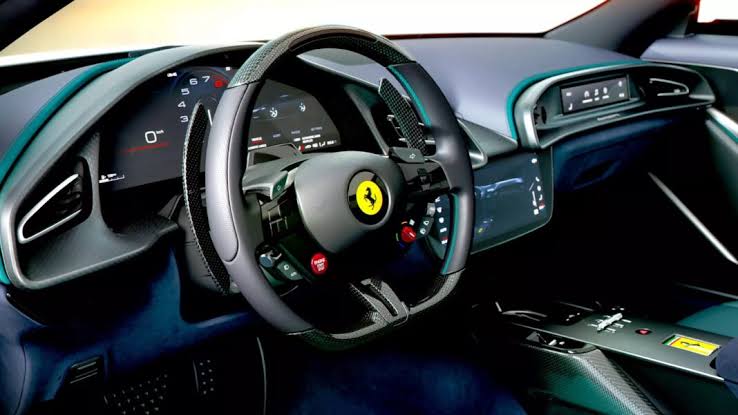
On a Ferrari from the 458 onwards, the steering wheel is not a steering wheel. It’s the car’s primary control surface. It carries the manettino, the engine start button, the indicators, the wipers, the bumpy road button, the LED shift light strip, and on the SF90, 296 and Purosangue, haptic touch controls. When those go dead, the owner accurately reports that the steering wheel has stopped working. The steering itself is perfect.
The clock spring (spiral cable)
Your steering wheel rotates. The wiring to it can’t. The bridge between them is a clock spring — a flat ribbon conductor coiled inside a housing behind the wheel that winds and unwinds through the full lock-to-lock range. It carries the airbag circuit, the horn, and every button and light on the wheel.
It is a wear item. Every turn flexes the ribbon. And in Dubai, cabin temperatures behind a parked Ferrari’s dashboard routinely exceed 70 °C in summer, which embrittles the ribbon’s polyimide substrate and its solder joints. Ribbon cracks; circuits open; buttons die — often intermittently first, often only at certain steering angles.
The tell that confirms it: the airbag warning light is on. The clock spring carries the driver’s airbag circuit, so a broken ribbon almost always sets an airbag fault alongside the dead buttons. If your manettino stopped responding and there’s an airbag light, you can be fairly confident before anyone opens anything.
Why this is not a DIY job on a Ferrari: the clock spring sits behind the airbag module. Removing it involves a pyrotechnic device and a live SRS circuit. Worse, a clock spring must be installed centred — if the column is rotated while the wheel is off, the new part is destroyed on first installation. This is a workshop procedure with the battery isolated and the column locked, and it’s part of what our Ferrari specialists in Al Quoz do routinely.
The steering column control module
Sitting behind the clock spring is a module that multiplexes all those wheel inputs onto the car’s data bus. When it fails, you get the same dead-buttons symptom — but typically all functions at once rather than a few, and typically without the angle-dependent intermittency that points to a clock spring. It’s the more expensive of the two outcomes, and on certain platforms it can take the start function with it.
The electric column adjustment motor
A distinct fault with an overlapping description. You press the column adjustment control and nothing happens — no motor sound, no movement. The wheel steers perfectly; it just won’t move in or out, or up and down. This shows up regularly on the California and its contemporaries. Causes are the motor itself, its drive cable, or the switch pack. Cosmetically annoying rather than dangerous, but it fails an inspection on a resale car and it’s worth fixing before you sell.
The manettino “software glitch” theory
You’ll see other Dubai workshop blogs claim that a manettino software fault can “lock your steering in an unexpected configuration.” Treat that carefully. The manettino changes damper stiffness, traction thresholds, gearshift aggression and — on EPS cars — assist weighting. A genuine manettino fault presents as drive modes not changing, not as loss of steering. If your Race mode feels floaty and Comfort feels heavy, look at the adaptive damper and suspension side before you look at the steering.
4. The wheel is fine. The car isn’t.
The steering wheel turns normally, the assist is there, every button lights up. But the car pulls, wanders, vibrates, sits off-centre, or feels vague. This is a chassis problem being reported as a steering problem.
Off-centre steering wheel
If the wheel sits at 10° while the car goes straight, the alignment is out — and on a Ferrari that’s often not just a toe adjustment. Dubai’s speed bumps, the aggressive ramp angles in Downtown and DIFC car parks, and the constant low-speed kerb-strike risk of a low front splitter all knock geometry out. Correcting it needs a four-wheel alignment set to Ferrari’s factory geometry, not a generic tyre-shop toe-and-go. See our wheel alignment and suspension work.
Critically: after any alignment, rack work, or battery disconnection, the steering angle sensor must be recalibrated. The sensor tells the ABS, ESC and traction systems where straight ahead is. If it’s out, the car’s stability systems fight inputs you didn’t make, and you get warning lights across the dash. Skipping this step is one of the most common reasons a car comes back from a cheap alignment with three new faults it didn’t arrive with.
Vibration through the wheel
Diagnose by speed. Vibration that appears around 90–110 km/h and worsens is wheel balance or a tyre issue. Vibration only under braking is warped discs — see Ferrari brake service. Vibration at all speeds with a knocking element over bumps is worn bushings, ball joints or a hub bearing.
Dubai gives Ferrari tyres a hard time regardless: heat cycling ages the compound faster than tread wear suggests, and a five-year-old Cup 2 with 4 mm left is still a five-year-old tyre. Our Ferrari tyre and wheel service checks manufacture date, not just depth.
Cracked suspension bushings
The most reliable Dubai failure of all. Rubber bushings on the 360, F430, 458 and 599 dry, harden and crack under sustained heat. You feel it as a knock over speed bumps and a general vagueness that owners describe as “the steering feels loose.” It isn’t the steering. It’s the geometry moving under load because the bushings no longer control it.
Rear-wheel steering faults
Overlooked entirely by every competing page. The 812 Superfast, F12tdf, SF90, 296 and Purosangue have rear-wheel steering — Ferrari’s Virtual Short Wheelbase / PCV system — which turns the rear wheels a few degrees to sharpen turn-in and stabilise the car at speed. When a rear-steer actuator or its sensor faults, the car feels wrong in a way that’s genuinely hard to describe: unstable on turn-in, or oddly reluctant. The front steering is perfect. Owners chase the front axle for weeks. If you own an 812 and the handling has changed character without a corresponding front-end symptom, this belongs on the list.
Ferrari steering repair cost in Dubai — indicative AED ranges
Real numbers, because nobody else publishes any. These are typical independent-specialist ranges in Dubai for parts and labour combined. They vary with model, parts tier and what the inspection actually finds — we quote in writing before any work starts.
| Job | Typical AED range | Notes |
|---|---|---|
| Diagnostic scan + road test | 0 – 500 | Often waived if you proceed with the repair |
| AGM battery replacement | 900 – 1,800 | Fixes more “steering faults” than any other item |
| Steering angle sensor recalibration | 250 – 500 | Mandatory after alignment, rack work or battery disconnect |
| Four-wheel alignment to factory geometry | 400 – 900 | Not the same as a tyre-shop alignment |
| Power steering fluid flush (hydraulic cars) | 600 – 1,200 | Correct Ferrari-spec fluid only |
| Tie rod ends / inner rack ends | 1,200 – 3,500 | Alignment required afterwards |
| High-pressure PAS hose | 1,500 – 3,500 | Common 458/488 failure, cheaper than the pump |
| Electric column adjustment motor | 2,000 – 4,500 | Cosmetic urgency, resale relevance |
| Clock spring / spiral cable replacement | 1,800 – 4,500 | Includes SRS handling and airbag light clear |
| Steering lock / ignition barrel (360, F430) | 2,500 – 6,000 | Key and immobiliser sync included |
| Steering column control module | 2,500 – 6,000 | Reman units available on some platforms |
| PAS pump replacement | 4,500 – 9,000 | Flush the system or you’ll do it twice |
| Hydraulic rack reseal / recondition | 6,000 – 12,000 | Viable if the housing and bore are good |
| New hydraulic rack (458 / 488 class) | 12,000 – 25,000 | Parts-led cost |
| EPS rack (812, Roma, SF90, 296) | 25,000 – 55,000+ | Coding and calibration mandatory |
| Rear-steer actuator | 12,000 – 22,000 | 812 / SF90 / 296 / Purosangue |
For context on how our pricing compares generally: a minor service on a 488 starts around AED 2,500 at our workshop against AED 8,000–12,000 at a dealer for the same work. The same gap applies to steering work — the parts cost what they cost, but the labour rate doesn’t have to.
Drive it or flatbed it? A straight answer
| Symptom | Verdict |
|---|---|
| Assist completely gone, wheel very heavy | Flatbed. No exceptions. |
| Assist intermittent — comes and goes | Flatbed. Intermittent is worse than absent; you won’t be ready when it drops. |
| Grinding or metallic noise on lock | Flatbed. Something is failing mechanically. |
| Excessive free play at the wheel before the car responds | Flatbed. |
| Wheel locked, car won’t start | Not drivable. Try the kerb-pressure trick first, then recover. |
| Buttons dead, airbag light on, steering normal | Drivable short-term. Book it — the airbag is not protecting you. |
| Vibration at 100 km/h+ | Drivable at reduced speed. Get it balanced this week. |
| Wheel off-centre, car tracks straight | Drivable. Book an alignment before it eats a AED 6,000 set of tyres. |
| Knocking over speed bumps | Drivable, gently. Bushings and joints. |
| Steering fault light with no change in feel | Scan it before you drive it. Could be voltage, could be the sensor. |
Free collection across Dubai — Marina, Palm Jumeirah, Downtown, Emirates Hills, Dubai Hills, DIFC, Business Bay, Al Barsha — and recovery for non-drivable cars is arranged through our contact desk.
Why Dubai specifically breaks Ferrari steering systems
Not vague “heat and dust” filler. Four concrete mechanisms:
Thermal cycling attacks bonded and flexible components, not metal. The failure sequence here isn’t wear from mileage — it’s a 50 °C ambient, a 90 °C engine bay, then an air-conditioned garage, repeated daily. Rubber rack boots, bushing compounds, hose crimps and the clock spring’s ribbon substrate all age on that cycle, regardless of odometer reading. This is why a 12,000 km Dubai Ferrari can need bushings that a 60,000 km European car doesn’t.
Silica sand is harder than the components it gets into. Once a rack boot cracks, fine sand enters and mixes with grease to form a lapping paste around the inner rack ends. The same sand packs the front axle area from behind, where nobody inspects.
Under-use, not overuse. Most Ferraris in Dubai are second or third cars. Weeks of standing means a battery in permanent partial discharge, seals that dry out without fluid circulation, and modules that log low-voltage faults. The garage-queen ownership pattern is a distinct failure mode, and it drives more steering complaints here than hard driving does.
Speed bumps and ramp angles. Dubai’s residential speed bumps and car park ramps are punishing for a car with 100 mm of ground clearance. Repeated compression at an angle loads the front geometry in ways the factory alignment spec doesn’t anticipate.
Getting the diagnosis right the first time
Three things separate a real Ferrari steering diagnosis from an expensive guess:
The right tool. Ferrari’s own diagnostic platforms — SD3 and Leonardo for the earlier generations — read live steering angle values, EPS torque sensor data, module supply voltages and stored freeze-frame data. A generic OBD reader gives you a P-code and no context. Guessing between a torque sensor, a module and a supply fault costs the difference between AED 500 and AED 40,000.
Sequence discipline. Voltage, then live data, then mechanical inspection, then parts. Reversed, you replace a rack and the fault comes back in three weeks because the battery was the cause all along.
Knowing which Ferrari is in front of you. A 488 and an 812 have almost nothing in common in the steering system, despite overlapping production. Our full model-by-model service breakdown covers each platform individually rather than treating “Ferrari” as one car.
Steering work rarely arrives alone, either. A rack leak often shows up during a suspension inspection; a low battery frequently surfaces during a routine oil service; and vibration blamed on steering turns out to be brakes more often than owners expect. If you’re buying rather than fixing, a proper pre-purchase inspection plus a free UAE VIN check will surface a repaired front-end impact that a test drive won’t.
FAQ — Ferrari steering wheel problems in Dubai
Can I drive my Ferrari with the power steering warning light on? Only if the assist itself is unaffected and you’re going straight to a workshop. If the wheel has gone heavy, or the assist is cutting in and out, don’t drive it — intermittent assist is more dangerous than none, because the moment it disappears is the moment you’re not expecting it. Arrange a flatbed.
Why did my Ferrari’s steering wheel buttons stop working but the steering is fine? Almost certainly the clock spring — the coiled ribbon conductor behind the wheel that carries every button, the horn and the airbag circuit. It’s a wear item, and Dubai cabin heat accelerates the failure. Check whether your airbag warning light is also on; if it is, that’s near-confirmation. Budget roughly AED 1,800–4,500 fitted.
Does my Ferrari have electric or hydraulic power steering? The 812 Superfast (2017) was Ferrari’s first EPS road car. If your Ferrari predates it — 360, F430, 599, California, 458, 488, F12, FF, GTC4Lusso — it’s hydraulic and has fluid. The F8 Tributo carried over the 488’s hydraulic system. The 812, Roma, SF90, 296 and Purosangue are EPS and have no steering fluid at all.
How much does Ferrari steering rack replacement cost in Dubai? A hydraulic rack on a 458 or 488 typically runs AED 12,000–25,000 supplied and fitted. A reseal, where the housing is sound, is AED 6,000–12,000. An EPS rack on an 812, Roma or SF90 starts around AED 25,000 and can exceed AED 55,000, because the part is expensive and it requires coding and calibration after fitting.
My Ferrari’s steering wheel is locked and the key won’t turn. What do I do? Don’t force the key. Apply firm steady pressure to the wheel in whichever direction it has a few millimetres of give, and turn the key at the same time. This releases a loaded steering lock pin — the usual cause when you’ve parked with the wheels turned against a kerb. If it still won’t release, stop; on a 360 or F430 you may be looking at an immobiliser or lock actuator fault instead.
Why does my Ferrari steering feel heavy only at parking speed? Because that’s when assist does the most work. At speed, the steering is light regardless because of the caster effect. Heaviness confined to low speed is the classic early sign of partial assist loss — a failing pump or degraded fluid on a hydraulic car, a torque sensor or voltage issue on an EPS car. It rarely stays partial.
Do I need a steering angle sensor calibration after changing my battery? Frequently, yes. On many Ferraris the sensor loses its learned centre position when power is removed, and the car throws steering, ABS and ESC faults until it’s recalibrated with a scan tool. If you’re replacing a battery yourself, use a memory saver — or budget AED 250–500 for the recalibration afterwards.
My steering wheel won’t adjust up or down anymore — is that serious? Not safety-critical, but it’s a real fault. It’s usually the electric column adjustment motor, its drive cable, or the switch. Common on the California and its contemporaries. Fixing it costs roughly AED 2,000–4,500 and matters more than you’d think at resale time.
Is it worth going to a specialist rather than a general luxury garage? For steering, yes — decisively. The gap between a torque sensor fault, a control module fault and a low-voltage cascade is invisible without a tool that speaks Ferrari’s own protocols, and the wrong call is a five-figure mistake. A workshop that services 488s and 812s weekly has seen your fault before.
Book a Ferrari steering diagnosis in Al Quoz
Carzilla Auto Service is an independent Ferrari specialist garage in Al Quoz Industrial Area 2, Dubai, with ten years on Italian exotics, Ferrari SD3 and Leonardo diagnostics, and genuine parts through verified European supply. We diagnose properly, quote in writing before touching anything, and pick your car up from anywhere in Dubai free of charge.
Call 056 684 9665 or message us on WhatsApp with your model and the symptom — heavy wheel, dead buttons, locked column, or a car that’s just steering wrong — and we’ll tell you what we think it is before you bring it in.
More reading: Ferrari repair Dubai · car steering repair · Ferrari engine repair · Ferrari transmission repair · Ferrari AC repair · gearbox repair · tyre services · RTA vehicle inspection