There is a moment familiar to almost every Mercedes owner in this city. The damage is done — a bumper scuffed on a basement pillar, a wing folded on Al Khail Road, a door creased in a mall car park — and the search begins. Within an hour you have five phone numbers, four WhatsApp quotes, and a growing suspicion that every workshop in Al Quoz is telling you the same thing in the same words.
They are. And that is the problem, because behind the identical language sits an enormous range of actual capability. Some of the units on those industrial streets can rebuild an aluminium S-Class shell to factory tolerance. Others are excellent panel shops that have never opened a Mercedes with a high-voltage battery in the floor and do not know what they do not know.
This guide is written for the owner trying to tell the two apart. It covers what makes a modern Mercedes-Benz genuinely harder to repair than the car parked next to it, what a properly equipped body shop looks like from the inside, how paint and sensor calibration actually work, what the process costs in Dubai, and how the insurance and police paperwork fits together. By the end you should be able to have an informed conversation with any workshop in the emirate — which is the real defence against paying twice for the same repair.
Why Al Quoz Became Dubai’s Body Repair District
Al Quoz Industrial Areas 1 through 4 hold the densest concentration of automotive workshops in the UAE. The reasons are practical: warehouse-scale units, industrial zoning that permits spray booths and paint storage, and a location wedged between Sheikh Zayed Road and Al Khail Road that puts most of Dubai within twenty minutes.
That density is genuinely good news for owners. It creates competition, it keeps specialists close to their parts suppliers, and it means you can physically visit four workshops in an afternoon rather than relying on websites. Almost every European and exotic marque in the city is serviced somewhere in those few square kilometres, and the concentration of skill is real.
The catch is variance. The same street can hold a workshop with a dedicated aluminium repair bay and calibrated measuring equipment, and a workshop whose primary tool is filler. Both will describe themselves as a Mercedes specialist. Neither is lying in any way you could prove. The distinction lives in equipment, procedure and training — none of which appear on a signboard.
So the question is not where to look. It is what to look for once you get there.
What Makes a Mercedes Different From Any Other Car on the Ramp
The single most useful thing an owner can understand is that a modern Mercedes-Benz is not made of one material. It is a deliberate mixture, engineered so that different parts of the car behave differently in a collision — and each of those materials has its own repair rules.
Steel, Aluminium and the Panels That Must Never Be Heated
Look at a current C-Class or E-Class and you are looking at a steel-intensive structure built around a safety cell of press-hardened boron steel, with aluminium bonnet, wings and often doors hung onto it. Boron steel gets its extraordinary strength from a heat-treatment process during manufacture. Reheat it in a workshop — with a torch, with a heat gun, with prolonged welding — and that strength is permanently destroyed. The metal looks fine. It simply will no longer do its job in the next impact.
For this reason, Mercedes specifies that boron sections are replaced at defined factory cut points rather than straightened or pulled. A workshop that treats a B-pillar as ordinary steel and heats it back into shape has produced a car that looks repaired and is structurally compromised. This is invisible to the owner, invisible at resale, and only revealed by a second accident.
Aluminium brings a different set of rules. Unlike steel, aluminium has no shape memory: it does not want to return to where it was, so it cannot simply be pushed out. It is drawn back with glue-pulling or stud-welding systems, and it loses temper if it gets too hot. It also cannot share a workspace with steel. Steel dust settling on bare aluminium sets up galvanic corrosion, which typically appears eighteen months to two years later as bubbling beneath perfectly good paint. This is why a serious body shop keeps a physically separated aluminium bay with its own tools and its own extraction — not as a luxury, but because the alternative fails.
Why Your Model Changes the Answer
How much of this applies depends entirely on what you drive.
An S-Class (W223) or Maybach is aluminium-intensive through the shell, joined substantially with self-piercing rivets and structural adhesive rather than welded. Repairing one properly requires equipment a general panel shop simply will not own.
A C-Class, E-Class, CLA or CLS is the mixed case described above — steel structure, boron safety cell, aluminium closures. The risk here is a workshop that does not know which panel is which.
The GLC, GLE and GLS add a heavy sensor load in the bumpers and mirrors on top of mixed-material construction, which makes the electronics side of the repair as important as the metalwork.
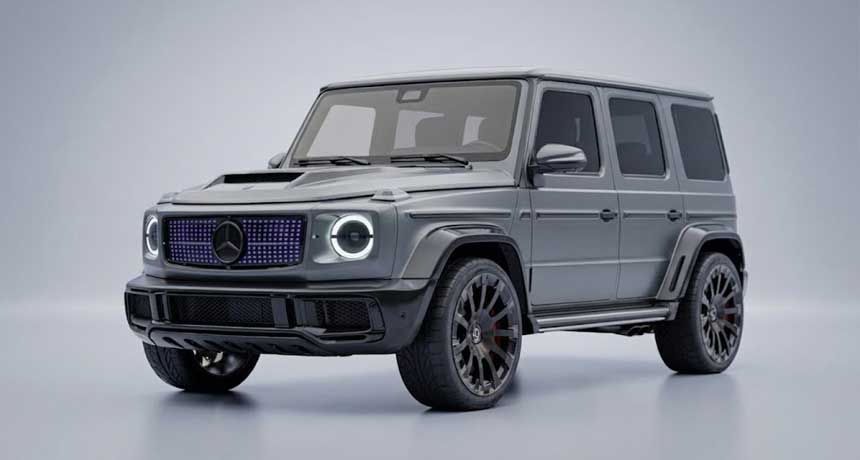
A G-Class (W463A) is a different animal altogether — body-on-frame, with a steel ladder chassis and a separate body. Chassis damage and body damage are measured and corrected as two distinct tasks, and a shop without chassis measuring capability cannot honestly quote a structural G-Wagon repair.
The EQS, EQE and other EQ models sit on a dedicated electric architecture with a large high-voltage battery mounted in the floor. Any welding, grinding or heat near that floor requires a documented high-voltage isolation procedure and a technician trained to perform it. Any underbody impact requires the battery to be inspected, not assumed to be fine.
And an AMG GT or SL built on the AMG aluminium spaceframe is specialist work by any standard, with castings, extrusions and defined section-replacement limits. Very few workshops in Al Quoz are genuinely equipped for structural repair on one, and the honest ones will tell you so rather than take the job.
Carzilla works across all of these through our Mercedes-Benz repair workshop in Dubai, with dedicated pages for the S-Class, E-Class, GLE, GLS, GLC, GL, CLS, CLA, G-Class and C63 AMG.
What a Properly Equipped Mercedes Body Shop Looks Like Inside
Photographs on a website tell you nothing, but fifteen minutes inside a workshop tells you a great deal — provided you know what you are looking at.
The first thing worth noticing is whether aluminium work happens somewhere separate. In a well-run shop this is obvious: a partitioned area, its own extraction, its own set of tools that never cross to the steel side. In a shop that has not thought about it, everything happens on the same bench with the same grinder.
The second is measuring equipment. Structural repair means bringing a body back to factory dimensions, and dimensions have to be measured, not judged. A bench or jig with electronic or laser measuring is the equipment; the better sign is a workshop that keeps before-and-after measurement printouts from previous jobs and is happy to show you one. Documentation is a habit, and habits are what you are actually buying.
The spray booth deserves a look as well. What you want is a downdraught booth with clean filters and a working bake cycle — and a shop that gives you a different answer for aluminium and composite panels, which need a lower-temperature, longer cure than steel. A booth being used for storage is a booth that is not being used for painting.
It is also worth asking to see a car mid-repair rather than a car in the delivery bay. Finished vehicles are marketing. A car in primer shows you the work nobody polishes: clean masking, properly feathered sanding edges, seam sealer applied to the original profile, no overspray creeping onto adjacent trim. That is where quality lives.
Two smaller things carry more weight than they appear to. A paint depth gauge sitting on the bench means someone measures what they are spraying over — and can tell you whether a panel has been painted before, which matters at resale in a market where buyers arrive with gauges of their own. And a diagnostic laptop matters because a body shop that cannot read and clear fault codes cannot verify its own work.
Finally, notice who answers your technical questions. If a technician or the foreman talks to you directly, you are in a workshop where knowledge sits close to the customer. If everything routes through a salesperson who leaves the room to check, that will be your entire experience of the repair.
You are welcome to walk our own facility at 20 C Street, Al Quoz Industrial Area 2 — the auto body shop and car painting workshop are open to inspection before you commit to anything.
Mercedes Paint Matching in Dubai: Why Your Colour Code Isn’t One Colour
Paint is the part owners underestimate most, and it is where the difference between an acceptable repair and an invisible one is decided.
Every Mercedes has a paint code recorded on its data card — obsidian black, selenite grey, cavansite blue, diamond white bright. What surprises people is that the code is a starting point rather than an answer. Manufacturers run multiple production variants of the same code across model years and plants. Obsidian black on a 2016 GLE and obsidian black on a 2023 GLE are not guaranteed to be the same chip. Sun exposure then moves the target again: a seven-year-old panel in Dubai has faded, however slightly, and the new paint has to match the car as it is today, not as it left Sindelfingen.
The process that handles this properly has three steps. The code comes from the VIN data card rather than a chart. A spectrophotometer reading is taken from your actual panel to find the right variant. Then a spray-out card is mixed and checked against the car in daylight before anything is sprayed onto the vehicle. “Our painter has a very good eye” is the answer that produces a bumper reading as a slightly different car from ten metres away.
Metallics, Multi-Stage Finishes and Why Blending Is Not a Shortcut
With solid colours, the job is relatively simple — basecoat and clear. Metallics and micas are harder, because their appearance depends on how the metallic flake lies in the film, and that is a function of spray technique. Get it slightly wrong and the panel reads darker or lighter than its neighbours at certain angles.
This is why blending into adjacent panels is standard practice on metallic repairs rather than a cost-saving trick. Spraying a single panel edge-to-edge and stopping at the shut line almost always produces a visible boundary. A repair that blends into the neighbouring doors is doing more work, not less, and it should appear on the quote as such.
Multi-stage and tri-coat finishes such as diamond white bright add a translucent mid-coat between base and clear — and the thickness of that mid-coat changes the final colour. That makes a let-down card mandatory rather than optional and adds meaningful labour. MANUFAKTUR and designo special finishes can add days simply in sourcing and mixing.
The One Finish That Cannot Be Polished
Magno matte finishes on AMG models are the absolute case. Matte clearcoat cannot be polished, buffed or spot-repaired, because polishing it creates a permanently shiny patch that cannot be reversed. Any workshop that offers to buff a scratch out of a magno panel has told you, without meaning to, that it has never worked on one. Matte damage is repaired by respraying the full panel or section — every time, without exception.
If your car wears paint protection film or a wrap, that comes off before the repair and goes back on only once the new paint has finished outgassing. For a colour change that leaves the original paint untouched, peelable paint is the reversible route, and our detailing and protection team can schedule film work around the cure window.
ADAS Recalibration: The Step Behind Your Bumper That Gets Skipped
If your Mercedes was built in the last decade, its front bumper is not just a cover. Behind it sits the forward radar. In the corners sit short-range radar units for blind-spot and cross-traffic monitoring. Parking sensors pierce the face of it. On many models a surround-view camera lives in the grille, and another sits behind the windscreen.
Removing and refitting those components shifts their aim by fractions of a degree — which is more than enough for DISTRONIC, active brake assist, lane keeping and blind-spot monitoring to start behaving incorrectly. Recalibration is not an upsell. It is the step that makes the car’s safety systems true again.
It is skipped often, because nothing visible goes wrong when you skip it. The car looks perfect. It simply stops seeing properly, and the fault surfaces weeks later as an intermittent warning nobody connects back to a bumper job.
There is one Mercedes-specific detail worth knowing. On many models the forward radar sits behind the star emblem or a grille panel that is radar-transparent by design. Respray that cover with ordinary metallic paint, or replace the emblem with a cheap aftermarket item, and the radar signal is attenuated. The result is intermittent DISTRONIC faults with no obvious cause.
Air suspension adds an ordering requirement. On AIRMATIC and E-ACTIVE BODY CONTROL cars, ride height must be set to specification before wheel alignment and before any camera or radar calibration, because every calibration target is referenced to how the car is sitting. Do it in the wrong order and the calibration is void. Our Mercedes suspension repair team handles that alongside body work.
One item here is not negotiable at all. Any deployed airbag, pyrotechnic belt tensioner or active bonnet is single-use hardware, and the airbag control unit stores crash data — it is replaced, not reset. A workshop offering to “clear the airbag light” is offering to sell you a car whose restraint system will not deploy. Walk out.
A competent shop runs a full diagnostic scan before the repair and again afterwards, and gives you both. Both are standard on every body job through our Mercedes repair workshop in Dubai.
What a Fair Mercedes Body Repair Quote Includes
Most disputes between Dubai workshops and owners trace back to a quote that said “Mercedes body repair — AED 6,500” and nothing more. A single number gives you nothing to hold anyone to, and it gives the workshop unlimited room to move.
A quote worth signing breaks the work down panel by panel, so you can see what is being repaired and what is being replaced. It names part numbers and states whether parts are genuine, OE-supplier or aftermarket — there is a legitimate place for quality aftermarket panels on an older car, but you should be told which you are getting and see it reflected in the price. It states the paint code and the finish type, because a multi-stage or matte finish costs materially more to reproduce than a solid colour. It names the adjacent panels being blended into. It includes a calibration line naming the sensors involved. And it accounts for seam sealer and cavity wax, because panel replacement removes factory corrosion protection and reapplying it is real work that cheap quotes silently delete.
Finally, it states a warranty term — on paint and on workmanship separately — along with what voids it.
There is one conversation worth preparing for in advance. Once a damaged car is disassembled, workshops frequently find damage that was not visible from outside: a cracked impact bar behind an intact bumper cover, a bent radiator support, a broken sensor bracket. This is called supplementary damage, and it is normal. What matters is how it is handled. You should receive photographs of what was found, a revised written quote, insurer approval where a claim is involved, and your explicit sign-off — all before the additional work begins. A revised number delivered as a phone call with no photographs is the point at which to slow everything down.
Carzilla quotes a fixed price agreed before work starts, after a free inspection, with free pickup and delivery across Dubai. You can arrange either through our contact page or on 056 684 9665.
Insurance, Police Reports and the Order Things Happen in Dubai
The paperwork sequence in the UAE is unforgiving, and getting it right at the start prevents an argument later.
Everything begins with the police report. Dubai Police issue a colour-coded accident report — green where you were not at fault, red where you were — and no insurer will process a claim without it. Report through 999 or the Dubai Police app, and leave the vehicles where they are unless the damage is minor and they are obstructing traffic.
There is a detail here that catches owners out. Recovery drivers in Dubai often receive referral fees for delivering damaged cars to particular workshops, which means the truck that arrives is not neutral. You are entitled to nominate the destination, and if you have not chosen a workshop yet, sending the car to secure parking is better than accepting a roadside recommendation.
Your policy then determines the path. Newer vehicles — commonly within the first two to three years — often carry agency repair cover, which sends the car to the authorised Mercedes-Benz body shop and buys you dealer documentation and factory process. Beyond that window, most policies direct you to an approved garage network instead. It is worth asking your insurer directly whether a particular workshop, including ours, sits on their approved list before the car goes anywhere.
Whichever path applies, notify the insurer before repairs begin, understand your excess including any age or driver loading, and photograph the car thoroughly before it leaves you — all four corners at an angle, each damaged panel straight on, the odometer, the interior, and any pre-existing damage.
Two related points. If the registered colour changes as part of the work, that change must be recorded on the Mulkiya through the proper RTA process; our guide to car modification rules in Dubai covers it, and the RTA testing centre page covers re-registration inspection. And after significant structural work, an independent car inspection before you accept delivery is money well spent — as is a VIN check if you are on the other side of this, buying a used Mercedes whose history feels incomplete.
How Long the Work Should Take
Speed is the most common false economy in body repair, because the parts of the job that cannot be rushed are exactly the parts you cannot see.
A single-panel cosmetic repair generally takes two to four days including cure time. Bumper work involving sensor removal and recalibration usually runs three to five days. Structural repairs — where parts have to be ordered, dimensions measured and multiple systems recalibrated — commonly take two to four weeks, and a shop that quotes dramatically less is either not doing the measuring or not doing the calibration.
Anyone promising same-day panel paint is compressing preparation, bake or cure. Those three stages determine whether the finish is still on the car in three years.
What Mercedes Body Repair Costs in Al Quoz, Dubai
These are realistic market bands for planning. Actual cost depends on model, finish, parts tier and what disassembly reveals — which is precisely why a free physical inspection is more useful than a WhatsApp photo estimate.
| Repair | Indicative cost (AED) |
|---|---|
| Paintless dent repair, one panel, paint intact | 250 – 800 |
| Single panel respray, solid or metallic | 500 – 1,200 |
| Bumper respray including sensor removal and refit | 600 – 1,500 |
| Multi-stage or designo panel respray | 1,200 – 2,500 |
| Magno matte panel or section respray | 2,000 – 4,500 |
| Genuine bumper replacement, painted and fitted | 3,500 – 9,000+ |
| Aluminium panel replacement (W223, AMG GT, SL) | 3,000 – 8,000 per panel |
| Structural correction on a measuring bench | 4,000 – 15,000 |
| ADAS recalibration, static and dynamic | 600 – 2,000 |
| Windscreen replacement with camera calibration | 2,500 – 8,000 |
| Full respray, sedan, single-stage colour | 12,000 – 25,000 |
| Full respray, large SUV or multi-stage / matte finish | 20,000 – 45,000 |
A quote sitting well below these bands is rarely a better deal. It is usually the same quote with calibration, blend panels, seam sealer or genuine parts quietly removed from it.
Collecting the Car, and the First Ninety Days
Do not accept the car inside the workshop. Take it outside into daylight and give it a proper ten minutes.
Crouch at each corner and sight along the panel at a shallow angle — ripples, waves and orange peel only reveal themselves at around 45 degrees and are invisible head-on. Run a fingertip along the shut lines to check panel gaps are even end to end and match the undamaged side of the car. Open the doors, bonnet and boot and look into the shuts and jambs; colour that stops neatly at the visible edge suggests a panel sprayed in place without proper preparation. Check for overspray on rubber seals, glass edges and arch liners. Then drive it for half an hour at mixed speeds and pay attention to wind noise, warning lights, any pull under braking, and whether the driver-assistance systems behave as they did before.
Raise anything you find before you take the keys. Everything is easier to resolve while the car is still in the workshop’s hands.
The repair is not finished when you drive away, either. Fresh paint continues releasing solvent for weeks. Hand wash only for the first month, with a thorough pre-rinse before anything touches the surface, and no machine polishing for at least thirty days. Most importantly, wait thirty to ninety days before applying paint protection film or a ceramic coating — sealing paint that is still outgassing traps the solvent underneath and causes hazing, clouding and adhesion failure.
Keep the invoice and the paint code with the car’s documents. In the UAE’s inspection-heavy used market, a documented repair history is worth considerably more than an undocumented perfect finish.
Since the car is already apart, this is also the natural moment to address anything that shares the same disassembly — interior and upholstery restoration, carbon fibre components, body kits or wider exterior modification.
Frequently Asked Questions
How do I find the best Mercedes-Benz body shop in Al Quoz, Dubai? Start by finding out what your car’s body shell is made of, since that determines which workshops are even eligible. Then visit in person and look for a separate aluminium bay, measuring equipment with documentation, a properly maintained spray booth and direct access to a technician. Finally, insist on an itemised quote naming panels, parts, paint code, blend panels and calibration.
Will using an independent body shop void my Mercedes warranty? Not automatically. UAE right-to-repair norms allow you to use a qualified independent workshop provided the procedure is correct, the parts are appropriate and the work is documented. Keep every invoice. Whether your insurance policy entitles you to agency repair is a separate contractual question worth checking in the wording.
Can any body shop repair an aluminium Mercedes? No. Aluminium has no shape memory, loses temper when overheated, and corrodes galvanically when steel particles settle on it. Proper repair requires a physically separated bay with dedicated tools. Ask to see that bay before booking.
How much does Mercedes bumper repair cost in Dubai? A respray including sensor removal and refit typically runs AED 600–1,500. A genuine painted replacement bumper is usually AED 3,500–9,000, more on AMG trim. Add AED 600–2,000 where radar or camera recalibration is required.
Why does my Mercedes need calibration after bumper work? Because the forward radar, corner radars, parking sensors and often a camera sit in or behind the bumper. Refitting them changes their aim by fractions of a degree, which is enough to affect DISTRONIC, active brake assist and blind-spot monitoring.
Can a magno matte AMG panel be spot-repaired? No. Matte clearcoat cannot be polished, buffed or blended without creating a permanent shiny patch. It is always a full-panel or full-section respray.
The workshop found more damage after taking the car apart. Is that normal? Yes — supplementary damage is discovered at disassembly rather than predicted from outside. What should accompany it is photographic evidence, a revised written quote, insurer approval where relevant, and your explicit approval before work continues.
Should I use the authorised dealer body shop instead? The dealer makes most sense for in-warranty vehicles, agency-repair insurance policies, and structural damage on aluminium-intensive or electric platforms. A properly equipped independent makes sense for cosmetic to moderate damage, out-of-warranty cars and faster turnaround — provided it meets the standards described in this guide.
When can I apply PPF or ceramic coating after a respray? Thirty to ninety days. The paint is still outgassing before then, and sealing it early causes hazing and adhesion failure.
Bringing It Together
Choosing a Mercedes-Benz body shop in Al Quoz, Dubai comes down to a small number of things that are entirely knowable. Find out what your car’s body is made of. Visit the workshop rather than the website. Ask how the colour will be matched and how the sensors will be recalibrated. Read a quote that has been broken into parts. And look at the car in daylight before you accept it.
None of that requires technical expertise — only the willingness to ask specific questions and notice whether the answers are specific in return. Workshops that do this work properly are, in our experience, glad to be asked.
If you would like a second opinion on a quote or an inspection before you commit, Carzilla Auto Repair is at 20 C Street, Al Quoz Industrial Area 2, Dubai. Call 056 684 9665 or 800-CARZILLA (800-2279 4552), or email info@carzillauae.com. Inspection is free, pickup and delivery across Dubai is free, and the price is fixed before any work begins.
You can read more on our Mercedes-Benz workshop page, browse the full services index and specialisations, learn more about us, or follow our detailed walkthrough of rebuilding a crash-damaged luxury sedan back to standard on the Carzilla blog. Clients outside the city can also visit our Abu Dhabi page.