A Maserati’s cooling fan is engineered to a European reference climate, and Dubai isn’t one. Ambient temperatures that regularly pass 45°C, engine bays that trap radiant heat off the asphalt, and long idling stretches in summer traffic push the fan far past the duty cycle it was designed for. When it can’t move enough air through the radiator and condenser stack, coolant temperature climbs, the cabin AC weakens, and the engine itself is eventually at risk. This guide explains why Maserati cooling fans lose that fight in UAE heat, what actually fails, how it’s fixed, and how to stop it happening again.
How the Maserati Cooling Fan System Works
Every modern Maserati relies on an electric cooling fan controlled by the engine’s own computer rather than a simple on/off switch — from the Ferrari-built naturally aspirated V8s in the GranTurismo, GranCabrio, Coupé and Spyder, to the 3.0-litre twin-turbo V6 in the Ghibli, Levante and Quattroporte. Fan speed is varied by a control module using coolant temperature, AC refrigerant pressure and vehicle speed as inputs. On the turbocharged cars, the same front-end stack also pulls air through an intercooler, so the fan does more total heat-rejection work per hour of driving than on a naturally aspirated model of similar size. Because these engines share their DNA with the Italian performance benches our Ferrari repair and Lamborghini repair teams work on daily, the underlying cooling logic is familiar territory for our technicians.
This variable-speed design copes fine in Italy. In Dubai, the fan is almost never at rest — ramping to maximum in traffic, at idle, and even after the engine is switched off, since most of these cars run an after-run cooling cycle to protect the turbo from heat soak.
Why the Fan Falls Behind in Dubai Conditions
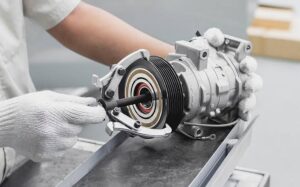
Worn fan motor brushes and bearings. Electric fan motors are consumable parts. As brushes wear and bearings loosen, the motor’s maximum achievable RPM drops even though it still spins. A fan running at 80% of its rated speed goes unnoticed in mild weather but becomes the deciding factor at 45°C ambient with the AC on full — one reason our Maserati AC repair team treats fan output as part of any climate-control complaint, not a separate issue.
Fan control module or relay overheating. The module commanding fan speed sits in an already hot engine bay. Repeated exposure to underhood temperatures well above its design rating causes internal drift, so it either delays the high-speed command or caps output below what the ECU is actually requesting.
Sand and dust packing the radiator and condenser core. Dubai’s fine sand works its way into the front-end stack from behind the bumper and settles between the radiator and AC condenser fins. Even a fan in perfect mechanical condition can’t pull enough air through a core that’s 30–40% blocked.
AC condenser load stacked onto the engine fan. The cooling fan doesn’t just cool the engine — it’s also responsible for pulling air through the AC condenser at low speed and idle. A system running with excess refrigerant or a marginal condenser adds heat load the fan has to reject on top of its engine-cooling job, which is exactly why our workshop’s own experience shows AC and climate weakness is the single most common Maserati complaint in the UAE.
Coolant that’s low, old, or trapped with air. Coolant that hasn’t been changed on a heat-cycle-adjusted schedule loses corrosion inhibitors and heat-transfer efficiency, so the fan ends up trying to cool a system already running hotter than it should. This is separate from — but related to — the well-documented plastic thermostat housing on the 3.0L V6, which warps and develops hairline cracks under heat cycling and seeps coolant slowly, often blamed on a hose before the housing itself is found. Our Maserati engine repair team pressure-tests the full cooling circuit before condemning any single part.
Faulty coolant temperature sensor. A sensor reading low causes the ECU to command the fan later and slower than the engine actually needs, letting temperature spike before the fan responds.
Damaged or missing fan shroud. The plastic shroud directs airflow through the radiator core. A cracked or missing shroud lets the fan spin at full speed while much of that air escapes around the radiator instead of through it.
Warning Signs Worth Acting On
- Temperature gauge climbing in stationary traffic or at idle, then dropping once moving
- AC blowing noticeably warmer in slow traffic than on the highway
- Fan audibly running at full speed constantly, including after the engine is switched off
- A coolant or check-engine warning appearing specifically on hot afternoon drives
- A sweet coolant smell from the front of the car after a drive
If any of these show up alongside stiffer or uneven ride height, it’s also worth having the Maserati suspension repair team take a look at the same visit, since heat-soaked engine bays and heat-soaked air suspension compressors often surface together on the same hot week.
How Carzilla Diagnoses a Cooling Fan Fault
A proper diagnosis reads the commanded fan duty cycle directly from the ECU and compares it against the fan’s actual current draw and RPM, rather than guessing from a generic code reader. From there, the front-end stack is inspected for sand and debris, the coolant is pressure-tested against its correct specification, and the AC system’s refrigerant charge is checked separately — because a cooling complaint that starts in the AC circuit needs an AC fix, not a fan replacement. Our Maserati specialists run this full sequence at our Al Quoz workshop before recommending any part.
Typical Repair Costs
| Repair | Indicative Cost (AED) |
|---|---|
| Diagnostic scan and fan current-draw test | 300 – 600 |
| Radiator/condenser stack cleaning | 400 – 900 |
| Fan motor replacement | 1,800 – 4,500 |
| Fan control module or relay replacement | 1,200 – 3,000 |
| Coolant flush and refill | 500 – 1,200 |
| AC condenser service (if the AC load is the root cause) | 1,500 – 4,000 |
Preventing Cooling Fan Failure Before Next Summer
- Have the radiator and condenser stack cleaned before peak summer as part of a general car AC check, not after symptoms appear
- Follow a coolant change interval based on Dubai’s heat-cycling rather than the manufacturer’s temperate-climate mileage figure, and pair it with your regular Maserati oil change visit
- Book a pre-summer car inspection that specifically checks fan current draw and coolant condition, not just fluid levels
- Address any AC performance drop immediately rather than living with it, since it adds hidden heat load to the cooling system
- Avoid long idling in direct sun where it can be avoided — heat soak accelerates wear on both the fan motor and its control module
Which Models Feel This First
The 3.0-litre twin-turbo V6 cars — Ghibli, Levante and Quattroporte — carry the heaviest cooling load because of the added intercooler duty, and tend to show symptoms earliest in Dubai traffic. The naturally aspirated V8 cars, including the GranTurismo, GranCabrio, Coupé, Spyder and Pininfarina, are less exposed but not immune once the fan motor itself has aged.
If your Maserati is running hot in traffic or blowing warm air at idle, it’s worth having the fan, coolant system and AC checked together rather than replacing parts one at a time. Our team at Carzilla’s Maserati garage diagnoses the full cooling circuit in one visit — alongside related work like transmission service, brake repair and general engine repair — at our Al Quoz Industrial Area workshop.