A Rolls-Royce does not ride the way it does because of clever springs. It rides that way because the car is constantly rebuilding its own stance — measuring each corner, adding air, releasing air, and adjusting damping many times a second. When a leak enters that system, the car does not fail all at once. It quietly starts working harder to hide the problem, and by the time the ride is obviously wrong, the leak has usually already taken the compressor with it.
This guide explains what an air suspension leak looks like on a Rolls-Royce in everyday driving, why these leaks happen, how they are properly repaired, and what genuinely prevents them.
How a Rolls-Royce Air Suspension Holds the Car Up
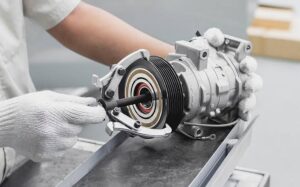
Every corner of the car carries an air spring — a reinforced rubber bellows that rolls over a piston as the wheel moves. Air pressure inside that bellows carries the weight of the car. A compressor, usually mounted with a small dryer cartridge, makes that air. A valve block routes it to individual corners, and ride-height sensors mounted between the body and the suspension arms tell the control module exactly where each corner is sitting.
The details vary by model. A Phantom, Ghost, Wraith, Dawn or Cullinan uses air springs with electronically controlled dampers, and the newer cars on the aluminium spaceframe add camera-assisted road reading and 48-volt anti-roll control on top of the air system. What matters for leak diagnosis is the same across all of them: the car self-levels continuously, so it will mask a small leak for months before you notice anything.
The Overnight Sag: The First Sign Almost Everyone Misses
The earliest and most reliable warning sign of a Rolls-Royce air suspension leak shows up when the car has been parked for a night or a weekend.
Walk out to the car in the morning and look at it from twenty feet away before you unlock it. A healthy car sits level and even. A car with a leaking air spring sits noticeably lower on one corner, or squats at the back, or drops its nose. Then you start the engine, the compressor runs for a long time, and the car lifts itself back to normal — which is exactly why owners dismiss it. The car “fixed itself,” so nothing seems wrong.
Nothing fixed itself. The car simply spent compressor life covering a leak. If a Rolls-Royce is sitting differently after a long park, the system already has a hole in it.
What a Slow Leak Sounds and Feels Like
Beyond the overnight sag, there are four everyday symptoms worth knowing.
A compressor that runs too often or too long. Air suspension compressors are designed for short cycles. When you can hear a faint motor running under the car after starting up, or running again at traffic lights, it is refilling something that will not hold. Extended running builds heat, and heat is what eventually kills the compressor — the leak is the cause, the compressor failure is the bill.
A hiss you can hear when the cabin is silent. Rolls-Royce cabins are unusually well isolated, so a leak that would be inaudible in another car can sometimes be heard with the windows down in a quiet garage, usually near a wheel arch.
A ride that has quietly turned firm or unsettled. Low pressure in one corner changes how the car deals with joints and speed bumps. Owners describe it as the car losing its float, thumping over expansion joints, or feeling like it leans oddly on one side through roundabouts.
Slow response after start-up. If the car takes an unusually long time to reach normal ride height, or refuses to lift to the higher setting at all, the system is either short of air or has already restricted itself to protect the compressor.
Warning Messages, and What They Actually Mean
Most Rolls-Royce models will eventually put a chassis or suspension message in the instrument cluster and drop the car into a protective mode — often described as reduced ride height, or an instruction to drive moderately.
That message is a late-stage event, not an early one. The control module tolerates a great deal of correction before it complains. By the time it displays a fault, it has usually logged a corner that will not hold pressure, a compressor that exceeded its run-time limit, or a height sensor reading that does not agree with the others. It is also why a proper fault-code read matters more than a visual guess: the stored data shows which corner is losing air and how hard the compressor has been working, which is the difference between replacing one air spring and replacing an entire system. Our broader look at professional engine and chassis diagnostics on modern cars explains why that data layer matters on cars this complex.
Where Rolls-Royce Air Suspension Leaks Usually Start
Leaks are rarely mysterious. They come from a short list of places.
The rubber bellows itself is the most common source. It fails where it folds — a hairline crack in the rolling lobe that opens under load and closes at rest, which is exactly why the car can sag overnight yet behave normally on the move.
Next are the air line connections. The system uses nylon lines with push-fit collet fittings, and those fittings leak when they are disturbed, when the line has been nicked during other work, or when the plastic has aged.
Then there is the valve block, where internal seals allow air to bleed between circuits or back out to atmosphere. This is the failure that produces the classic “one corner down, and nobody can find the hole” case.
Finally, the compressor’s own outlet seals and dryer cartridge can leak. A saturated dryer is important for another reason: once it stops absorbing moisture, damp air circulates through the valve block and struts, and corrosion follows.
Why Dubai Conditions Are Hard on Air Springs
Air suspension in the UAE ages differently from air suspension in Europe. Sustained heat and UV exposure drive plasticisers out of the bellows rubber, so it loses flexibility and cracks earlier in its life. Fine silica dust settles into the rolling fold and acts like a mild abrasive every time the wheel moves. Coastal humidity saturates the compressor dryer faster than a dry inland climate would. And a car that spends the summer parked — very common with Rolls-Royce ownership here — holds one fold position for months, which sets a crease in the rubber that becomes a leak the first time it is driven.
None of that is a design flaw. It is simply why an air spring that might last a decade elsewhere often needs attention sooner here, and why long-term Rolls-Royce maintenance in Dubai is planned around heat and storage rather than mileage alone.
How a Workshop Confirms the Leak
A credible diagnosis is not a mechanic pressing down on the corner of the car. It follows a clear order.
Battery voltage is checked first, because low voltage on its own produces levelling faults that mimic a leak. The system is then read with the correct diagnostic platform, and live corner pressures and ride-height sensor values are compared. The car is raised, pressurised, and the individual corners are isolated at the valve block to see which circuit bleeds down. Soapy solution over the bellows, fittings and valve block finds the physical leak, and a static pressure-hold test over time confirms the repair afterwards.
That last step matters. A leak that takes eight hours to show itself will not be proven fixed by a ten-minute test drive.
What the Repair Involves
For a cracked bellows, the correct fix is a new air spring or complete strut assembly for that corner. On models where the damper and air spring are a single electronically controlled unit, that means replacing the assembly rather than just the rubber. Fitting an air spring in isolation on a car with a badly worn opposite corner is usually a false economy, since both sides have aged in the same climate for the same number of years.
If the compressor has been running long cycles to cover the leak, it needs to be assessed honestly rather than optimistically — replacing the leaking spring while leaving a heat-damaged compressor in place is the single most common reason an owner is back within a few months. The dryer cartridge is replaced with it.
Valve block and line repairs are cheaper but demand care: fittings must be cut square and seated fully, or the repair becomes the next leak.
Finally, ride height must be recalibrated after any component is replaced, with the car level and the specified reference measurements taken at each corner. Skipping calibration leaves the car sitting slightly wrong, which shows up later as uneven tyre wear, incorrect headlight aim and, on cars with camera or radar systems, unhappy driver-assistance calibration. Our Rolls-Royce suspension repair work always ends with that calibration step, not the bolt-up.
A word on coil-spring conversion kits: they exist, they are cheaper, and on a Rolls-Royce they remove the exact quality the car was engineered around. They also confuse the control module, which still expects to level a car it no longer controls. For a car in this class, it is the wrong answer.
How to Prevent Air Suspension Leaks
Prevention here is mostly attention rather than expense.
Look at how the car sits before you drive it, especially after a long park. Deal with the first sag rather than waiting for a warning message, because that decision is what separates one air spring from a spring, a compressor and a valve block. Keep the wheel arches and the area around the air springs clean, since caked dust sits directly on the rubber. Drive a stored car occasionally — even ten minutes a fortnight cycles the springs and stops the rubber setting in one fold. Have the dryer serviced when the compressor is worked on. And when the car is in for routine work, ask for the suspension fault memory to be read even if nothing feels wrong, which is one of the quiet advantages of regular diagnostics in preventing expensive repairs.
Owners who follow a structured service checklist for luxury cars in Dubai tend to catch air leaks at the cheap stage, because the checklist forces someone to look at ride height on a level floor several times a year.
Getting It Looked At Properly
Air suspension work rewards specialists, because the diagnosis is mostly interpretation — pressures, sensor values, run times and hold tests — rather than parts swapping. If your car is showing any of the signs above, a model-specific inspection is the sensible next step, whether that is at our Rolls-Royce workshop in Dubai or through our general Rolls-Royce repair and service department in Al Quoz.
Model-specific pages are available for the Cullinan, Ghost, Wraith and Dawn, and for cars of other marques the same principles apply through our general car suspension repair service. To book an inspection, contact the workshop directly.