
An engine that has seized is not an engine with a fault. It is an engine that has stopped being a machine. The crankshaft will not turn, the starter groans or clicks against a solid mass, and every system downstream of that crankshaft is now irrelevant. Understanding why an engine seizes matters more than most owners realise, because almost every seizure is the final second of a process that had been running for weeks, and almost all of it is visible beforehand if you know what to look at.
This guide explains the mechanics of a locked-up engine, the five failure paths that actually cause it, the faults that get mistaken for it, what can realistically be repaired, and how seizure is prevented — with particular attention to why hot, dusty, stop-start conditions accelerate every one of these mechanisms.
What “Seized” Actually Means Inside the Engine
At operating speed, the crankshaft never touches the bearings it spins in. It rides on a pressurised wedge of oil a few microns thick, and the pistons ride on a similar film against the cylinder walls. Nothing inside a healthy engine is metal-on-metal.
A seizure is what happens when that film disappears. Two surfaces make contact, friction generates heat far faster than oil or coolant can remove it, aluminium or bearing material softens, transfers, and effectively welds itself to the harder surface. Once that happens, the rotating assembly stops.
The second route to a locked engine is purely mechanical: something physically blocks rotation. Liquid in a combustion chamber, a valve buried in a piston crown, a broken timing component, or corrosion bonding rings to bores. The engine is undamaged by heat but immovable all the same.
Every seizure you will ever see falls into one of those two categories, and the repair path is completely different depending on which one you are dealing with. That is why proper engine repair and diagnostics starts with establishing how the engine locked, not just confirming that it has.
The Five Ways an Engine Locks Up
1. Oil Starvation and Bearing Seizure
This is the most common cause and the most preventable. Low oil level, a collapsed oil pump pickup, a blocked filter forcing the bypass valve open, degraded oil that has lost its viscosity in heat, or simply an interval stretched too far — all of them end the same way. The main or big-end bearing loses its oil wedge, the bearing shell overheats, spins in its housing, and the crank journal picks up material.
The tell is almost always audible first: a deep knock under load that gets worse when you lift off. Copper or silver flake in the drained oil confirms it. Critically, the oil pressure warning lamp is not an early warning — it illuminates when pressure has already dropped below the point at which damage begins. Regular oil changes with the correct manufacturer-approved specification exist to prevent exactly this failure, and using an oil that merely “meets” a viscosity grade rather than the actual approval number is a real risk on modern high-output engines.
2. Overheating and Piston Pick-Up
When coolant flow fails, cylinder wall temperature climbs, the piston expands faster than the bore around it, and aluminium transfers directly onto the iron or Nikasil liner. This is bore scoring in its terminal form.
Overheating rarely starts as a coolant leak. In this region it usually starts as airflow loss — a cooling stack packed solid with fine sand from behind, where a visual inspection from the front shows nothing wrong. The same fault frequently presents first as weak air conditioning, because the condenser sits in the same stack. Anyone reading up on radiator and cooling system repair will find that airflow, not coolant volume, is the usual culprit in high-ambient climates. Continuing to drive an engine that has gone into the red is what turns a repairable cooling fault into a rebuild.
3. Hydrolock
Liquid does not compress. If enough water, coolant or fuel enters a cylinder while the engine is running, the piston cannot complete its stroke and the engine stops instantly — often bending a connecting rod in the process.
The classic cause is driving through standing water on a low intake, which is why flooded underpasses claim engines every rainy season. The quieter causes are a failed head gasket letting coolant weep into a cylinder overnight on a parked car, or a leaking injector washing a bore with fuel. A car that has stood through a heavy rain event, or one recovered from water, should be inspected before it is ever cranked — the crank attempt is what does the damage, not the water itself.
4. Timing Chain, Belt and Valvetrain Failure
On an interference engine — which covers virtually every modern performance and luxury unit — valves and pistons occupy the same space at different times. Remove the timing relationship and they occupy it simultaneously. A snapped belt, a stretched chain jumping teeth, or a failed hydraulic tensioner will bury valves into piston crowns and lock the engine solid in a fraction of a revolution.
Chain-driven engines give warning: a rattle on cold start lasting a second or two, a timing correlation fault code, or a slightly rough idle. Those are not cosmetic complaints. They are the last cheap opportunity to fix the problem. This is a well-documented weak point on several V8 and turbocharged V6 families, and it is a routine part of the work handled through specialist channels like Range Rover engine repair and Ferrari engine repair, where engine-out access makes early intervention dramatically cheaper than late intervention.
5. Corrosion Seizure in Stored Cars
An engine that sits unused for months in humid coastal air can rust its piston rings to the cylinder walls. There is no heat, no oil starvation and no impact — the engine simply will not turn. This is a genuine risk for collection and weekend cars, particularly those parked with a partially empty fuel system and no battery maintenance. Forcing a stored engine with the starter is the single most common way a recoverable car becomes a rebuilt one.
What Gets Mistaken for a Seized Engine
Before condemning an engine, several far cheaper faults have to be ruled out, because they produce identical symptoms at the key:
- A failed starter or dead battery. A solenoid clicking against a healthy engine sounds exactly like a solenoid clicking against a locked one. Battery life in extreme heat is frequently 24–36 months, not five years.
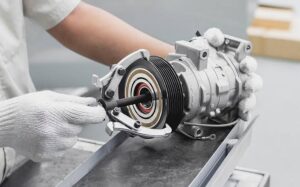
- A seized accessory. A locked air conditioning compressor or alternator pulley can jam the accessory belt hard enough to stop the crank from turning. Removing the belt and retrying is a two-minute test that has saved a great many engines from being wrongly written off — and points the diagnosis toward air conditioning system repair instead.
- Transmission or torque converter failure. A locked torque converter or a failed gearbox can prevent rotation with an entirely healthy engine attached to it, which is why gearbox and transmission diagnosis belongs in the process.
- Immobiliser and electronic no-crank faults. A car that will not crank because a control module refuses to release is not mechanically seized at all.
The definitive check remains the simple one: attempt to rotate the crankshaft by hand at the front pulley bolt. If it moves, the engine is not seized.
Can a Seized Engine Be Repaired?
Sometimes, and the answer depends entirely on the cause.
Hydrolock caught before the rod bends is often the best outcome — plugs out, cylinders cleared, oil and filter replaced, rods inspected, source of the liquid fixed. Corrosion seizure in a stored car can occasionally be freed with penetrating oil and patient manual rotation, followed by a full fluid service. Both of these are recoverable.
Bearing seizure and piston pick-up are different. Once metal has transferred, the crank journals, bearing shells and cylinder bores are all compromised, and debris has circulated through the entire oil system including the turbochargers and oil cooler. The realistic options become a full strip and rebuild with machining, or a replacement engine. On a high-value car, the deciding factors are usually parts availability, whether the block can be bored or resleeved, and documented history — which is one reason a clean VIN and history check matters so much when buying used.
Timing failures sit in the middle. If the damage is limited to valves, the heads can be reworked. If a piston is cracked or the block is scored, it becomes a rebuild.
An honest assessment always includes dropping the sump to look for bearing material, a borescope inspection of every bore, and a compression or leak-down test where the engine can be turned. Any workshop that quotes a rebuild before doing those things is guessing. This assessment work is standard across marque-specific programmes such as Mercedes repair, Porsche repair and Lamborghini engine repair.
How to Prevent an Engine Seizure
Prevention is unglamorous and extremely effective:
- Check oil level monthly, not annually. Many modern turbocharged engines consume oil normally. Consumption is only dangerous when nobody is watching it.
- Shorten intervals for the climate. Manufacturer intervals are set for moderate conditions. Sustained high ambient temperatures, short trips and idling in traffic all age oil faster than the odometer suggests.
- Use the exact approved specification. Approval numbers matter more than the viscosity grade printed on the bottle.
- Treat cooling as a maintenance item. Coolant condition, correct chemistry, and physically cleaning the cooling stack from behind should be part of routine service, not a response to a temperature gauge.
- Never restart an engine that has knocked, overheated or stopped abruptly. Recovery by flatbed is vastly cheaper than a rebuild.
- Avoid standing water entirely. No luxury car has an intake designed for it.
- Keep stored cars running properly. Long enough to reach full operating temperature, on a maintained battery, not a five-minute idle.
- Act on early noises and warning lamps. Cold-start rattles, ticking, oil pressure warnings and coolant temperature creep are the cheap stage of an expensive problem.
An engine seizure is almost never bad luck. It is a maintenance signal that went unread, a warning noise that got another week, or a stored car that was cranked when it should have been checked. Catching any of those in time is the difference between a service item and a new engine — which is why routine inspection and preventive servicing remains the most cost-effective work you can do on a high-performance car.