Most advice about choosing a brake workshop is generic: check reviews, compare quotes, ask about warranty. None of that is wrong, but none of it helps with an F8 Tributo, because the F8’s braking system is not a scaled-up version of an ordinary car’s. It is built around a different material, and almost every mistake a garage can make with it follows from misunderstanding that one fact.
So instead of a checklist, this guide works forwards from the material itself. Understand what carbon-ceramic brakes actually are, and the right questions to ask a Ferrari service centre in Dubai become obvious.
Start With the Discs: The F8 Tributo Is Ceramic, Not Steel
Every F8 Tributo left Maranello with Brembo Extreme Design carbon-ceramic (CCM) discs as standard equipment — roughly 398 mm at the front and 360 mm at the rear, clamped by aluminium monobloc calipers. This was never a factory option box on the F8 the way it is on a German saloon. If you own one, you own ceramics.
Carbon-ceramic discs are a carbon-fibre-reinforced silicon carbide composite. They are dramatically lighter than cast iron, they shrug off the fade that ruins steel discs on a hot lap, and they do not rust or warp. They are also brittle in ways iron is not, they wear through a thin friction layer rather than through their whole body, and they cost several times what iron discs cost to replace.
That single material difference is what separates a genuine Ferrari brake service specialist from a competent general workshop. The next four sections are the consequences.
Consequence One: F8 Brake Discs Are Measured by Weight, Not Thickness
Ask any workshop how they will assess your F8’s discs. If the answer involves a micrometer and a minimum thickness figure, they are measuring a steel-brake car.
Carbon-ceramic discs erode from the friction surface as the silicon carbide layer is consumed, and the accepted method of judging remaining life is to weigh the disc against the minimum mass specified for that part number, supported by a visual inspection of the friction layer for pitting, edge chipping and exposed carbon fibre. A disc can measure close to its original thickness and still be finished. A workshop that does not own a suitable scale and does not know the minimum-weight figure cannot tell you whether your discs have 40,000 km left in them or 4,000.
This is also the check that protects you from the opposite problem — being sold a pair of discs you did not need, at exotic-car prices.
Consequence Two: The Pad Compound Is Not Interchangeable
Carbon-ceramic discs require pads formulated for them. Fitting a pad intended for an iron rotor onto a CCM disc will chew through the silicon carbide friction layer, and that damage cannot be machined out or recovered. The disc is scrap.
This is the single most expensive avoidable mistake in F8 brake work, and it happens because a well-meaning workshop sources “Ferrari 488/F8 front pads” from a catalogue without checking what the pads are certified against. Ask for the part numbers before the job starts, and ask specifically whether the compound is the CCM-rated item. A specialist will answer immediately; a generalist will need to call someone back.
The same logic applies to the wear sensors, which report pad condition to the instrument cluster. They are consumable, single-use items, and skipping them to save a few dirhams means the car can no longer warn you.
Consequence Three: The Fluid Fails Before the Friction Does
Ceramic discs last a very long time in road use. Brake fluid does not, and in the UAE it fails on a calendar, not an odometer.
Ferrari specifies a high-boiling DOT 4 fluid, and DOT 4 is hygroscopic — it pulls moisture out of the air through seals and reservoir venting. Water lowers the boiling point, and a fluid that boils under heavy braking produces the long, soft, travel-heavy pedal owners describe as “the brakes going away.” Dubai’s combination of ambient heat, coastal humidity and cars that sit in air-conditioned garages between short drives accelerates that uptake considerably. A two-year interval is the sensible outer limit for a road-driven F8, and annual replacement is the right call for anything that sees Dubai Autodrome or Yas Marina.
A workshop that quotes for pads and discs but never mentions fluid condition is not thinking about your braking system. It is thinking about the parts on the invoice.
Consequence Four: The Car Does Not Come Apart Without Ferrari-Level Diagnostics
The F8 Tributo carries an electric parking brake acting on the rear calipers. Those caliper pistons must be electronically wound back into a service position before the pads come out. Forcing them mechanically damages the actuator spindle, and replacing an actuator costs far more than the brake job that caused it.
Beyond that, a proper F8 brake service needs factory-level diagnostic access to cycle the ABS hydraulic unit during bleeding — old fluid trapped inside the modulator will not come out under gravity or a simple pressure bleed — and to reset the pad wear counters afterwards. Ferrari’s braking hardware is also woven into the car’s stability electronics, including Side Slip Control and the Ferrari Dynamic Enhancer, which uses individual brake actuation to shape the car’s yaw behaviour. Steering angle and yaw sensor calibration after brake or suspension work is part of the job, not an optional extra.
When you are shortlisting a Ferrari garage in Dubai, this is the concrete question to ask: which Ferrari-specific diagnostic platform do you run? SD3 and Leonardo are the names you want to hear. Generic OBD-II readers cannot do any of the above.
Why F8 Brake Complaints Appear Sooner in Dubai
The climate does not attack the discs so much as everything around them.
Fine silica dust works into the pad-to-disc interface and abrades the friction layer faster than clean European road use would. Heat-soak after a hard run into a slow-moving car park cooks the fluid and bakes pad material onto the disc face. Low annual mileage — very common for exotics here — leaves caliper piston seals and dust boots sitting dry, and lets fluid degrade quietly while the car looks brand new. And morning drives start with genuinely cold ceramics, which have noticeably less initial bite than warm ones. Owners often read that as a fault when it is normal behaviour.
Two symptoms in particular get misdiagnosed. Vibration under braking is almost never a “warped” CCM disc, because these discs do not warp — it is usually uneven pad deposit or a hub or bearing issue. And a pedal that is high and stone-hard rather than long and soft points at the vacuum supply to the servo, since a twin-turbo V8 relies on an electric vacuum pump rather than manifold vacuum. Sorting the two apart before ordering parts is exactly what you are paying a specialist for.
What a Real Ferrari Brake Specialist Does Differently
In practice, the difference shows up in the process. A specialist workshop will road test the car before touching it, put it on a proper lift using the correct jacking points for a low-slung mid-engine car, weigh the discs, inspect the friction layer, test the fluid for moisture content rather than judging it by colour, check the calipers for seal weep and piston drag, retract the electric parking brake electronically, fit CCM-rated pads with fresh sensors, bleed the system through the ABS unit, reset the service counters, and road test again to bed the brakes in properly.
A general workshop will fit pads and hand you the keys. The car will stop. It just will not stop the way an F8 is supposed to, and you may not discover the difference until the one moment it matters.
Brake work is also a natural point to check the systems that share load with it — tyre condition and age, suspension bushes and dampers, and the 12V battery, since weak voltage causes stability and brake-system warning lights that have nothing to do with the brakes themselves.
Making F8 Tributo Brakes Last
Prevention on this car is mostly about habits. Use the brakes properly rather than gently — a light, dragging pedal glazes pads without ever getting the system hot enough to clean itself. Give the car a cool-down lap or a gentle final few kilometres after a spirited drive instead of parking hot. Rinse the wheels and caliper area regularly to keep abrasive dust out of the friction surfaces. Replace fluid on time even if the pads look untouched. Drive the car at least fortnightly if it lives in storage, and have the brake system inspected annually regardless of mileage — the same visit that covers an oil service or a general Ferrari inspection is the sensible time to do it.
Choosing Well in Dubai
Shortlist on evidence, not on marketing. The workshop should be able to tell you how it measures CCM discs, name the pad part numbers it intends to fit, name its Ferrari diagnostic platform, explain how it bleeds the ABS unit, and show you the old parts afterwards. It should also be doing enough Ferrari work generally — engine, transmission, AC and related 488 GTB, 812 Superfast and Roma work — that F8 brakes are routine rather than an experiment.
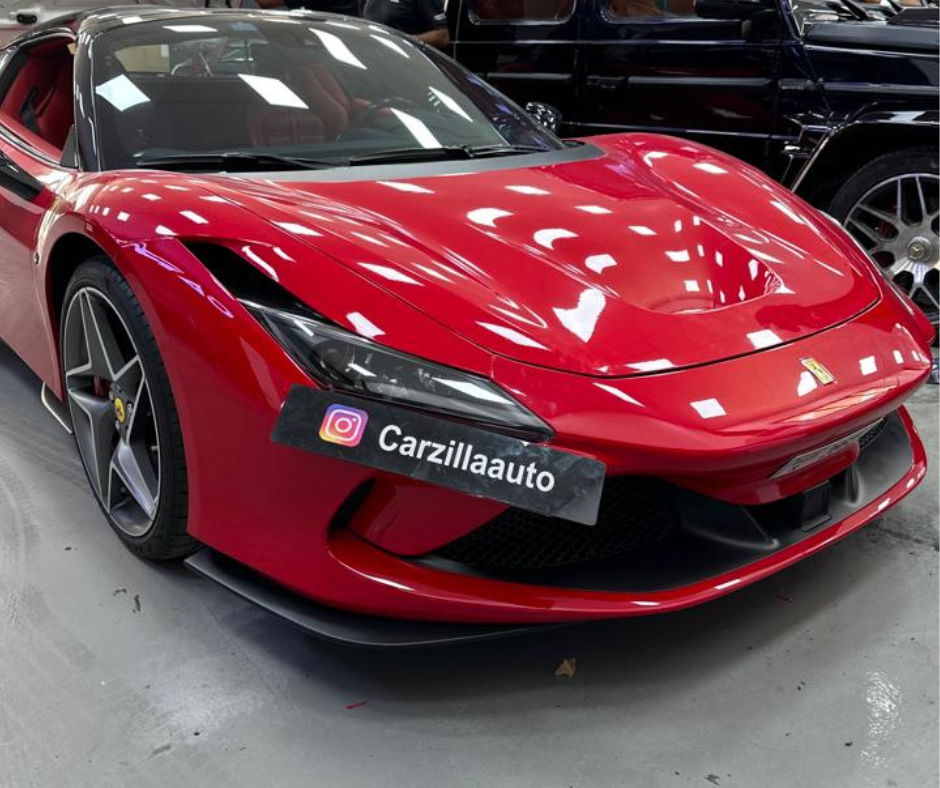
Carzilla is a luxury and exotic specialist based in Al Quoz Industrial Area, Dubai, running Ferrari-specific SD3 and Leonardo diagnostics alongside general brake repair and suspension capability. You can browse the full range of services and model specialisations, read more about the workshop, or get in touch for an F8 brake inspection.