Almost every car in Dubai uses more fuel than the figure printed in its brochure. That is not a defect on its own — the official number comes from a laboratory cycle run at moderate temperature with the air conditioning off. Dubai gives the engine a different job: 45°C ambient air, a compressor running most of the year, stop-start traffic on Sheikh Zayed Road, short trips that never let the engine reach full operating temperature, and fine airborne sand that loads filters and radiators faster than in almost any other market.
The useful question is not “why is my consumption higher than the sticker” but “how much of that extra fuel is avoidable”. Some of it is physics you cannot argue with. A large part of it is tyre pressure, a lazy sensor, carbon on an intake valve, or a cooling system that never lets the engine warm up properly. This guide explains where fuel is actually spent, which mechanical faults quietly increase fuel consumption, how to fix them, and how to stop them coming back.
Where the Fuel in Your Tank Actually Goes
Every litre of petrol is spent overcoming four loads. Improving fuel economy in Dubai means reducing them one at a time, in the order they cost you the most.
Rolling Resistance: Tyres, Pressure and Alignment
Rolling resistance is the largest avoidable loss in city driving. Under-inflated tyres flex more in the sidewall, that flex turns into heat, and that heat comes straight out of your fuel tank. In UAE conditions the problem is self-inflicted twice over: drivers often drop pressures deliberately in summer because they fear blowouts, and tyres lose pressure naturally through the valve and bead over time.
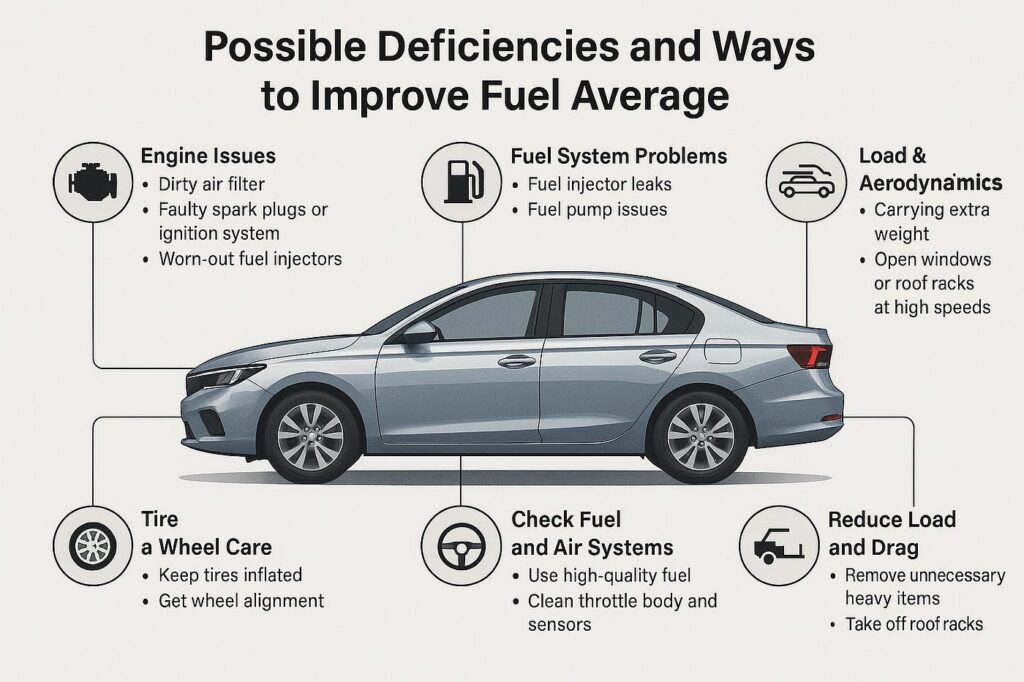
Set pressures cold, to the placard value on the driver’s door frame, not to the maximum figure moulded into the sidewall. Check monthly — heat cycling in Dubai accelerates natural pressure loss. Worn or hardened tyres also raise resistance, and UAE heat ages rubber by date as much as by mileage, so read the DOT week/year code, not just tread depth. Poor wheel alignment adds a second penalty: a car that is scrubbing its front tyres sideways is dragging them down the road. If the steering pulls, the wheel sits off-centre, or the tyres show feathered wear, get the geometry corrected through a proper tyre and wheel service before you look at anything else. Worn bushes and dampers change those angles under load, which is why suspension repair and alignment belong in the same conversation.
Aerodynamic Drag: Speed, Roof Loads and Body Modifications
Drag rises with the square of speed, so it dominates above roughly 80 km/h. On a long run to Abu Dhabi, the difference between 120 km/h and 140 km/h is a real fuel penalty, not a rounding error. Roof boxes, roof racks left on all year, and open windows at highway speed all add measurable drag.
Body modifications matter here too. Aggressive aftermarket splitters, wings and non-OEM bumpers change the airflow the car was designed around, and poorly fitted panels create turbulence and gaps that add drag without adding downforce. If you are modifying the car, use parts designed for the model and fitted to OEM mounting points — see our guidance on body kits, carbon fibre kits and the car modification rules in Dubai before committing to a change.
Air Conditioning and Electrical Load
In Dubai the AC is not an occasional accessory — it is a permanent load on the engine, and a weak system costs more fuel than a healthy one. A system low on refrigerant, or with a dirty condenser packed with sand, runs the compressor longer and at higher head pressure to deliver less cold air. The cabin never feels cold, so the driver turns the fan and temperature up, and the cycle continues.
A correct repair is not “top up the gas”. The system must be evacuated, leak-tested, and charged by weight to the manufacturer’s specification with the right oil type. A blocked cabin filter — a common problem given the dust load here — makes the blower work harder and reduces airflow across the evaporator. Get the system checked properly through car AC repair if cooling has faded gradually; gradual loss is exactly what people learn to live with while paying for it at the pump.
Engine and Drivetrain Losses
The rest is friction and combustion efficiency: oil viscosity, dragging brakes, transmission behaviour and how completely the engine burns each charge of fuel. This is where most fuel-economy problems in workshops actually originate.
Car Problems That Increase Fuel Consumption
Rising fuel consumption is often the first symptom of a fault, and it usually appears long before a warning light. These are the causes we see most often in Dubai.
Oxygen sensors and mass airflow sensors that are lazy rather than dead. A sensor that still responds — just slowly, or with a drifted signal — will not always set a fault code, but the ECU trims fuel based on what it reports. A rich trim from a heat-aged oxygen sensor can add a noticeable percentage to consumption with no other symptom. Live data on a manufacturer-level scan tool, not just a code read, is what identifies this.
Carbon build-up on direct-injection engines. On port-less direct-injection engines, no fuel washes the back of the intake valve, so oil vapour from the crankcase ventilation system bakes into deposits. Airflow drops, the mixture goes off, and the car feels flat while drinking more. The fix is borescope inspection and walnut blasting, not chemical sprays through the throttle body. Short trips and long idling in traffic accelerate it.
Misfires from tired plugs and coil packs. A partial misfire dumps unburned fuel out of the exhaust and, if ignored, damages the catalytic converter, which then adds back pressure and costs more fuel again. Heat shortens coil life in this climate. Any hesitation under load deserves attention through engine repair and diagnostics.
Clogged air filters and sand-packed cooling stacks. Dubai fills filters faster than the service book assumes. More importantly, sand packs the radiator and condenser from behind, where a visual check from the front looks clean. That raises coolant and intake temperatures, the ECU pulls timing to protect the engine, and efficiency falls. If temperatures are creeping up, read our guide on radiator repair costs in Dubai.
A thermostat stuck open. An engine that never reaches full operating temperature runs in a richer warm-up strategy for far longer than it should. There is no overheating and often no warning light — only high fuel consumption and a temperature gauge that sits low.
Dragging brakes and seized caliper slides. A caliper that does not release fully makes the engine fight the brakes continuously. Look for one wheel hotter than the others after a drive, uneven pad wear, or a faint smell after highway use. This is straightforward to correct with proper brake service.
Transmission faults and lost adaptations. A torque converter that will not lock up at cruise, or a dual-clutch gearbox with stale adaptation values after a battery change, keeps the engine at higher revs than necessary. Fluid must be the specified type and set at the correct temperature, and adaptations relearned with the right tooling — one of the most common reasons a car “suddenly” started using more fuel after unrelated work. Our gearbox and transmission repair page covers the process.
Wrong oil grade. Using a heavier oil than the manufacturer specifies increases pumping losses and slows warm-up. Always match the OEM specification, not just the viscosity number, at every oil change service.
Driving Habits That Reduce Fuel Consumption in Dubai Traffic
Mechanical condition sets the ceiling; driving style decides where you sit under it. Accelerate smoothly to the speed you intend to hold rather than sprinting to the next brake application — braking is fuel already burned and thrown away. Read the traffic far enough ahead to coast instead of stopping. Hold a steady speed on the highway and use cruise control on open roads, but not in dense traffic where it accelerates harder than you would.
Avoid long idling. Waiting in a parked car with the engine running to keep the AC on is one of the largest single fuel losses for Dubai drivers, because you are burning fuel at zero kilometres per litre. Combine errands so the engine reaches operating temperature once rather than making three cold starts, which is also the single most effective way to slow carbon build-up. Finally, remove weight you are not using — roof boxes, tools and equipment left permanently in the boot all cost fuel, and the penalty is worst in city driving.
Fuel Grade, Warning Lights and the RTA Test
UAE stations offer 95 and 98 octane. High-compression and turbocharged engines — most performance and luxury models — are calibrated for 98. Running 95 in an engine that expects it causes the knock sensor to retard ignition timing, which reduces both power and efficiency, so the cheaper fuel can cost more per kilometre. Follow the fuel-filler label rather than habit. Using 98 in an engine designed for 95 delivers no benefit.
Never ignore a check engine light because the car still drives. Most emissions faults that cost fuel show up here first, and a lit lamp is an automatic fail at the RTA testing centre. Clearing a code before the test does not help either — readiness monitors reset and the car will fail on incomplete monitors instead.
Preventing High Fuel Consumption: Maintenance That Actually Works
Prevention in this climate means servicing to conditions, not to a European calendar. Shorten oil and filter intervals if you do mostly short city trips. Replace air and cabin filters more often than the book states. Have the cooling stack cleaned from the engine side. Keep tyre pressures and alignment correct. Have the AC checked before summer rather than during it, and address small leaks while they are small.
Track your own consumption instead of relying on the dashboard average, which is an estimate. Fill to the same click at the same pump, note the trip meter, and calculate litres per 100 km over several tanks. A steady 10–15% rise with no change in driving pattern is a fault, and it is worth a diagnostic scan and a full car inspection before it becomes a bigger repair. If you are buying a used car, a VIN check alongside a pre-purchase inspection tells you whether you are inheriting someone else’s deferred maintenance.
Expert Fuel Efficiency Diagnostics in Dubai
Carzilla is a specialist auto garage in Dubai based in Al Quoz, working on luxury and performance vehicles with manufacturer-level diagnostic equipment rather than generic code readers. Our technicians diagnose fuel-economy complaints by measuring fuel trims, sensor response, coolant and intake temperatures and drivetrain behaviour, so the repair addresses the actual cause.
We service Mercedes-Benz, BMW, Audi, Porsche, Range Rover, Ferrari, Lamborghini and Maserati, with the full range of work listed across our services and specialist model pages. If your fuel consumption has climbed without an obvious reason, contact Carzilla to book a diagnostic assessment.