The Continental GT is a heavy car pretending not to be. Depending on generation and specification it sits between roughly 2,200 kg and 2,450 kg, and every one of those kilograms has to be stopped by the brakes and carried by the air suspension. That is why brakes and suspension are the two systems Continental GT owners in Dubai spend the most on, and why choosing the right Bentley repair workshop in Dubai matters more on these two systems than on almost any other.
This guide works through the actual jobs a Continental GT needs — pads and discs, carbon ceramics, the electronic parking brake, air struts, the compressor and valve block, bushings and calibration — and explains what a correct repair looks like for each one. Use it to judge whether a workshop is equipped for the car before you hand over the keys.
Why Continental GT Brakes and Suspension Wear Faster in Dubai
Braking energy scales with mass and with the square of speed. A Continental GT stopping from 120 km/h on Sheikh Zayed Road puts far more heat into the pads and discs than a normal saloon, and in 45°C ambient air that heat has nowhere to go. Pad material gasses off, disc surfaces glaze, and brake fluid absorbs moisture faster in coastal humidity than it would in a dry climate.
The suspension takes a parallel beating. Air spring rubber loses plasticiser above about 45°C and hardens. Fine silica dust works into the rolling lobe of the air bag and abrades it from the outside in. Speed bumps in residential communities load the bushings and top mounts repeatedly at low speed, which is exactly the duty cycle that kills them. And cars that sit for weeks in a garage are worse off than cars that are driven — a parked air spring develops a fold set at the crease line and splits there later.
Brake Pad and Disc Replacement on a Bentley Continental GT
First and second generation cars use large iron rotors — 405 mm at the front on most specifications — with multi-piston fixed calipers. These are not a pad-slap job. A proper workshop measures disc thickness against the minimum stamped on the disc hat, checks lateral runout with a dial gauge mounted to the upright, and inspects the caliper piston seals and guide hardware before quoting.
Pad choice matters. Genuine Bentley pads and OE-supplier equivalents are formulated for the disc material and the mass of the car. Cheap aftermarket pads on a Continental GT do not simply wear faster; they change the friction coefficient, extend stopping distance, and can deposit unevenly onto the disc face. Wear sensors are single-use and must be replaced, not re-fitted. If a garage quotes a Continental GT brake job at the same price as a saloon, that is the tell.
Carbon Ceramic Brake Service Needs a Specialist
Carbon-silicon-carbide brakes were offered on GT Speed models and are standard or optional on much of the third-generation range. They behave nothing like iron. A carbon ceramic disc is condemned on mass loss, not just thickness — the disc is weighed against a factory minimum figure because the silicon carbide matrix oxidises slowly over its life. A workshop that measures a carbon ceramic disc with a vernier caliper alone does not know what it is looking at.
Carbon ceramic discs also require their own pad compound. Fitting standard iron-disc pads to a carbon ceramic rotor destroys the disc coating, and a replacement set runs into serious money. Ask any workshop directly whether it has weighed a carbon ceramic disc before. The answer tells you what you need to know. General car brake repair services are fine for iron systems; carbon ceramics belong with a workshop that regularly handles Bentley Continental GT repair.
Electronic Parking Brake Work on Later Cars
Third-generation Continental GT models built on the MSB platform use an electric parking brake integrated into the rear calipers. The motors must be driven into service position with factory-level diagnostics — ODIS with Bentley brand data — before the rear pads can be replaced, and driven back and re-calibrated afterwards.
Forcing a rear caliper piston back with a wind-back tool while the EPB motor is engaged shears the spindle and turns a routine pad change into a caliper replacement. This is the single most expensive avoidable mistake on Continental GT rear brakes, and it happens in workshops that own a generic OBD reader instead of the correct platform tooling.
Brake Judder Is Usually Not a Warped Disc
Owners describe a shudder through the steering wheel under braking and are commonly sold new discs. Discs rarely warp. What actually happens is one of three things: uneven pad transfer film building disc thickness variation, hub or wheel-mounting-face corrosion causing runout, or — very often on a Continental GT — worn front control arm bushings and top mounts letting the wheel move under braking load.
That last cause is the reason brakes and suspension should be assessed together rather than as separate jobs. A workshop that replaces discs without checking the front suspension geometry will hand the car back with the same judder. This is also where poor tyre condition and wheel balance and worn steering components get misdiagnosed as brake faults.
Air Suspension Repair on the Continental GT
The Continental GT rides on four air struts with adaptive damping, fed by an electric compressor through a valve block. Third-generation cars use three-chamber air springs, and the 48-volt Bentley Dynamic Ride active anti-roll system on some specifications is separate hardware from the air springs entirely — a distinction routinely missed, leading to air struts being replaced for a body-control fault they were never causing.
A leaking air spring shows itself as overnight sag on one corner, a compressor that runs longer and more often than it used to, or a ride that has quietly become harsh. The correct diagnostic sequence starts with battery voltage, then reads live corner pressures, then performs a static pressure-hold test with the car switched off, then isolates the valve block to separate a leaking spring from a leaking valve. Guessing at this stage is what makes Bentley Continental suspension repair expensive.
Compressor, Valve Block and Air Dryer Replacement
Compressors almost never fail on their own. They burn out because an upstream leak has been ignored for months and the compressor has been running at a duty cycle it was never designed for. Replacing the compressor without finding and fixing the original leak simply schedules the next failure.
The integrated desiccant dryer must be replaced whenever the compressor is replaced. In Dubai’s coastal humidity a saturated desiccant pushes moist air into the system, which corrodes valve seats and causes intermittent, hard-to-trace pressure loss. A quote that includes a compressor but not a dryer is an incomplete repair.
Ride Height Calibration and Alignment After Suspension Work
Every air strut replacement must be followed by ride height calibration through factory diagnostics, then a four-wheel alignment performed at the calibrated ride height. Skipping calibration leaves the car sitting at the wrong height, which throws camber and toe out of specification and destroys tyres and brake pads within months.
Control arm and subframe bushings have a related rule: they are torqued with the suspension loaded at ride height, not hanging on the lift. Bushings tightened at full droop are permanently pre-loaded and tear early. This detail separates workshops that follow Bentley procedure from those that treat it as generic car suspension repair.
What to Check Before Choosing a Bentley Workshop in Dubai
- Factory-level diagnostics with Bentley brand data, not a generic scan tool
- Ability to put the electronic parking brake into service mode and re-calibrate it
- Ride height calibration and in-house four-wheel alignment
- Willingness to weigh carbon ceramic discs and quote the correct pad compound
- Air suspension leak testing before parts are quoted
- Genuine or OE-supplier parts specified by part number on the quote
- Experience across the range, from the Continental GT V8 to the Bentayga
How to Prevent Brake and Suspension Problems
Drive the car at least every ten days rather than leaving it parked for long periods — this alone prevents fold-set failures in the air springs. Change brake fluid every two years regardless of mileage, because moisture uptake in this climate does not wait for kilometres. Have corner pressures and compressor run-time read at every scheduled service, since a small leak is far cheaper than the compressor failure it eventually causes. Rinse the underbody after coastal or desert driving to clear silica dust from the air spring lobes. And treat any new noise over speed bumps as a bushing or top mount inspection rather than something to live with.
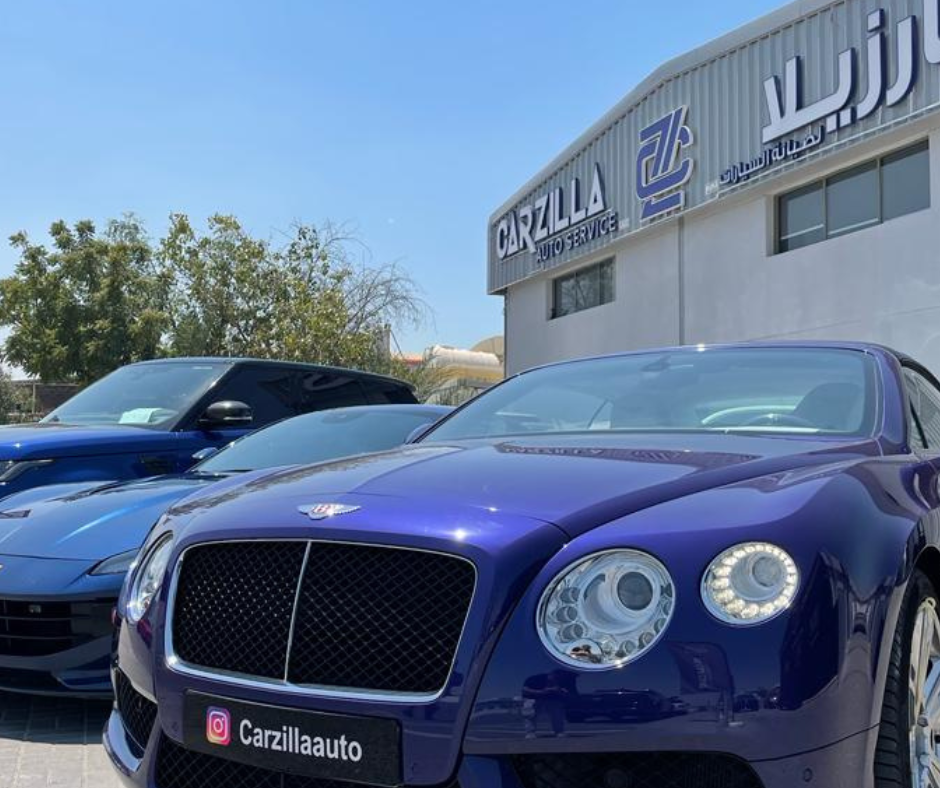
Brakes and suspension on a Continental GT are one system with two names. Assess them together, fix the cause rather than the symptom, and the running costs stay predictable. Carzilla handles Bentley brake and suspension work in Al Quoz, Dubai, alongside engine, gearbox and full Continental servicing.