The Rolls-Royce Wraith was designed around silence and comfort, and in the UAE the air conditioning system carries a bigger share of that promise than anything else on the car. A Wraith cabin is large, glazed heavily, and often finished with a dark Starlight headliner and dark leather — all of which soak up heat. Add ambient temperatures above 45°C for five months of the year and an AC system that in Europe would loaf along at half capacity ends up running close to maximum output almost every day.
That workload is why Wraith owners in Dubai see air conditioning faults far earlier than the mileage on the odometer would suggest. This guide explains the faults that come up most often, why they happen here specifically, how they are properly repaired, and what actually prevents them from returning.
How the Wraith Air Conditioning System Is Built
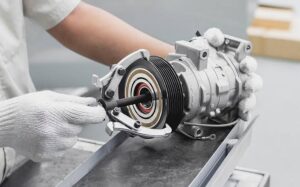
The Wraith shares its underlying architecture with the Ghost, and its climate system is a Rolls-Royce interpretation of BMW’s IHKA (Integrated Heating and Air Conditioning) design. A belt-driven compressor sits low on the 6.6-litre twin-turbo V12, feeding a condenser mounted at the very front of the cooling stack — ahead of the radiator and charge-air coolers. Refrigerant then passes through an expansion valve into an evaporator buried inside the HVAC housing behind the dashboard, where a blower pushes cabin air across it and a set of electric flap actuators decides where that air goes and at what temperature.
Two details matter for almost every fault described below. First, the condenser is the first thing airflow touches, so it is also the first thing dust and sand reach. Second, the compressor is a variable-displacement unit controlled electronically rather than by a clutch, which means a technician who tells you “the AC clutch isn’t engaging” is describing a part your car does not have.
If you want the wider context on how Rolls-Royce systems are serviced locally, the Rolls-Royce repair Dubai overview and the model-specific Rolls-Royce Wraith repair Dubai page cover the workshop side of it.
Refrigerant Loss Through Heat-Hardened Seals and O-Rings
The single most common Wraith AC complaint in Dubai is gradual loss of cooling over a season — cold in November, lukewarm by June. Nine times out of ten this is refrigerant loss, not a failed component.
Refrigerant escapes through elastomer O-rings at the line joints, through the compressor shaft seal, and occasionally through a pinholed condenser. Heat is what causes it: repeated cycling between a 70°C engine bay and an overnight cool-down drives the plasticisers out of the rubber, the seals shrink and harden, and the joint begins to weep. Cars that sit for long periods make it worse, because a system that never runs never circulates the oil that keeps those seals conditioned. A stored Wraith loses refrigerant faster than a driven one.
The correct fix is to find the leak before adding anything. That means a UV dye trace, a nitrogen pressure hold, or an electronic sniffer at each joint, followed by replacement of the specific seals or line that failed. Simply topping the system up is not a repair — the gas will leave again by the same route, and the compressor will have spent that time running short of oil, which is how a AED 1,000 seal job becomes a compressor replacement. Our general car AC repair service page explains the leak-testing sequence in more detail.
Compressor Failure and the Misdiagnosis That Causes It
When a Wraith compressor fails, it is almost always downstream of something else — usually a slow leak that ran the system low on refrigerant, and therefore low on the oil that travels with it.
Symptoms are a grinding or rattling noise from the front of the engine, a squeal that appears with the AC on, or no cooling at all. Because the compressor is variable-displacement and electronically controlled, a partial failure often shows up as air that is cold at high revs and merely cool at idle, which is easy to mistake for a low charge.
The repair is genuinely serious if the compressor has seized. Metal debris travels through the whole circuit, and the Wraith’s parallel-flow condenser cannot be reliably flushed — it has to be replaced along with the receiver-drier and expansion valve, and every line cleaned. Skipping that decontamination is the reason some cars go through two or three compressors in as many years. Replacing a compressor also demands the correct PAG oil type and quantity, a deep vacuum to remove moisture, and a charge measured by weight rather than by gauge pressure.
A Sand-Packed Condenser That Cools Only at Speed
A very Dubai-specific fault: the AC blows cold on Sheikh Zayed Road but goes lukewarm the moment traffic stops.
The cause is airflow, not refrigerant. Fine silica dust mixes with oil mist and road film and builds a mat inside the condenser fins — often from the back face, where it is invisible from the front of the grille. At speed, ram air still forces enough flow through to reject heat. At a standstill, the fan alone cannot pull air through the blockage, high-side pressure climbs, and cooling collapses. The same blockage raises coolant temperatures, which is why AC complaints and engine overheating complaints on Rolls-Royce models so often arrive together.
The fix is a proper stack clean with the front removed — not a pressure wash through the grille, which bends fins and pushes debris deeper. On a Wraith this usually means dropping the undertray and separating the coolers so each core can be cleaned individually. It is a labour job, not a parts job.
Cooling Fan and Fan Control Faults
The other reason for warm-at-idle air is the electric cooling fan itself. Fan motors and their control modules fail in this climate because they run near-continuously; a failing fan often works intermittently before it stops, so the car cools normally one day and not the next. A fan that no longer reaches full speed produces exactly the same symptom set as a blocked condenser, which is why the two have to be separated by watching live fan duty and refrigerant pressures on a scan tool rather than by guessing.
One Side Cold, One Side Warm: Blend Flap Actuators
If the driver’s side is cold and the passenger’s side is warm — or the temperature is right but air comes from the wrong vents — the fault is usually a blend or distribution flap actuator inside the dashboard. These are small geared stepper motors, and their plastic gears become brittle after years of heat cycling. A clicking or ticking sound from behind the dash when the ignition is switched on is the classic tell.
Actuators are inexpensive parts, but access varies enormously depending on which one has failed; some are reachable from the footwell, others require significant dash disassembly. The system stores specific fault codes identifying the failed motor, so a Rolls-Royce-level scan before any panels come off saves a great deal of labour.
Musty Smell, Damp Carpets and a Blocked Evaporator Drain
A damp footwell, foggy glass or a sour smell on start-up almost always points to a blocked evaporator drain rather than a refrigerant fault. In Dubai the humidity near the coast means the evaporator produces a surprising volume of condensate, and dust turns that moisture into a sludge that plugs the drain tube. Water then backs up in the HVAC housing and finds its way onto the carpet — and, on a car with sensitive electronics under the seats, that is a much bigger problem than a wet mat.
Clearing the drain is straightforward. Undoing the water damage afterwards, including interior and upholstery repair, is not. The smell itself comes from microbial growth on the evaporator fins and needs a proper evaporator treatment along with new cabin filters — not an air freshener.
Weak Airflow From Clogged Cabin Filters
The Wraith uses activated-charcoal cabin filters that are sized for European dust loads, not for Al Quoz. In this environment they load up long before the service interval suggests, and the result is weak airflow at every fan speed, extra strain on the blower motor, and a system that never quite pulls the cabin down to temperature. Replacing them twice a year rather than annually is one of the cheapest reliability improvements available on this car, and it is normally covered as part of a full luxury car service.
Sensor and Voltage Faults That Look Like AC Failures
Two less obvious causes are worth knowing about. The interior temperature sensor is drawn over by a small aspirator fan hidden in the dashboard; when dust jams that fan, the climate module reads a false cabin temperature and regulates to it, producing air that is too cold, too warm, or that swings between the two for no apparent reason. The solar sensor on the dash top does something similar by misreporting sun load.
Separately, battery condition matters more than most owners expect. AGM batteries in Dubai routinely last only two to three years, and a Wraith running on a weak battery will throw climate control faults, actuator errors and blower irregularities that vanish the moment the battery is replaced and registered to the car. Any credible vehicle diagnostic session starts by checking system voltage before chasing HVAC codes.
Why a Quick Regas Often Makes the Problem Worse
Roadside and quick-fit “AC top-up” services are the most common way a manageable Wraith AC fault becomes an expensive one. Adding refrigerant without recovering and weighing the existing charge routinely overfills the system, and an overcharged circuit runs high head pressures, cools poorly at idle, and puts real mechanical load on the compressor. The Wraith’s charge specification is a weight, not a pressure reading, and the only correct method is full recovery, a vacuum held long enough to prove the system is dry and leak-free, then a fresh charge measured on scales with the correct oil quantity added back.
How Wraith AC Faults Should Be Diagnosed
A proper diagnosis on this car follows a fixed order: check battery voltage, read stored climate-module fault codes with Rolls-Royce-capable equipment rather than a generic OBD reader, observe live data for compressor control signal, fan duty and both refrigerant pressures, then inspect the condenser face and the evaporator drain physically. Only after that does anyone touch the refrigerant circuit. Working the other way round — gas first, questions later — is what produces repeat visits.
Preventing Rolls-Royce Wraith AC Problems
Most of what fails on this system is preventable, and none of it is exotic:
Run the air conditioning for a few minutes every week, including in winter and including on a car that mostly sits, so the compressor seals stay lubricated. Have the condenser and cooling stack cleaned properly at least once a year, ideally before summer. Change the cabin filters twice a year in this climate. Have the evaporator drain checked at every service rather than waiting for a wet carpet. Replace the battery on condition, not on failure. Park in shade or use a windscreen shade to cut the heat load the system has to overcome on start-up. And have any drop in cooling performance leak-tested early, while it is still a seal — the difference between a small repair and a compressor and condenser replacement is usually just how long the car was driven low on gas.
Beyond the AC circuit itself, keeping the wider cooling and electrical systems healthy matters, since the engine cooling system shares the same airflow path. The long-term ownership advice in what Rolls-Royce owners in Dubai must know about maintenance applies directly here.
Getting Rolls-Royce Wraith AC Repair in Dubai
Wraith air conditioning work rewards a workshop that treats it as a Rolls-Royce job rather than a generic regas: correct diagnostic access to the climate module, refrigerant handling by weight, condenser cleaning done with the front apart, and the discipline to find a leak before filling the system. Carzilla’s Rolls-Royce workshop in Al Quoz handles Wraith, Ghost, Dawn and Cullinan models across servicing, transmission and suspension work, and you can get in touch to arrange an inspection.