How to choose the best car detailing in Dubai, paint depth checks, ceramic coating claims, PPF warranties, RTA tint limits, real AED prices and the red flags to walk away from.
Dubai has more car detailing operators per square kilometre than almost any city on earth, and the price for “full detailing” ranges from AED 250 to AED 15,000. Both ends of that range are advertised with the same words: premium products, certified technicians, showroom finish.
The gap between them is not marketing. It is measurable — in microns of clearcoat, in film thickness, in cure temperature, in whether anyone put a gauge on your paint before switching on a polisher.
This guide covers what to actually check before you hand over the keys. It is written from the workshop floor at Carzilla Auto Service in Al Quoz, where we detail Ferraris, Range Rovers, Rolls-Royces and daily-driven German sedans in the same building we repair them in.
Quick answer: the best car detailing service in Dubai is the one that measures your paint before correcting it, works in a temperature- and dust-controlled bay, uses film and coatings you can verify by batch and warranty registration, quotes in writing per stage, and tells you honestly when your car does not need the expensive package.
Why the choice matters more in Dubai than anywhere else
Three environmental facts drive everything in this guide.
Dubai’s dust is harder than your paint. Airborne desert dust here is largely silica — quartz, roughly 7 on the Mohs scale. Automotive clearcoat sits around 2 to 3. Every time someone drags a dirty mitt or a dry cloth across a panel, they are grinding a mineral harder than the surface into the surface. This is why the majority of swirl marks on cars in Dubai are not from driving. They are from washing.
Surface temperatures break the rules that products are designed around. A dark bonnet parked on Sheikh Zayed Road in July sits well above ambient. Coatings flash off before they level, polishes dry and grab, PPF adhesive tacks up before the installer can position the panel, and hard tap water evaporates on hot paint and etches mineral rings straight into the clear.
UV load is relentless. Clearcoat contains UV absorbers that deplete over time. Once they are gone, the clear goes chalky, then fails — and no polish brings that back. At that point you are no longer detailing, you are respraying, which is a different job handled by our car painting service in Dubai.
A detailing workshop that does not build its process around those three facts is applying a temperate-climate playbook in a desert. That is the real risk you are choosing against.
Car wash vs car detailing vs paint correction: know what you’re buying
Half the disappointment in this market comes from buying the wrong service under the wrong name.
| Service | What it does | Typical time | What it will not do |
|---|---|---|---|
| Express / tunnel wash | Removes loose surface dirt | 10–20 min | Nothing for gloss; often adds swirls |
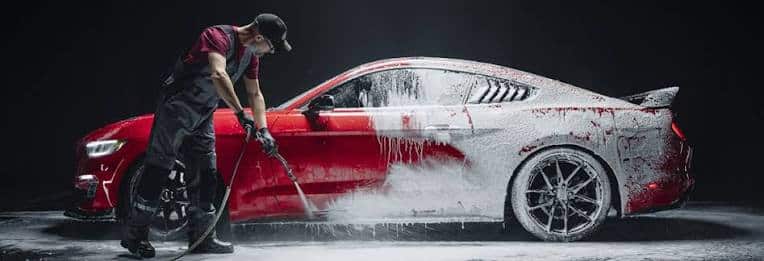
| Safe hand wash | Removes dirt without adding scratches | 45–90 min | No defect removal |
| Interior detailing | Deep clean, sanitise, condition, protect cabin | 2–4 hrs | Nothing to exterior paint |
| Exterior detailing | Decontamination, light polish, protection layer | 4–8 hrs | Won’t remove deeper scratches |
| Paint correction | Machine removal of swirls, etching, oxidation | 1–3 days | Won’t fix chips through the clear |
| Ceramic coating | Chemical protection layer over corrected paint | +1–2 days | No impact protection |
| PPF | Physical urethane film over paint | 2–4 days | Won’t hide defects underneath |
The key relationship: protection is only as good as the surface underneath it. Ceramic coating over swirled paint locks the swirls in for three years. Any workshop that offers coating without discussing correction first is selling you a sealed-in problem. We break this down further in our comparison of car detailing vs car washing for luxury cars in Dubai.
1. The paint thickness question that separates professionals from polishers
This is the single most useful question you can ask, and almost nobody in Dubai asks it:
“Will you take paint depth readings before you polish, and can I see them?”
Here is why it matters. A modern factory paint system is roughly 100–160 microns total on steel panels, of which the clearcoat — the only layer you can safely polish — is usually just 40–50 microns. Aluminium panels and some composite panels can be thinner.
Every machine polishing stage removes clearcoat. A light finishing polish might take 2 microns. A heavy compounding stage on hard paint can take 5 or more. Do the arithmetic: your car’s clearcoat can survive a small, finite number of corrections in its entire life. Spend that budget carelessly and you get clearcoat failure — irreversible, and only fixable at our auto body shop with a full respray.
What a professional does: takes readings across every panel with an electronic paint depth gauge, notes anomalies (a door reading 300 microns has been repainted before), agrees a correction level against the numbers, and gives you the before/after readings in writing.
What an amateur does: starts with the most aggressive compound because it works fastest, on every panel equally, with no idea what is underneath.
Readings also reveal history. If a panel on a car you just bought reads far above the rest, it has filler or a repaint under it — which is exactly the kind of finding our pre-purchase car inspection in Dubai is designed to surface, alongside a UAE VIN check.
2. Does the workshop know what kind of paint your car has?
“Luxury car detailing in Dubai” is a phrase every workshop uses. Very few can tell you how the paint differs between the cars they claim to specialise in.
- Soft paint — many Italian exotics use softer, more easily marred clear. It corrects quickly but scratches from almost nothing, including an incorrectly chosen towel. A pad and compound combination that is right for a German saloon will haze a Ferrari or Lamborghini panel.
- Hard ceramic clear — common on Mercedes, Audi and BMW models. Resists marring well, but needs genuine cutting ability to correct. Underpowered equipment just burnishes the defect and moves on.
- Matte, satin and frozen finishes — these cannot be polished at all. Polishing a satin AMG or a Frozen-finish BMW puts gloss into the panel permanently. If a detailer does not immediately flag this when you mention your finish, stop the conversation there.
- Three-stage pearls, tri-coats and bespoke colours — found on Rolls-Royce, Bentley and Aston Martin. Correction near an edge risks breaking through into a mid-coat that cannot be spot-repaired without blending whole panels.
- Painted composite and carbon panels — McLaren and similar. Different heat behaviour under a machine polisher, and exposed weave clearcoat has its own rules. Relevant too if you have fitted a carbon fibre kit or aftermarket body kit.
Ask which specific models they handled in the past month. A workshop with genuine luxury experience answers instantly and specifically. You can see the range we work on across our brand specialisations, covering Porsche, Range Rover, Maserati, Jaguar and Tesla among others.
3. Wash and decontamination technique: where Dubai swirl marks actually come from
If you only audit one part of the process, audit the wash. It causes more damage than everything else combined.
What a correct Dubai wash looks like:
- Pre-rinse under pressure to float off silica dust before anything touches paint. Skipping this step is the number one cause of new swirls.
- pH-neutral snow foam dwell to lift what the rinse left.
- Two buckets with grit guards, or a rinseless method with fresh media per panel. One bucket means you are reapplying dirt.
- Separate wheel kit. Brake dust is metallic. A mitt used on wheels must never touch paint.
- Chemical decontamination — an iron remover for embedded rail dust and industrial fallout (common near Dubai construction corridors), plus a tar and adhesive remover.
- Clay bar or clay towel with generous lubrication, only after chemical decon, never dry.
- Drying by blower or plush towel with a drying aid. Air-drying in Dubai water leaves mineral spots that etch.
What to ask: “Do you pre-rinse before contact, and do you use separate wash media for wheels and paint?” The answer, and how quickly it comes, tells you most of what you need to know.
4. Ceramic coating in Dubai: reading past the marketing claims
Ceramic coating is the most oversold product in the UAE car care market. It is genuinely excellent — and genuinely misrepresented.
“9H hardness” is a pencil test. It comes from the Wolff-Wilborn scale, which measures resistance to a graded pencil lead. It is not a scratch-proofing metric and it does not stop stone chips, key marks, or careless washing. Any workshop presenting 9H as impact protection either misunderstands the product or is counting on you to.
Coating durability in Dubai is shorter than the label. Marketing claims of seven or ten years assume ideal conditions. Under 45°C summers, constant UV and silica abrasion, a well-applied professional coating realistically delivers strong performance for three to five years, provided maintenance washes continue every six to eight weeks. Graphene-enhanced products extend the top end. Coatings that go through automatic touch tunnels degrade far faster.
Preparation is 80% of the cost and 100% of the result. The coating is a few hundred dirhams of liquid. What you are actually paying for is decontamination and multi-stage correction. If a quote is cheap, the prep is what was removed.
Cure conditions are not optional. After application the car needs a dust-controlled, temperature-stable environment — typically 12–24 hours before it leaves, no water for 24–48 hours, and full hardness over roughly a week. A workshop that coats your car and hands it back the same afternoon in an open bay has not given the product a chance.
Questions to ask: Which product and grade, exactly? Can I see the bottle and batch before application? How many correction stages are included in this price? What is the warranty term, what voids it, and does it require paid maintenance visits? Is the warranty registered to my VIN?
Our own ceramic coating and car detailing packages in Dubai list prep stages separately from the coating itself, so you can see exactly what you are paying for.
5. Paint protection film (PPF) in Dubai: what to verify before you pay
PPF is a genuine physical barrier — self-healing thermoplastic urethane, typically 150–200 microns thick, that absorbs stone chips your paint would otherwise take. On Dubai’s truck-heavy highways it is the only thing that meaningfully stops chip damage. Ceramic coating does not do this.
It is also the easiest service in this market to get badly wrong.
Verify the film, not the word “PPF.” Ask for the manufacturer by name — the recognised names in the UAE include XPEL, STEK, SunTek, 3M and Llumar. Ask whether the warranty is registered in your name against your VIN with the manufacturer, not just a card from the installer. An installer’s warranty is worth exactly as much as the installer’s continued existence.
Ask what the warranty actually covers. Good manufacturer warranties (commonly 5–10 years) cover yellowing, cracking, delamination and bubbling. They do not cover impact damage beyond the film’s rating, or poor installation. Those are separate conversations.
Plotter-cut vs bulk-cut. Pre-cut patterns from a plotter mean no blade ever approaches your paint. Bulk-cutting on the vehicle is faster and cheaper, and one slip leaves a cut through clearcoat that requires paint repair. Ask which method they use. If the answer is “we cut on the car, our guys are careful,” understand what you are accepting.
Edge treatment. Wrapped edges (film tucked behind the panel) look invisible and resist lifting. Relief cuts left on the surface collect dirt and lift early in heat. Wrapped edges take longer, which is why cheap quotes avoid them.
Environment and time. Full-body PPF on a large SUV is a two-to-four day job in a clean, climate-controlled, well-lit bay. A quote promising full-body film in one day, in an open Al Quoz workshop in August, is describing a result you will be unhappy with by winter.
Coverage honesty. “Full front” should be specified panel by panel: bumper, full bonnet or partial, front fenders, mirrors, headlights, A-pillars. “Full front” with a half-bonnet leaves a visible line across your car forever.
6. Window tinting and the RTA rules most detailers skip
Tinting is usually bundled into detailing packages, and it is the one part with a legal consequence attached.
Under UAE rules (Ministerial Resolution No. 178 of 2017), private vehicles may have tint down to a minimum of 50% Visible Light Transmission on side and rear windows. The front windshield must remain clear, with only a narrow sun strip at the top. Mirrored and reflective films are not permitted. The standard fine is AED 1,500, and in Dubai excessive tint can lead to impoundment with a vehicle release fee running to AED 10,000. Taxis and several commercial categories are treated differently. Medical exemptions exist but require RTA approval in advance, with documentation kept in the vehicle.
What this means when choosing a detailer: a workshop that offers “35% limo tint, no problem” is quietly transferring a fine and a failed inspection onto you. Illegal tint is also a straightforward fail at RTA vehicle testing.
Ask for the film’s VLT rating on paper and, ideally, a meter reading after installation. Note that VLT is multiplicative — a 50% film over factory-tinted rear glass produces a much darker result than the film’s number alone suggests. Good installers measure the finished window, not the box.
For the broader picture on what is and isn’t permitted, see our guide to car modification rules and RTA fines in Dubai, and our car modification services for compliant work.
7. Interior car detailing in Dubai: the material questions that decide the result
Interior detailing gets treated as the simple half of the job. On a luxury car it carries more risk of permanent damage than the exterior does, because interior mistakes cannot be polished out.
Ask how they handle each material in your specific car:
- Alcantara and microsuede — must be cleaned with minimal moisture and re-brushed to restore nap. Saturating it mats the fibres permanently. Any workshop treating Alcantara like fabric will ruin it.
- Perforated and ventilated seats — over-wetting pushes moisture through the perforations into the foam and the ventilation ducts. In Dubai’s humidity that becomes odour and mould inside the seat base, which no amount of surface cleaning fixes.
- Semi-aniline and nappa leather — needs pH-appropriate cleaning and a breathable conditioner. Heavy silicone dressings leave a slick, shiny finish that looks cheap, attracts dust and accelerates UV cracking on the seat shoulders.
- Piano black and gloss trim — the most scratch-prone surface in a modern cabin. It needs the same care as paint, not a general-purpose cloth.
- Dashboard tops — silicone-heavy dressings outgas in heat and haze the inside of the windscreen. A matte, UV-protective, non-greasy product is the correct choice in this climate.
- Sand in the mechanicals — seat rails, seat-belt reels, door check straps and window channels collect abrasive dust in Dubai. Proper interior detailing includes these, not just the visible surfaces.
- Cabin air and vents — ozone or enzyme treatment addresses odour at source. If the smell returns quickly, the problem is usually the evaporator or a blocked drain, which is a job for car AC repair rather than detailing.
Where trim, leather or headlining is worn beyond cleaning, restoration is a separate discipline — see our car upholstery services in Dubai.
8. Mobile car detailing in Dubai vs a fixed workshop
Mobile detailing is convenient and legitimate for the right jobs. It is the wrong choice for others, and knowing the line saves money.
Mobile works well for: maintenance washes, interior refreshes, quick decontamination, wax or sealant top-ups, minor odour work.
Mobile is the wrong tool for: multi-stage paint correction (needs controlled lighting to see defects — you cannot correct what you cannot see), ceramic coating (needs a dust-free cure), PPF (needs climate control and a lint-free environment), and anything requiring paint depth measurement across a full panel set under consistent light.
There is also a practical constraint people forget: most Dubai residential and tower car parks restrict water use and chemical discharge, so a “mobile detail” in a basement park is often a rinseless job by necessity.
If a mobile operator offers full-body PPF or a three-stage correction in your driveway, the constraint is physics, not their skill.
9. Car detailing prices in Dubai 2026: what the numbers should look like
Prices vary by vehicle size, paint condition and finish type. As a sedan baseline in this market:
| Service | Realistic Dubai range | What “too cheap” means |
|---|---|---|
| Interior detailing | AED 199 – 800 | Vacuum and wipe only; no steam, no extraction |
| Full interior + exterior detail | AED 599 – 1,800 | Skipped decontamination; wax passed off as sealant |
| Single-stage paint correction | AED 900 – 2,500 | One pass with a filler-heavy glaze; defects return in weeks |
| Multi-stage correction | AED 2,000 – 6,000+ | Aggressive compounding with no depth readings |
| Ceramic coating (with prep) | AED 899 – 6,000 | Coating applied over uncorrected paint |
| PPF front kit | AED 3,500 – 6,500 | Unbranded film, bulk-cut, no registered warranty |
| Full-body PPF | AED 9,000 – 25,000+ | One-day turnaround, no manufacturer warranty |
| Window tint (RTA-compliant) | AED 400 – 2,500 | Dyed film that purples and bubbles within a UAE summer |
SUVs and seven-seaters typically add 15–30%. Matte finishes, tri-coat pearls and exotics carry a premium because of the labour and risk.
The useful principle: in detailing, price mostly buys time. A AED 900 ceramic coating and a AED 4,500 ceramic coating may use similar liquid. The difference is the twenty hours of correction under the coating. When you compare quotes, compare hours and stages, not headline numbers.
Current package pricing with the stages itemised is on our car detailing services page, and you can see the same transparent approach across our full car repair and service list.
10. Licence, insurance and paperwork: the boring checks that protect you
Skip these and you have no recourse when something goes wrong.
- Trade licence with the right activity. A licence covering car washing does not necessarily cover coating, film application or tinting. Ask to see it. Legitimate workshops display it.
- Garage-keeper’s liability insurance. Your car will sit on their premises for days, sometimes with a valet key. Ask, in writing, what happens if it is damaged or broken into while in their care.
- Written condition report at intake. Photographs of existing damage, agreed by both parties. This protects you and them, and its absence is a signal about how they handle disputes.
- Itemised quotation. Stages, products, hours, coverage areas. “Full detail package — AED 2,500” is not a quotation.
- Warranty documentation before work starts, not promised afterwards. Verbal warranties are unenforceable.
- Location and permanence. A workshop with a fixed address in an established automotive area — Al Quoz, Ras Al Khor, Al Qusais — has more to lose from a bad outcome than a rotating pop-up unit. Ours is at 20 C Street, Al Quoz Industrial Area 2; details on our contact page.
11. Timing: when your car should not be detailed yet
Two situations where booking too early causes real damage:
After a respray or panel repair. Fresh paint continues outgassing solvents for weeks. Sealing it under ceramic coating or PPF too early traps that off-gassing and causes hazing, bubbling or adhesion failure. The accepted window is 30 to 90 days after paint work before applying either. Any detailer who agrees to coat a car resprayed last week is telling you they do not know this. If you have just had work done at an auto body shop or a full repaint, mention the date.
Before a planned body change. If you intend to fit a body kit or carbon components, do it before PPF and coating, not after. Removing and refitting film around new panels costs more than sequencing the work correctly.
A related option worth knowing: peelable paint offers a fully reversible colour change that protects the original paint underneath — useful if you want a different look without touching the factory finish or the car’s value.
12. Twelve questions to ask before you book
Send these by WhatsApp before committing. The speed and specificity of the replies is the assessment.
- Will you take paint depth readings before polishing, and will I see them?
- What paint type does my car have, and how does that change your pad and compound choice?
- How many correction stages are included in this quote, and what does each add?
- Which exact coating or film product, at which grade — and can I see the packaging before you start?
- Is the warranty registered with the manufacturer against my VIN?
- Do you plotter-cut PPF, or cut on the vehicle?
- Do you wrap film edges or use surface relief cuts?
- Is the work done in-house, or subcontracted?
- What is the temperature and dust control in the bay where my car will be coated?
- What VLT will my tint be after installation, and will you meter it?
- How long will the car be with you, and what is the cure period before I can wash it?
- What is your written policy if the car is damaged on your premises?
Scoring it: clear, specific answers to at least nine of twelve is a workshop worth trusting with an expensive car. Vague answers to the technical ones — 1, 4, 5, 6, 9 — mean the process is not defined, whatever the Instagram feed looks like.
Red flags: when to walk away from a car detailing quote
- Ceramic coating advertised at AED 299. The prep cannot exist at that price.
- Full-body PPF promised in a single day.
- No paint depth gauge on the premises.
- “Lifetime warranty” with no manufacturer, no document and no exclusions listed.
- An open, unfiltered bay used for coating or film work.
- Refusal to show the product packaging before application.
- No portfolio of cars like yours — only stock images and reposted content.
- Pressure to decide today because of an expiring offer.
- Willingness to fit sub-50% VLT tint without mentioning the law.
- Agreeing to coat or wrap paint that was resprayed days ago.
- Work subcontracted to a third party you cannot identify or hold responsible.
- Verbal-only quoting with the number changing at collection.
How often should you detail your car in Dubai?
Dubai’s climate compresses every interval you would use elsewhere.
| Protection status | Maintenance wash | Full detail | Correction |
|---|---|---|---|
| Unprotected paint | Every 1–2 weeks | Every 2–3 months | As needed, budget permitting |
| Sealant / wax | Every 2 weeks | Every 3 months | Every 12–24 months |
| Ceramic coated | Every 6–8 weeks | Annual inspection + top-up | Rarely, if maintained |
| PPF + ceramic | Every 6–8 weeks | Annual film check | Almost never |
Cars parked outdoors or driven daily need the shorter end of every range. Cars stored for long periods have the opposite problem — dust settling and bonding onto a static surface, plus interior humidity, which is why stored vehicles often need more interior work than driven ones.
Practical habits that extend any detail: rinse before touching, never use a touch tunnel, remove bird droppings within hours (uric acid etches clearcoat fast in heat), park covered where possible, and replace the cabin filter more often than the manual says — Dubai dust loads it far quicker than the schedule assumes.
Car detailing and resale value in the UAE market
The UAE used-car market is unusually inspection-driven. Buyers here routinely bring paint depth gauges, and body-shop history is checked as a matter of course.
That has two implications:
Paint that has been over-polished reads as thin, and a thin reading on an otherwise clean car raises the same questions as an accident repair. Correction records showing measured, conservative work protect you at sale.
Documented protection adds credibility. A registered PPF or coating warranty transferable with the car, plus a service file, supports a higher asking price — particularly on cars where buyers expect sun damage. If you are working out where your car sits, our number plate valuation tool and car inspection service are useful before listing.
Why owners choose Carzilla for car detailing in Al Quoz
We are a full luxury car workshop, not a detailing-only unit — and that changes what we can tell you.
Because the same building handles engine repair, gearbox work, suspension, brakes, AC, oil changes, tyres and bodywork, we see the whole car. A recurring cabin odour gets diagnosed as an AC drain issue rather than perfumed over. Sand-loaded window channels get flagged, not ignored. And detailing gets sequenced correctly around paint, panel and modification work instead of colliding with it.
- Paint depth readings taken and shared before any correction
- Correction stages quoted separately from coating and film
- In-house work across more than a dozen luxury brands
- RTA-compliant tinting with the finished VLT confirmed
- Free pickup and delivery across Dubai
- Written, itemised quotes with zero hidden charges
More on our approach: why owners choose Carzilla for vehicle detailing, or read the rest of our car care guides and about the workshop.
Car detailing in Dubai: frequently asked questions
How do I choose the best car detailing service in Dubai? Judge the process, not the photos. The best car detailing in Dubai measures paint depth before correcting, works in a dust- and temperature-controlled bay, names the exact film or coating product, registers manufacturer warranties against your VIN, quotes each stage separately in writing, and tells you when a cheaper option is the right one for your car.
How much does car detailing cost in Dubai? Interior detailing typically starts around AED 199 and full interior-plus-exterior detailing around AED 599 for a sedan. Ceramic coating with proper preparation runs from roughly AED 899 upward, and PPF front kits generally start in the AED 3,500–5,000 range. SUVs add 15–30%. Full pricing is on our car detailing services page.
Is ceramic coating worth it in Dubai? Yes, for most owners — for UV protection, resistance to chemical etching and dramatically easier washing in a dusty climate. But it does not stop stone chips or key marks, and it is only worth it if the paint is properly corrected first. On a car that is chipping on the highway, PPF on the front end is the better first investment.
How long does ceramic coating last in Dubai’s heat? A professionally applied coating over corrected paint realistically performs for three to five years here, with maintenance washes every six to eight weeks. Graphene-enhanced coatings sit at the longer end. Automatic touch tunnels shorten it significantly.
Can car detailing remove scratches from my paint? Scratches confined to the clearcoat can usually be removed by machine correction. If your fingernail catches in the scratch, it has likely gone through the clear and needs paint repair rather than polishing — a job for our body shop or painting service.
Is 35% window tint legal in Dubai? No. Private vehicles must keep at least 50% VLT on side and rear windows, with the front windshield clear apart from a narrow sun strip. The fine is AED 1,500, and excessive tint can lead to impoundment. Any workshop offering darker film without warning you is passing the risk to you.
How long does full car detailing take? Interior detailing takes 2–4 hours, a full interior and exterior detail 6–8 hours, a multi-stage correction with ceramic coating 2–3 days, and full-body PPF 2–4 days. Anyone quoting far less has removed a stage.
Should I choose mobile car detailing or a workshop in Dubai? Mobile is good for maintenance washes and interior refreshes. Paint correction, ceramic coating and PPF need controlled lighting, temperature and dust levels — those belong in a fixed workshop.
Can I detail a matte or satin car? It can be cleaned, decontaminated and protected with matte-specific products, but it must never be polished — polishing puts permanent gloss into the finish. Matte PPF is the correct protection route. Confirm the workshop has done matte work before, specifically.
Do you detail exotic cars like Ferrari, Lamborghini and Rolls-Royce? Yes. Soft-paint exotics, tri-coat and bespoke finishes, and matte or satin panels each follow a separate workflow at our Al Quoz workshop. See our brand specialisations for the full list.
Book car detailing in Dubai
Send us photos of your car by WhatsApp with the make, model, year and finish type. We will come back with the correction level your paint actually needs, an itemised quote per stage, and an honest answer about whether the expensive package is worth it for your vehicle.
Free pickup and delivery across Dubai. Written quotes. No hidden charges.
Book car detailing at Carzilla Auto Service → | Contact the workshop →