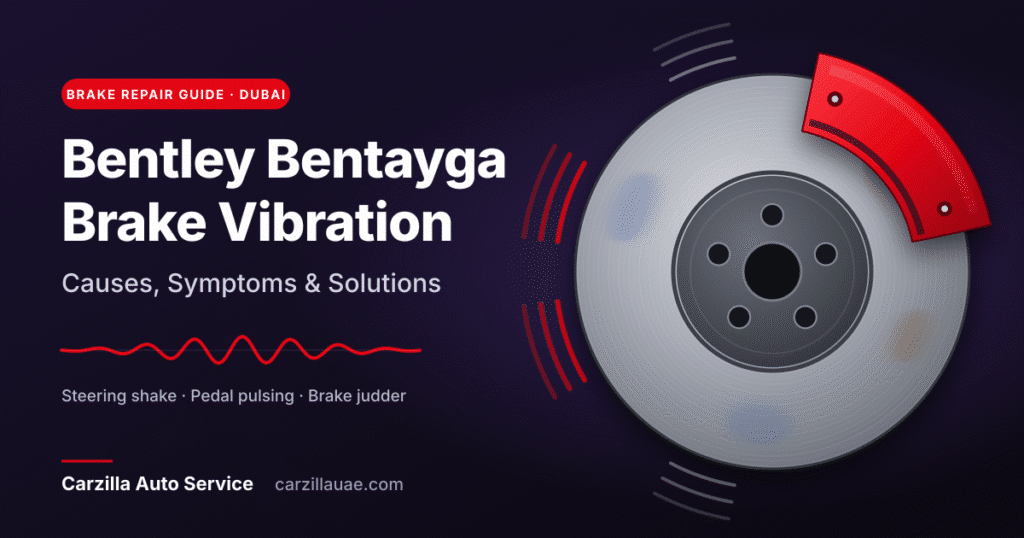
Brake vibration on a Bentley Bentayga is one of the most common complaints Bentley workshops in Dubai deal with. It usually shows up as a shake in the steering wheel, a pulsing brake pedal or a shudder through the floor when you slow down from motorway speed. Most owners are told their brake discs are “warped”, but that is rarely the full story, and on a Bentayga a wrong diagnosis is expensive because the discs, pads and calipers are among the largest fitted to any production car.
This guide explains how the Bentayga braking system works, the symptoms to look out for, what actually causes brake vibration, why the problem is more frequent in Dubai, how a Bentley specialist finds the real fault, the correct repair, and how to stop it from coming back.
How the Bentley Bentayga Brake System Is Built
To understand Bentayga brake judder, you first need to understand the size of the job these brakes do. A Bentayga weighs roughly 2.4 to 2.6 tonnes depending on the version, with the Hybrid and the Extended Wheelbase models at the heavier end. Every stop from 120 km/h turns a very large amount of movement into heat inside four brake discs.
Bentley fitted the Bentayga with two different brake systems:
- Standard cast iron brakes – ventilated iron discs of 400 mm at the front and 380 mm at the rear, with large fixed multi-piston calipers at the front. On the Bentayga V8, the front calipers are six-piston units.
- Optional carbon ceramic brakes – first offered with the Bentayga V8 and later on the Bentayga Speed, using 440 mm front discs with ten-piston calipers and 370 mm rear discs. At launch these were the largest front brake discs on any production car.
The rear calipers also carry the electronic parking brake (EPB) motors, and the brakes work alongside ABS, stability control and, on the Hybrid, regenerative braking from the electric motor. The front axle uses double wishbones and the rear uses a multi-link layout, both on air suspension, with 20 to 23 inch wheels depending on specification.
This matters for vibration diagnosis for three reasons. First, the mass of the car means very small faults in the disc surface are felt clearly. Second, the heavy wheels and low-profile tyres pass every irregularity straight into the steering. Third, iron and carbon ceramic discs fail in completely different ways, so the cause and the fix are not the same on both systems. If you are not sure which system your car has, a Bentley specialist can confirm it from the VIN during a Bentley Bentayga service.
Bentley Bentayga Brake Vibration Symptoms
Brake vibration is not one symptom. Where you feel it and when it happens point to different causes, so it is worth paying attention to the details before you take the car to a Bentley garage.
Steering wheel shakes when braking. A side-to-side shimmy in the steering wheel during braking, usually strongest between 120 and 60 km/h, points to the front axle. The front brakes do most of the work on a heavy SUV, so this is the most common Bentayga brake vibration complaint.
Brake pedal pulsing or pumping. A rhythmic push-back through the pedal, without the ABS light or the grinding noise of ABS working, normally means the disc thickness is no longer even all the way around. This can come from the front or the rear.
Shudder through the seat and floor. A vibration you feel in the body of the car rather than in your hands often comes from the rear discs. On the Bentayga, the rear brakes also work hard because the stability system uses them to control the car.
Vibration only when the brakes are hot. If the car is smooth around town but shakes after a fast motorway run or a long mountain descent such as Jebel Jais or the Hatta road, the disc is changing shape or picking up uneven pad material as it heats.
Vibration on the first drives after the car has been parked. A Bentayga that has stood for several weeks often judders on the first few stops, then either clears or stays. This is usually corrosion on the iron disc faces.
Vibration that is there without braking but gets worse when you brake. This is normally a tyre, wheel or suspension problem, not a brake disc problem. The braking load simply makes it more noticeable.
Squeal, groan or clicking with the vibration. Brake noise is also a form of vibration, just at a much higher frequency. Squeal, low-speed groan and clicking from the front corners each have their own causes, explained further below.
Pulling to one side as it vibrates, or a warning light. A pull, a brake warning, an ABS or stability control message, or an EPB fault alongside the vibration means a caliper, sensor or parking brake issue that should be checked straight away.
For a wider view of how brake problems develop, our guide on how to detect and fix common brake problems and our article on the warning signs that brake pads need replacing cover the basics that apply to every car.
What Causes Bentley Bentayga Brake Vibration?
The causes fall into three groups. Some start at the disc and pads themselves. Some are faults elsewhere that make a small brake problem feel much bigger. And some are not brake problems at all but feel exactly like one. A correct repair depends on knowing which group you are dealing with.
Brake Disc and Pad Causes of Bentayga Brake Judder
Disc thickness variation (DTV). This is the real cause behind most “warped disc” diagnoses. Iron brake discs very rarely warp. What happens instead is that the disc wears unevenly, so it becomes slightly thicker in some areas than others. A difference of only a few hundredths of a millimetre is enough to push the pistons back and forth with every turn of the wheel, and on a car as heavy as a Bentayga that is felt clearly in the pedal and the steering.
Uneven pad material deposits. Brake pads leave a thin, even layer of friction material on the disc. This layer is normal and necessary. If it is laid down unevenly, for example because the brakes were never properly bedded in, or because the car was held stationary with hot brakes clamped on, the disc develops patches with different grip. These patches grab harder on every revolution and create judder, and over time they cause uneven wear that turns into real thickness variation.
Lateral runout. If the disc does not spin perfectly flat, it wobbles slightly as it turns. The pads brush against the high spot with every revolution and wear it unevenly, which creates thickness variation over a few thousand kilometres. Runout on a Bentayga usually comes from rust or dirt between the hub face and the disc, a damaged hub, or wheel bolts tightened unevenly with an impact gun.
Corrosion from standing. Iron discs start to rust within days in humid coastal air. If the car stands for weeks, the area under the pads corrodes differently from the rest of the disc and can leave a clear pad-shaped mark. When the car is driven again, this patch grabs and vibrates. Light corrosion cleans off with use; deep pitting needs new discs.
Overheated discs. Repeated hard stops from high speed, or long descents with the brakes applied, can overheat the iron disc. Overheating changes the metal structure in patches, creates hard spots and leaves blue marks, and these spots wear at a different rate from the rest of the disc. Discs that are already close to minimum thickness overheat faster because there is less metal to absorb the heat. Our Bentley brake disc wear guide explains how wear patterns develop on Bentley discs in more detail.
Sticking caliper pistons and rear slides. The front calipers on the Bentayga are fixed multi-piston units. Brake dust and fine sand build up on the piston faces and dust seals, and in the heat the seals harden. If one or more pistons do not retract evenly, a pad keeps light contact with the disc, overheats it locally and leaves uneven deposits. At the rear, dry or seized slides and carriers do the same thing.
Electronic parking brake issues. The rear calipers contain the EPB motors. A parking brake that does not fully release, or a rear caliper that has been forced back without putting the EPB into service mode, can leave the rear pads dragging. This causes heat, uneven wear and a rear shudder.
Wrong or mixed parts. Pads that are not designed for the Bentayga’s disc type, cheap discs with poor metal quality, or new pads fitted to old discs (or the other way round) are a common cause of vibration returning soon after a brake job.
Problems That Make Brake Vibration Feel Worse
Worn front suspension bushes. Every time you brake, the braking force tries to twist the front hub. Healthy control arm bushes hold it in place. Worn or split bushes let the hub move, which turns a minor disc problem into a strong shake in the steering wheel. On a heavy SUV with large wheels, front lower arm bushes are a frequent cause of brake shimmy. If you replace the discs but ignore the bushes, the vibration often comes back. The same logic is covered in our article on Bentley Continental GT brakes and suspension, and the general warning signs are explained in common signs your car needs new suspension parts.
Worn tie rod ends and wheel bearings. Play in the steering joints or a worn wheel bearing lets the wheel move under braking load and makes vibration stronger. A worn wheel bearing can also cause disc runout on its own.
Tyres and wheels. The Bentayga runs very heavy wheels and low-profile tyres. A tyre that has developed a flat spot from standing in the heat, a tyre with an internal belt fault, a wheel that has lost a balance weight, or a 22 or 23 inch rim bent by a pothole or speed bump will all cause vibration. These faults are usually felt at a constant speed as well, but they become more obvious under braking. Our guides on rim repair cost in Dubai and cracked rim repair or replace explain when a bent wheel can be saved.
Faults That Feel Like Brake Vibration but Are Not
Rumble at low speed on full steering lock. Bentley has published a technical bulletin for Bentayga models with a rumble or vibration through the floor and steering column when manoeuvring slowly on full lock, for example in a car park. The repair is not on the brakes: it is a drain and refill of the front and centre differential oil, including the differential oil cooler. If the shake happens when you turn and creep rather than when you brake, the driveline should be checked first.
ABS working when it should not. ABS activation feels like a fast pulsing in the pedal with a buzzing noise. It is normal on a dusty road surface or during an emergency stop. If it happens at low speed on a clean, dry road, a wheel speed sensor or its sensor ring may be contaminated with brake dust and sand, or damaged. This is diagnosed by checking the wheel speed signals in live data with Bentley diagnostic software.
Gearbox downshifts and engine mounts. A knock or jolt as the car slows to a stop is often the 8-speed automatic gearbox changing down, or a worn engine or gearbox mount moving under engine braking, not the brakes. Our Bentley transmission repair team checks fluid condition and gearbox adaptations when this is suspected, and our article on signs your car’s motor mounts need replacement explains the mount side.
Brake squeal and groan. Squeal is the brake pad and disc vibrating at thousands of cycles per second. Bentley has issued several technical bulletins on Bentayga brake noise: rear squeal on iron brakes at different frequencies, repaired with a rear pad shim kit, a specified grease and in some cases revised rear caliper carriers; and a front squeal on 2017 to 2021 cars, listed for the UAE market, repaired with modified front calipers fitted with a vibration absorber and modified disc guard plates. These are noise problems rather than judder, but they are often reported together, and a good Bentley workshop separates them before replacing parts. For comparison, our article on why Rolls-Royce brake noise happens at low speeds explains the same physics on another heavy luxury car.
Clicking from the front wheels when braking. A click or tick from the front corners as you brake from low speed is a known Bentayga complaint. Bentley’s guidance points to the contact surfaces between the wheel and the brake disc and to the condition of the wheel bolts, not to a failed brake component.
Why Brake Vibration Is More Common on Bentaygas in Dubai
The same car driven in Europe and in Dubai does not wear its brakes the same way. Several local conditions push the Bentayga towards brake judder.
High-speed stops. Sheikh Mohammed Bin Zayed Road, Emirates Road and Al Khail Road allow high cruising speeds, and traffic often slows suddenly. The energy a brake must absorb rises with the square of speed, so a stop from 140 km/h puts far more heat into the discs than a stop from 100 km/h. Repeated high-speed stops create hot spots and uneven pad deposits.
Heat that the brakes cannot get rid of. With air temperatures above 45°C in summer and road surfaces much hotter, brake discs start from a higher temperature and cool more slowly between stops. Stop-start traffic on Sheikh Zayed Road at rush hour adds hundreds of brake cycles with very little cooling time.
Parking with hot brakes clamped. Holding the car on the footbrake or with Auto Hold at a traffic light straight after a hard stop presses the hot pads against one spot on the disc. This leaves a pad-shaped deposit that causes judder later.
Long periods standing. Many Bentaygas in Dubai stand for weeks during summer travel or are used as second cars. Humid air near the coast rusts the iron discs where the pads sit, and the tyres can develop flat spots in the heat.
Sand and dust. Fine sand gets into caliper seals, slides and the EPB mechanism, and mixes with brake dust on the wheel speed sensors. It also acts as an abrasive on the disc surface.
Car washes and wheel cleaners. Bentley’s own brake noise guidance lists chemical contamination of the disc from wheel or tyre cleaner sprayed directly onto it. Strong acid-based wheel cleaners used at some car washes can mark the disc and pads unevenly. Our article on car detailing vs car washing for your Bentley explains safer cleaning methods.
Speed bumps, potholes and kerbs. Large, low-profile wheels are easily bent by speed bumps in residential communities and car parks. A slightly bent rim is one of the most common causes of vibration that owners mistake for a brake fault. Regular checks, as explained in how wheel alignment protects your tires in Dubai, catch this early.
For a broader look at how the local climate affects luxury cars, see our guide on how to take care of your luxury car in Dubai’s harsh climate.
Carbon Ceramic Brakes and the Bentayga Hybrid: What Changes
Carbon ceramic brake vibration. Carbon ceramic discs do not rust and do not warp in the way iron discs can, so the causes are different. Vibration on a carbon ceramic Bentayga usually comes from uneven pad material on the disc surface, glazed pads from long periods of very light braking, the wrong pad compound, or damage such as chipped edges and surface cracks. Carbon ceramic discs also wear by losing material from inside the disc as they oxidise at high temperature, so their condition is judged by weighing the disc against the minimum weight Bentley specifies, not by measuring thickness alone. They must never be skimmed on a brake lathe. Because these discs are very expensive, an accurate diagnosis before replacement is essential.
Bentayga Hybrid brake vibration. On the Bentayga Hybrid, much of the everyday slowing down is done by the electric motor recovering energy, so the friction brakes are used less. Lightly used iron discs collect more corrosion and uneven deposits, which can cause judder when the friction brakes take over during a firm stop. Hybrid Bentaygas that are mostly driven in town benefit from regular firm, safe stops to keep the disc surfaces clean. Any brake work on the Hybrid must also follow high-voltage safety procedures, which is part of our EV and hybrid repair work.
How a Bentley Specialist Diagnoses Bentayga Brake Vibration
Replacing discs and pads without finding the cause is the main reason brake vibration comes back on a Bentayga. A proper diagnosis at a Bentley service center or specialist garage follows a clear order.
Road test to reproduce the fault. The technician brakes from different speeds and with different pressure, with the brakes cold and hot, and notes whether the vibration is in the steering, the pedal or the seat. They also check whether the vibration is there without braking, and test slow manoeuvring on full lock to rule out driveline rumble.
Diagnostic scan. A full scan with Bentley-level ODIS software checks the ABS, stability control and EPB modules for stored faults, and live data confirms that all four wheel speed signals are clean. A battery and voltage check comes first, because low voltage causes false EPB and stability control faults on Bentleys. Our article on why regular car diagnostics prevent expensive repairs explains why this step matters.
Disc measurement on the lift. On iron discs, the thickness is measured with a micrometer at several points around the disc to find thickness variation, and a dial gauge measures lateral runout with the wheel bolts torqued correctly. The disc is checked against the minimum thickness stamped on it. Carbon ceramic discs are inspected for cracks and edge damage and weighed against the factory limit.
Pads, calipers and parking brake. The pads are checked for uneven wear, glazing, cracking and taper. The front caliper pistons are checked for free movement, and the rear slides and carriers for corrosion. The EPB is put into service mode with the diagnostic tool before any rear caliper work, because forcing an EPB piston back can damage the caliper.
Hub faces and wheel contact surfaces. The hub face is checked for rust and damage, and the wheel bolts and wheel contact surfaces are inspected, following Bentley’s guidance on front clicking complaints.
Suspension, steering and wheels. Front control arm bushes, tie rod ends and wheel bearings are checked for play under load. The wheels are checked for bends and balance, and the tyres for flat spots, uneven wear and age. A full car inspection on the lift covers these in one visit.
Only when every step is complete should a Bentley mechanic recommend parts. This is the approach we follow at our Bentley repair Dubai workshop.
Bentley Bentayga Brake Vibration Solutions
The right fix depends on what the diagnosis finds. These are the correct repairs for each cause.
Brake disc and pad replacement. If the discs have thickness variation, deep corrosion, heat damage or are near minimum thickness, the correct repair is new discs and new pads on the whole axle, both sides together. Genuine Bentley or OE-supplier parts matched to your disc type should be used, with new wear sensors where required. Fitting new pads to judder-affected discs does not cure the vibration. Our luxury car brake repair service covers Bentayga disc and pad replacement, and our article on brake pad replacement explains what a correct pad job includes.
On-car disc machining, only in the right cases. An iron disc that still has plenty of thickness and only minor runout can sometimes be corrected with an on-car brake lathe, which machines the disc true to its own hub. This is not suitable for thin, heat-damaged or cracked discs, because removing more metal makes them run hotter and judder again. Carbon ceramic discs are never machined.
Hub cleaning and correct wheel fitting. Every disc replacement must include cleaning the hub face back to bare metal so the new disc sits perfectly flat. The wheels are then tightened by hand with a calibrated torque wrench in the correct sequence, never with an impact gun. Damaged wheel bolts are replaced.
Caliper service or replacement. Sticking front pistons are cleaned and freed, and seals renewed where needed, or the caliper is replaced if the bore is corroded. At the rear, slides and carriers are cleaned and lubricated with the correct grease. Where a known noise bulletin applies to your car, the updated shims, grease or calipers should be fitted at the same time.
Electronic parking brake repair. A dragging rear brake caused by the EPB needs the motor and caliper checked, faults cleared and the system put through its service and calibration routine with the diagnostic tool after the work.
Correct bedding-in. New pads and discs must be bedded in so the pad material is laid down evenly. Bentley’s procedure for the Bentayga uses a series of progressive stops, starting with light braking from around 100 to 120 km/h down to about 40 km/h, then gradually firmer braking with only a few full stops, and driving in between so the brakes cool before the next stop. Skipping this step is one of the most common reasons judder comes back within weeks.
Suspension and steering repair. If worn bushes, tie rods or wheel bearings are found, they must be replaced at the same time as the brakes. Bushes are tightened with the car at its normal ride height, not hanging on the lift, and a wheel alignment is done afterwards. Our Bentley suspension repair and car steering repair teams handle this in the same visit.
Tyre and wheel correction. Bent rims are straightened or replaced, wheels are balanced, and tyres with flat spots, internal damage or heat ageing are replaced with the correct size and load rating. Our auto tyre services cover balancing and fitting for large luxury SUV wheels, and our SUV tyre load index guide explains why load rating matters on a car of the Bentayga’s weight.
Driveline service. If the vibration is the low-speed rumble on full lock, the front and centre differential oil is drained and refilled to Bentley’s procedure, including the differential oil cooler, with new single-use plugs and seals.
How to Prevent Brake Vibration on a Bentley Bentayga
Most Bentayga brake vibration can be avoided with good driving habits and regular checks.
- Drive the car regularly. If the Bentayga will stand for more than two or three weeks, have it driven or plan a short drive with a few gentle stops before using it at high speed.
- Avoid clamping hot brakes. After a hard stop from high speed or a long descent, avoid holding heavy pressure on the pedal at a standstill where it is safe to do so, and give the brakes time to cool before parking.
- Brake progressively. Leave a safe gap on the motorway so you can slow down gradually rather than making repeated hard stops from high speed.
- Keep wheel cleaner off the discs. Ask car wash and detailing staff not to spray acid-based wheel cleaner onto the brake discs, and rinse the brakes with water if it happens.
- Bed in new brakes properly. Make sure any brake job includes the correct bedding-in drive, and avoid hard braking for the first few hundred kilometres.
- Check the brakes at every service. In Dubai, a brake inspection every 6 to 9 months, with disc and pad measurements recorded, catches uneven wear before it becomes judder. This fits into a Bentley Bentayga major service or a minor service at our Bentley service Dubai workshop.
- Change the brake fluid on time. Brake fluid absorbs moisture, especially in coastal humidity. Changing it every two years protects the calipers and ABS unit from internal corrosion.
- Look after the suspension and wheels. Take speed bumps slowly, avoid kerbs, and have the alignment checked after any heavy impact. Healthy bushes and straight wheels stop a small brake fault from becoming a strong vibration.
- Use the right parts. Insist on genuine Bentley or OE-supplier discs and pads matched to your brake system, and replace discs and pads as an axle set.
Our guides on brake maintenance, luxury car maintenance schedules in the UAE and Bentley maintenance and repair guidelines give more detail on keeping a Bentley in good condition between visits.
Is It Safe to Drive a Bentayga With Brake Vibration?
Mild brake judder does not usually mean the brakes will stop working, but it should not be ignored. Vibration reduces the contact between the pads and the disc, which can lengthen stopping distances in an emergency, and on a 2.5 tonne SUV that difference matters. Vibration also speeds up wear on suspension bushes, steering joints and wheel bearings, turning a brake repair into a much larger bill.
Stop driving and have the car checked as soon as possible if the vibration is getting worse quickly, if the car pulls hard to one side, if you hear grinding, if the pedal feels soft or goes lower than normal, or if a brake, ABS, stability control or parking brake warning appears. Our article on why timely brake service keeps you safe on the road explains the risks in more detail.
Bentley Bentayga Brake Repair in Dubai at Carzilla
Carzilla Auto Service is an independent Bentley specialist workshop in Al Quoz Industrial Area 2, repairing the Bentayga W12, V8, Speed, Hybrid and EWB alongside the Continental GT and Flying Spur. Every Bentayga brake vibration job starts with a road test, a full ODIS scan and a lift inspection of the brakes, suspension, steering and wheels, so the real cause is found before any parts are fitted.
Our Bentley mechanics fit genuine Bentley and OE-supplier discs and pads for both iron and carbon ceramic systems, put the electronic parking brake into service mode correctly, clean the hubs, torque the wheels by hand and bed in the new brakes to Bentley’s procedure. You receive a written quote before work starts, Warranty on Repair, and Free Pickup and Delivery* anywhere in Dubai. If you are searching for a Bentley brake repair garage near me, our auto garage in Al Quoz is easy to reach from Sheikh Zayed Road and Al Khail Road, and payment in instalments is available through Tabby.
To book a Bentley Bentayga brake inspection, call 056 684 9665 or visit our contact page. You can also read our guide to the most common Bentley problems and repairs or learn how to identify Bentayga air suspension problems early.
*Free Pickup and Delivery terms apply.
Bentley Bentayga Brake Vibration FAQs
Why does my Bentley Bentayga shake when I brake at high speed?
The most common cause is disc thickness variation on the front iron discs, often started by uneven pad deposits from hard high-speed stops or from holding hot brakes clamped at a standstill. Worn front control arm bushes and bent wheels make the shake stronger. A Bentley specialist should measure the discs and check the suspension before replacing parts.
Are Bentayga brake discs really warped?
Usually not. Iron discs rarely warp. The vibration normally comes from the disc becoming slightly thicker in some places than others, from uneven pad material on the surface, or from runout caused by rust on the hub face.
Can carbon ceramic brakes on a Bentayga cause vibration?
Yes, although they do not rust or warp like iron discs. Carbon ceramic brake vibration usually comes from uneven pad deposits, glazed or incorrect pads, or surface damage. The discs are checked by weight and must never be machined.
Why did the vibration come back after new brake discs?
The most common reasons are that the hub faces were not cleaned, the wheels were tightened with an impact gun, the brakes were not bedded in properly, worn suspension bushes were left in place, or low-quality parts were used.
How often should Bentayga brakes be checked in Dubai?
Have the discs and pads measured at every service, ideally every 6 to 9 months in Dubai conditions, and change the brake fluid every two years.
Can I drive my Bentayga to the workshop with brake vibration?
If the vibration is mild and there are no warning lights, pulling or grinding, the car can usually be driven carefully to a Bentley workshop. If any of those signs are present, arrange collection or recovery instead.