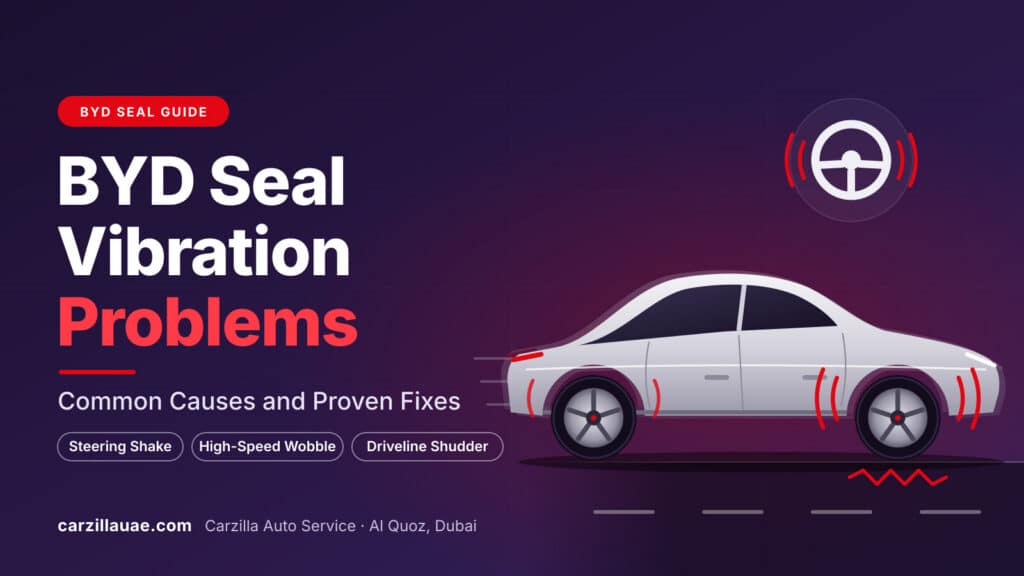
BYD Seal vibration is one of the most talked-about issues among Seal owners. It shows up in several different ways: a buzz in the steering wheel on rough roads, a shake at highway speed, a shudder when accelerating hard, or a knock over speed bumps. Each type has a different cause and a different fix.
Most BYD Seal vibration problems come from six areas: tyres and wheels, rear driveshafts and CV joints, front suspension and steering, wheel alignment, brake discs, and the electric drive unit and its mounts. In most cases the fault can be found and fixed without replacing expensive parts, as long as the car is measured properly before anything is changed.
This guide explains why the BYD Seal vibrates, how to identify the type of vibration you have, how each problem is fixed, and how to prevent it. It covers the rear-wheel-drive BYD Seal Design and Premium and the all-wheel-drive BYD Seal Performance sold in the UAE. If you need the car checked, our BYD Seal repair Dubai workshop handles all of the work described below.
Why the BYD Seal Is Prone to Vibration
The BYD Seal is a refined car, but several parts of its design make vibration easier to feel and, in some cases, more likely to develop.
- High weight. UAE-spec Seals weigh between about 2,055 kg and 2,185 kg. Autocar weighed a rear-wheel-drive test car at 2,116 kg, around 60 kg more than BYD’s claimed figure. A heavy car loads its tyres, bushes, ball joints and wheel bearings harder, and any imbalance in a heavy wheel is felt more.
- Low-profile 19-inch tyres. All UAE trims use 19-inch alloy wheels with 235/45 R19 tyres. A 45-profile sidewall absorbs less, so rim damage, tyre faults and rough road surfaces reach the cabin more directly.
- Instant electric torque. The rear motor delivers 360 Nm from zero, and the Performance AWD delivers 670 Nm combined. That torque arrives instantly and loads the driveshafts, CV joints and motor mounts much harder than a petrol engine does.
- A very stiff body. The Seal uses BYD’s Cell-to-Body (CTB) design, where the Blade Battery forms part of the car’s floor. BYD claims a torsional stiffness of 40,500 Nm per degree. A stiff body handles well, but it also passes vibration from the suspension into the cabin with less damping.
- No engine noise. There is no engine to mask small vibrations, so a buzz or shake that would go unnoticed in a petrol saloon is obvious in a Seal.
Independent testers have noticed this too. In its full road test, Autocar reported constant, speed-dependent vibrations through the steering wheel on rough surfaces, which eased at motorway speeds but never fully disappeared. It described the front axle as lacking isolation at low speed.
These EV traits also change how often parts wear, which we explain in our guide to EV vs petrol car maintenance costs in the UAE.
BYD Seal Specifications That Affect Vibration
Many BYD Seal vibration problems start with something as simple as wrong tyre pressure or incorrect wheel nut torque. These are the figures that matter.
| Item | BYD Seal specification |
|---|---|
| UAE trims | Design and Premium (rear-wheel drive, 230 kW / 360 Nm); Performance (all-wheel drive, 390 kW / 670 Nm) |
| Front motor (Performance) | Induction (asynchronous) motor, 160 kW |
| Wheels and tyres | 19-inch alloys, 235/45 R19 99V XL |
| Wheel fitment | 5 x 120 bolt pattern, 64.1 mm centre bore |
| Cold tyre pressure | 250 kPa (2.5 bar / 36 psi) front, 290 kPa (2.9 bar / 42 psi) rear |
| Hot tyre pressure | 30–40 kPa above the cold figure is normal |
| Wheel nut torque | Published figures are around 120–130 Nm; confirm against BYD service data |
| Front suspension | Double wishbone |
| Rear suspension | Multi-link (five-link) |
| Dampers | Conventional or Frequency Selective Damping (FSD) depending on version; the 2025 update brought FSD to the Premium and DiSus-C adaptive damping to the Performance in many markets |
| Tyre rotation | Every 10,000 km (BYD service schedule) |
| Wheel alignment and wheel bearings | Checked at scheduled services |
| Rear drive unit gear oil | First change at 24 months or 40,000 km, then at regular intervals with the filter |
Note that the rear tyres run at a higher pressure than the fronts. Tyre shops sometimes set all four tyres to the same value, which changes how the car rides, steers and wears its tyres.
How to Identify the Type of BYD Seal Vibration
Before any repair, it helps to describe the vibration accurately. Four questions narrow down the cause quickly.
Does the BYD Seal Vibrate at a Certain Speed?
A vibration that appears at a set speed and fades above or below it usually comes from something turning at wheel speed: a tyre, a rim, wheel balance or a driveshaft.
On an electric car, the driveshafts sit after the reduction gear, so they turn at exactly the same speed as the wheels. This is why a driveshaft fault and a tyre fault can feel almost identical, and why tyres must be ruled out first.
The table below shows how fast a Seal’s 235/45 R19 wheel turns. A fault that happens once per wheel turn pulses at this rate.
| Road speed | Wheel turns per second | What a once-per-turn fault feels like |
|---|---|---|
| 60 km/h | About 7.6 | Slow thump or wobble |
| 80 km/h | About 10.2 | Steady shake |
| 100 km/h | About 12.7 | Clear shake in the steering wheel or seat |
| 120 km/h | About 15.3 | Fast shake, often worst in this range |
| 140 km/h | About 17.8 | Fine, fast vibration |
A worn inner CV joint pulses three times per wheel turn under load, so it feels like a faster shudder than a tyre fault at the same speed. A motor or reduction gear fault pulses many times faster again, so it is felt as a hum, whine or buzz, not a shake.
Does It Change When You Accelerate or Lift Off?
If the vibration appears under hard acceleration and stops when you ease off at the same speed, the cause is in the driveline: driveshafts, CV joints or motor mounts. Tyres and rims vibrate the same whether you are accelerating or coasting.
Does It Depend on the Road Surface?
A buzz that only appears on concrete, grooved or rough asphalt at lower speeds is road texture coming through the tyres, suspension and steering column.
Does It Only Happen When Braking?
A shake that only appears when braking is almost always a brake disc problem.
Where Do You Feel It?
- Steering wheel: front wheels, front suspension or steering.
- Seat and floor: rear wheels, rear driveshafts or rear motor mounts.
- Brake pedal: brake discs.
- One trim panel or the dashboard: usually a rattle or a resonating part.
For a broader look at how mechanics narrow down faults like these, see 10 common car problems and how to diagnose them.
BYD Seal Steering Wheel Vibration on Rough Roads
This is the most widely reported BYD Seal vibration complaint, and it is different from a wheel balance problem.
What Owners Notice
Owners on BYD forums describe a buzz or fine vibration in the steering wheel, felt most at the top of the wheel and in the trim around the indicator and wiper stalks. It usually appears between about 25 and 60 km/h, is strongest on porous asphalt, concrete roads and expansion joints, and is sometimes louder when turning one way. One owner in New Zealand described the steering as feeling like driving on gravel when the road was smooth. Several owners report it from the first few hundred kilometres.
Dealers have tried different fixes, including new tyres and, in some cases, a replacement head-up display. Results have been mixed, which shows the buzz can come from more than one source.
Why BYD Seal Steering Vibration Happens
- Front axle tuning. The firm front suspension and stiff body pass more road texture into the steering than many rivals. This is a design trait, and reviewers noticed it on new cars.
- Wrong tyre pressures. Tyres pumped up hot at a fuel station, or set above the placard value, become stiffer and transmit more road texture into the steering.
- Steering column and intermediate shaft. The shaft between the steering wheel and the steering rack has universal joints and a sliding section. A loose clamp bolt or slight play lets road vibration buzz through the column.
- Electric power steering (EPS) rack mounts. The rack is bolted to the subframe through rubber mounts. Worn or loose mounts let the rack move and amplify road texture.
- Head-up display and dashboard trim. The HUD unit and surrounding panels can resonate at certain road frequencies. If the buzz is mainly heard and felt in the trim rather than the wheel rim, a resonating dash part is likely.
- Worn front bushes and ball joints. Wear in the double wishbone joints lets more road vibration through.
How to Fix BYD Seal Steering Wheel Vibration
- Set tyre pressures cold to 250 kPa front and 290 kPa rear, then retest on the same road.
- Road test on the exact surface that causes the buzz, using a vibration analyser or chassis microphones on the column, HUD, dash and front suspension to find where the vibration is strongest.
- Check and re-torque the intermediate shaft joints and clamp bolts.
- Check the steering rack mounts, inner and outer tie rods for play.
- Inspect front bushes and ball joints on a lift.
- Secure or insulate any resonating trim, or repair a loose HUD mount.
Our car steering repair service covers the steering column, tie rods, rack mounts and EPS. For more on steering rack faults, read our article on steering box repair in Dubai. If the fault is traced to the HUD or other electronics, our car electrician team handles the electrical side.
Does the 2025 BYD Seal Update Reduce Steering Vibration?
For the 2025 update, BYD revised the suspension in many markets. The Premium gained FSD dampers and the Performance moved to DiSus-C adaptive damping, which softens the dampers on bumpy roads. This improves low-speed ride, but it does not change the steering column, tyres or tie rods, so a buzz caused by those parts still needs to be fixed separately.
BYD Seal Shaking at High Speed: Wheels, Tyres and Rims
If your BYD Seal shakes at 90 to 120 km/h and the shake stays the same whether you are accelerating or coasting, the cause is almost always a wheel or tyre. It is also the cheapest type of vibration to fix, so it is always checked first.
Tyre Flat Spots From Parking in the Heat
When a heavy EV sits in one place for days in 40°C+ heat, the part of the tyre touching the ground softens and takes on a flat shape. On the next drive, it thumps once per wheel turn. Light flat spots usually go after 10 to 20 minutes of driving. A Seal left parked for weeks during summer travel can develop flat spots that never fully recover.
Tyre Road Force Variation
A tyre can be perfectly balanced and still vibrate if its construction is slightly stiffer in one spot. A normal balancer cannot detect this. A road force balancer presses a roller against the tyre with the weight of the car, finds the stiff spot, and allows the tyre to be turned on the rim to cancel it out (called match mounting).
Bent Rims From Potholes, Kerbs and Speed Bumps
The Seal’s 19-inch rims with 45-profile tyres bend easily, often on the inner lip where you cannot see it with the wheel fitted. A slightly bent rim shakes the steering wheel at highway speed and can leak air slowly. Most bent alloys can be straightened if they are not cracked. Read how wheel rims are repaired, whether a cracked rim should be repaired or replaced and what rim repair costs in Dubai. Corrosion where the tyre seals against the rim also causes uneven seating and slow leaks; see corroded rims causing air leaks.
Lost Wheel Weights and Poor Balancing
A wheel weight that falls off after a car wash or a pothole leaves the wheel out of balance, and the steering wheel shakes in a specific speed band.
Wrong Wheel Nut Torque and Dirty Hub Faces
Wheel nuts tightened unevenly with an impact gun, or a wheel fitted against a rusty or dirty hub face, makes the wheel sit slightly off-true. Nuts should be tightened with a torque wrench in a star pattern to BYD’s specification.
Aftermarket Wheels and Tyres
The Seal uses a 64.1 mm centre bore. Aftermarket rims with a larger bore must be fitted with the correct hub-centric rings, or the wheel sits off-centre and vibrates no matter how often it is balanced. Seal owners who fitted larger 20-inch aftermarket wheels have reported more small vibrations and a drop in range. If you are planning a wheel change, check the car modification rules in Dubai and have fitment confirmed by our car modification team first.
How to Fix BYD Seal High-Speed Vibration
- Set tyre pressures cold to the door placard values.
- Inspect each tyre for bulges, flat spots, uneven wear and the DOT date.
- Check each rim for runout, including the inner lip.
- Road force balance all four wheels and match mount any tyre with high road force.
- Straighten or replace bent rims.
- Clean the hub faces and torque the wheel nuts correctly.
- Check the wheel alignment.
When new tyres are needed, choose the correct size, load index and speed rating. Our guides to choosing the right tyres, buying tyres online in the UAE and how to spot the best tyre shop in Dubai explain what to check. All of this work is carried out by our auto tyre services team.
BYD Seal Shudder When Accelerating: Driveshafts, CV Joints and Motor Mounts
A BYD Seal shudder when accelerating that disappears when you ease off is a driveline problem. It is the most serious type of vibration on the Seal because it puts extra load on the drive unit.
Rear Driveshaft Vibration on the BYD Seal Premium and Performance
On both the rear-wheel-drive and all-wheel-drive Seal, the rear motor drives the rear wheels through two driveshafts. Workshop and owner reports from Australia describe a distinct shudder or wobble under hard acceleration on 2023–2025 Seal Premium and Performance models, in two speed bands:
- Around 55 to 70 km/h
- Around 100 to 120 km/h
The reported cause was a manufacturing defect in the rear driveshafts, which could be out of balance or not stiff enough for the motor’s torque. A technical service bulletin was reported, and the fix was to replace both rear driveshafts. In some cases, the vibration had also damaged rubber seals at the rear motor unit.
The correct order of checks is:
- Road force balance the tyres to rule them out.
- If the shudder remains under acceleration, inspect the rear driveshafts.
A Seal still under manufacturer warranty should have this documented and taken to the dealer. A written diagnosis showing the tyres have been ruled out makes the claim much easier.
Worn CV Joints and Torn CV Boots
The inner CV joints on most modern driveshafts are tripod joints, with three rollers sliding in three tracks. When a tripod joint wears, it pushes the shaft in and out slightly three times per turn under load. The result is a shudder when accelerating, often at low to medium speed, that goes away when coasting.
Outer CV joints click or knock when accelerating on full steering lock, for example when pulling out of a parking space.
CV joints usually fail after the rubber boot splits. Grease escapes and fine sand gets in, which grinds the joint quickly. A torn boot caught early only needs a new boot and fresh grease. A noisy joint needs the driveshaft replaced.
Front Driveshafts on the BYD Seal Performance AWD
The Seal Performance adds a front induction motor with its own pair of front driveshafts. The front axle takes sudden full torque on hard launches, so worn front CV joints are often felt through the steering wheel when accelerating hard with some steering lock. On the Performance, iTAC torque control can also feel like a brief judder when it cuts torque on sand, painted lines or wet car park ramps. If it only happens on slippery surfaces and no warning light appears, it is the system working normally.
Motor Mounts and Subframe Bushes
The Seal’s drive units sit on rubber mounts and are carried on subframes with their own bushes. When a mount cracks or softens, the motor moves under torque. Typical signs are:
- A clunk when moving off, or when switching between Drive and Reverse.
- A thump or shudder when pressing the accelerator hard, then again when lifting off and regenerative braking takes over.
- More vibration through the floor under load.
Read our guide to signs your car’s motor mounts need replacement for the full list of symptoms.
How to Fix BYD Seal Acceleration Shudder
- Replace driveshafts with worn joints or confirmed imbalance, in pairs on the same axle.
- Replace torn CV boots and repack the joint with the correct grease if the joint is still good.
- Replace cracked or collapsed motor mounts and worn subframe bushes, tightening bolts with the car at normal ride height.
- Tighten driveshaft hub nuts to the correct torque, with new nuts where specified.
- Road test under the same conditions that caused the shudder.
For more on the Seal’s electric drive system, see our guide to BYD Seal EV motor diagnostics.
BYD Seal Suspension Knock and Vibration Over Bumps
The Seal’s ride is firm by design, but a distinct knock or clunk over bumps is not normal. Workshops that service the Seal report that the most common causes are small, inexpensive parts.
Anti-Roll Bar Links and Bushes
The anti-roll bar links connect the anti-roll bar to the suspension. When their ball joints wear, they knock over small bumps at low speed and over speed bumps. Anti-roll bar links and their bushes are the first thing to check when a Seal knocks, and they are quick to confirm on a lift.
Front Double Wishbone Bushes and Ball Joints
The upper and lower control arms are mounted on rubber bushes. Dubai’s many speed bumps put heavy loads through these bushes on a two-tonne car. Once the rubber cracks or softens, the wheel moves slightly under load, causing a shimmy after bumps, a shudder when braking, vague steering on the motorway and uneven tyre wear. Worn ball joints add knocking and play.
Rear Multi-Link Bushes
The rear suspension uses several links, each with bushes at both ends. Worn rear bushes let the rear wheels steer slightly under load, which you feel as a shudder through the seat and see as inner-edge tyre wear.
Shock Absorbers, FSD Dampers and DiSus-C
A leaking or worn damper lets the wheel bounce after a bump instead of settling. On a Seal this feels like a repeated patter over road joints, and the tyre starts to wear in a cupped (scalloped) pattern, which then creates its own hum and vibration. On cars with DiSus-C adaptive damping, a damper or sensor fault may also show a warning on the dashboard. See signs of bad shock absorbers.
How to Fix BYD Seal Suspension Noise and Vibration
- Replace worn anti-roll bar links, bushes, ball joints and dampers, with dampers replaced in pairs per axle.
- Tighten bush bolts with the car at normal ride height so the new rubber is not pre-twisted.
- Carry out a four-wheel alignment after any suspension work.
Our guides to common signs your car needs new suspension parts and car suspension problems in Dubai explain the warning signs. The repair itself is carried out by our car suspension repair team.
BYD Seal Uneven Tyre Wear and Wheel Alignment Problems
Uneven tyre wear is both a result of other faults and a cause of vibration in its own right. A tyre that has worn in patches or steps is no longer round, so it hums and vibrates, and balancing cannot fix it.
Why BYD Seal Tyres Wear Unevenly
- Rear tyres wear faster. On the rear-wheel-drive Seal, the rear tyres put all of the motor’s torque onto the road. One UK workshop measured a 2025 Seal at about 29,000 km with the rear tyres down to 2 mm while the fronts still had 3.5 mm.
- Inner-edge wear on the Performance. Owners of the Seal Performance have reported the factory tyres reaching their wear indicators in as little as 10,000 to 15,000 km, mostly on the inner shoulders. The car’s weight, its torque and its factory alignment settings all play a part. Like most performance saloons, the Seal’s rear axle is set with some negative camber and toe-in for stability, which loads the inner edge of the tyre.
- Alignment drift. Kerb strikes, potholes and worn bushes change the alignment over time. Even a small change in rear toe wears the inner edge quickly on a heavy, powerful car.
- Wrong pressures. Running the rear tyres at the front pressure, or the other way round, changes how each tyre wears.
How to Fix BYD Seal Tyre Wear and Alignment Vibration
- Replace tyres that have worn in steps, cups or feathered patterns. They will keep vibrating even after alignment.
- Check the suspension for worn bushes first. An alignment on worn bushes will not hold.
- Carry out a four-wheel alignment to BYD’s figures and reset the steering angle sensor afterwards.
- Rotate the tyres every 10,000 km, or more often on the Performance AWD.
Choose tyres with the correct load rating for a heavy EV; our tyre load index guide explains how to read it. Read more about how wheel alignment protects your tyres in Dubai and why a professional wheel alignment matters on luxury and performance cars.
BYD Seal Vibration When Braking
If the steering wheel shakes or the brake pedal pulses only when braking, the cause is almost always the brake discs. Because regenerative braking does most of the stopping, the Seal’s friction brakes are used lightly. The discs rust more easily, pad material builds up unevenly, and the rear discs in particular can develop rust bands when the car is parked for long periods.
The fix is usually machining or replacing the discs, fitting new pads, bedding them in correctly for an EV and servicing the calipers. We cover this fully in our dedicated guide: BYD Seal steering wheel shakes when braking. For general brake care, see our guide to brake maintenance, read how BYD’s electronic brake systems are set up in our BYD Han brake system calibration article, or book our car brake repair service.
BYD Seal Hum, Whine or Clunk From the Drive Unit
Faults in the electric drive unit show up as a hum, whine or fine buzz rather than a slow shake, and they usually change between accelerating and regenerating.
Reduction Gear Oil and Bearing Noise
The motor drives the wheels through a single-speed reduction gear and differential with its own oil. On the Seal, BYD’s schedule calls for the first gear oil change at 24 months or 40,000 km, then regular changes with the filter. Worn bearings or old, low oil produce a whine or hum that rises with speed and changes when switching between driving and regenerating. Our gearbox repair team services EV reduction gearboxes.
Motor Position Sensor Faults
The motor controller reads the exact position of the rotor from a position sensor called a resolver. If the resolver signal is weak or noisy, for example because of a damaged connector, the motor delivers uneven torque. This feels like a fine shudder or jerk when pulling away and may come with a warning light or reduced power. A BYD-level diagnostic tool can read live motor data to confirm it. This is part of the work carried out at our EV repair Dubai workshop.
Clunk When Lifting Off the Accelerator
When you lift off the accelerator, the motor switches from driving the car to slowing it with regenerative braking, and the torque reverses direction. If there is wear in the motor mounts or play in the driveline, you feel a short clunk or shudder at that moment. Changing the regen level may hide it slightly, but the real fix is to replace the worn part.
AC Compressor Vibration Through the Dashboard
The Seal’s electric AC compressor works hard in UAE summer, and the same refrigerant system also helps cool the battery. Worn compressor mounts, an overcharged system or a failing compressor can cause a low hum or vibration through the dashboard when the AC is running hard, even when the car is parked. Read our article on car AC compressor repair in Dubai, and see how cooling problems affect BYD batteries in our guide to BYD Atto 3 battery cooling issues in UAE heat.
Rattles and Buzzes That Feel Like Vibration
Some “vibrations” are actually rattles from trim or loose items. Common examples on the Seal include:
- Items sliding in the open tray under the centre console, which Autocar noted rattles on the move.
- Items in the door bins and centre storage.
- The panoramic roof sunshade and its trim.
- Dashboard panels around the HUD and the rotating screen.
- Door trim and seals on rough roads.
A simple test: if the noise changes when you press on a panel or empty the storage areas, it is a rattle, not a mechanical fault. Rattles are fixed by securing or padding the trim, not by replacing suspension or drive parts.
How Mechanics Diagnose BYD Seal Vibration
The main reason vibration repairs fail is guesswork: balancing the wheels, then replacing discs, then changing tyres, without ever measuring anything. A proper BYD Seal vibration diagnosis follows a set order.
- Road test with a vibration analyser. The technician records the speed where the vibration starts and stops, whether it changes when accelerating, coasting or regenerating, and its frequency. The frequency shows what is turning: wheel speed points to tyres, rims or driveshafts; three times wheel speed under load points to a CV joint; a much higher frequency points to the motor or reduction gear.
- Full diagnostic scan. The motor controllers, battery management, brakes, stability control, EPS and damping system are scanned with BYD-specific equipment. Live data from the wheel speed sensors and motors can show faults that never set a warning light.
- Tyre and wheel checks. Cold pressures, tyre condition and DOT date, rim runout including the inner lip, and road force balancing. Wheels may be swapped front to rear to see if the vibration moves.
- Lift inspection. Driveshafts and CV boots, motor mounts and subframe bushes, anti-roll bar links, control arm bushes, ball joints, dampers, tie rods, steering rack mounts, intermediate shaft, wheel bearings and brake discs.
- Alignment check. All four wheels are measured against BYD’s figures.
- Repair and confirmation road test under the same conditions that caused the vibration.
Our article on why regular car diagnostics prevent expensive repairs explains why measuring first saves money. The full process is part of our car inspection in Dubai. If you are buying a used Seal, our BYD pre-purchase inspection checklist shows what should be checked before you pay.
Why BYD Seal Vibration Is More Common in Dubai
Local driving conditions speed up almost every cause in this guide.
- Summer heat and long parking. Tyres flat-spot when a heavy EV sits for days in the heat, and rubber bushes, mounts and CV boots age faster with heat and UV.
- Sand and dust. Fine sand gets into split CV boots, ball joints and tie rod ends and wears them quickly.
- Speed bumps. Residential communities have many sharp speed bumps, and the Seal’s low ride height and weight load the suspension and rims hard on each one.
- High-speed driving. Long runs on Sheikh Zayed Road, Al Khail Road and the E311 make wheel balance and driveshaft faults obvious.
- Construction diversions and potholes. Temporary road surfaces bend rims and damage tyres.
- Hot tyre inflation. Setting tyre pressures at a fuel station in the afternoon gives wrong readings, because hot tyres read 30–40 kPa higher.
- Impact guns at tyre shops. Over-tightened wheel nuts distort hubs and brake discs.
Our guide on how to take care of your luxury car in Dubai’s harsh climate covers more of these effects.
How to Prevent BYD Seal Vibration Problems
Most vibration problems on the BYD Seal can be prevented, or caught early while the fix is still cheap.
Tyre and Wheel Care
- Check tyre pressures cold, in the morning: 250 kPa front and 290 kPa rear.
- Rotate the tyres every 10,000 km, and more often on the Seal Performance.
- Have the alignment checked after any hard pothole or kerb strike, and whenever you notice uneven wear.
- Make sure every tyre shop tightens the wheel nuts with a torque wrench.
- Replace tyres in matching pairs per axle, and keep all four tyres the same make and model on the all-wheel-drive Seal.
- If the car will be parked for weeks, move it every week or two to avoid tyre flat spots.
Driving Habits
- Take speed bumps slowly. A two-tonne EV puts big loads through its suspension on sharp bumps.
- Avoid repeated full-power launches. Every hard launch loads the driveshafts, CV joints and motor mounts.
- Use the friction brakes firmly from time to time, where safe, to keep the discs clean.
Servicing and Inspections
- Have the CV boots, anti-roll bar links, bushes, ball joints and motor mounts inspected at every service.
- Follow BYD’s schedule for reduction gear oil and brake fluid. Our guide to luxury car maintenance schedules in the UAE explains why UAE driving counts as severe use.
- Keep the car’s software up to date, since updates can change how the drive, steering and stability systems behave.
- Test the 12V battery regularly. A weak 12V battery can trigger warning lights and odd system behaviour; see how to prevent car battery drain in the UAE summer heat.
- Use a full car service checklist so suspension and tyre checks are not skipped at service time.
Is It Safe to Drive a BYD Seal That Vibrates?
A mild vibration at one speed is not usually an immediate danger, but it should be fixed soon. Vibration wears tyres, bushes, wheel bearings and CV joints faster, so a cheap balance problem can turn into a suspension or driveshaft repair. A driveline shudder also loads the rear drive unit.
Stop driving and have the car checked straight away if:
- The vibration gets worse quickly, or the steering wheel becomes hard to hold.
- You hear knocking, grinding or loud clicking from a wheel or driveshaft.
- The car pulls strongly to one side.
- A tyre has a bulge, or you can see damage on a rim.
- A warning light appears for the drive system, brakes, stability control, steering or suspension.
- The car loses power or jerks under acceleration.
In these cases, have the car collected rather than driving it. Our guide to choosing a roadside assistance service in Dubai explains your options.
BYD Seal Vibration FAQs
Why does my BYD Seal vibrate at high speed?
The most common causes are wheel balance, a bent rim, tyre flat spots or tyre road force variation. If the vibration only appears under hard acceleration at 55–70 km/h or 100–120 km/h, the rear driveshafts should be checked once the tyres have been ruled out with a road force balance.
Is steering wheel vibration normal on the BYD Seal?
Some road texture through the steering is a known trait of the Seal and was noted by reviewers on new cars. A strong buzz, a shake at a set speed, or a vibration that has got worse over time is not normal and should be diagnosed.
Why does my BYD Seal shudder when accelerating?
A shudder under acceleration that stops when you ease off points to the driveline: rear driveshafts, worn CV joints or motor mounts. On the Performance AWD, worn front CV joints are often felt through the steering wheel.
What tyre pressure should a BYD Seal run?
BYD specifies 250 kPa (36 psi) front and 290 kPa (42 psi) rear, set cold. Readings 30–40 kPa higher when the tyres are hot are normal.
Can wheel alignment fix BYD Seal vibration?
Alignment fixes pulling and uneven tyre wear, and correct alignment prevents future vibration. It does not fix a vibration caused by wheel balance, bent rims, driveshafts or brake discs. Tyres that have already worn unevenly will keep vibrating after an alignment and need replacing.
How often should BYD Seal tyres be rotated?
BYD’s schedule calls for tyre rotation every 10,000 km. The Seal Performance benefits from more frequent rotation and alignment checks because of its faster rear and inner-edge wear.
Why does my BYD Seal knock over speed bumps?
The most common causes are worn anti-roll bar links or bushes, followed by control arm bushes, ball joints and damper top mounts. These are usually quick to confirm on a lift.
Is BYD Seal vibration covered by warranty?
Faults caused by a manufacturing defect, such as the rear driveshaft issue reported on 2023–2025 cars, are normally handled by the dealer under warranty. Wear items such as tyres, wheel balance, alignment and damage from kerbs or potholes are not. A documented diagnosis helps either way.
BYD Seal Vibration Repair in Dubai at Carzilla
Carzilla is a specialist BYD Seal workshop and service center in Al Quoz, Dubai. Our EV mechanics work on the BYD Seal Design, Premium and Performance AWD every day, using BYD-specific diagnostic equipment for the motors, brakes, steering and suspension systems.
For BYD Seal vibration problems, our garage:
- Road tests the car with a vibration analyser to identify the type of vibration before any parts are replaced.
- Road force balances and match mounts wheels, checks rims for runout and repairs bent alloys.
- Inspects and replaces rear and front driveshafts, CV joints, CV boots and motor mounts.
- Repairs anti-roll bar links, bushes, ball joints, dampers and steering components.
- Carries out four-wheel laser alignment and resets the steering angle sensor.
- Diagnoses drive unit, resolver and brake faults with BYD-level scan tools.
- Confirms every repair with a final road test on the same roads that caused the problem.
Every job comes with Free Pickup and Delivery* across Dubai and Warranty on Repair. You can also visit our main BYD repair Dubai page for other BYD models, see our full list of car repair services, spread the cost with Tabby pay later, or read how to find the best car mechanic in Dubai.