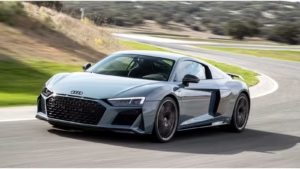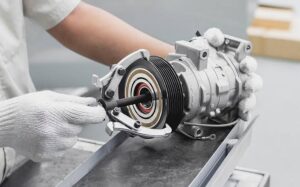

What your Lamborghini engine warning light means, the checks to do before you drive, and when it needs a specialist scan. Al Quoz workshop, Dubai.
An amber engine symbol on a Lamborghini dashboard does not mean the same thing it means on a family hatchback. On a naturally aspirated V10 or V12 running high compression in 45 °C ambient heat, the light is the first and often the only warning you get before something expensive changes state — a partially burnt fuel charge on its way into a catalytic converter, a coolant temperature climbing under a lean condition, an oil pressure trend the ECU has already noticed and you have not.
The good news is that most engine lights are not catastrophic. The problem is that you cannot tell which kind you have from the light alone, and the wrong reaction in the first ten minutes is what converts a two-thousand-dirham repair into a twenty-thousand-dirham one.
This guide teaches you how to read the light properly, in four layers of depth: what you can determine yourself in the car park, what a generic code reader adds, what Lamborghini-level diagnostic software sees that nothing else does, and what only appears with the car on a lift. Work through them in order and you will know — before you spend anything — whether you are dealing with a loose fuel filler cap or a cylinder head coming off.
First, Make Sure You Are Looking at the Right Light
Lamborghini sits inside the Volkswagen Group, and it inherits the Group’s dashboard warning language. That language contains three separate amber symbols that owners routinely describe to us on the phone as “the engine light”, and each one points somewhere completely different.
| Symbol | What it actually is | What it is telling you |
|---|---|---|
| Amber engine outline (MIL) | Malfunction Indicator Lamp — the emissions-related fault light | The ECU has logged a fault that affects, or could affect, combustion and emissions: misfire, lambda, fuel trim, EVAP, air metering |
| Amber EPC | Electronic Power Control | A fault in the drive-by-wire chain — throttle body, pedal sensor, brake light switch, cruise or traction interaction. Often accompanied by a hard power limit |
| Red engine / thermometer / oil can | Stop warnings | Pressure or temperature has left the safe band. This is not a “get it looked at” light. This is a “stop now” light |
The distinction matters because the advice differs completely. An EPC light with reduced throttle response is a control-system fault and the car is usually safe to drive gently to a workshop. A red oil pressure or coolant symbol is a shut-down-and-call-recovery event, and continuing to drive a V12 on it will cost more than the recovery truck ever would.
If your car is showing a message in the driver display alongside the symbol — the Urus and later Huracán models will spell it out in text — read the wording carefully and photograph it. That text is generated by the module that raised the fault, and it is genuinely useful information for the technician who scans the car later. On Aventador models and earlier cars, the display is far less talkative, which is why the physical checks below matter more.
Steady, Flashing, or Intermittent — The Light Has Three Dialects
Before anyone connects anything to your car, the behaviour of the lamp itself narrows the field considerably.
A steady amber light means the ECU has confirmed a fault across enough drive cycles to store it and illuminate. Something is out of specification, but the engine management is still able to run the engine within a controlled envelope. This is the common case, and it is not an emergency. Drive gently, avoid full throttle, and get it scanned within a few days.
A flashing engine light is a different category entirely. In VAG-derived engine management, a flashing MIL almost always signals an active misfire severe enough to be dumping unburnt fuel into the exhaust. On a Lamborghini this is the single most expensive light on the dashboard, because the raw fuel goes straight into the catalytic converters, and exotic-tier catalysts and the lambda sensors that live around them are eye-watering to replace. A misfire caught in the first ten minutes is usually a coil pack. The same misfire caught two hundred kilometres later has often taken a catalyst with it. If the light flashes: stop, switch off, and arrange recovery rather than driving it in.
An intermittent light — on, then gone after a restart, then back a week later — is the most under-investigated of the three, and the most commonly ignored. The fault is real; it simply is not meeting the confirmation threshold on every drive cycle. Heat-sensitive electrical faults behave exactly like this in Dubai: a connector or sensor that reads correctly at 25 °C and drifts out of range once the engine bay soaks to 90 °C after shutdown. The stored fault memory still holds the history even when the lamp is out, which is why a scan is worth doing even on a car that currently looks fine.
Layer One: The Five-Minute Inspection You Do Before the Car Moves
You can eliminate a meaningful proportion of engine lights without any equipment at all. Do this with the car parked safely and the engine off.
Start with what changed. Engine lights rarely appear at random. Ask yourself what happened immediately before it came on — did you refuel? Was the car jump-started or left on a battery tender? Has it been standing in a garage for weeks? Was it washed, or driven through standing water after rain? Did you fill with 95 rather than 98 octane? Each of those has a well-known fault pathway, and the answer often tells the technician where to look before the scanner is even plugged in.
Check the fuel filler cap. It is the cliché of engine-light advice for a reason: the evaporative emissions system pressure-tests the fuel tank, and a cap that is loose, cross-threaded or has a perished seal will fail that test and set a code. Remove it, inspect the rubber seal for cracking or hardening — UV and heat destroy these seals far faster here than in Europe — and refit it until it clicks. If that was the cause, the light will typically clear itself after several drive cycles.
Check the coolant level, cold. Only ever open an expansion tank on a cold engine. You are looking for level against the marks, and for the colour and clarity of the coolant. Cloudy, oily, or rust-tinted coolant is a finding worth reporting. A level that has dropped without any visible puddle underneath the car is a finding too — in Dubai heat, a slow leak often evaporates off a hot component before it ever reaches the floor.
Check the oil — and check it the right way for your model. This is where a lot of owners go wrong. The Huracán and Aventador run dry-sump lubrication, and a dry-sump engine will give you a meaningless reading if you check it cold and switched off, because most of the oil is sitting in the tank rather than the sump. The correct procedure is to check it at operating temperature with the engine running at idle, following the on-board menu prompts where the car provides them. Checking a dry-sump V10 cold and then “topping up” to the mark is one of the most common ways owners overfill these engines — and an overfilled dry-sump engine will aerate its oil, smoke, and set faults of its own.
Use your nose and your ears. A sweet smell is coolant. A sharp, acrid smell is usually oil on a hot exhaust component. A fuel smell after the light appears is worth taking seriously. A ticking that changes with engine speed, a hiss under the intake, or an uneven idle you can feel through the seat are all things to note now, while the memory is fresh.
Look underneath and behind. Reverse the car a metre and look at where it was standing. Clear water is condensate from the air conditioning and is normal. Anything coloured is not.
Consider the battery. A tired AGM battery is a genuinely common cause of nonsense fault codes across multiple modules at once. In UAE heat these batteries frequently last only two to three years rather than the five they might manage in a cooler climate, and low cranking voltage will throw faults that have nothing to do with the actual health of the engine. If your Lamborghini has been sitting between drives — and many in Dubai are weekend cars — this belongs at the top of your suspect list, not the bottom.
Layer Two: What a Generic Code Reader Tells You, and Four Things It Hides
A cheap Bluetooth OBD dongle will read a Lamborghini. It will give you a P-code, and a code is genuinely better than nothing. But it is worth understanding precisely how partial that picture is before you make a decision based on it.
It reads generic powertrain codes only. OBD-II standardisation covers emissions-related faults. Manufacturer-specific fault memory — the codes that actually tell a technician which subsystem and which component — sits outside that standard and simply will not appear.
It reads one module. A modern Lamborghini runs dozens of control units on multiple CAN and FlexRay networks. A generic reader typically talks to the engine ECU and stops there. The fault that lit your engine light may have originated in the gearbox controller, the transmission hydraulic system, the chassis and suspension network, or the body electronics, and been passed forward as a secondary code.
It gives you a code, not a cause. P0301 tells you cylinder one is misfiring. It does not tell you whether that is a coil, a plug, an injector, low compression, a wiring fault, or a vacuum leak pulling that one cylinder lean. Every one of those has a different cost and a different urgency.
And the erase button is a trap. Clearing a code does not repair anything; it deletes the freeze-frame data — the snapshot of engine load, RPM, coolant temperature and fuel trim at the moment the fault occurred — which is often the most diagnostically valuable thing in the entire fault memory. It also resets the readiness monitors to “not ready”, which matters practically in the UAE: an illuminated engine light is a straightforward fail at a vehicle testing centre, and clearing the code the morning of the test typically just swaps one failure reason for another until the car has completed enough drive cycles to re-run its self-tests.
Read the code by all means. Photograph it. Then treat it as the first line of the investigation rather than the conclusion.
Layer Three: What Lamborghini-Level Diagnostics Actually Sees
This is where the picture changes completely, and it is the reason a proper diagnostic session is worth paying for rather than working around.
Lamborghini’s factory diagnostic environment is the VW Group ODIS platform running Lamborghini brand data through a compatible vehicle interface, with older Gallardo and Murciélago-era cars additionally supported by the earlier Lamborghini-specific software and VAS hardware of their period. What that combination provides is not simply “more codes” — it is a different class of information.
Guided fault finding. The factory system links a fault code to the manufacturer’s own test plan, so the technician follows the sequence Lamborghini’s engineers wrote for that specific fault on that specific engine, rather than a generic diagnostic instinct.
Live measured values. Individual misfire counters per cylinder, short and long-term fuel trims per bank, lambda sensor voltages upstream and downstream, camshaft adjustment angles against target, fuel rail pressure against demand, charge pressure against demand on the Urus, and intake air temperature. This is what separates “cylinder one misfires” from “cylinder one misfires only above 4,000 rpm under load while bank one runs 18% lean” — two very different repairs.
Every module, not just the engine. A full network scan reads fault memory across the entire car, which is how you discover that the engine light is a downstream symptom of something in the gearbox or the chassis systems.
Adaptation, coding and calibration. Many components on these cars require adaptation values to be written after replacement — throttle bodies, actuators, and various sensors will not behave correctly if they are simply bolted on. This is a substantial part of why a component replaced without the right tooling frequently fails to resolve the original fault.
If you are choosing where to take the car, the single most useful question you can ask a workshop is what they will connect to it. A shop that names its tooling and can describe reading live misfire counters is telling you something real. A shop that answers “we have a scanner” is telling you something too.
Layer Four: What Only Shows Up With the Car on a Lift
Some causes never appear on a screen. A proper Lamborghini inspection puts the car up and looks for the physical evidence that explains the data.
Cracked or collapsed intake ducting and perished vacuum lines are a leading cause of lean-running codes, and heat cycling in this climate is exactly what makes rubber and plastic components go brittle. The cooling stack gets inspected from behind rather than through the grille, because fine silica sand packs into radiators and condensers from the rear where it is invisible from the front, and a partially blocked stack raises intake temperatures and coolant temperatures until the ECU starts pulling ignition timing and logging faults. Wiring looms are checked where they run near exhaust heat. Oil residue is traced upward to its actual source rather than assumed from where it drips. Exhaust valve actuators and their linkages get checked physically. And on cars with any recent body or panel work, connectors and sensors in the repaired area get inspected, because a disturbed connector is a genuinely common cause of a light that appeared “for no reason”.
Where Engine Lights Come From, Model by Model
Once the diagnostic data is in front of you, knowing your engine family narrows the likely causes sharply. These engines have very little in common with each other beyond the badge.
Urus — 4.0 V8 Twin-Turbo
The Urus uses a hot-V twin-turbo V8, and it lights its engine light for turbocharged, direct-injection reasons. Carbon accumulation on the intake valves is the headline issue: because fuel is injected straight into the cylinder, there is no fuel washing over the valve stems to keep them clean, and the deposits eventually disturb airflow enough to cause rough running, misfires and lean codes. The fix is mechanical cleaning rather than a chemical additive. Beyond that, the usual suspects are ignition coils, the high-pressure fuel pump and rail pressure faults, the crankcase ventilation system, thermostat and coolant temperature sensor faults, wastegate actuator faults, and the EVAP purge valve. As the most-driven Lamborghini in Dubai and the one most likely to be used as an actual daily car, the Urus also accumulates the most heat cycles — which is exactly what fatigues plastic coolant components. See our Urus repair page for the model-specific service detail.
Huracán — 5.2 V10
The V10 is naturally aspirated and, in the later cars, combines direct injection with port injection — which is why Huracáns do not suffer the same severity of intake valve carbon that the Urus does. Its engine lights tend to come from elsewhere: ignition coils (there are ten of them, and one failing coil is a classic flashing-MIL misfire), lambda sensors, the crankcase ventilation and oil separator system, camshaft adjustment faults, exhaust valve flap actuators, and secondary air injection on the relevant cars. Oil consumption on a hard-driven V10 is normal within limits; a sudden change in the rate is not. The Huracán and Huracán Spyder share the drivetrain, though the Spyder adds its own roof-system electronics to the network scan.
Aventador — 6.5 V12
The V12 is dry-sumped, and oil is the theme of most of its engine-light stories. Oil weeping from cam cover and cylinder head sealing surfaces onto hot exhaust components produces the smoke that Aventador owners describe, and left long enough it damages wiring and sensors in the vicinity. Coil packs and lambda sensors feature here as well, and because the ISR gearbox is tightly integrated with engine management, transmission-side faults sometimes present to the owner as an engine warning. If the car also has a vibration or driveline complaint alongside the light, our Lamborghini vibration diagnosis service is the right starting point rather than an engine teardown.
Gallardo, Murciélago and the Classics
On Gallardo V10s, the secondary air injection system is the single most frequent engine-light cause — the pump and its valves fail, the system fails its self-test at cold start, and the light appears on a car that otherwise runs perfectly. E-gear hydraulics and clutch wear generate their own warnings that owners often bundle in with the engine light. Murciélago, Diablo and Countach cars need period-correct diagnostic access, and on the earliest of them the “warning light” conversation becomes a compression, fuelling and ignition conversation instead.
Revuelto and Hybrid Models
On the plug-in hybrid V12, the combustion engine’s fault memory is only part of the picture — the high-voltage system, the electric drive units and the battery management system all raise their own warnings, and any diagnosis has to cover them together rather than treating the V12 in isolation.
Why Dubai Lights Engine Lights That Europe Does Not
Several causes on this list are effectively local, and they explain why a car that never showed a light in Europe starts showing one here.
Fuel octane. These are high-compression engines with knock sensors that will retard ignition timing to protect themselves. Filling a V10 or V12 with 95 rather than 98 in ambient temperatures above 40 °C makes that knock retard work considerably harder, and persistent knock correction shows up in the data long before it shows up as a driveability complaint. This is one of the cheapest problems on the entire list to avoid.
Heat soak. After shutdown, an engine bay in a Dubai summer climbs well above running temperature with no airflow. Marginal sensors and connectors that read correctly on the move drift out of range, which is the mechanism behind most intermittent lights.
Fine sand in the cooling stack. Silica sand is drawn into radiators and condensers and packs from the back, invisible during a walk-around. Reduced cooling capacity raises intake and coolant temperatures, which changes fuel trims, which eventually sets codes.
Standing still. A large proportion of Lamborghinis in the UAE are weekend and seasonal cars. Fuel degrades, EVAP purge valves stick, AGM batteries sulphate, and the first drive after a long standstill is a classic engine-light event. If the car is stored over summer, a proper wake-up inspection is worth more than any single repair.
Short trips. A ten-minute run to a café and back never brings the engine and exhaust fully to temperature, and repeated short cycles are hard on lambda sensors, oil condition and catalyst function.
The Mistakes That Turn a Cheap Fault into an Expensive One
Four behaviours account for most of the avoidable damage we see arriving on a flatbed.
Driving on a flashing light. Already covered, but it is worth repeating because it is the one that writes the biggest invoices. The misfire is cheap. The catalyst is not.
Clearing the code and hoping. The light will come back, and the freeze-frame evidence that would have shortened the diagnosis is gone.
The parts cannon. Replacing all the coils, then all the plugs, then the lambda sensors, in sequence, based on a generic code. On exotic-tier parts pricing this approach frequently costs more than the correct diagnosis and the correct repair combined — and often does not fix the fault, because the actual cause was a wiring or vacuum issue all along.
Topping up with the wrong fluid. Generic coolant into a system specified for a particular chemistry causes problems that appear months later. The same applies to oil specification: viscosity and approval matter more on these engines than on almost anything else, which is why our oil change service is specified per engine rather than per brand.
Drive It, Park It, or Call Recovery?
Use the light’s own behaviour to decide, in this order.
If the light is flashing, or if any red warning is showing, or if the temperature gauge is rising, or if there is smoke, a loud new noise, or a fuel smell — do not drive it. Switch off and arrange recovery. We can collect a Lamborghini anywhere in Dubai, and from Abu Dhabi as well.
If the light is steady and the car drives normally — no power loss, no unusual noise, normal temperatures — you can drive it gently to a workshop. Keep the revs moderate, avoid full throttle and avoid long high-speed runs until it has been scanned.
If the light is steady but the car is limping, holding a gear, refusing to rev past a set point or showing an EPC warning, the engine management has already put the car into a protection strategy. It is telling you it does not trust one of its own inputs. Short distance at low speed only, or recovery — and stop if anything worsens.
What a Proper Lamborghini Engine Light Inspection Includes
At our Al Quoz Lamborghini workshop, an engine-light inspection is a defined process rather than a code read: a full multi-module network scan with fault memory and freeze-frame data preserved, live measured values recorded at idle and under load, a physical inspection of the intake, cooling and ignition systems with the car on the lift, a battery and charging system test, a road test with data logging where the fault is intermittent, and then a written explanation of the cause with a fixed price before any work is authorised.
Indicative costs are below. These are ranges, not quotes — the point of the diagnosis is to establish which of them applies to your car.
| Job | Indicative AED |
|---|---|
| Full diagnostic session, multi-module scan and road test | 400 – 900 |
| Ignition coil replacement (per coil, fitted) | 600 – 1,200 |
| Full coil set, V10 | 3,500 – 7,000 |
| Lambda / oxygen sensor (each, fitted) | 1,800 – 3,500 |
| EVAP purge valve or fuel cap seal | 500 – 2,000 |
| Intake carbon cleaning, Urus V8 | 4,500 – 8,500 |
| Thermostat housing / coolant temperature sensor | 2,500 – 5,500 |
| Secondary air injection pump, Gallardo | 3,500 – 7,000 |
| High-pressure fuel pump | 5,000 – 9,500 |
| Cam cover / head sealing oil leak repair | 6,000 – 25,000+ |
| Catalytic converter replacement after a sustained misfire | 15,000 – 45,000+ |
The last line is the argument for reacting to a flashing light in the first ten minutes rather than the first week.
Questions Lamborghini Owners in Dubai Ask Us About the Engine Light
Can I keep driving with the engine light on? If it is steady, the car drives normally and no red warnings are showing — yes, gently, for a short period, until it can be scanned. If it is flashing, or any red warning is present, no.
Why did the light come on right after I filled up? Two common reasons: the fuel filler cap was not sealed properly and the evaporative system failed its pressure test, or the fuel itself changed something — a lower octane than the engine expects, or fuel drawn from a tank that had been standing. Refit the cap correctly and give it a few drive cycles before assuming the worst.
Will disconnecting the battery reset the engine light? It may extinguish the lamp, but it also erases the diagnostic evidence and resets readiness monitors and various adaptation values. On a modern Lamborghini this creates more work than it saves.
The light went off by itself. Do I still need to check it? Yes. The fault memory retains the history even when the lamp clears, and an intermittent fault that resolves itself is usually heat-related and usually returns.
Does an engine light fail a UAE vehicle test? An illuminated engine warning light is a straightforward fail. Clearing it immediately before the test does not solve the problem, because the on-board self-tests need several drive cycles to complete before the car reports itself ready.
How is EPC different from the engine light? EPC covers the electronic throttle control system rather than combustion and emissions. It often comes with a deliberate power restriction. The two can appear together, and a proper scan separates them.
Does using an independent workshop affect my warranty? Servicing at a qualified independent workshop using genuine or equivalent parts, with the work properly documented, does not by itself invalidate a manufacturer warranty in the UAE. Keep the invoices and the parts documentation.
How long does a diagnosis take? A straightforward fault is usually identified the same day. An intermittent, heat-dependent fault may need the car overnight so it can be tested from properly cold and again after a full heat soak — which is the only reliable way to reproduce it.
Can you collect the car if it is not safe to drive? Yes. We arrange recovery across Dubai, and collection and delivery is free for scheduled work.
Book a Lamborghini Engine Diagnostic in Al Quoz
Carzilla Auto Service is an independent Lamborghini service centre in Al Quoz Industrial Area 2, minutes from Sheikh Zayed Road. We diagnose and repair every model from the Countach to the Revuelto, with Lamborghini engine repair and rebuild handled in-house rather than outsourced.
Send us your model, year, mileage, a photograph of the warning message and what the car was doing when the light appeared. We will collect it, diagnose it properly, and send you a written explanation and a fixed price before anything is touched.
Carzilla Auto Service — 20 C Street, Al Quoz Industrial Area 2, Dubai Call 056 684 9665 or 800-CARZILLA (800-2279 4552) · info@carzillauae.com Contact us · About Carzilla · All services · All brands we specialise in