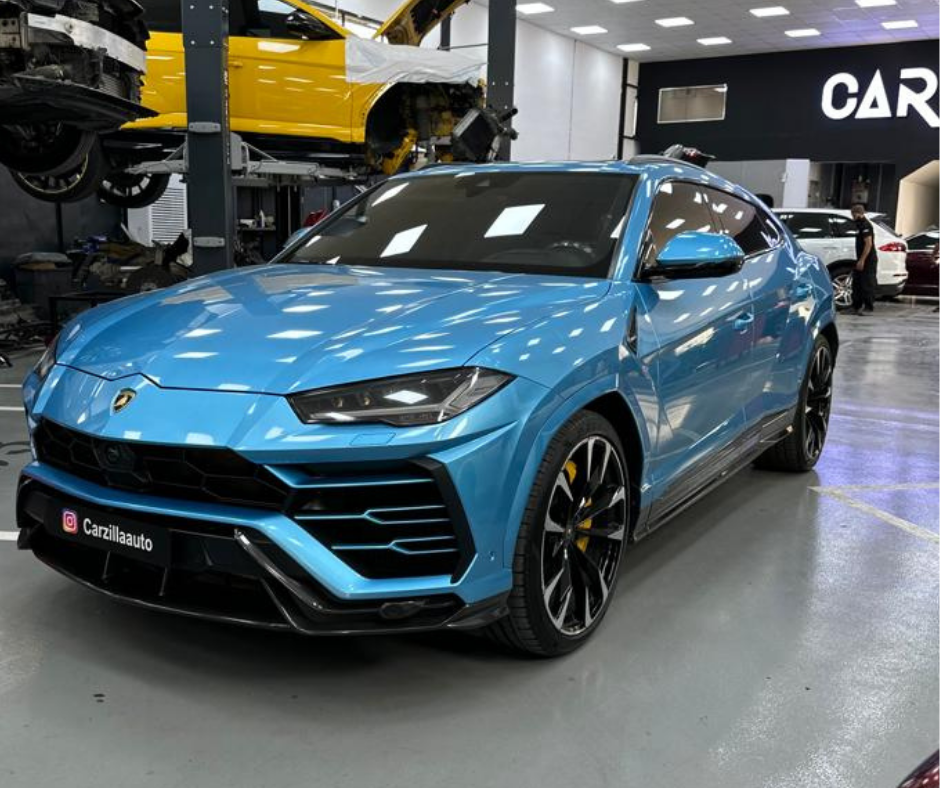
Overheating is one of the few Urus faults that punishes delay. A coolant temperature that climbs 15°C above normal on a Sheikh Zayed Road crawl is not a comfort issue — it is the first stage of a chain that ends with warped heads, a failed gasket or a heat-soaked turbocharger. The Urus is also one of the harder cars in Dubai to get diagnosed properly, because its cooling system is not a radiator and a thermostat. It is a set of separate circuits, each with its own pump, its own sensors and its own failure modes, and a workshop that treats it like a normal SUV will usually fix the symptom and miss the cause.
This guide explains how the Urus cooling system is built, what actually fails in UAE conditions, what a correct diagnosis looks like, and how to judge whether a garage is genuinely equipped for Lamborghini Urus repair in Dubai before you hand over the key.
Why the Urus Cooling System Has More Than One Circuit
The Urus uses the EA825 4.0-litre twin-turbo V8, shared in different states of tune with the Audi RS Q8, Porsche Cayenne Turbo and Bentley Bentayga. It is a hot-V engine: both turbochargers sit inside the vee of the block, directly under the intake, which puts the hottest components in the least ventilated part of the engine bay.
To manage that, the car runs a high-temperature circuit for the engine itself, a separate low-temperature circuit for the water-to-air charge coolers, and additional oil-to-air or oil-to-water coolers for engine oil, the ZF eight-speed gearbox and the driveline. The Urus SE plug-in hybrid adds another loop again for the high-voltage battery and electric motor. Each circuit has its own coolant path, and the low-temperature and after-run circuits are driven by auxiliary electric pumps rather than the belt-driven main pump.
The practical consequence is simple: a Urus can overheat while the main radiator, thermostat and water pump are all perfectly healthy. Any garage that quotes a radiator flush before it knows which circuit is failing is guessing.
Where Urus Overheating Usually Starts
In the high-temperature engine circuit, the recurring problems are the electronically controlled thermal management valve sticking or reporting incorrectly, plastic coolant housings and pipe junctions going brittle, the expansion tank developing hairline cracks around its seams, and the pressure cap losing its rated seal. None of these announce themselves loudly. A cap that no longer holds system pressure lowers the coolant boiling point, and the car will run fine at speed and creep upward the moment traffic stops.
The low-temperature charge-air circuit fails differently. Its electric pump can degrade without setting an obvious fault, and when it does, intake air temperatures rise, the ECU pulls timing to protect the engine, and the owner reports a car that feels flat in the heat rather than one that is overheating. That is why intake temperature data matters as much as coolant temperature data during diagnosis, and why expert engine repair work on this platform always starts with logged live values rather than a visual inspection.
Then there is airflow. Every cooler on the car — main radiator, low-temperature radiator, oil coolers and the air conditioning condenser — sits in one stacked assembly behind the front bumper. Fine silica dust packs into that stack from the back, where it is invisible from the grille. A stack that looks spotless from the front can be half blocked internally, and the first symptom is often weak air conditioning at idle, which is why AC performance is a useful early warning of a cooling problem rather than a separate complaint.
What UAE Conditions Do to a Urus
Heat cycling, not mileage, is what ages this system. A car that does short runs in 45°C ambient temperatures expands and contracts plastic housings thousands of times, and those parts fail at the joint long before any metal component wears out. Coolant additives also deplete faster at sustained high temperatures, and once the corrosion inhibitors are gone, internal deposits reduce heat transfer everywhere at once.
Two owner habits accelerate this. The first is topping up with plain water when the level warning appears, which dilutes the additive package and raises the risk of internal corrosion. The second is shutting the engine down immediately after a hard drive, which cuts short the after-run cycle that circulates coolant through the turbochargers and lets residual heat soak into the bearing housings.
Stored cars have their own version of the problem. A Urus that sits for months in a Dubai garage develops dried seals, settled coolant and a corroded pump impeller, and it will often overheat within days of returning to use. If a car has been parked for a season, a proper pre-use inspection is worth more than any single repair.
The Signs Worth Acting On Early
Before a temperature warning appears, the car usually tells you something else first: a faint sweet smell after parking, a coolant level that needs topping every few weeks, a heater or AC that weakens at idle but recovers when moving, cooling fans that run loudly for longer than usual after shutdown, or a temperature needle that sits slightly higher in traffic than it used to. Any one of these justifies a pressure test.
Once you see steam, a rising gauge, reduced power or a stop warning, the correct action is to stop safely, switch off, and not open the expansion tank. A pressurised system at that temperature will discharge coolant violently. From there the car should be recovered rather than driven, because the distance between an inexpensive hose repair and a head gasket failure is usually a few kilometres of continued driving.
What a Correct Urus Overheating Diagnosis Involves
A garage working properly on this car will connect factory-level diagnostics with Lamborghini brand data — not a generic OBD reader — and read live values across both circuits: coolant temperature, intake air temperature, thermal valve position, fan duty cycle and auxiliary pump commands. Generic scanners show stored fault codes; they do not command the thermal management valve or the fans, and without that, a sticking valve looks identical to a healthy one.
That is followed by a cold pressure test held at system pressure to find leaks that only open when hot, a combustion-gas test on the coolant if there is any suspicion of head gasket involvement, an infrared scan across the radiator core to find blocked sections, and a physical inspection of the cooling stack from the engine side with the front removed if necessary.
The final step is the one most often skipped: refilling. The Urus cooling system will not bleed properly by gravity. It needs a vacuum fill and the correct bleed routine, because trapped air in the hot-V area or the low-temperature circuit produces exactly the same symptoms as the original fault. A repeat overheat two weeks after a repair is very often an airlock, not a new failure.
How to Judge a Garage Before the Work Starts
Ask which circuit they believe is at fault and how they established it. A capable workshop will answer with measured values, not with a parts list. Ask whether they have factory-level Lamborghini diagnostic access, whether they vacuum-fill after a coolant job, and which coolant specification they use — the answer should be the VW-group specification the car was built with, not a universal green or red coolant from a drum.
Ask about parts. Genuine or original-equipment radiators, thermostats, pumps and expansion tanks from the actual manufacturers are the sensible standard; unbranded aftermarket cooling parts on a 650 hp twin-turbo SUV are a false economy. Ask whether the quote includes removing the front bumper and undertray for cleaning the cooler stack, because a garage that avoids that step is not going to find dust-packed cores.
Finally, look at the workshop itself: lift capacity for a 2.2-tonne SUV, clean handling of carbon-ceramic brake components during any front-end work, and a written quote that separates diagnosis, parts and labour. A specialist Lamborghini workshop should be able to show you the failed component and the data that identified it. If the explanation is vague, the diagnosis probably was too.
Preventing Urus Overheating in Dubai
Change coolant on schedule rather than on condition, and never extend the interval because the car covers low mileage — heat depletes additives whether the car moves or not. Have the cooling stack cleaned from behind at least annually, more often if the car is parked outdoors or driven on sandy roads. Let the engine idle briefly after hard driving so the after-run cycle completes. Keep an eye on oil condition too, since heat-degraded oil raises engine temperature and shortens turbo life, which makes a correct oil change interval part of thermal management rather than a separate service item.
If the car has an aftermarket body kit, front lip or grille mesh, confirm it has not reduced airflow to the stack. And treat related symptoms as connected: transmission temperature warnings, weak air conditioning and reduced power in traffic often trace back to the same blocked or under-circulating cooling system rather than to independent faults in the gearbox or the AC.
Carzilla handles Lamborghini repair in Dubai from Al Quoz Industrial Area 2, across the Urus, Huracán and Aventador ranges, including engine, cooling and AC, suspension and vibration diagnosis work. If you want an idea of what cooling repairs cost locally, our guide to car radiator repair costs in Dubai covers the pricing side, and you can see the full range of services or get in touch for a diagnosis booking.