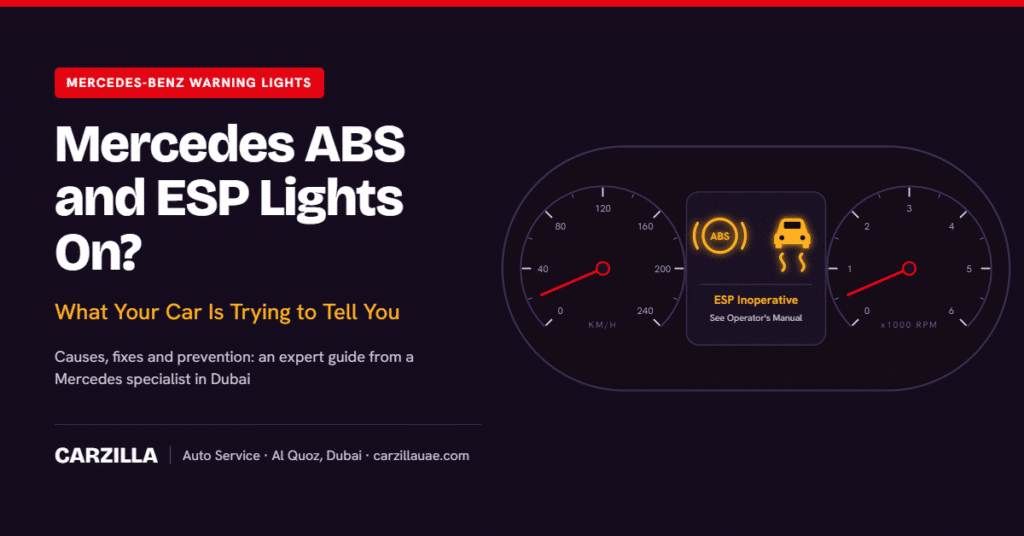
When the ABS and ESP warning lights come on together in a Mercedes-Benz, the car is telling you that its stability and anti-lock braking systems have switched themselves off because one of their inputs can no longer be trusted. Your normal brakes still work, but the car will no longer stop a wheel from locking under hard braking, stop the car sliding in a fast corner, or control wheelspin. In most cases the cause is a wheel speed sensor, a damaged wheel bearing encoder, a steering angle sensor that has lost its calibration, or low battery voltage. Less often it is the brake light switch, a yaw rate sensor, mismatched tyres, or the ABS/ESP control unit itself.
This guide explains what each Mercedes ABS and ESP warning combination means, why these faults happen, how a Mercedes specialist workshop finds and fixes them, and what owners can do to stop the lights coming back.
What ABS and ESP Do on a Mercedes-Benz
ABS (Anti-lock Braking System) stops the wheels locking when you brake hard, so you can still steer while stopping. ESP (Electronic Stability Program) goes further. It compares where you are steering with where the car is actually going, and if the car starts to understeer or oversteer, it brakes individual wheels and cuts engine torque to pull the car back into line.
On a Mercedes, ABS and ESP are not two separate systems. One control unit, mounted on one hydraulic unit, runs all of these functions:
- ABS – anti-lock braking
- ESP – stability control
- ASR – acceleration skid control (traction control)
- BAS – Brake Assist, which detects emergency braking from how fast you press the pedal
- EBD – electronic brake force distribution between front and rear axles
- 4ETS – the electronic traction system on 4MATIC models, which brakes a spinning wheel to send drive to the wheels that have grip
Because all of these share the same sensors, a single faulty sensor can switch off several of them at once. That is why Mercedes owners rarely see the ABS light alone. More often it is ABS and ESP together, sometimes with BAS, EBD or “ESP Inoperative – See Operator’s Manual” in the instrument cluster.
On newer models such as the W205 C-Class, W213 E-Class, W222 and W223 S-Class, and the W167 GLE, the ESP system also supports the HOLD function, Active Brake Assist, adaptive cruise control (DISTRONIC) and Active Lane Keeping Assist, which uses one-sided braking to correct the car’s path. When ESP goes down, several of these driver assistance systems may switch off with it.
Mercedes ABS and ESP Warning Light Meanings
The way the lights behave tells a technician a lot before any scan tool is connected. Here is what each combination usually means.
ESP Light Flashing While Driving
A flashing yellow ESP light (the car symbol with wavy lines) is not a fault. It means ESP or ASR is working right now because one or more wheels have reached the limit of grip. You will typically see it on sand-covered roads, on wet roads after the first rain, when pulling out hard from a junction, or on painted road markings. Ease off the throttle and the light will stop. If it flashes on dry roads during gentle driving, it can point to a wheel speed signal that is giving false readings, which needs checking.
ESP OFF Light On
The ESP OFF lamp means the system has been switched off, usually by the button on the dashboard or centre console. Pressing the button again or restarting the car normally turns it back on. On AMG models, some drive modes also change how much ESP intervention you get. If ESP will not switch back on, the system has a fault and should be checked by a Mercedes mechanic.
ABS and ESP Lights On Together
This is the most common Mercedes ABS and ESP fault. A steady ABS light with a steady ESP light means the control unit has lost or rejected a signal it needs for both systems, and in most cases that signal is wheel speed. If the lights come on only after the car starts moving, often at around 10 to 20 km/h, a wheel speed sensor or its encoder ring is the most likely cause, because the system only checks those signals once the wheels are turning.
ESP Light On Without the ABS Light
When only the ESP light stays on, ABS is still working and the fault sits in an input that only ESP uses. The usual suspects are the steering angle sensor, the yaw rate and lateral acceleration sensor, the brake light switch, or a fault on the engine side that stops ESP from reducing engine torque.
ESP Light On With the Check Engine Light
ESP needs the engine control unit to cut torque when the car starts to slide. If the engine has a fault that stops it accepting that request, such as a throttle body fault, a misfire or a sensor error, the ESP system switches itself off as a precaution. In this case, fixing the engine fault normally clears the ESP light. Our guide on why the Mercedes engine warning light comes on covers the engine side of this, and if the car is also running rough, see Mercedes engine misfire symptoms.
ABS, ESP and Red Brake Warning Light On
This combination is more serious. When the red brake warning comes on alongside ABS and ESP, the car may also have lost EBD, the function that balances braking between the front and rear axles. Without it, the rear wheels can lock earlier under hard braking. A red brake light can also mean low brake fluid or a hydraulic fault. Drive gently and have the car checked straight away by a brake repair specialist.
“Brake Defective, Stop Vehicle” on Older E-Class, SL and CLS Models
Early W211 E-Class, R230 SL-Class and C219 CLS-Class models used Sensotronic Brake Control (SBC), a brake-by-wire system where the brake pedal sends an electronic signal and a high-pressure pump does the braking. SBC failures show up as ABS and ESP lights together with a red brake message. The SBC unit keeps a count of brake applications, and once its service life is reached it logs fault code C249F. If the system fails completely, the car falls back to a hydraulic mode that brakes mainly through the front wheels, so stopping distances increase. A car showing this message should not be driven until it is checked.
ABS and ESP Lights With Heavy Steering or Gearbox Limp Mode
Wheel speed is not only used by the brakes. On many Mercedes models, the speed-sensitive power steering and the gearbox control unit also use it. When the wheel speed signal is lost, the steering can feel heavy at parking speed, the speedometer can drop out, and the gearbox can hold one gear. Owners often assume they have three separate problems, but a single wheel speed fault can cause all of them. If you are seeing gearbox symptoms with no warning lights, read our guide to Mercedes transmission failure symptoms.
Is It Safe to Drive a Mercedes With the ABS and ESP Lights On?
With only the yellow ABS and ESP lights on, the normal brakes still work, so you can usually drive the car carefully to a Mercedes garage. What you lose is the safety margin. The wheels can lock in an emergency stop, the car will not correct a slide, and on 4MATIC models the traction system will not shift drive away from a spinning wheel. Keep speeds down, leave a longer gap to the car in front, and avoid hard braking and fast cornering.
Do not drive the car if any of these apply:
- The red brake warning light or a “Brake defective, stop vehicle” message is showing
- The brake pedal feels soft, long or different from normal
- The steering has become very heavy or the car pulls under braking
- There is a burning smell or a brake fluid leak
In these cases, the safest option is to have the car collected rather than driven.
Common Causes of Mercedes ABS and ESP Faults
Faulty ABS Wheel Speed Sensor
Each wheel has a speed sensor that reads a rotating ring and sends the control unit a pulse signal. The control unit compares all four wheels many times per second. If one sensor stops sending a signal, or sends a signal that does not make sense against the other three, the system shuts down ABS and ESP. Mercedes logs these as wheel-specific faults, so a proper scan will say which corner is at fault.
Sensors fail for several reasons. The sensor head sits close to the brake disc and suffers constant heat cycles, which break down the internal electronics over time. Rust can build up in the sensor bore in the steering knuckle and push the sensor away from the ring, so the gap becomes too large for a clean reading. Brake work can also damage a sensor if it is pulled out carelessly or the cable is stretched when the caliper is removed.
How it is fixed: the faulty sensor is confirmed with live data, comparing the speed reading from each wheel while the car is driven. The sensor bore is cleaned of rust and debris, and a genuine or OE-supplier sensor is fitted. Cheap sensors are a common cause of repeat faults, because their signal strength and air gap tolerance are often different from the original part.
Damaged Wheel Bearing Magnetic Encoder Ring
On most modern Mercedes models, the ring that the speed sensor reads is not a toothed metal wheel. It is a ring of tiny magnets built into the wheel bearing seal. On many 4MATIC models the magnetic ring is part of the front wheel bearing, so the bearing and the “ABS ring” are one part.
This ring can be damaged by rust working under the seal, by metal particles from brake wear sticking to the magnets, or by a bearing that has developed play and lets the ring scrape the sensor. A very common cause of ABS and ESP lights after a repair is a wheel bearing fitted the wrong way round. If the magnetic side faces away from the sensor, the sensor reads nothing at all, even though both parts are new and in perfect condition.
How it is fixed: the technician checks the ring with a magnetic encoder test card, which shows the magnetic pole pattern, and checks bearing play. If the ring is damaged, the bearing must be replaced, because the ring cannot be replaced on its own. The new bearing must be fitted with the magnetic side facing the sensor. Replacing the sensor alone will not fix a damaged ring, which is why many owners change a sensor and still have the same warning lights.
Wheel Speed Sensor Wiring and Connector Damage
The cable from each wheel speed sensor has to move with the suspension and steering every time the car goes over a bump or turns. Over the years, the cable can crack at its flex points, rub through on a suspension arm or brake hose bracket, or get pulled out of its clips after suspension or brake work. The connectors sit in the wheel arch or under the wheel arch liner, where they are exposed to water, sand and heat.
These faults are often intermittent. The light may come on only over bumps, only in turns, or only when the car is hot. A sensor can test perfectly on the bench while the wiring between it and the control unit is failing.
How it is fixed: the wiring is checked for resistance and continuity from the sensor all the way back to the control unit connector, and wiggle-tested while watching live data. Damaged sections are repaired with sealed connectors or the harness section is replaced, and the cable is routed back into its correct clips. If the cable has been damaged by a worn suspension component, that part needs replacing too, or the new wiring will fail the same way.
Steering Angle Sensor Fault or Lost Calibration
The steering angle sensor sits behind the steering wheel and tells ESP where the driver is pointing the car. ESP compares this with the actual direction of travel from the yaw rate sensor. If the steering angle reading is missing, wrong or not calibrated, ESP cannot tell the difference between a corner and a slide, so it switches off.
Steering angle sensor faults often appear after a battery has been disconnected or gone flat, after a wheel alignment, after steering rack or column work, or after airbag or steering wheel removal. A brief voltage drop when starting the car can also make the sensor lose its zero point, and Mercedes records this as a steering angle sensor “not initialised” fault such as C1140.
How it is fixed: on many older models, the sensor relearns its centre position when the steering is turned from lock to lock with the engine running and the car is then driven straight. On most newer models, the sensor must be calibrated with Mercedes diagnostic software after alignment or steering work, with the wheels set straight. If the sensor itself has failed, it is replaced, and the replacement is then calibrated. An alignment done without steering angle calibration is a common reason for an ESP light appearing a day after a tyre shop visit. Our Mercedes steering repair team handles both the steering work and the calibration in one visit.
Low Battery Voltage and Charging System Problems
The ABS/ESP control unit is very sensitive to supply voltage. If the voltage drops below its working range, even for a moment while the engine cranks, the unit can log faults across several sensors at once and turn on the ABS and ESP lights. A weak battery, a failing alternator, a loose battery terminal or a corroded earth connection can all cause this.
The tell-tale sign is a cluster of unrelated faults appearing together, often with other warnings in the instrument cluster, and the lights coming on mainly at start-up. Our guide to Mercedes electrical system warnings explains how voltage problems spread across the car’s control units.
How it is fixed: the battery is load tested, not just checked with a voltmeter, and the alternator output is measured at idle and under electrical load. Main earth points between the engine, body and battery are cleaned and tightened. When a battery is replaced on a Mercedes, it should be the correct AGM or EFB type and, on many models, registered to the car so the charging system treats it correctly. Once the voltage problem is fixed, stored faults are cleared and the steering angle sensor is recalibrated if needed. If the car also struggles to start, see why a Mercedes cranks but won’t start.
Brake Light Switch Failure
The brake light switch does more than turn on the brake lights. ESP and Brake Assist use it to know when the driver is braking. Many Mercedes models use a two-circuit switch, and if the two circuits disagree, the control unit flags a fault and can switch off ESP and BAS. Cruise control may stop working at the same time, and in some cases the brake lights stay on or do not come on at all.
This was a very common cause of ABS, ESP and BAS lights on W203 C-Class, W211 E-Class and W163 and W164 M-Class models. Newer cars use a brake pedal position sensor that does a similar job.
How it is fixed: the switch signal is checked in live data while pressing the pedal. If it is faulty, the switch is replaced and correctly adjusted so it opens and closes at the right point in the pedal travel. It is a small part, but if it is fitted out of adjustment the fault will come straight back.
Yaw Rate and Lateral Acceleration Sensor Faults
The yaw rate sensor measures how fast the car is rotating, and the lateral acceleration sensor measures how hard it is being pushed sideways. On older models these are separate sensors or a combined “sensor cluster”, usually mounted on the floor under a seat, in the centre tunnel, or behind the rear seat. On newer models, the sensor is often built into the ESP control unit or the airbag control unit.
Because these sensors are mounted low in the cabin, they are vulnerable to water. Blocked sunroof drains, leaking windscreen seals, a spilled drink or a car that has been through a flooded road can let water reach the sensor connector and corrode it. A sensor that has been dropped or has a loose mounting can also give false readings.
How it is fixed: the technician compares the sensor reading with the car standing still and level, where it should read zero, and while turning. A corroded connector can sometimes be cleaned and sealed. A faulty sensor is replaced and its zero point is calibrated with diagnostic software. The source of the water must be found and fixed, or the new sensor will fail again.
Mismatched Tyre Sizes and Uneven Tyre Wear
ESP works out the car’s behaviour by comparing wheel speeds. If one tyre has a different rolling circumference from the others, that wheel turns at a different speed all the time, and the system can read it as wheelspin or a sensor fault. Common causes include:
- Fitting one or two new tyres alongside heavily worn ones
- Using a tyre of a different size or profile from the factory specification
- Running a space-saver spare for longer than intended
- A tyre that is badly under-inflated
- Fitting aftermarket wheels with a different overall diameter
This matters even more on 4MATIC models, where the front and rear axles are linked through the transfer case and the 4ETS traction system relies on accurate wheel speeds.
How it is fixed: check that all four tyres match the size on the door pillar placard, that tyre wear is even across each axle, and that pressures are correct. Our guide to choosing the best tyre shop in Dubai explains what to check before buying tyres for a luxury car, and the SUV tyre load index guide covers sizing for the GLE, GLS and G-Class. Carzilla’s tyre services include matched-set fitting and balancing.
ABS/ESP Control Unit and Hydraulic Pump Failure
The control unit is bolted directly to the hydraulic unit in the engine bay, close to engine heat. Over time, solder joints on the circuit board can crack, valve coils can fail, and the pump motor or its relay can stop working. Mercedes models have used several generations of Bosch units over the years, and some are known for internal electronic faults after many years of heat cycling. A failed control unit typically shows as an internal fault code, a pump motor fault, or a complete loss of communication with the ESP system.
How it is fixed: depending on the fault and the model, the control unit can be repaired, or the unit can be replaced with a new one. A replacement unit must be programmed and coded to the car’s VIN with SCN coding through Mercedes diagnostic software, and the steering angle and yaw rate sensors must then be calibrated. Fitting a used unit from another car without coding and calibration will leave the lights on and can make the system report false faults. After any hydraulic unit replacement, the brake system must be bled using the diagnostic routine that cycles the pump and valves, because air trapped inside the unit cannot be removed by bleeding the calipers alone.
Engine Management Faults That Switch ESP Off
As explained above, ESP relies on the engine control unit to reduce power during a slide. If the engine has a fault in the throttle body, accelerator pedal sensor, a misfire, or a CAN bus communication fault between the engine and ESP control units, ESP turns itself off. These cars usually have the check engine light on as well.
How it is fixed: the engine fault is repaired first, then the ESP faults are cleared. Replacing ESP parts on a car whose real problem is in the engine wastes money. Carzilla’s engine repair team handles these engine-side faults.
Low Brake Fluid and Brake System Faults
Low brake fluid usually lights the red brake warning first, but on some models the ESP system will also restrict itself because it cannot be sure it has enough fluid to work with. Low fluid normally means the brake pads are very worn or there is a leak. Old brake fluid is another problem. Brake fluid absorbs moisture over time, which lowers its boiling point and causes internal corrosion in the hydraulic unit valves.
How it is fixed: the brake pads, discs and hoses are inspected, any leak is repaired, and the fluid is replaced with the correct DOT 4 grade specified by Mercedes. Our guides on common brake problems, when brake pads need replacing and urgent Mercedes brake service explain the warning signs in more detail.
Why Mercedes ABS and ESP Lights Come On More Often in Dubai
The UAE climate puts extra strain on the parts that feed the ABS and ESP system.
Heat. Wheel speed sensors sit right next to brake discs, which can run very hot after stop-start city traffic or a fast drive back from Hatta. Add 45°C+ summer air temperatures and the sensor electronics, cable insulation and connector seals age much faster than they do in Europe.
Battery life. High under-bonnet temperatures shorten battery life considerably. A battery that is getting weak will often show itself first as ABS, ESP and steering angle faults at start-up, before the car actually fails to start. Our guide on car battery drain in UAE summer heat explains why.
Sand and dust. Fine sand gets into wheel bearing seals, sensor bores and connectors. Mixed with brake dust and moisture, it forms a paste that helps rust form under the sensor and around the encoder ring.
Flooded roads. During heavy rain, low roads and underpasses in Dubai and Sharjah can flood. Driving through deep water can push water into wheel bearings and wheel arch connectors and, in some cases, into the cabin floor where older yaw rate sensors are mounted.
Speed bumps, kerbs and potholes. Hitting a speed bump or kerb hard can disturb the wheel bearing and sensor air gap, damage an encoder ring, or knock the alignment out. Our Mercedes vibration repair page covers what a hard hit can do to the steering and suspension, and rim repair vs new wheels explains what to do about damaged wheels.
Frequent tyre and wheel changes. Dubai owners often fit aftermarket wheels or replace tyres one or two at a time. Both can upset the wheel speed comparison that ESP relies on.
Cars that sit for long periods. Cars left parked through the summer or while the owner travels often come back with a flat battery, and the low-voltage start then leaves ABS and ESP faults stored.
How a Mercedes Specialist Diagnoses ABS and ESP Warning Lights
A generic OBD scanner from a parts shop usually cannot read Mercedes chassis codes properly. It may show “no faults” while the ESP control unit has several stored. Correct diagnosis needs dealer-level Mercedes software such as XENTRY that can talk to the ESP control unit, read live data from each sensor, and run calibration routines.
The first step is a full quick test of every control unit in the car, not just the ESP unit. This shows whether the ABS and ESP faults are on their own or part of a wider voltage or network problem. Battery and charging voltage are checked next, because there is no point chasing sensor faults if the supply voltage is low.
The technician then reads the fault codes and, more importantly, the freeze-frame details: the speed, voltage and conditions when the fault was logged. A wheel speed fault logged at 0 km/h means something very different from one logged at 110 km/h.
Live data is the most useful test. With the car driven, all four wheel speeds should match closely in a straight line. A wheel that reads zero, drops out over bumps, or reads slightly faster or slower than the others points directly to the sensor, encoder ring, wiring or tyre at that corner. Steering angle should read close to zero with the wheels straight, and the yaw rate should read zero with the car parked.
Only after that is the suspected part inspected on the lift: sensor bore, encoder ring, bearing play, wiring routing, tyre sizes and wear. This order matters, because it stops parts being replaced on guesswork. Regular diagnostics also catch these problems earlier, as explained in our article on why regular car diagnostics prevent expensive repairs.
Mistakes That Keep Mercedes ABS and ESP Lights Coming Back
Clearing the codes without fixing the cause. The lights will go out, then come back as soon as the system runs its next self-check, often within a few kilometres.
Replacing a sensor when the encoder ring is damaged. On models where the magnetic ring is part of the wheel bearing, a new sensor cannot fix a damaged ring.
Fitting the wheel bearing the wrong way round. The car will have a permanent ABS and ESP fault at that wheel straight after the repair.
Skipping steering angle calibration after alignment or steering work. The car may drive normally, but ESP will either stay off or intervene at the wrong moment.
Using the cheapest sensors available. Low-quality sensors often have weaker signals or different tolerances, which leads to intermittent faults at higher speeds.
Fitting a used ABS/ESP module without coding. Mercedes control units are coded to the car’s VIN and equipment. An uncoded unit will not work correctly and may report false yaw or sensor faults.
Pulling the ESP fuse to turn the light off. This removes ABS, ESP and EBD protection completely, and on many models it also affects the gearbox, steering and driver assistance systems.
Ignoring an intermittent light. An ABS light that comes and goes is usually a wiring or connector fault that is getting worse. It is cheaper to fix before the wiring fails completely.
How to Prevent Mercedes ABS and ESP Problems
Look after the battery. In the UAE, have the battery tested at every service and replace it before it fails, using the correct type for your model. If the car will sit for weeks, use a proper battery maintainer.
Replace brake fluid on time. Mercedes specifies regular brake fluid replacement, typically every two years. Fresh fluid protects the valves inside the ABS hydraulic unit from internal corrosion. Our brake maintenance guide explains why this matters.
Keep tyres matched. Replace tyres in axle pairs at least, and as a full set on 4MATIC models where possible. Stick to factory sizes, check pressures every two weeks, and correct them when the weather changes.
Ask for calibration after alignment. Whenever the car has a wheel alignment, steering repair or suspension work, make sure the steering angle sensor is calibrated before you collect the car. Read how wheel alignment protects your tyres for more on alignment.
Have brake work done carefully. During pad and disc changes, the sensor cables should be unclipped properly, not stretched, and the sensor bores cleaned if a sensor is removed. See our brake pad replacement guide for what a proper job includes.
Keep drains clear. Have sunroof and windscreen cowl drains cleaned during servicing, especially before the rainy months, so water does not reach sensors and modules under the seats.
Avoid deep water. If you have to drive through a flooded road, go slowly, and have the wheel bearings and sensors checked if water came above the wheel hubs.
Slow down for speed bumps and kerbs. Hard impacts are one of the most common causes of bearing, sensor and alignment problems.
Do not ignore suspension wear. Worn bushes and ball joints let the wheel move more than it should, which stresses sensor cables and the bearing. Our guides to common signs your car needs new suspension parts and Mercedes air suspension problems cover the warning signs.
Service at a Mercedes specialist. A workshop with Mercedes diagnostic software will spot stored chassis faults, weak batteries and sensor signal problems during a routine service, before a warning light appears. Our article on choosing the right Mercedes-Benz garage in Al Quoz explains what to look for.
ABS and ESP Faults Across Mercedes-Benz Models
The same basic causes apply across the range, but some models have their own patterns:
- C-Class and E-Class: brake light switch faults on older W203 and W211 cars, SBC brake-by-wire faults on early W211 E-Class, and steering angle sensor calibration issues after alignment on W205 and W213. See our E-Class repair page.
- S-Class and CL-Class: many electronic systems depend on ESP, so a single sensor fault can switch off several driver assistance features. Read more on our S-Class repair and CL-Class repair pages.
- SL and CLS: SBC brake system faults on R230 SL and C219 CLS models. See CLS-Class repair.
- M-Class, GLE and GLS: front wheel bearings with integrated encoder rings on 4MATIC models, and heavy steering at low speed when the speed signal is lost. See our M-Class, GLE-Class and GLS-Class repair pages.
- GLC and G-Class: sand and water exposure from off-road and desert use, and tyre size changes on modified cars. See our GLC-Class repair and G-Class service pages.
- AMG models: higher brake temperatures put more heat into wheel speed sensors, and aftermarket wheels are common. See C63 AMG repair, AMG GT 63 repair, and our guide to maintaining Mercedes-AMG models in Dubai.
Mercedes ABS and ESP Repair in Dubai at Carzilla
Carzilla is a Mercedes-Benz repair specialist in Al Quoz, Dubai, using XENTRY dealer-level diagnostics to read ESP, ABS and SBC faults, check live sensor data, and carry out steering angle sensor, yaw rate sensor and SCN coding procedures after repairs. Our technicians handle everything from wheel speed sensor and wheel bearing replacement to brake light switch, wiring and ABS/ESP control unit repair, along with brake repair, steering repair, suspension repair and tyre services in the same auto garage.
Every job comes with a Warranty on Repair, and we offer Free Pickup and Delivery* across Dubai, so you do not have to drive a car with reduced braking protection to the workshop. If your Mercedes is showing ABS, ESP or brake warning lights, contact our team to book a diagnostic check.