A Porsche Macan that shudders while parking, jerks when pulling away or vibrates under light acceleration very often has a transfer case problem. Transfer case vibration is the most widely documented drivetrain fault on the petrol and diesel Macan (95B). Porsche issued several technical bulletins about it and extended the transfer case warranty on early cars. The fault is also commonly misdiagnosed. Gearboxes, engine mounts and driveshafts have all been replaced on cars where the transfer case was the real cause, and the reverse happens too.
This guide explains how the Macan transfer case works, why it starts to vibrate, which faults feel the same, how a Porsche specialist in Dubai diagnoses it properly and what the repair options are. It also covers how to make a transfer case last longer in UAE conditions.
What the Transfer Case Does in a Porsche Macan
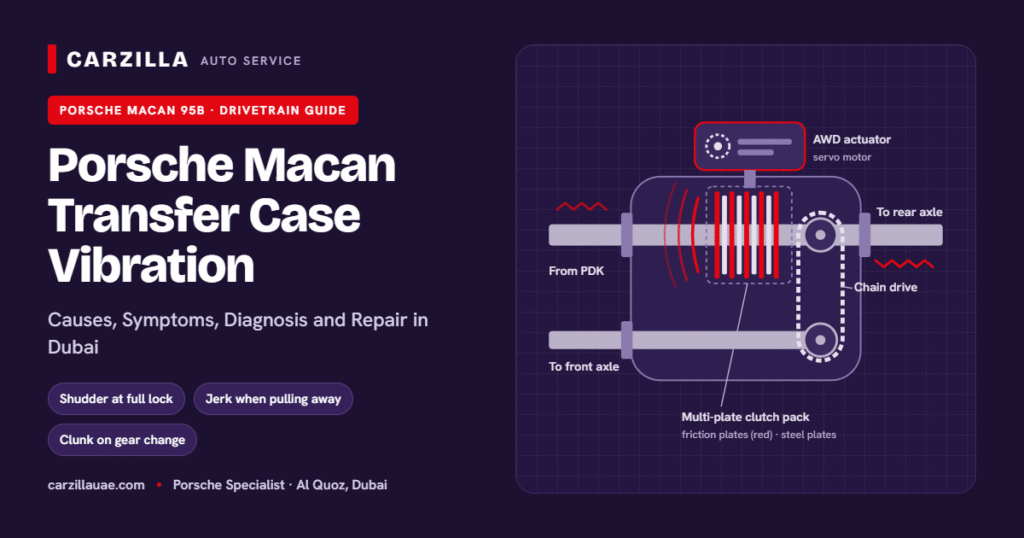
Every petrol and diesel Macan is all-wheel drive, but it is not permanent 50/50 four-wheel drive. Porsche calls the system Porsche Traction Management (PTM). Engine torque goes through the 7-speed PDK gearbox to a transfer case mounted at the back of the gearbox. From there the rear propshaft drives the rear axle all the time, and a multi-plate clutch inside the transfer case decides how much torque goes forward to the front axle.
That clutch pack is the heart of the system. It is squeezed together by an electric servo motor (the all-wheel drive actuator), which is controlled by the all-wheel drive control unit. The control unit reads wheel speeds, steering angle, throttle position, yaw rate and gear selection many times per second. It then tells the actuator how hard to clamp the clutch. Pulling away hard on a dry road, the clutch clamps firmly and sends a large share of torque forward. Cruising on the motorway, it opens almost fully and the car runs mainly in rear-wheel drive.
So the clutch pack is constantly working in a partly engaged, slipping state. That makes the system fast and fuel-efficient. It also means the condition of the clutch plates and the fluid around them decides how smoothly the car drives. The control unit keeps a running figure of how much work the clutch has done, called the transfer gear wear integrator. A specialist can read it with the Porsche PIWIS diagnostic system.
Why a Worn Transfer Case Causes Vibration and Shudder
A healthy multi-plate clutch slips smoothly. As the clutch is loaded, the friction between the plates rises steadily and torque passes to the front axle without any jolts. As the friction material wears and the fluid ages, that behaviour changes. The plates start to grip, release and grip again many times per second. This is called stick-slip, and it is what you feel as shudder or judder.
Three things push the clutch into stick-slip:
- Worn friction surfaces. Once the plates glaze or lose their surface texture, the friction level changes with slip speed, and the clutch can no longer slip smoothly.
- Degraded transfer case fluid. The fluid contains friction modifiers designed for this exact clutch. Heat breaks those additives down, and fine wear material from the plates collects in the oil. Old fluid lets the plates grab instead of slip.
- Constant unwanted slip. If the front and rear axles are turning at slightly different speeds, for example because of mismatched tyres, the clutch is forced to slip all the time. That builds heat and wears the plates much faster.
Software updates can change how the control unit applies the clutch, but they cannot restore worn friction material. That is why a Macan with a clearly worn transfer case usually comes back with the same shudder after a reflash alone.
Porsche Macan Transfer Case Vibration Symptoms
Transfer case symptoms are very consistent from car to car. The biggest clue is when the vibration happens, not how strong it is.
Shudder When Parking or Turning at Full Lock
This is the classic Macan transfer case complaint. The car shudders, jerks or lurches at walking pace with the steering near full lock, often while lightly on the brake. Typical places are a car park ramp or a tight parking space, and it can also happen in reverse. Porsche’s own bulletin describes this behaviour on the 95B in 1st or 2nd gear and notes that it usually stores no fault code. A gentle tightness in very tight turns can be normal on any all-wheel drive car, especially with Off-road mode selected. A clear rhythmic shudder or jolt is not normal.
Vibration or Jerking When Pulling Away and Under Light Acceleration
Many owners describe a vibration from a standstill up to around 30–50 km/h under part throttle, as if the engine were misfiring or the engine mounts were broken. It often fades once the car is cruising, because the clutch opens and the front axle is no longer driven hard. Because it feels like an engine fault, it is easily confused with a misfire or a gearbox problem.
Clunk or Hesitation on Gear Changes
A worn transfer case can show up as a knock or hesitation during low-speed PDK shifts, especially 1–2 and when coming off throttle. Drivers often blame the gearbox, and on some cars the PDK has been replaced when only the transfer case was faulty.
Whine, Grinding or Clicking From Under the Car
Bearing wear inside the transfer case makes a whine that rises with road speed. Clicking or ticking under acceleration can come from the internal chain or a failing actuator. Grinding means the unit is in an advanced state of wear.
All-Wheel Drive Warning or Car Stuck in Rear-Wheel Drive
If the actuator or its wiring fails, the control unit may show an all-wheel drive fault message and disable the front drive completely. The car then drives in rear-wheel drive only, and the vibration may actually disappear while the fault is present. Related warnings for PSM or traction control can appear at the same time, because these systems share wheel-speed data. Our guide on why a Porsche check engine light comes on explains how drivetrain faults can light up other warnings.
Which Porsche Macan Models Are Affected
The problem is best known on the first-generation Macan 95B.1 (model years 2014–2018). Porsche extended the transfer case warranty on these cars to seven years from first delivery with unlimited mileage, and reimbursed owners who had paid for repairs. Every car in that range is now past the seven-year period. In Dubai today, the owner pays for any transfer case repair on an early Macan unless the unit was already replaced and has its own parts cover.
Later cars are not immune. Porsche issued a further bulletin for low-speed shudder and jerking on the 2022 Macan (95B.3), and ran a workshop campaign to replace the transfer box on some 2023 Macan, Macan T, Macan S and Macan GTS cars. Facelifted 95B.2 (2019–2021) cars use the same basic design and can show the same symptoms as they age, especially in heat.
The all-electric Macan Electric introduced in 2024 has no transfer case. It drives each axle with its own electric motor, so this fault does not apply to it.
The same type of transfer case design is used on the 958 Porsche Cayenne. Owners of that model can find related information on our Porsche Cayenne service page, and Maserati Levante owners will recognise similar drivetrain behaviour in our guide to Levante steering vibration.
Main Causes of Porsche Macan Transfer Case Vibration
Clutch Pack Wear
The internal multi-plate clutch is the part that wears out. Wear comes from slip, and slip is highest at low speed with large steering angles, when the front and rear axles naturally turn at different speeds. A car used mainly for short city trips, car parks and stop-and-go traffic puts far more wear on the clutch than one used for motorway driving, even at the same mileage.
Old or Incorrect Transfer Case Fluid
The transfer case holds a small volume of special fluid matched to the clutch friction material. On many early cars the fluid was treated as almost lifetime, and Porsche later revised the transfer case oil specification. Small volume plus high temperatures means the additives break down quickly. Using a general gear oil or the wrong ATF instead of the approved transfer case fluid can bring on shudder within a few thousand kilometres.
Mismatched Tyres or Uneven Tread Depth
This is one of the most common hidden causes. If the tyres on the front axle have a different rolling circumference from the rear, the clutch has to slip all the time just to keep the axles in step. Causes include a different brand or model, a different size, uneven tread depth or wrong pressures. On a Macan with wider rear tyres, the factory sizes are matched so the system works correctly. Fitting cheaper tyres on one axle only, or one new tyre next to three worn ones, can wear out a transfer case. Our guide on buying tyres online in the UAE explains how to check size and DOT date, and our luxury car tyre workshop can match and fit Porsche N-rated tyres correctly.
All-Wheel Drive Actuator and Wiring Faults
The electric servo motor contains position sensors and has a sealed electrical connector. Heat cycling and moisture can degrade the connector seal and corrode the contacts. Internal motor or sensor faults also happen. A failing actuator can apply the clutch unevenly, causing jerks, or not at all, leaving the car in rear-wheel drive with a warning message.
Control Unit Software and Adaptation
The control unit learns the clutch characteristics over time. Software updates from Porsche changed how the clutch is applied at low speed on affected cars. A car still on old software, or one where the transfer case was replaced without reprogramming the all-wheel drive control unit, can shudder even with good hardware.
Heat Damage
The transfer case sits close to the gearbox and the exhaust in a tunnel with limited airflow. Repeated heat soak oxidises the fluid, hardens seals and speeds up friction material wear. This is why ambient temperature matters so much for this component.
Faults That Feel Like Transfer Case Vibration
Before a transfer case is replaced, the other parts of the drivetrain that cause the same feeling have to be ruled out. Porsche’s own technical information warns that the PDK has often been replaced together with the transfer case when only the transfer case was faulty. The opposite mistake is just as expensive.
Front Drive Shafts (Inner Tripod Joint)
On the Macan 95B, the inner tripod joint on the front drive shafts can be damaged by high load under acceleration. The result is strong vibration when accelerating, which feels almost identical to transfer case judder. Porsche introduced optimised front drive shafts and specifies that both sides are replaced together. The all-wheel drive control unit has to be reprogrammed if a different shaft type is fitted. A damaged front shaft can also hide during testing, because disconnecting the transfer case stops torque going to the front wheels and the vibration disappears for the wrong reason.
Rear Propshaft and Centre Support Bearing
The propshaft from the transfer case to the rear differential has a rubber-mounted centre support bearing. When the rubber cracks or the bearing wears, the shaft runs off-centre and causes vibration that rises with speed, often with a whine or a thump when pulling away.
PDK Clutch Judder
The PDK has its own wet clutches, which can judder when pulling away if the gearbox fluid is old or the clutch adaptation is wrong. This is treated by a Porsche transmission repair specialist with a PDK fluid service and adaptation, not a transfer case. Our gearbox repair team handles both, so the two units can be tested against each other.
Engine and Gearbox Mounts
Collapsed hydraulic engine mounts or a worn gearbox mount let the powertrain move under load and pass vibration into the cabin, mostly when pulling away and when shifting between Drive and Reverse. Our article on engine mount failure symptoms explains the typical signs, which apply to the Macan as well.
Rear Differential and PTV Plus
Macans with Porsche Torque Vectoring Plus have an electronically controlled rear differential lock with its own clutch and fluid. When that fluid ages, it can also cause low-speed shudder in tight turns. Like the noise from a worn rear differential, it is diagnosed separately from the transfer case.
Wheels, Tyres and Brakes
Vibration that appears only at higher speeds and changes with road speed rather than throttle is usually wheel balance, a bent rim or a tyre with a broken belt. Vibration only under braking points to brake disc problems. A bent wheel is a common cause on Dubai roads, and our guide on when you need professional rim repair covers the signs.
Why Dubai Driving Conditions Make Transfer Case Problems Worse
Several local factors speed up transfer case wear on the Macan:
- Ambient heat. Summer temperatures above 45°C and long heat-soak periods in car parks make the fluid break down much faster than the factory schedule expects for temperate climates.
- Spiral car park ramps. Mall and tower car parks with tight ramps make the car drive slowly at near full lock with light braking. That is exactly the condition in which the clutch slips most and in which Porsche’s bulletin describes the shudder.
- Stop-and-go traffic. Constant pulling away in heavy traffic loads the clutch pack far more than steady motorway driving.
- Off-road and sand driving. Off-road mode and desert driving hold the clutch engaged harder for longer, adding heat.
- Tyre replacement habits. Replacing only one or two tyres, or mixing brands to save money, creates the rolling-circumference mismatch that makes the clutch slip constantly.
- Imported and high-mileage used cars. Many early Macans in the UAE are imports with unknown service history, and transfer case fluid is rarely recorded in the service book.
How a Specialist Diagnoses Macan Transfer Case Vibration
Correct diagnosis follows a set order, because the expensive parts must be proven faulty before they are replaced.
The technician first road tests the car to reproduce the complaint under the exact conditions the owner describes, such as a full-lock turn at walking pace, part-throttle acceleration from a standstill, or a low-speed upshift. Knowing exactly when the vibration occurs already rules many causes in or out.
Next, the car is scanned with Porsche-level diagnostics (PIWIS or an equivalent factory-level tool), not a generic OBD reader. This shows stored faults in the all-wheel drive, PDK, engine and PSM control units, the software version of the all-wheel drive control unit and the transfer gear wear integrator value. A generic reader does not see most of this information.
All four tyres are then checked for brand, size, tread depth and pressure, and the rolling circumference is compared front to rear. On many cars, fixing a tyre mismatch is the first step before any drivetrain work.
On the lift, the technician inspects the front drive shafts for play and torn boots, the rear propshaft and its centre bearing, the engine and gearbox mounts, the transfer case for leaks and the actuator connector for corrosion. A fluid sample from the transfer case shows whether the oil is dark, burnt or full of wear material.
Porsche’s own procedure also includes an isolation test in which the transfer case actuator is temporarily disconnected and the car is driven gently at low speed on a straight road. If the vibration disappears, the transfer case is confirmed as the cause and the PDK must not be replaced. If it stays, the cause is in the gearbox or elsewhere in the drivetrain. This test must only be done by a technician following the correct limits, because driving with the connector unplugged under load can damage the transfer case bearings. It must also be read together with the front drive shaft inspection, as explained above.
Porsche Macan Transfer Case Repair Options
The right repair depends on how far the wear has gone and what the diagnosis found.
Transfer Case Fluid Change and Software Update
If the fault is caught early and the wear integrator value is still moderate, draining and refilling the transfer case with the correct Porsche-approved fluid and updating the all-wheel drive control unit software can remove mild shudder. Some specialists flush the unit with a second fill to remove more of the old oil and wear material. This typically costs from around AED 700 to AED 1,500 at an independent specialist in Dubai. It is the cheapest fix but it does not repair worn plates. If the shudder returns within weeks, the clutch pack is worn.
Correcting Tyres
Where tyres are mismatched, replacing them as a matched set is part of the repair, not an extra. Fitting a new or rebuilt transfer case on a car with mismatched tyres will wear the new unit early.
All-Wheel Drive Actuator Replacement
If diagnosis shows an actuator or connector fault, the servo motor can be replaced on its own without changing the whole transfer case. After fitting, the system is calibrated with diagnostic software. Fitted cost typically falls between AED 3,000 and AED 5,500 depending on parts source.
Front Drive Shaft Replacement
Where the front tripod joints are the cause, both front drive shafts are replaced with the updated type and the all-wheel drive control unit is reprogrammed. Typical cost is around AED 5,000 to AED 9,000 for the pair, fitted.
Transfer Case Rebuild or Replacement
When the clutch pack is worn, the transfer case has to be rebuilt or replaced. A rebuild replaces the friction plates, steel plates, seals and, where needed, bearings and the internal chain, using quality parts. A replacement fits a new genuine Porsche or updated remanufactured unit. In both cases the job is completed with fresh fluid, reprogramming of the all-wheel drive control unit, resetting the wear values and a road test. Depending on the route chosen and parts availability, the total typically ranges from around AED 7,000 for a rebuild to AED 15,000–25,000 for a new genuine unit fitted. Any of these figures is confirmed only after diagnosis.
Replacing the transfer case without first ruling out the front drive shafts, mounts and tyres is the most common reason a Macan still vibrates after an expensive repair.
Is It Safe to Drive a Macan With Transfer Case Vibration?
Mild low-speed shudder is not an immediate safety risk, and many cars are driven for months with it. It does get worse, though, and worn plates create debris that circulates in the fluid and damages the bearings. If the car starts to grind, clunk heavily, show an all-wheel drive warning or lose drive, stop using it and have it inspected. Continued driving can damage the PDK output and the propshafts as well, turning a transfer case repair into a much bigger job. If in doubt, have the car recovered rather than driven.
How to Prevent Transfer Case Problems on a Porsche Macan
A Macan transfer case can last a long time if it is looked after with UAE conditions in mind:
- Change the transfer case fluid more often than the factory interval. In Dubai, every 40,000–60,000 km is a sensible interval, using only the Porsche-approved transfer case fluid. It is a short job that can be done alongside a Porsche oil change or major service. Our article on major vs minor car service explains what each service should include.
- Keep the PDK fluid on schedule too. The gearbox and transfer case work together, and old PDK fluid adds to drivetrain harshness.
- Always run matched tyres. Same brand, model and size on each axle as specified by Porsche, ideally replaced as a full set or at least in axle pairs with similar tread depth. Check pressures monthly, because heat changes them quickly. Our guide on how to spot the best tyre shop in Dubai explains what to look for.
- Ease off in tight turns. Avoid heavy throttle at full lock in car parks, and use Off-road mode only off-road.
- Have the wear integrator read at each service. A rising value is an early warning that the clutch is working hard, and it gives time to change the fluid before shudder starts.
- Keep software up to date. Make sure the all-wheel drive control unit has the latest software Porsche released for your model year.
- Fix small vibrations early. A worn engine mount, damaged driveshaft or bent wheel puts extra load and vibration through the whole drivetrain. Our car suspension repair and Porsche suspension repair teams can check the chassis at the same time. Worn shock absorbers also make drivetrain shudder feel worse.
Checking the Transfer Case Before Buying a Used Macan in Dubai
Because the early warranty extension has expired, the transfer case should be part of any used Macan inspection. Ask whether the transfer case has been replaced and when, and check the service history for transfer case fluid changes. During the test drive, drive slowly at full lock in both directions and accelerate gently from a standstill. A proper inspection should include a Porsche-level scan with the wear integrator reading and a check of tyre matching. Our Porsche pre-purchase inspection checklist covers the full process, and a UAE VIN check helps confirm the car’s history. A full car inspection in Dubai is strongly recommended for imported cars.
Porsche Macan Transfer Case Repair in Dubai at Carzilla
Carzilla is a Porsche specialist workshop in Al Quoz Industrial Area 2, Dubai, and services every Macan generation, from the early 95B.1 to the latest models. Our technicians use Porsche-level diagnostics to read the all-wheel drive control unit, the wear integrator and related systems. Every vibration complaint is diagnosed systematically, covering the transfer case, front drive shafts, propshaft, PDK, mounts and tyres, so the repair targets the actual cause.
We carry out transfer case fluid services, actuator replacement, front drive shaft replacement, transfer case rebuilds and replacement with genuine or quality OE parts, followed by software programming and a road test. Work comes with Warranty on Repair, and Free Pickup and Delivery* is available across Dubai.
For full model care, visit our Porsche Macan repair page. Related services include Porsche steering repair, car engine repair and brake repair. If your Macan is shuddering, jerking or vibrating, contact Carzilla to book a drivetrain diagnosis with our Porsche technicians.