A short metallic rattle in the first few seconds after you start a BMW is one of the most common engine complaints we hear. Most of the time it comes from the timing chain system. Usually the chain has gone slack for a moment before engine oil pressure reaches the hydraulic tensioner. A fresh, healthy engine keeps the chain tight even in those first seconds. When the tensioner, the plastic chain guides or the chain itself wears, the slack shows up as a rattle at start-up. With time the rattle gets louder and lasts longer.
This guide explains how the BMW timing chain system works and why the noise appears at start-up rather than while you drive. It also covers which BMW engines are most affected, why UAE driving conditions speed up the wear, and which other start-up noises get mistaken for chain rattle. Finally, it walks through how the problem is diagnosed, how it is repaired properly, and how to prevent it.
How the BMW Timing Chain System Works
Every modern BMW petrol and diesel engine uses a timing chain instead of a rubber timing belt. The chain links the crankshaft to the camshafts, so the valves open and close at exactly the right moment against the movement of the pistons. BMW engines are interference engines. That means the valves and pistons share the same space at different moments in the cycle. If the chain slips or breaks, the pistons can hit the valves.
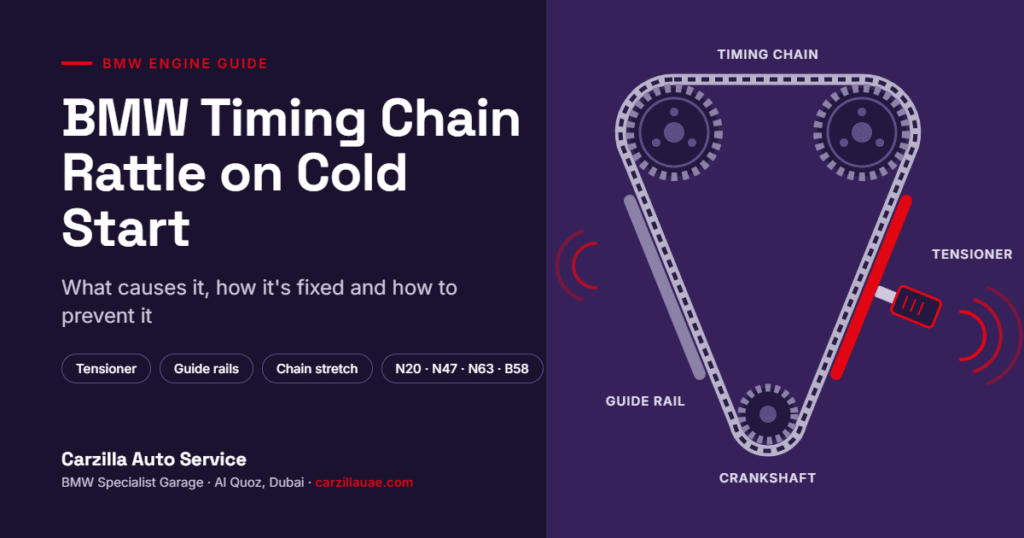
The timing chain does not work alone. It relies on three parts working together:
- The timing chain – a steel roller or bush chain (some engines have more than one) that drives the camshafts and, on many engines, the oil pump or high-pressure fuel pump.
- The chain guides and tensioner rail – plastic-faced rails that set the path of the chain and stop it whipping around at high engine speed.
- The hydraulic timing chain tensioner – a spring-loaded piston fed by engine oil pressure. It pushes against the tensioner rail to take up slack in the chain.
The chain itself does not wear out in a day. The guides and the tensioner are the parts that age first. When they do, the chain loses its control.
Why the Rattle Happens at Start-Up and Then Goes Away
This is the most important point for understanding the problem. The BMW timing chain tensioner gets most of its force from engine oil pressure, not from its spring. When the engine is switched off, oil slowly drains out of the tensioner and the upper part of the engine. A small check valve inside the tensioner is meant to hold oil in, but it is never perfect, especially once it is worn.
When you start the car the next morning, there is a gap of a second or two before the oil pump builds pressure. During that gap only the tensioner’s spring holds the chain. If the chain is still within specification and the guides are intact, the spring is enough and you hear nothing. If the chain has stretched, the guides have worn down, or the tensioner leaks oil, the spring cannot take up the extra slack. The chain then slaps against the guides until oil pressure arrives and pushes the tensioner out.
That is why owners often say “it only does it for a few seconds in the morning.” The noise is short, but the wear behind it is real. It does not fix itself.
Normal Start-Up Noise vs a Timing Chain Rattle That Needs Attention
Not every sound at start-up is a fault. Direct-injection BMW engines make a light ticking from the injectors and the high-pressure fuel pump. A healthy engine can also make a very brief noise, under a second, after it has been parked for a long time.
A timing chain rattle that needs checking usually has these features:
- It sounds metallic and loose, like a chain being shaken, not a fine tick.
- It lasts two seconds or more after the engine fires.
- It is loudest after the car has sat overnight or for several days.
- It is getting longer or louder over weeks or months.
- On front-chain engines it comes from the front of the engine. On rear-chain engines it comes from the area where the engine meets the gearbox.
- It comes back at warm idle, or turns into a whine when you rev the engine. This is a later stage.
The simplest thing an owner can do is record a cold-start video with the bonnet open on the same day each week. Comparing the recordings shows clearly whether the rattle is growing. It also gives your BMW specialist useful evidence on days when the car is quiet in the workshop.
The Main Causes of BMW Timing Chain Rattle on Cold Start
Worn or Leaking Timing Chain Tensioner
The tensioner is the most common single cause of start-up rattle. Over time its internal check valve and piston seal wear. Oil then drains out of it faster after shut-down, and the tensioner takes longer to pump back up at the next start. On some engines the tensioner can lose its ability to hold position altogether. The chain then stays slack for longer.
A weak tensioner on its own is the best case, because the chain and guides may still be healthy. If it is left too long, though, the slack chain starts to hit the guides hard, and a cheap fix becomes an expensive one.
Cracked or Worn Plastic Timing Chain Guides
The guide rails have a plastic contact surface. Years of heat cycles make that plastic harder and more brittle. Once the surface wears or cracks, the chain has more room to move, and broken pieces of guide can fall into the oil pan. There they can partly block the oil pump pickup screen, which lowers oil pressure and makes the tensioner problem worse.
Guide failure is the main issue on some BMW engines, especially the N20, and on the older N62 and M62 V8 engines. On these engines the guides are often the first part to fail, ahead of the chain itself.
Stretched Timing Chain
A timing chain “stretches” because the pins and bushings inside each link wear. Each link only grows by a tiny amount, but across the length of the chain it adds up. A stretched chain changes the relationship between the camshafts and the crankshaft. The tensioner has to extend further to keep up, and eventually it runs out of travel.
A stretched chain causes the start-up rattle, and it also moves the cam timing away from its base setting. The engine control unit tries to correct this through the VANOS variable valve timing. Once the error goes beyond what VANOS can compensate for, it stores camshaft-to-crankshaft correlation faults (often read as P0016, P0017 or P0008 on a generic scanner). You may then see the check engine light or a drivetrain warning.
Low Oil Level, Old Oil or the Wrong Oil Specification
The whole timing chain system lives on engine oil. Three oil problems cause or speed up chain rattle:
- Low oil level. Many modern BMWs have no dipstick and rely on an electronic oil level sensor. Owners rarely check it, and turbocharged BMW engines can use some oil between services. A low oil level means air in the pickup at start-up and slower pressure build-up.
- Old, broken-down oil. Oil that has been in the engine too long thins out and loses its anti-wear additives. That speeds up wear on the chain pins and the tensioner piston. Sludge can also block the small oil passage that feeds the tensioner.
- Wrong oil specification. BMW engines are designed around oils with a specific BMW Longlife approval (such as LL-01, LL-04 or LL-17 FE+, depending on the engine). A cheap oil without the right approval may not hold its film strength in the heat or keep the tensioner and VANOS passages clean.
Read more on choosing the right engine oil for your car’s make and model and why regular oil changes matter.
Oil Drain-Back and Slow Oil Pressure at Start-Up
Sometimes the chain parts are only partly worn, but oil pressure takes too long to arrive at start-up. Common reasons include a partly blocked oil pump pickup screen (often with guide debris), sludge, a faulty seal in the oil filter housing, or the wrong oil filter. This is one reason a timing chain inspection on a BMW should always include looking at the oil, the filter element and, where needed, the oil pan. If you have had oil filter housing problems before, our guide to BMW oil filter housing leak repair explains why that part fails so often.
Worn VANOS Camshaft Adjusters
The VANOS units sit on the ends of the camshafts and are driven by the timing chain. Inside, they are held in a locked position at start-up until oil pressure releases them. When the locking mechanism or the internal vanes wear, a VANOS unit can clatter briefly at start-up. To the ear this sounds very close to chain rattle. Faulty VANOS solenoids or adjusters can also set camshaft timing faults that look like chain stretch. That is why a proper diagnosis tests the VANOS system before anyone condemns the chain.
BMW Engines Most Known for Timing Chain Rattle
The risk of timing chain problems varies a great deal across BMW engine families. Where the chain sits matters too, because it decides how big the repair job is.
BMW N20 and N26 2.0 Turbo Petrol
The N20 (and its N26 variant) was used from around 2011 to 2017 in the 320i, 328i, 420i, 428i, 520i, 528i, X1, X3, X4 and Z4. It is the engine most associated with BMW timing chain rattle. The weak point was the plastic material of the timing chain guides, which became brittle and cracked. BMW revised the guide parts during production, so engines built from around 2015 onward are generally less affected.
On the N20 the main timing chain is at the front of the engine. A separate chain drives the oil pump, and it has its own guide that can fail in the same way. A correct N20 repair renews the oil pump chain parts as well as the main timing chain kit. Owners usually hear the start-up rattle first, then a whine at higher engine speed, then camshaft timing faults. If you drive a BMW 3 Series, 4 Series, 5 Series or X1 from these years, the timing chain history should be one of the first things you check.
BMW N47 and N57 Diesel (Rear-Mounted Timing Chain)
The N47 2.0 diesel and N57 3.0 diesel are the best-known BMW timing chain engines worldwide. On these engines the chain sits at the back of the engine, between the block and the gearbox. The rattle is therefore heard from the rear of the engine and is easiest to hear from underneath or near the bulkhead. Repairs usually mean removing the engine or the gearbox, which makes the job much larger. Diesel BMWs are uncommon on UAE roads and usually arrive as imports. If you own one, take a rear-of-engine rattle very seriously.
BMW N52, N54 and N55 Inline-Six
These six-cylinder engines appear across the 3, 5, 6 and 7 Series and the X3, X5 and X6. They have the chain at the front, and the tensioner screws into the side of the engine from the outside. On many of these engines a start-up rattle comes from the tensioner alone, and a new tensioner fitted correctly can cure the noise. If the rattle continues, or plastic pieces show up in the oil, the guides and chain need to be inspected and replaced as a full kit. The N54 and N55 run hotter and are often tuned, which loads the timing parts more heavily.
BMW N62, N63 and S63 V8
The N62 naturally aspirated V8 (older 5 Series, 7 Series and X5) is known for worn timing chain guide rails, usually with plastic debris in the oil pan. The N63 twin-turbo V8 (550i, 650i, 750i, X5 and X6 xDrive50i) and the related S63 in M models are known for chain stretch. Both engines carry their turbochargers inside the “hot V” between the cylinder banks, which exposes the engine to high heat. BMW’s own diagnostic system includes a specific test plan that measures timing chain elongation on these engines. The repair is a major job. On many models the engine has to come out to renew the chains, guides and tensioners properly. Owners of the BMW 7 Series, X5, X5 M and X6 with V8 engines should have the timing chain checked as part of regular maintenance, not only when the noise appears.
BMW B38, B48 and B58 Modular Engines
The newer B-series engines are found in most BMWs built since around 2015, such as the 330i, 530i, 740i, X3 30i/M40i, X5 40i and X7 40i. Their timing chain systems are far more durable than the N20 and N47. Like the diesels, though, they carry the timing chain at the back of the engine on the gearbox side. Early B58 engines used a two-piece chain with an intermediate sprocket. The updated B58 changed to a simpler single chain.
Timing chain rattle on a B48 or B58 is less common, but it does happen. It is most often linked to poor oil maintenance, long service intervals or heavy tuning. Because the chain sits at the back, the repair needs engine or gearbox removal, so early detection saves a great deal of money.
Older BMW M54 and M62 Engines
Classic BMWs such as the E39 5 Series, E38 7 Series and E53 X5 still run in the UAE. The M62 V8 in the 540i, 740i and X5 4.4 and 4.6 is well known for timing chain tensioner and guide failure. On the M54 inline-six, a start-up rattle more often comes from the double VANOS unit than from the chain. For these older cars, a good-quality tensioner caught early can save the guides. Once the guides have broken, a full timing job is the only correct repair.
Why Dubai Conditions Make BMW Timing Chain Problems Worse
Timing chain wear depends heavily on oil quality and heat, and UAE driving puts both under pressure.
High engine bay temperatures. Outside temperatures above 45°C, long idling with the air conditioning on, and slow traffic all keep engine oil and engine bay temperatures high. Hot oil oxidises faster and loses its protective additives sooner. The plastic chain guides also go through repeated heat cycles, which makes them harder and more brittle with age. Read more on how Dubai heat damages car engines.
Service intervals that are too long for the climate. BMW’s condition-based service display can allow long gaps between oil changes. That suits mild European driving, but it is too long for a BMW that idles in Dubai traffic in summer. Carzilla’s recommended BMW oil change intervals for Dubai are shorter: around 10,000 km for four-cylinder engines, 8,000–10,000 km for six-cylinder engines, and 7,500–8,000 km for twin-turbo V8 engines.
Short trips and fuel dilution. Direct-injection engines on short trips may never fully warm up. Some fuel then gets past the piston rings into the oil and thins it. Thin oil means weaker tensioner pressure and faster chain wear.
Stored and rarely driven cars. Many luxury cars in the UAE sit for weeks during summer travel or are used only at weekends. A car that has sat for a long time starts with almost no oil in the tensioner or the top of the engine. Long-stored BMWs are often the loudest at start-up, and the oil inside them may have aged even though the mileage is low.
Dust and sand. Fine dust that gets past a worn air filter or a loose intake duct ends up in the oil, where it acts as a grinding paste on chain pins and bushings.
Tuning. Stage-tuned N20, N55, B48 and B58 engines produce more torque than the timing parts were designed around, especially at low engine speed. Without shorter oil intervals, tuned engines often show chain wear sooner.
Start-Up Noises Often Mistaken for Timing Chain Rattle
Before anyone quotes for a timing chain job, a careful technician rules out other parts that can make a noise at start-up:
- Hydraulic valve lifters (lash adjusters). These give a fast, light ticking from the top of the engine that fades within seconds or minutes. It is more of a tap than a rattle.
- VANOS adjusters and solenoids. As explained above, these can clatter briefly at start-up and set camshaft timing faults.
- High-pressure fuel pump and injectors. These make a normal, steady ticking on direct-injection engines that stays the same when the engine is warm.
- Alternator pulley and belt tensioner. A worn one-way alternator pulley or belt tensioner can rattle or chirp at start-up, especially when the alternator takes a heavy load right after starting.
- Loose heat shields. Exhaust and catalytic converter heat shields can rattle at start-up when the engine rocks on its mounts. This is often mistaken for an internal noise.
- Starter motor. A starter that is slow to disengage can grind briefly after the engine fires.
- Worn engine mounts. These make the engine shake more at start-up and let other parts knock.
- Electric water pump. This makes a whirr when it runs on start-up or after shut-down. That is normal operation, not a rattle (see our guide to BMW water pump failure symptoms for when that sound is a problem).
Getting this step wrong is expensive in both directions. You can pay for a timing chain job you didn’t need, or you can ignore a real chain problem because it was called “just the lifters.”
How a BMW Specialist Diagnoses Timing Chain Rattle
A correct diagnosis combines listening, electronic testing and a physical inspection. It is not guesswork.
The car is first heard from cold, ideally after sitting overnight. A technician listens at the front, the rear, the top and underneath the engine with a mechanic’s stethoscope to find where the noise is coming from. Whether the noise comes from the front or the rear already narrows down the engine type and the cause.
Next comes a full scan with BMW-level diagnostic software (ISTA). A generic code reader is not enough here. The specialist reads the BMW fault memory for camshaft offset and VANOS faults. They look at live camshaft position values against the crankshaft and run the VANOS actuator tests. On engines where BMW provides a timing chain elongation test plan, they run it. These tests separate a stretched chain from a faulty VANOS unit or sensor.
The oil tells the rest of the story. Draining the oil and cutting open or inspecting the filter element can show plastic guide fragments or metal particles. On engines where the guides are known to break up, the oil pan may need to come off to check the pickup screen. Where possible, the technician then looks at the chain, guides and tensioner directly, through an access point or with an inspection camera, to check how far the tensioner has extended and whether the guides are cracked.
Only then can a workshop honestly say whether you need a tensioner, a full timing kit, or a different repair altogether. Our engine diagnostics guide explains more about why testing before replacing parts saves money, and why regular diagnostics prevent expensive repairs in Dubai.
BMW Timing Chain Repair Options
The right repair depends on what the diagnosis finds and on which engine is in the car.
Timing Chain Tensioner Replacement
On engines with an externally fitted tensioner, such as the N52, N54 and N55, replacing the tensioner alone can cure the start-up rattle. This only applies when the chain is within specification, the guides are intact and the oil shows no debris. The new tensioner should be a genuine or OE-quality part, primed with oil before fitting. The engine may need a few start cycles before the new tensioner is fully charged. This is the smallest repair, and it only works if the problem is caught early.
Full BMW Timing Chain Kit Replacement
When the chain has stretched or the guides are worn or broken, the correct repair is a complete timing chain kit. That means the chain or chains, all guide and tensioner rails, the tensioner, and the sprockets where needed. On the N20 it also includes the oil pump drive chain and its guide. The job is done with BMW engine locking tools that hold the crankshaft and camshafts in their exact positions. Bolts that BMW lists as single-use, such as VANOS and camshaft sprocket bolts, are replaced, along with the related seals and gaskets.
Replacing the chain alone while reusing old guides, or replacing only the guides, is a false saving. The new parts wear against the old ones and the noise returns.
Rear-Mounted Timing Chain Repairs (N47, N57, B47, B48, B57, B58)
When the timing chain is at the back of the engine, the engine or the gearbox has to be removed to reach it. The parts are similar, but the labour is much greater. This is the biggest reason to act early on a rear-chain BMW. A planned chain replacement costs far less than repairing an engine after the chain has jumped. While the engine is out, it makes sense to replace parts in the same area that are known to leak, such as the rear crankshaft seal.
Repair After the Timing Chain Has Jumped or Broken
If the chain has skipped teeth or broken, the valves have usually touched the pistons. The workshop then checks the engine with a compression or leak-down test and an inspection camera. The cylinder head often has to come off for new valves and guides, and in severe cases the engine needs a rebuild or replacement. This is the outcome every owner wants to avoid. Our article on what causes an engine to seize explains how mechanical failures like this progress.
What Happens After the Repair
After a timing chain job, the engine needs fresh oil with the correct BMW approval and a new filter. If guide debris was found, the oil pan and pickup must be cleaned. Stored camshaft and VANOS adaptations are then reset with diagnostic software, and the engine is test-driven. A final scan confirms that the camshaft timing values are back where they should be.
On cost, the price of BMW timing chain repair varies widely with engine type and chain position. A front-mounted tensioner-only repair is at the low end. A full kit on a rear-mounted chain or a V8 that needs engine removal is at the top. As a general guide, Carzilla’s BMW engine common problems and solutions article lists full timing chain kit replacement at roughly AED 4,500 to AED 12,000+, depending on the engine. That is still a fraction of the cost of an engine rebuild after a chain failure.
Can You Keep Driving a BMW With Timing Chain Rattle?
For a short time, usually yes. The car will often drive normally once oil pressure has built up. That is exactly why owners put off the repair. The rattle, however, means the chain is already moving more than it should. Every cold start adds wear to the guides and puts shock load on the chain.
The usual progression goes like this. The rattle grows longer. It then begins to appear at warm idle or as a whine under load. Camshaft timing faults follow, and the engine may go into reduced power mode. The final stage is the chain jumping teeth or the guides breaking up, at which point the engine can be badly damaged.
If the rattle lasts more than a couple of seconds and happens at every cold start, book an inspection within days, not months. If the check engine light comes on, the engine runs rough, or the rattle continues at idle, stop driving the car and have it recovered to a workshop. Our guide to signs your car needs immediate engine service covers the other warnings that should never be ignored, and our engine misfire repair guide explains why rough running with a timing fault needs urgent attention.
How to Prevent BMW Timing Chain Rattle
A worn chain cannot be repaired with an additive. Most timing chain wear can be delayed a long way with good oil care and sensible driving habits.
Change the oil on a Dubai schedule, not the dashboard schedule. Follow climate-appropriate intervals rather than waiting for the service display, especially on turbocharged and V8 engines. Use only oil carrying the BMW Longlife approval listed for your engine, with a quality filter.
Check the oil level regularly. On BMWs without a dipstick, use the electronic oil level check in iDrive every few fuel stops. Top up with the correct oil when it shows low. Never let a turbo BMW run near the minimum mark.
Give the engine a few seconds at start-up. Let the engine settle for a short time before pulling away, and do not rev a cold engine. Drive gently until the oil reaches temperature. This gives the tensioner and VANOS time to fill with oil.
Look after stored cars. If the car will sit for weeks, change the oil before storage, not after, so old oil does not sit in the engine. Start and drive it to full temperature regularly where possible, and keep the battery on a maintainer.
Don’t ignore early warnings. Timing-related fault codes, a longer start-up rattle, or plastic fragments found at an oil change are all reasons to inspect the timing chain early, while a cheaper repair is still possible.
Plan ahead on high-risk engines. On an N20, N47, N57 or N63 with no record of timing chain work, a planned inspection is the sensible step. Where the measurements show it is needed, a preventive replacement makes sense.
Keep up with full servicing. Timing chain health is closely tied to general engine condition. Air filters, the crankcase ventilation system and the cooling system all affect oil life. See our guide to regular BMW maintenance for longevity, the difference between a major and a minor service, and our luxury car maintenance schedules for the UAE.
Checking the Timing Chain Before Buying a Used BMW in the UAE
Timing chain condition is one of the most important checks when buying a used BMW, especially with the N20, N47, N57, N62 or N63 engines. Ask the seller not to start the car before you arrive, so you hear a true cold start. Ask for invoices showing any previous timing chain work, including which parts were replaced. Have the car scanned with BMW software for stored camshaft timing faults, even if the dashboard shows no warning lights.
A professional inspection should also look at oil condition and service history. Low mileage alone is not a good sign if the car has been stored for long periods with old oil. Our BMW pre-purchase inspection checklist and engine inspection checklist cover the full process, and you can book a pre-purchase car inspection in Dubai before you commit.
BMW Timing Chain Inspection and Repair in Al Quoz, Dubai
Carzilla’s BMW repair workshop in Dubai diagnoses timing chain rattle the way BMW intends. That means a cold-start listening test, ISTA diagnostics with camshaft and VANOS testing, an oil and debris check, and a direct inspection of the chain, guides and tensioner. Our BMW mechanics then recommend the smallest repair that fixes the problem properly, from a tensioner replacement to a complete BMW timing chain replacement with genuine or OE-quality kits and BMW locking tools.
As a BMW specialist garage serving the full range, we work on everything from the BMW 3 Series and 5 Series to the X5, X7 and M models. Beyond the timing chain, we also handle the related work, from BMW oil changes and general BMW service and repair to BMW transmission repair and engine overheating diagnosis. Every repair comes with a Warranty on Repair, Free Pickup and Delivery*, and flexible payment through Tabby.
If your BMW rattles when you start it, have it checked early. Contact Carzilla to book a timing chain inspection at our Al Quoz service center.