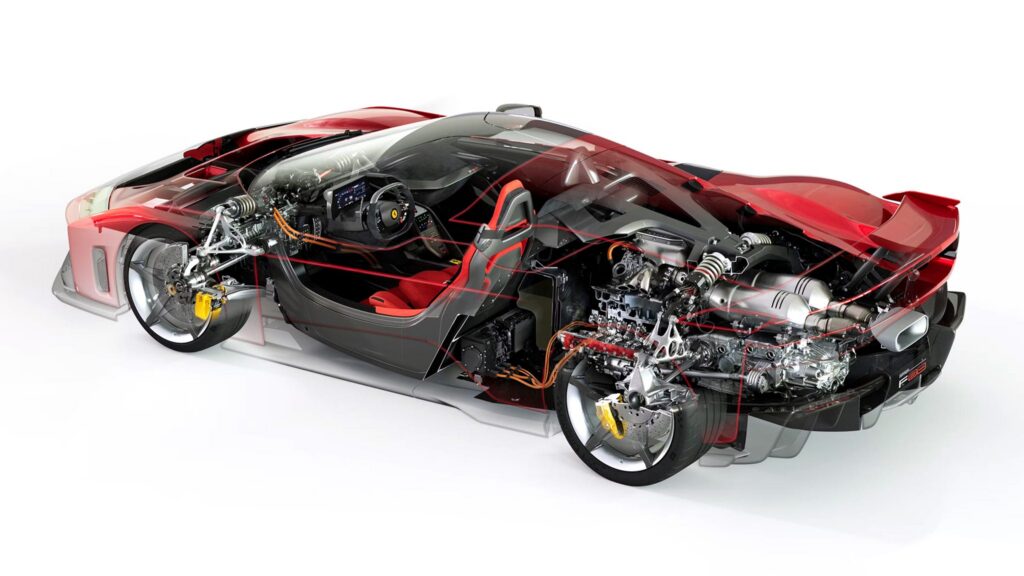
Most articles about Ferrari engine problems make the same mistake: they treat “a Ferrari” as one car. It isn’t. A 2005 F430 and a 2023 296 GTB share a badge and almost nothing else under the engine cover — different block, different induction, different lubrication, different failure modes entirely.
This guide is organised the way a workshop actually thinks about it: by engine family. Because the fault that will cost you AED 40,000 on an F136-engined 458 Italia is not the fault that will cost you AED 40,000 on an F154-engined 488 GTB, and diagnosing one as though it were the other is how owners end up paying twice.
Everything below is drawn from what actually comes through the doors of our Ferrari repair workshop in Al Quoz, Dubai — including the UAE-specific variables (50 °C ambient heat soak, fine desert dust in the radiator stack, cars that sit for six weeks between drives) that European and American guides simply don’t account for.
Quick Reference: Which Ferrari Engine Do You Actually Have?
Before you read a single symptom, find your engine. It changes the entire diagnostic path.
| Engine family | Configuration | Models | Signature weak points |
|---|---|---|---|
| F131 / F133 | NA V8 (belt-driven cams) / NA V12 | F355, 360 Modena, 550, 575M, 612 | Timing belt service interval, cam variators, valve guides |
| F136 | 4.3–4.5 L NA flat-plane V8, chain-driven | F430, 458 Italia, 458 Spider, California | Exhaust manifold cracking, cam variator solenoid leaks, oil consumption |
| F154 | 3.8–4.0 L twin-turbo V8, direct injection | California T, 488 GTB, 488 Spider, F8 Tributo, Roma, Portofino, SF90 | Turbo oil coking, carbon buildup on intake valves, timing chain tensioners |
| F140 | 6.0–6.5 L NA V12 | 599 GTB Fiorano, F12 Berlinetta, 812 Superfast, FF, GTC4Lusso, LaFerrari | Rear main seal, coolant circuit complexity, thermal management |
| F163 | 3.0 L 120° twin-turbo V6 (hybrid) | 296 GTB / 296 GTS | High-voltage system integration, charge-air cooling, early-production sensors |
Note for owners of the 612 Scaglietti, 360 Modena and GTC4Lusso T: these sit at the boundaries of the families above and each has its own service literature. Talk to our Ferrari engine repair team before applying generic advice to them.
A useful piece of trivia that has real diagnostic consequences: the F136 block was co-developed with Maserati. If you also run a GranTurismo or Quattroporte, several of the fixes below apply directly — see our Maserati repair services in Dubai.
1. Exhaust Manifold Cracking (F136 V8 — the defining Ferrari engine problem)
Affected models: F430, 458 Italia, 458 Spider, 360 Modena (less severe), F355
Symptoms
- A ticking or hissing on cold start that fades as the engine warms and the metal expands to close the crack. This is the classic tell — and it’s why a hot-engine test drive misses it entirely.
- Slight loss of low-end torque and a duller exhaust note.
- Check engine light for downstream O2 sensor correlation faults.
- Heat discolouration or soot staining around the heat shields.
Why it happens — and why it’s worse in the UAE
The original-equipment manifolds are thin-wall stainless steel, and they crack at the collector welds where the four primaries merge. The root cause is thermal cycling combined with the manifolds being rigidly clamped between the cylinder head and a chassis-mounted exhaust — the metal has nowhere to expand to.
In Dubai this accelerates for two reasons. Ambient heat means the manifolds start each cycle from a higher baseline and shed heat more slowly at a standstill. And because most Ferraris here are weekend cars, they see a far higher ratio of full cold-to-hot cycles per kilometre than a daily-driven car in Europe. Thermal cycles, not mileage, are what kill these manifolds.
The expensive part nobody warns you about
Older F136 cars carry pre-catalysts in the manifold assembly. When the manifold cracks and the pre-cat substrate breaks up, ceramic debris can be drawn back into the cylinder on valve overlap. That turns a manifold job into a bore-scoring, top-end-rebuild job. This is the single most important reason not to “leave it until next service.”
How to fix it
- Cold-start acoustic check plus smoke test to confirm the leak location before any parts are ordered.
- Borescope both banks through the plug holes to check for existing bore damage. Non-negotiable if the car has been ticking for a while.
- Replace in pairs. When one side cracks, the other is nearly always on the same thermal history. Doing one is a false economy.
- Choose thicker-wall replacements. Updated OEM units with a revised weld pattern are available, and quality aftermarket headers use heavier-gauge stainless with better expansion joints. Aftermarket also lets you delete the pre-cats where legally appropriate — worth discussing against your RTA vehicle inspection requirements before committing.
- Replace the engine mounts at the same time if they’re tired. Worn mounts allow engine movement that loads the manifolds further.
Indicative Dubai cost: AED 12,000 – 28,000 for a pair including labour, depending on OEM vs aftermarket and whether O2 sensors and gaskets are replaced. Book a diagnosis through our engine repair workshop.
2. Engine Oil Leaks — Valve Cover, Cam Cover Half-Moons and Rear Main Seal
Affected models: every Ferrari, but especially 360, F430, 458, 488, 599 and F12
Symptoms
- Dark oil spots under the car after parking.
- A burnt smell in the cabin, or white/blue smoke from the engine bay as oil bakes off the exhaust.
- Frequent top-ups between services.
- On mid-engined cars, oil pooling in the valley of the engine bay where you can’t see it without a lift.
Why UAE heat is the specific culprit
Elastomer seals — valve cover gaskets, oil pan gaskets, cam cover half-moon seals — harden as the plasticisers cook out of the rubber. That process is temperature-driven, not time-driven. A 458 in a climate-controlled European garage and a 458 that sits in a 55 °C Dubai underground car park do not age the same way. We routinely see gasket failure here at half the mileage quoted in Ferrari’s own literature.
Not all leaks are equal — this is where the cost splits
| Leak source | Access | Realistic labour |
|---|---|---|
| Valve cover / cam cover gasket | Top-end access | Half a day to one day |
| Cam variator solenoid connector seals | Front of head | Half a day |
| Oil pan gasket | Underside, subframe drop on some models | 1–2 days |
| Rear main seal (RMS) | Engine and gearbox must be separated | Multiple days — engine-out |
A rear main seal leak on a 599 or F12 is a genuinely major job because the clutch has to come out. This is the one where an owner who ignored a AED 4,000 valve cover job ends up with a AED 35,000+ invoice.
How to fix it
- Clean, then dye-trace. Oil migrates. A leak that appears at the bellhousing is frequently a cam cover leak that has run down the block. Degrease the engine, run a UV dye, drive it, then re-inspect. Skipping this step is how workshops replace the wrong seal.
- Replace with genuine Ferrari gaskets, not generic equivalents — the compound specification matters at these temperatures.
- Check the variator solenoids on F136 cars. Oil weeping through the high-pressure VVT solenoid connectors is common on the 360 and F430 and is often misdiagnosed as a cam cover leak.
- Combine jobs. If the engine or subframe is coming out anyway, do the mounts, the belt, the water pump and the seals in one visit. Our Ferrari engine repair service always quotes the combined option so you can see the saving.
Indicative Dubai cost: AED 3,500 – 7,000 for valve cover gaskets. AED 28,000 – 45,000+ for a rear main seal with engine removal.
3. Cam Variator and VVT Solenoid Failure (F136 and earlier)
Affected models: 360 Modena (early build years especially), F430, some 458
Symptoms
- A metallic rattle at idle, most audible on a cold start, lasting a few seconds.
- Rough idle or a slight hunting quality to it.
- Fault codes for camshaft position correlation.
- Oil seepage at the solenoid electrical connectors.
Why it happens
The variator is a hydraulically actuated cam phaser. It relies on oil pressure and clean oil to hold position. When oil is degraded, when the car has sat for long periods and drained the passages, or when the internal locking pin wears, the variator rattles on start-up before pressure builds.
Extended UAE storage is a direct contributor. A car that sits for two months has fully drained galleries, and the first three seconds of every start-up run near-dry.
How to fix it
- Read live cam timing data on a Ferrari SD3 or Leonardo diagnostic system. Generic OBD scanners cannot see cam phase deviation on these cars — this is the point at which a general workshop starts guessing.
- Oil analysis before parts. If the oil is out of specification, change it, run the engine, and re-test. A meaningful number of “variator failures” resolve at this step.
- Replace the solenoid and seals if the leak is at the connector — this is a modest job.
- Replace the variator unit if the rattle persists with correct oil pressure. Timing must be re-verified afterwards.
- Fit a battery maintainer if the car is stored. Consistent monthly running is the cheapest preventive measure available — see our Ferrari battery replacement and storage advice.
Indicative Dubai cost: AED 2,500 – 6,000 per solenoid job; AED 9,000 – 18,000 for variator replacement.
4. Turbocharger Oil Coking and Turbo Failure (F154 twin-turbo V8)
Affected models: 488 GTB, 488 Spider, California T, F8 Tributo, Portofino, Roma
Symptoms
- Loss of boost and a flat feeling in the mid-range.
- Whistling or a metallic scream changing pitch under load.
- Blue smoke on start-up or during overrun.
- Boost-deviation or wastegate-position fault codes.
Why it happens
Turbine bearings run extremely hot. When you shut down immediately after hard driving, oil sitting in the bearing housing bakes onto the shaft and forms carbon deposits — coking. Deposits restrict the oil feed, the bearing starves, and the shaft eventually fails.
Two factors make this a UAE problem specifically:
- Ambient heat soak. There is no cool air to help the after-run cooling circuit shed heat in a Dubai summer. Heat-soak temperatures after shutdown are meaningfully higher than the design assumption.
- Extended oil intervals. Early 488 models are known for coking where oil changes were stretched. The engine requires a fully synthetic oil to Ferrari’s specification, and in this climate the calendar interval matters more than the kilometre interval — an annual change is the floor, not the ceiling.
How to fix it
- Boost-leak test and log actual vs requested boost before assuming the turbo. A split charge pipe or a sticking wastegate actuator presents almost identically and costs a fraction.
- Inspect turbo shaft play with the intake removed. Any radial play is terminal.
- Replace turbo oil feed and drain lines whenever a turbo is replaced. Reusing a coked feed line will destroy the new unit.
- Shorten your oil interval. For a UAE-driven 488 or F8, we recommend annually or every 8,000–10,000 km, whichever comes first. See our Ferrari oil change service and oil change packages.
- Let the car idle 60–90 seconds after a hard drive before shutdown. Free, and it prevents the most expensive failure on this list.
Indicative Dubai cost: AED 18,000 – 40,000 per turbocharger fitted, depending on model and whether both are replaced.
5. Carbon Buildup on Intake Valves (F154 and F163 direct injection)
Affected models: 488, F8, Roma, Portofino, California T, SF90, 296 GTB
Symptoms
- Rough or lumpy cold idle.
- Misfire codes, often on one specific cylinder.
- Reduced throttle response and a measurable drop in power.
- Slightly worse fuel consumption.
Why it happens
Direct injection sprays fuel straight into the cylinder rather than across the back of the intake valve. Without that fuel wash, oil vapour from the crankcase ventilation system bakes onto the valve stems and seats and builds a hard carbon crust that disrupts airflow.
Short journeys make it worse — and a huge proportion of Ferrari use in Dubai is short: Marina to Downtown, a Friday morning run to a car meet, back into the garage. The engine rarely spends long at the temperatures that would help keep deposits down.
How to fix it
- Confirm with a borescope through the intake port. Do not walnut-blast on suspicion. Photograph before and after — any workshop that won’t show you the images is asking for trust it hasn’t earned.
- Walnut blasting is the correct mechanical removal method: crushed walnut shell media, port-by-port, with full vacuum extraction so nothing enters the cylinder.
- Check injector flow balance at the same time. If one injector is out of tolerance against the others, replace the set rather than a single unit — mixed flow rates cause their own misfires.
- Replace spark plugs and inspect coil packs while the intake is off. Labour is already paid for at that point.
Indicative Dubai cost: AED 7,000 – 15,000 for a full walnut blast including plugs and gaskets.
6. Timing Chain Tensioner and Guide Wear
Affected models: F430, 458, 488, F8 and other chain-driven F136/F154 engines
Symptoms
- A rattle for one to three seconds at cold start, then silence. Do not dismiss this.
- Timing correlation fault codes.
- Reduced compression on a leak-down test in advanced cases.
Why it’s urgent
The F154 is an interference engine. If timing is lost, pistons meet valves and the result is a complete rebuild — or a replacement engine. The chain system itself is robust; the failures are in the hydraulic tensioners and the plastic guide rails, and both degrade faster with contaminated or over-extended oil.
The cold-start rattle is a hydraulic tensioner that has bled down and isn’t taking up chain slack until pressure arrives. It is a warning, not a quirk.
How to fix it
- Measure chain stretch and verify cam timing against factory values on a proper Ferrari diagnostic system.
- Fit updated tensioners and guide rails. Ferrari has revised these components over the production run — check that your car’s parts are at the latest specification, not simply replaced like-for-like with the original design.
- Address the oil regime at the same time, because the original tensioners didn’t fail in a vacuum. Correct-specification synthetic oil, changed annually.
- Do it as preventive work on high-thermal-cycle cars. If your F430 or 458 has spent ten summers in the UAE, this is worth inspecting proactively at the next major service.
Indicative Dubai cost: AED 15,000 – 35,000 depending on access and whether the engine has to come out.
7. Overheating and Cooling System Failure
Affected models: all, with the mid-engined V8s and the V12 GT cars most exposed
Symptoms
- Temperature climbing in traffic, then settling once you’re moving — the classic airflow-dependent signature.
- Coolant smell without a visible puddle.
- White crusty residue in the engine bay.
- Cooling fans running at full speed constantly.
The UAE-specific causes competitors don’t mention
- Radiator stack contamination. Ferraris run side-mounted radiators fed through low intakes. Fine desert dust and sand pack into the fin matrix, forming an insulating blanket that a visual inspection from above will not reveal. This is, in our experience, the most common overheating cause in Dubai — and the cheapest to fix.
- Coolant expansion tank hairline cracks. These plastic tanks develop cracks at the moulding seams from repeated heat cycling. Look for the white residue trail.
- Failed auxiliary and after-run pumps. Modern Ferraris circulate coolant after shutdown to protect the turbos. When that pump fails there is no warning light — the damage shows up later as turbo coking.
- Degraded coolant. Ferrari’s specified coolant has a service life. Beyond it, the corrosion inhibitors are spent and the internal passages start to silt up.
How to fix it
- Pressure-test the system cold, then again warm. Some cracks only open at temperature.
- Remove and properly clean the radiator stack. Reverse-flush the fins with the radiators out — cleaning from the front simply pushes the debris deeper.
- Replace the expansion tank and cap as a set if either shows crazing.
- Verify fan operation across all speed steps with a diagnostic scan tool, not by listening.
- Flush and refill with the correct Ferrari-specification coolant. Mixing coolant chemistries causes gelling.
An overheating Ferrari and a weak air conditioning system frequently share a root cause — a blocked front-end heat exchanger stack. If you’re chasing both, read our car AC repair cost guide for Dubai and our Ferrari AC repair service.
Indicative Dubai cost: AED 1,800 – 3,500 for a radiator clean and coolant service. AED 9,000 – 22,000 for radiator or water pump replacement.
8. Excessive Oil Consumption and Valve Guide Wear
Affected models: early F136 builds, F355, 360, high-mileage V8s generally
Symptoms
- Needing to top up oil between services on a car that shows no external leak.
- Blue smoke on start-up or on the overrun after a long downhill section.
- Oil fouling on spark plug electrodes — often the first thing that illuminates a check engine light.
Why it happens
High-revving flat-plane V8s are hard on valve guides. As the guide wears, oil is drawn down the valve stem into the combustion chamber under vacuum. Ferrari’s own consumption figures for these engines are higher than most owners expect, so the diagnostic question is always “is this normal for this engine, or is it a fault?”
A dry-sump warning that catches out most owners
The F430 and other dry-sump Ferraris must be checked warm, with the engine running, following the correct procedure. Check it cold and static and you’ll read low, add oil, and overfill the system — which then blows oil into the intake and produces exactly the smoke you were trying to fix. We see self-inflicted “oil consumption problems” from this every year.
How to fix it
- Establish a real consumption rate first. Measure over 1,000 km with a documented procedure before spending anything.
- Compression and leak-down test to separate ring wear from valve guide wear. Where the air escapes tells you which it is: intake, exhaust or crankcase.
- Borescope inspection of bores and valve faces.
- Check the crankcase ventilation system. A blocked PCV creates crankcase pressure that pushes oil past seals and mimics guide wear at a tiny fraction of the cost. Always eliminate this first.
- Head removal and valve guide replacement if confirmed — a substantial job, and the point at which a wider engine rebuild becomes worth costing out.
Indicative Dubai cost: AED 2,000 – 3,500 for full diagnosis. AED 45,000+ for head work.
9. Engine Mount Collapse
Affected models: 360, F430, California, 458, and older V12s
Symptoms
- Vibration through the cabin at idle that disappears above 1,500 rpm.
- A clunk on gear engagement or throttle transitions.
- Visible sagging, cracking or oil contamination of the rubber when inspected on a lift.
Why it matters more than owners think
Ferrari mounts are hydraulic or rubber-isolated units designed to control the movement of a heavy, high-torque engine. When they collapse, the engine moves — and everything rigidly attached to it gets loaded in ways it wasn’t designed for. On F136 cars that means additional stress on the exhaust manifolds (problem #1 on this list). Worn mounts and cracked manifolds are causally linked, and replacing manifolds without checking mounts guarantees you’ll be back.
Heat and oil contamination both degrade the rubber, so this is another failure the UAE accelerates.
How to fix it
- Physical inspection on a lift with a pry bar — visual alone misses collapsed hydraulic mounts.
- Replace in pairs, always.
- Fix any oil leak feeding the mount at the same time, or the new one degrades on the same schedule.
- Preventive replacement at the ten-year mark on 360 and F430 cars is a sound investment given the secondary damage it prevents.
Indicative Dubai cost: AED 4,000 – 11,000 for a pair fitted, depending on access.
10. Misfires, Coil Packs and Fuel Delivery Faults
Affected models: all, with 360 and F430 particularly prone to coil failure
Symptoms
- Rough running, hesitation, a stumble under load.
- Flashing check engine light — stop driving immediately, this indicates raw fuel reaching the catalytic converter.
- Cylinder-specific misfire codes.
- Hard starting after long storage.
Why it happens
Ignition coils sit directly on top of an engine that reaches extreme under-bonnet temperatures. Insulation degrades, the coil breaks down under load, and you get an intermittent misfire that often only appears when hot — which is precisely why cold-workshop diagnosis fails to reproduce it.
On the fuel side, the reinforced rubber fuel lines used on older Ferraris dry out and crack over time. This is a fire risk, not merely a running issue, and any hardened or weeping line should be replaced on discovery rather than scheduled for later.
How to fix it
- Read misfire counters per cylinder rather than relying on the generic code.
- Swap-test the coil to a different cylinder. If the misfire follows the coil, you’ve confirmed it in ten minutes with zero parts cost.
- Replace coils as a full set on high-mileage cars. Once one has cooked, the others are at the same point in their life.
- Inspect fuel lines end to end on any Ferrari over fifteen years old — this is a safety item.
- Check fuel trims to catch a lean condition from an intake leak before it damages anything.
A misfire that isn’t resolved will destroy catalytic converters, and on F136 cars a failing cat can shed debris back toward the engine. Left long enough, a AED 2,000 coil becomes a AED 30,000 problem.
Indicative Dubai cost: AED 1,500 – 4,500 for a coil pack set. AED 900 – 1,800 for full diagnostics.
Ferrari Engine Problems by Model — Fast Lookup
| Model | Watch for first | Second priority |
|---|---|---|
| 360 Modena | Cam variators, timing belt interval | Coil packs, ball joints |
| F430 | Exhaust manifold cracking | Variator solenoid leaks, engine mounts |
| 458 Italia / 458 Spider | Exhaust manifolds, valve cover gaskets | Oil consumption |
| California | Timing chain noise | Oil leaks |
| California T | Turbo oil coking | Carbon buildup |
| 488 GTB / 488 Spider | Turbo coking on early cars | Intake carbon, chain tensioners |
| F8 Tributo | Carbon buildup | Charge-air cooling in UAE heat |
| Roma | Misfires, sensor faults | Turbo oil regime |
| 599 GTB / F12 | Rear main seal | Cooling system, coil packs |
| 812 Superfast | Thermal management | High-pressure fuel system |
| FF / GTC4Lusso / GTC4Lusso T | Cooling and AWD transfer unit | Oil leaks |
| LaFerrari | Hybrid system conditioning during storage | Battery drain |
| 612 Scaglietti | Oil leaks, cooling | Ignition system |
How a Ferrari Engine Should Actually Be Diagnosed
Half the money owners waste on Ferrari engine repair is spent on parts fitted before the fault was confirmed. A defensible diagnostic sequence looks like this:
- Manufacturer-level scan. Ferrari SD3 or Leonardo, reading live data and stored history across every module — not a generic OBD-II code pull. A generic scanner cannot see cam phase deviation, clutch wear percentage, or turbo boost deviation on these cars.
- Cold start, recorded. Many of the faults above only present in the first three seconds from cold.
- Borescope before disassembly. Bores, valve faces, intake ports.
- Compression and leak-down, cylinder by cylinder.
- Pressure and smoke testing for coolant and induction leaks.
- Oil analysis where wear metals would change the recommendation.
- Written quote before a single bolt is removed.
If a workshop skips straight from “it’s making a noise” to “you need a new engine,” you’re being sold a guess. Get a second opinion — our Ferrari specialist workshop in Dubai provides written diagnostic reports with the supporting data attached.
Preventing Ferrari Engine Problems in the UAE Climate
Prevention here is not the same as prevention in Europe. Adjust for the climate:
- Change oil annually regardless of mileage. Heat degrades oil on a calendar, not an odometer. This single habit prevents problems #3, #4 and #6 on this list.
- Idle for 60–90 seconds after hard driving on any turbocharged Ferrari.
- Have the radiator stack cleaned every 12 months. Dust ingress is constant and invisible.
- Fit a battery maintainer if the car sits. Deep-cycling the battery causes module faults that get misdiagnosed as engine problems, and dry start-ups accelerate variator wear. See our Ferrari battery service.
- Drive it properly, monthly. Twenty minutes at full operating temperature does more good than three months of careful storage.
- Book a full inspection before summer. Pre-empting a July breakdown is cheaper than recovering from one — see our comprehensive car inspection service.
- Run a history check before you buy. Our free UAE VIN check will surface accident and ownership records that a seller may not volunteer.
Engine faults rarely arrive alone. If your car is in for engine work, it’s worth having the gearbox and F1 clutch, the suspension bushings and the brake system assessed in the same visit while the car is already on the ramp.
Ferrari Engine Repair Cost in Dubai — Indicative Ranges
| Job | Indicative range (AED) |
|---|---|
| Full engine diagnostic report | 900 – 1,800 |
| Oil and filter service (F154 V8) | 2,500 – 4,500 |
| Coil pack set replacement | 1,500 – 4,500 |
| Radiator stack clean and coolant service | 1,800 – 3,500 |
| Valve cover gasket replacement | 3,500 – 7,000 |
| Engine mounts (pair) | 4,000 – 11,000 |
| Walnut blast carbon clean | 7,000 – 15,000 |
| Cam variator replacement | 9,000 – 18,000 |
| Exhaust manifolds (pair, fitted) | 12,000 – 28,000 |
| Timing chain, tensioners and guides | 15,000 – 35,000 |
| Turbocharger replacement (per unit) | 18,000 – 40,000 |
| Rear main seal (engine out) | 28,000 – 45,000 |
| Full engine rebuild | 90,000 – 250,000+ |
Ranges reflect model, parts choice and access. Dealer pricing for the same work is typically 50–100% higher. Get a firm figure for your car by contacting our technical advisor.
Repair, Rebuild or Replace?
- Repair when the fault is isolated and the rest of the engine tests healthy — the vast majority of cases.
- Rebuild when a leak-down test shows widespread ring or guide wear across multiple cylinders, or when debris ingestion has scored a bore. On a car with real value, a properly documented rebuild protects resale.
- Replace rarely, and only when a catastrophic timing failure has damaged the block or crank. Sourcing matters enormously here — engine provenance affects the car’s value permanently.
The right answer depends on the specific car, its history and what you plan to do with it. Our engine specialists will cost all three routes so you can decide with actual numbers rather than a recommendation.
Why Ferrari Owners in Dubai Choose Carzilla
We’re a luxury and exotic car workshop in Al Quoz Industrial Area 2, and Ferrari is one of the marques we’re built around — not one we accept.
- Manufacturer-level diagnostics — Ferrari SD3 and Leonardo systems, not generic scanners.
- Genuine parts through verified European supply, with the option of quality upgraded components where they’re genuinely better than OEM.
- Written quotes before work starts. No surprises.
- Free pickup and delivery across Dubai — Marina, Downtown, Palm Jumeirah, Emirates Hills, Dubai Hills, DIFC, Business Bay and beyond.
- Everything under one roof — engine, gearbox, AC, suspension, brakes, body and paint. No outsourcing.
- 1,200+ Google reviews.
We also handle everything beyond mechanical repair — carbon fibre and body kit fitting, full respray and colour change, performance modification, detailing and ceramic coating, tyres and wheel service and interior upholstery.
Book a Ferrari engine diagnostic today →
Frequently Asked Questions
What is the most common Ferrari engine problem?
Oil leaks are the most frequently seen fault across the whole Ferrari range, because heat hardens the elastomer seals faster than mileage wears them. On F136-engined cars specifically — the F430 and 458 — cracked exhaust manifolds are the most consequential problem, because a cracked manifold can allow pre-catalyst debris into the cylinders and turn a manageable repair into a top-end rebuild.
Are Ferrari engines reliable?
Mechanically, yes — the core architecture of both the F136 V8 and the F154 twin-turbo V8 is strong and will exceed 100,000 km when maintained to specification. What makes Ferrari ownership expensive is not fragility but the cost of access: many jobs require engine or subframe removal, so labour dominates the invoice. Reliability on these cars is bought with maintenance discipline, not luck.
How much does Ferrari engine repair cost in Dubai?
Common jobs run from AED 1,500 for a coil pack set to AED 28,000 for a pair of exhaust manifolds. A rear main seal requiring engine removal is typically AED 28,000–45,000, and a full rebuild starts around AED 90,000. Independent specialist pricing generally sits 50–100% below main dealer rates for identical work with genuine parts. Request a written quote for your specific model.
Why does my Ferrari overheat in Dubai traffic but not on the highway?
That pattern points to airflow rather than coolant. The most common cause we find is a radiator matrix packed with fine desert dust — at speed there’s enough ram air to compensate, but in traffic the fans can’t pull air through the blockage. Failed fan stages and a cracked expansion tank produce a similar signature. All three are inexpensive to fix and expensive to ignore.
Is a rattle on cold start serious on a Ferrari?
Yes, and it needs identifying rather than monitoring. On an F136 car a brief cold rattle usually points to a cam variator. On any chain-driven engine it can indicate a hydraulic timing chain tensioner that has bled down. Because the F154 is an interference engine, a timing failure means piston-to-valve contact and a rebuild — so a two-second rattle is worth a same-week diagnostic, not a wait-and-see.
How often should I change the oil in a Ferrari in the UAE?
Annually, regardless of distance driven. Ferrari’s kilometre-based intervals assume moderate ambient temperatures. In a climate where under-bonnet heat soak routinely exceeds design assumptions, oil degrades on a calendar. For turbocharged cars driven hard, we recommend annually or every 8,000–10,000 km, whichever comes first. See our Ferrari oil change service.
Can a general car garage in Dubai repair a Ferrari engine?
Only if it has manufacturer-level diagnostic equipment. Generic OBD-II scanners cannot read cam phase deviation, clutch wear percentage, boost deviation or the module-level history that Ferrari’s SD3 and Leonardo systems expose. Without that data, a workshop is replacing parts on probability — which is how owners end up paying for the same repair twice.
Does an engine fault affect a Ferrari’s resale value in the UAE?
An unresolved one does, significantly. A properly documented repair with genuine parts and an invoice trail often has neutral or positive effect, because it removes a known risk for the next buyer. Verified service history matters more on exotics than on any other segment — keep every record.
Should I get a pre-purchase inspection before buying a used Ferrari?
Always. The faults on this list are precisely what a proper inspection is designed to surface: manifold cracks caught on a cold start, F1 clutch wear read from the ECU, bore condition confirmed by borescope, and consumption history verified. Combine a full car inspection with a free UAE VIN check before you transfer any money.
Related Reading
- Ferrari Repair Dubai — full specialist service overview
- Ferrari Engine Repair & Rebuild Dubai
- Ferrari Transmission & F1 Gearbox Repair
- How Much Does Car AC Repair Cost in Dubai?
- EV vs Petrol Car Maintenance Costs in the UAE
- How to Choose the Best Car Modification Shop in Dubai
- All luxury brands we service