
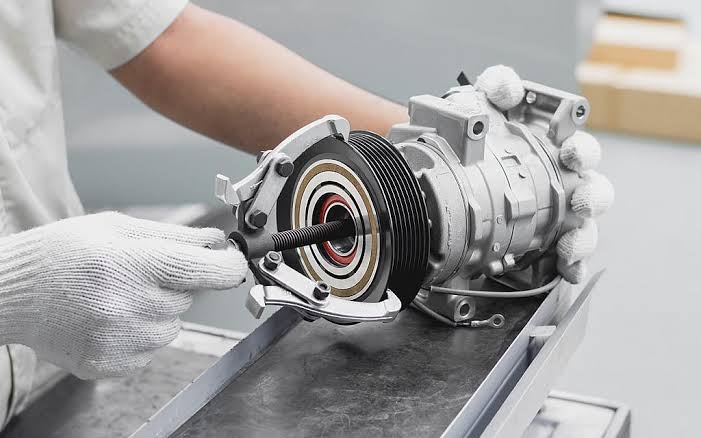
The AC compressor is the pump of your car’s air conditioning system. If it stops working properly, the AC cannot cool, however much refrigerant is in the system. In Dubai, the compressor runs for most of the year. In summer it works against ambient temperatures above 45°C, often in slow traffic where little air passes over the condenser. That is why compressor faults are among the most common jobs in car AC repair in Dubai.
This guide covers what the compressor does, why it fails in UAE conditions, how a proper repair is carried out, and how to make a compressor last.
A note on terms: when drivers search for “car air compressor repair”, they usually mean the AC compressor. Cars with air suspension also have a separate air suspension compressor that keeps the ride height up. That is a different part, handled under car suspension repair. This article covers the AC compressor only.
What a Car AC Compressor Does
The compressor draws in low-pressure refrigerant vapour from the evaporator behind the dashboard. It compresses that vapour into a hot, high-pressure gas and pushes it to the condenser at the front of the car, where the heat is released. The refrigerant then passes through an expansion valve or orifice tube, cools sharply, and returns to the evaporator to absorb heat from the cabin air.
The compressor has no separate oil supply of its own. Its lubricating oil travels around the system with the refrigerant. This is the single most important point in understanding compressor failure: most compressors fail because of a problem elsewhere in the system, not because the compressor itself was faulty.
Types of AC Compressors in Modern Cars
- Clutch-type fixed-displacement compressors are switched on and off by an electromagnetic clutch on the front pulley. You hear and feel a click when the clutch engages.
- Variable-displacement compressors with an external control valve (ECV) are standard on most German and luxury cars. On many of these units the pulley turns whenever the engine runs, and the engine control unit varies cooling output through a solenoid valve. The pulley contains a torque limiter that breaks deliberately if the compressor seizes, so the drive belt is protected.
- Electric high-voltage compressors are used in hybrids and EVs. They are driven by an inverter, use special insulating POE oil, and often cool the high-voltage battery as well as the cabin. This is why battery cooling issues on EVs like the BYD Atto 3 are closely linked to AC system health.
Common Signs of AC Compressor Problems
- Air from the vents is warm, or cooling fades in traffic and on very hot afternoons
- A rattle, grinding or knocking noise that starts when the AC is switched on
- A squeal from the belt area when the AC engages
- The clutch does not engage, or cycles on and off every few seconds
- Oily, dirty residue on the compressor body or around its pipe connections
- The AC switches itself off on hot days and returns after the car cools down
If the AC cools on the motorway but turns warm at traffic lights, the cause is usually airflow over the condenser, not the compressor. That points to the cooling fan or a blocked condenser, both covered below.
Why AC Compressors Fail in Dubai
Low Refrigerant and Oil Starvation
Because the oil circulates with the refrigerant, a system that is low on gas is also low on oil returning to the compressor. A slow leak at an O-ring, hose crimp, condenser or evaporator lets the compressor run with too little lubrication. Internal wear speeds up until the compressor seizes. Topping up the gas without finding the leak only delays this.
Blocked Condenser and High Head Pressure
The condenser sits in front of the radiator and collects sand, dust, insects and road debris. Much of this packs in between the condenser and the radiator, where it cannot be seen from the front grille. A blocked condenser cannot release heat, so pressure and temperature on the high side rise sharply. The compressor works harder, the oil breaks down faster, and on clutch-type units the clutch can slip and overheat.
Cooling Fan and Electrical Faults
At idle the condenser depends on the electric cooling fan for airflow. A weak fan, a failed fan control module or a bad relay produces the same high-pressure condition as a blocked condenser. The Maserati cooling fan failure guide explains how fan faults show up across the whole cooling stack. Other electrical causes include an open clutch coil, a faulty AC pressure sensor that stops the ECU from commanding the compressor, and low battery voltage. Low voltage can disable non-essential systems, as described in our guide to Mercedes electrical system warnings.
Control Valve Failure on Variable-Displacement Compressors
On ECV compressors, a failed control valve holds the compressor at minimum stroke. The pulley turns and the system holds gas, but the vents blow lukewarm air. This fault is often mistaken for a dead compressor. On many units the valve can be replaced on its own at a fraction of the cost of a new compressor.
Moisture, Contamination and Wrong Oil
Moisture that enters through a leak or an open system mixes with the refrigerant oil and forms acids. These acids attack internal parts and seals. A receiver-drier or accumulator that was never replaced loses its ability to absorb moisture. Other common forms of contamination are DIY top-up cans containing leak sealant, the wrong oil type, too much oil, and mixing R134a with R1234yf.
Worn Clutch, Pulley Bearing and Drive Belt
The clutch air gap widens with wear until the clutch slips or will not pull in, especially when hot. The pulley bearing can become noisy and eventually fail. A glazed or cracked drive belt slips under the compressor’s load, which is why belt condition should be checked at every major or minor service.
Long Periods Without Use
Cars stored for summer or used only occasionally suffer too. The compressor shaft seal relies on oil to stay supple. When the AC is not run for weeks, the seal dries out and starts to leak, and the first long drive in the heat can bring a sudden failure.
How AC Compressor Problems Are Diagnosed
A correct diagnosis comes before any parts are ordered, because many “failed compressors” turn out to be fan, sensor or valve faults. A proper diagnosis includes:
- Identifying the refrigerant from the label under the bonnet: R134a or R1234yf. They need different equipment.
- Reading high and low side pressures with gauges at a set engine speed, and comparing them with the ambient temperature and the vent outlet temperature.
- Reading live data with a diagnostic scanner: pressure sensor values, fan command, ECV current, and whether the ECU is actually requesting the compressor.
- Leak testing with UV dye, an electronic leak detector or a nitrogen pressure test, so the leak is found before the system is recharged.
- Inspecting the compressor and oil for noise, play in the pulley, clutch air gap and any metal debris in the oil.
AC Compressor Repair or Replacement: What the Fix Involves
Compressor Parts That Can Be Repaired Separately
When the compressor body is mechanically healthy, the fault is often in a part that can be serviced on its own:
- Clutch kit (plate, pulley, coil) and air gap adjustment
- External control valve on variable-displacement units
- Pulley bearing
- Leaking O-rings, service valves or hose connections
When Full AC Compressor Replacement Is Needed
The compressor must be replaced if it has seized internally, has lost compression, is producing metal debris, or is leaking from the shaft seal on a unit where the seal is not serviceable.
The Correct AC Compressor Replacement Procedure
A new compressor fitted into a dirty system will fail again. A proper job includes:
- Flushing the pipes and evaporator to remove old oil and debris
- Replacing the condenser if it is a parallel-flow type contaminated by a seized compressor, because these condensers cannot be flushed clean
- Fitting a new receiver-drier or accumulator, and a new expansion valve or orifice tube
- Draining the shipping oil from the new compressor and filling the correct oil type and quantity for that system
- Fitting new O-rings lubricated with the correct oil
- Evacuating the system to a deep vacuum (around 500 microns) and confirming it holds, which proves there is no leak and no moisture
- Charging the exact refrigerant weight on the vehicle label, not “by feel” or by gauge reading alone
- Checking pressures, vent temperature, fan operation and compressor control before the car goes back
How to Prevent AC Compressor Failure in Dubai’s Climate
- Keep the condenser clean. Have the radiator and condenser stack inspected and cleaned during servicing, especially after sandstorms or desert driving.
- Replace the cabin air filter on time. A clogged filter reduces airflow across the evaporator and can cause icing and poor cooling. See the dirty cabin air filter symptoms guide.
- Run the AC regularly, including in winter. This keeps the seals lubricated. Using the defrost setting also runs the compressor, as explained in how to demist your car windscreen.
- Book an AC check before summer. Measure vent temperature and pressures, and look for oily residue around fittings.
- Avoid DIY refrigerant cans with sealant. They can block the expansion valve and contaminate recovery equipment.
- Keep the battery and cooling fans healthy. Both directly affect how the compressor is controlled.
- Reduce heat load. Park in shade, use a sunshade, and drive with windows down for the first minute so hot air leaves before you set maximum AC. This also helps reduce fuel consumption.
Following a climate-adjusted service plan, such as the one in our luxury car maintenance schedules for the UAE, catches most of these issues before they reach the compressor. Heat affects far more than the AC, as covered in how Dubai heat damages car engines.
AC Compressor Repair for Luxury and Exotic Cars
Luxury cars bring extra work to a compressor job. Large SUVs with rear AC have a second evaporator and longer lines, so they need more refrigerant, more oil and a more thorough flush. On some sports and mid-engine cars, the compressor or condenser can only be reached after removing the bumper or undertray. Most models also need brand-level diagnostics to read compressor control data correctly.
Carzilla handles AC compressor work across the luxury range, including Mercedes, BMW, Range Rover, Porsche, Bentley, Rolls-Royce and McLaren. Brand-specific AC pages include:
Brand-specific AC guides include:
For EVs and hybrids with electric compressors, see our BYD repair service.
AC Compressor Repair Service at Carzilla Dubai
Carzilla’s workshop in Al Quoz Industrial Area 2 diagnoses the whole system before recommending a compressor. Repairs that solve the problem with a clutch, valve or leak fix are carried out where they are the right fix. Compressor replacements follow the full flush, vacuum and charge-by-weight procedure described above. The workshop handles both R134a and R1234yf systems.
What you get:
- Free Pickup and Delivery*
- Warranty on Repair
- Flexible payment through Tabby
Related reading:
- How Carzilla approaches car AC repair
- Car radiator repair costs in Dubai (the radiator shares its airflow with the condenser)
- How to find the best car mechanic in Dubai
You can also browse all car repair services and the brands we specialise in, or book a pre-purchase car inspection to have the AC checked before you buy.Car AC Compressor Repair in Dubai: Why It Fails & How to Fix