
The Rolls-Royce Cullinan was taken to the Middle East for hot-weather and desert testing during its development in 2017. Its 6.75-litre twin-turbo V12, engine code N74B68, is designed to cope with a Gulf summer. When a Cullinan does overheat, the design is rarely the problem. Something inside the cooling system has usually changed: the wrong fluid was added, air was left in after a repair, an electric pump has stopped, or the radiators are packed with dust.
This guide explains the most common Rolls-Royce Cullinan engine overheating causes. It draws on Rolls-Royce’s own technical bulletins for the Cullinan and on the factory documentation for the N74 V12 engine family. For each cause, it covers why it happens, how a specialist fixes it, and how to stop it coming back.
How the Rolls-Royce Cullinan Engine Cooling System Works
The standard Cullinan produces 563 bhp and 850 Nm of torque from just 1,600 rpm. The Black Badge raises that to 600 PS and 900 Nm. The engine moves around 2,660 kg before passengers or luggage are added, so it creates a lot of heat. Two separate coolant circuits remove it.
High-temperature (engine) circuit
- A belt-driven water pump moves coolant through the block, the cylinder heads and the two turbochargers.
- A map-controlled thermostat decides when coolant goes to the main radiator.
- An electric fan pulls air through the radiator stack.
- A small 20-watt electric pump keeps coolant moving through the turbochargers, both while driving and after the engine is switched off.
- The gearbox also passes its heat into this circuit through a fluid-to-coolant heat exchanger.
Low-temperature (charge-air) circuit
- It cools the hot air coming out of the turbochargers before that air enters the engine.
- It also cools the engine’s two control units.
- It has its own 50-watt electric pump, its own radiator at the front of the car and its own expansion tank.
On the N74 engine family, the turbo pump can keep running for up to 30 minutes after you park, and the fan for up to 11 minutes. Hearing both after shutdown is normal, not a fault.
For more background on the circuits themselves, see our guides on why a Rolls-Royce engine overheats in Dubai and Rolls-Royce Cullinan coolant leak repair.
How a Cullinan Protects Its Engine When It Gets Too Hot
Most Cullinan owners never watch a temperature needle climb, because the engine management steps in first, in stages. BMW’s training material for this engine family describes the order:
- At roughly 117°C coolant temperature, the system starts reducing air-conditioning load.
- A degree or two higher, it begins cutting engine power.
- From around 125°C, it switches to an emergency mode.
Engine oil has its own limits at roughly 150°C and 158°C. Exact values depend on model and software, but the order stays the same.
This explains the warning signs owners actually notice:
- The AC blows less cold in traffic before any warning appears.
- The engine feels down on power or shows a reduced-power warning.
- An “Engine too hot” Check Control message appears.
- The fan and pumps run long and loud after shutdown.
If your Cullinan’s AC weakens on hot afternoons, have the cooling system checked as well as the AC. It may be the first symptom of engine heat, not an AC fault. See our Rolls-Royce Cullinan AC repair guide.
Overheating Causes Documented by Rolls-Royce
Wrong Coolant Mix and Deposits in the Cooling System
Rolls-Royce has issued a technical bulletin covering the Cullinan and its other V12 models for intermittent “Engine too hot” warnings. The cause it identifies is deposits and internal corrosion that reduce coolant flow through the system. These deposits form when:
- the 50/50 ratio of antifreeze to water is not kept,
- plain water is added, or
- a coolant that Rolls-Royce has not approved is used.
The bulletin applies to both the engine circuit and the charge-air circuit.
This matters in Dubai because a low-coolant warning in summer often leads to a quick top-up with water or whatever coolant a petrol station sells. Rolls-Royce also rates the factory coolant as long-life and does not schedule a coolant change, except after a cooling system repair. A contaminated system can therefore go years without anyone flushing it, while deposits slowly build up in the radiator.
Expert fix: The Rolls-Royce procedure is thorough:
- Drain and refill the system.
- Drive the car until the engine oil reaches 100°C, then drive for another 15 minutes.
- Let it cool, then drain and refill again.
- Repeat the heat cycle.
- Replace the main radiator.
- Refill with new approved coolant, then bleed and leak-test the system with a vacuum filler.
The radiator is the main cost, and our car radiator repair cost guide explains what affects the price.
Prevention: Use only Rolls-Royce-approved coolant mixed 50/50, and have the concentration tested with a refractometer at every service. Our radiator and coolant service guide covers why this matters.
False “Top Up Coolant” Warning on 2018–2020 Cullinans
This fault does not cause overheating on its own, but it often leads to cause number one. A second Rolls-Royce bulletin covers Cullinans built between 1 May 2018 and 18 September 2020. The expansion tank contains a protective sleeve filled with silicate gel. On some tanks, this sleeve was fitted in the wrong position, where it can block the small chamber around the coolant level sensor. With the engine running, that chamber can be sucked empty, and the car warns of low coolant even though the level is correct.
The same bulletin notes that the warning normally appears only when the level is well below the MIN mark. A genuine message therefore means the coolant is seriously low. The risk is that owners either learn to ignore the warning or keep pouring in extra fluid, often the wrong fluid.
Expert fix:
- Check the level visually with the engine cold.
- Inspect the level sensor connector for corrosion.
- Read the production date moulded on the expansion tank. Tanks dated before 9 September 2020 are replaced.
If the coolant really is disappearing, see our guides on why a car loses coolant but doesn’t leak and choosing a garage to fix a Cullinan fluid leak.
Overheating Causes Linked to the Cullinan’s V12 Cooling Design
Air Trapped in the System After a Repair
With two circuits, several electric pumps and many high points in the pipework, the Cullinan cannot be filled by simply pouring coolant into the tank.
- The Rolls-Royce procedure for the Cullinan bleeds and leak-tests the system with a vacuum filling unit.
- The charge-air circuit has its own separate venting routine, run from the diagnostic software.
- The electric pumps are lubricated by the coolant itself, so running one dry can damage its bearings.
The typical pattern is overheating or a power reduction shortly after any job that opened the system: a hose, a pump, a radiator, or even AC condenser work where the radiators were moved.
Expert fix: Vacuum fill the system, run the venting routine for each circuit, then recheck levels after a full heat cycle. This is part of what a full Rolls-Royce Cullinan service should include, and a reason professional engine diagnostics matter on this engine.
Charge-Air Cooling Pump or Circuit Failure
The 50-watt charge-air pump does not run all the time. The engine computer switches it on based on outside temperature and on how much hotter the charge air is than the outside air. A weak pump may therefore only show up on hot afternoons.
The circuit can fail in several ways: the pump stops, the circuit’s own tank runs low, an airlock forms, or its radiator is blocked. In each case the charge air runs hot and the engine cuts power to protect itself, while the main coolant temperature can still look normal. Because this circuit also cools the engine control units, heat-related electronic faults can appear at the same time.
Expert fix:
- Read charge-air temperatures on live data.
- Command the pump on with diagnostic software.
- Check the circuit’s own tank level.
- Vent the circuit separately from the engine circuit.
This work falls under our Rolls-Royce engine repair service. Because the V12 is BMW-built, the same diagnostic logic applies to the V8 and V12 engines covered in our BMW engine overheating guide.
Turbocharger After-Run Pump Failure
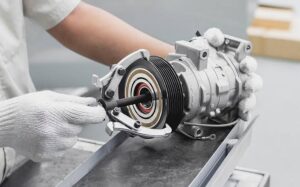
The 20-watt turbo pump supports turbo cooling while you drive, and keeps coolant flowing for up to 30 minutes after shutdown. If it fails, the turbochargers heat-soak after every hot drive. Oil in the turbo bearings can then cook into carbon, and coolant can boil in the turbo lines. That shows up as gurgling noises after parking and slow coolant loss.
Expert fix: Confirm whether the pump runs after shutdown, read the fault memory, replace the pump with a genuine part, and bleed the system correctly. Our guide to water pump failure symptoms covers the same pump designs used on BMW-built engines.
Main Water Pump and Map-Controlled Thermostat
The main water pump is belt-driven and wears like any mechanical pump. The shaft seal starts to weep, and the bearing becomes noisy.
The thermostat is map-controlled. Alongside the normal wax element, it has an electric heater that the engine computer switches on to open the thermostat earlier under heavy load. If that heater or its wiring fails, the engine runs hotter under load. If the thermostat sticks, overheating shows up on long climbs or at sustained high speed.
Expert fix: The system has temperature sensors at both the engine outlet and the radiator outlet. Comparing these two readings on live data shows whether coolant is actually reaching the radiator. A failed thermostat or pump is replaced, and the drive belt and tensioner are checked at the same time.
Coolant Leaks at Known N74 Weak Points
Specialists working on the N74 family regularly report leaks at the coolant transfer pipe near the front timing cover, at the quick-connect fittings on the turbo coolant lines, and at the expansion tank. On a Cullinan, the full underbody trays catch the drips, and coolant often evaporates on hot exhaust parts before it ever reaches the ground.
Expert fix: Cold pressure test, UV dye, and removal of the underbody trays to find the exact source before any parts are ordered. See Rolls-Royce common problems and fixes for other V12 weak points.
Overheating Causes Created by Dubai Driving
Dust-Packed Radiator Stack and Cooling Fan Strain
Several heat exchangers sit stacked behind the Cullinan’s grille: the AC condenser, the charge-air radiator, the main radiator and the gearbox cooling radiator. Fine sand packs into the gaps between these layers. The front face can look clean while airflow through the middle of the stack is badly reduced. The electric fan then works much harder in slow traffic, and both the fan and the electric pumps depend on stable battery voltage.
Expert fix:
- Separate the stack and clean it from behind.
- Check the fan at full speed with diagnostic software.
- Test the battery and charging system.
A clean condenser also restores cabin cooling through our car AC repair service. For batteries, see the best car battery brands for Rolls-Royce in Dubai.
Towing, Sand Driving and Long Idling
The Cullinan is rated to tow up to 2,700 kg braked. Towing a boat or caravan in August, crawling through soft sand at low speed, or idling for long periods with the AC on all push heavy, continuous load through the cooling system with little airflow. The gearbox adds its heat to the same circuit.
None of these is a fault, but they expose any weakness already present.
Expert fix and prevention:
- Have the cooling system checked before the towing or desert season.
- After towing or sand driving, drive gently for the last few kilometres instead of switching off straight away.
For the gearbox side, see Rolls-Royce transmission repair and our guide on how Dubai heat damages car engines.
What to Do If Your Rolls-Royce Cullinan Shows an Overheating Warning
- Reduce the load. Ease off the throttle and switch the AC off.
- Stop safely and switch off. The fan and turbo pump will keep running to remove heat. This is normal.
- Keep the expansion tank caps closed while the engine is hot. Both circuits are pressurised.
- Don’t top up with plain water or an unknown coolant. Rolls-Royce links exactly this to the deposits that cause repeat overheating. If you had to add something to reach a workshop, tell the technician so the system can be flushed.
- Don’t keep driving on a red warning. Use flatbed recovery. The Cullinan is all-wheel drive and should not be towed with its wheels on the road. See how to choose roadside assistance in Dubai.
Driving on after the engine has entered emergency mode is how a pump replacement turns into a much larger bill. Read what causes an engine to seize to understand the worst case.
How to Prevent Rolls-Royce Cullinan Engine Overheating
- Check both coolant tanks with the engine cold, monthly during summer.
- Have coolant concentration tested at every service, even though the coolant has no scheduled change.
- Clean the radiator stack from behind once a year, ideally before summer.
- After any cooling work, make sure the workshop vacuum-fills and vents both circuits.
- Keep the battery healthy so the fan and electric pumps get full voltage.
- Don’t stretch oil changes during hot-season use. See our oil change services and luxury car maintenance schedules in the UAE.
- Book a full car inspection before long summer trips or towing.
If you are buying a used Cullinan, ask whether the coolant was ever topped up with water, and check the expansion tank date on 2018–2020 cars. Our Rolls-Royce pre-purchase inspection covers what else to look for, and what Rolls-Royce owners in Dubai must know about long-term maintenance explains the wider ownership picture.
Rolls-Royce Cullinan Overheating Repair at Carzilla Auto Service
Carzilla Auto Service in Al Quoz, Dubai, diagnoses Cullinan overheating the way Rolls-Royce’s own procedures describe:
- live data from both coolant circuits,
- pressure testing before any parts are replaced,
- approved coolant at the correct mix,
- vacuum filling with a separate venting routine for each circuit.
Every job comes with Warranty on Repair and Free Pickup and Delivery*.
For the full repair process, see our Rolls-Royce Cullinan engine overheating repair page and our Rolls-Royce Cullinan service in Dubai. The same V12 cooling expertise applies at our Rolls-Royce workshop in Dubai for the Phantom, Ghost and Dawn, as part of our wider Rolls-Royce repair in Dubai and Rolls-Royce service.