Buying tyres online in the UAE has become the normal way to shop for a new set. You enter your tyre size, compare brands and prices across several websites, pick a fitting slot and the tyres arrive at an installer or at your door. It saves time and it usually saves money.
The problem is that an online product page only shows part of what matters. It shows the size, the brand, the tread pattern and the price. It rarely shows the week the tyre was made, whether it is approved for sale in the UAE, whether it carries the original equipment marking your car was designed around, or how carefully it will be fitted. Those details decide whether a tyre lasts five years on UAE roads or fails early in summer heat.
This guide explains, from a workshop point of view, how to buy car tyres online in the UAE correctly: how to read your tyre size, which UAE tyre laws apply to you, how to choose the right tyre type for your car, the most common problems online buyers run into, why they happen, how to fix them and how to prevent them.
Why Buying Tyres Online in the UAE Is Different
A tyre bought in the UAE has to survive conditions most tyre markets never see. Summer air temperatures pass 45°C and road surfaces in direct sun can go well beyond 60°C. Tyre temperatures in direct sunlight have been measured at around 80°C, which is higher than the conditions many tyres are tested for. Heat speeds up the ageing of rubber, softens the compound, raises inflation pressure and puts extra stress on the bond between the rubber and the steel belts inside the tyre.
Because of this, the UAE regulates tyres more strictly than many countries. Tyres sold here must meet Gulf (GSO) standards and UAE conformity requirements, tyre warehouses are required to be air-conditioned, the sale of used tyres is banned and every tyre has a legal age limit. When you buy tyres online, you are trusting the seller to have followed all of this before the tyre reaches you, so it pays to know what to check.
UAE Tyre Laws Every Online Buyer Should Know
The Five-Year Tyre Age Limit in the UAE
In the UAE, a passenger car tyre must not be used more than five years from its date of manufacture, regardless of how much tread is left or how good it looks. The clock starts at the factory, not on the day the tyre is fitted to your car. A tyre that sat in a warehouse for two years before you bought it only has three years of legal life left.
This rule also applies to your spare wheel. A spare that has never touched the road is still counted by its manufacture date, and a full-size spare on many SUVs, including the Land Rover Defender and the Mercedes G-Class, is often the oldest tyre on the car.
Minimum Tread Depth and the RTA Vehicle Test
The legal minimum tread depth is 1.6 mm. Every tyre has small raised bars inside the main grooves called tread wear indicators. When the tread surface wears down level with these bars, the tyre has reached 1.6 mm and must be replaced.
Tyres are checked during registration renewal, so expired, cracked or worn tyres will fail the test. If your registration is due, check tyre age and tread before booking your RTA vehicle inspection so a tyre problem does not cost you a second visit.
From a safety point of view, waiting for 1.6 mm is too late. Wet braking performance drops sharply below about 3 mm, and on a high-performance car or a heavy SUV the difference in stopping distance on a wet road after rain or on a sprinkler-wet slip road is significant.
Fines for Expired or Worn Tyres in the UAE
Driving on worn-out, damaged or expired tyres carries a fine of AED 500, 4 black points and seven-day vehicle impoundment under the Federal Traffic Law. Police across the UAE run regular summer campaigns on tyre condition because tyre blowouts are a known cause of serious crashes in hot months.
Certified Tyres Only: GSO Approval and the UAE Conformity Sticker
Tyres sold in the UAE must be certified to GSO standards and approved by the UAE authority for standards, which is now part of the Ministry of Industry and Advanced Technology (MoIAT, formerly ESMA). Approved tyres carry a conformity sticker, often with an RFID chip or a scannable code, that confirms the tyre has been homologated for the UAE climate. Retreaded tyres have their own shorter life limit, and the resale of used tyres is not allowed.
When tyres arrive from an online order, the sticker is usually on the tread face. It is easy to peel off and throw away during fitting, so ask the installer to show it to you before the tyre goes on the rim.
How to Read Your Tyre Size Before Ordering Tyres Online
Every online tyre search starts with the size, and most ordering mistakes start here too. Take the size from the tyres currently on your car and confirm it against the tyre placard, which is usually on the driver’s door frame (B-pillar) or inside the fuel flap. The placard also lists the correct cold inflation pressures.
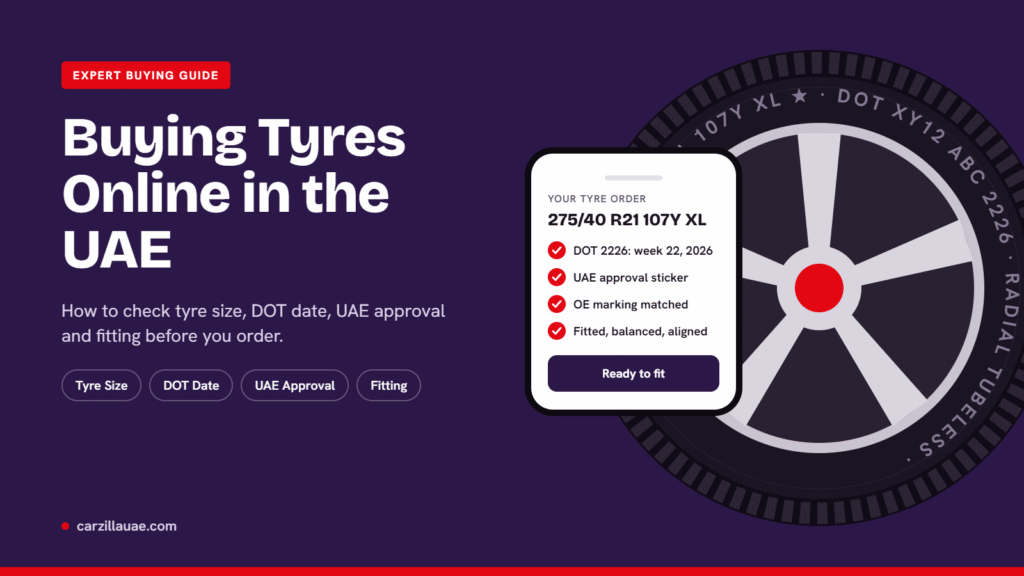
Here is how a typical luxury SUV tyre marking reads: 275/40 R21 107Y XL ★
| Marking | What it means |
|---|---|
| 275 | Tyre width in millimetres, sidewall to sidewall |
| 40 | Aspect ratio: sidewall height is 40% of the width |
| R | Radial construction |
| 21 | Wheel (rim) diameter in inches |
| 107 | Load index: 975 kg per tyre at the correct pressure |
| Y | Speed rating: up to 300 km/h |
| XL | Extra Load (reinforced) construction |
| ★ | Original equipment approval mark for BMW |
Tyre Load Index and Speed Rating
The load index tells you how much weight each tyre can carry. Never buy a tyre with a lower load index than the one specified for your car. This matters most on heavy vehicles such as large SUVs, 4x4s, pickups and electric cars, where the factory figure has very little margin. Carzilla’s SUV tyre load index guide explains how to find the correct load rating for UAE roads in more detail.
The speed rating is the maximum sustained speed the tyre is built for. Common ratings are H (210 km/h), V (240 km/h), W (270 km/h) and Y (300 km/h). A higher speed rating usually also means a stiffer construction that copes better with heat build-up, which is one reason performance cars are specified with W and Y-rated tyres even if they rarely go that fast. Fitting a lower speed rating than the manufacturer specifies can affect insurance and handling, and it is not something a good installer will accept on a performance car.
XL, Reinforced and HL Load Tyres
XL (Extra Load) and RF (Reinforced) tyres carry more weight than a standard-load tyre of the same size, but only when inflated to the higher pressure listed for them. If your car specifies an XL tyre and you fit a standard-load tyre, it can be overloaded even at the correct pressure.
Newer tyres made for heavy electric cars and large SUVs may show an HL (High Load) prefix before the load index. These tyres carry more load again at the same size, and if your car is fitted with HL tyres from the factory, a normal XL tyre of the same size is not a like-for-like replacement.
How to Check the Tyre DOT Code and Manufacture Date
The DOT code is a string of letters and numbers on the sidewall. The last four digits are the date code: the first two are the week of manufacture and the last two are the year. A tyre showing 2226 was made in the 22nd week of 2026, and in the UAE it must be off the road before the 22nd week of 2031.
The full DOT code with the date is sometimes only moulded on one side of the tyre, which can face inward once fitted. Check it when the tyres are delivered, before fitting, not afterwards.
Original Equipment Tyre Markings: Why the Same Size Is Not Always the Same Tyre
On luxury and performance cars, the tyre size alone does not tell the whole story. Car makers work with tyre manufacturers to develop versions of a tyre for a specific model, with a different rubber compound, sidewall construction, noise level or rolling resistance. These tyres carry an original equipment (OE) marking on the sidewall.
Common OE markings you will see when buying tyres online in the UAE include:
- MO, MO1, MOE for Mercedes-Benz (MO1 is usually AMG-specific, MOE is the Mercedes run-flat version)
- ★ (star) for BMW
- AO, RO1, RO2 for Audi and Audi Sport
- N0, N1, N2 and upward for Porsche, where the number changes with each tyre generation
- J and LR for Jaguar and Land Rover
- MGT for Maserati, MC for McLaren, L for Lamborghini and K codes for Ferrari on Pirelli tyres
- T0 for Tesla
A tyre with the right size but the wrong OE marking is not illegal, but it can change how the car behaves. On a Porsche, for example, the stability control and four-wheel-drive calibration are developed around N-marked tyres. On a Mercedes AMG or an Audi RS, the OE version may use a stiffer sidewall to support the steering response the car is tuned for. Mixing marked and unmarked tyres on the same axle is never a good idea.
If you drive a Porsche, Mercedes-Benz, BMW, Audi, Ferrari, Lamborghini, McLaren or Maserati, filter your online search by the OE marking, not just the size. Many online tyre shops list it in the product title; if it is missing, ask before ordering.
Choosing the Right Tyre Type for UAE Roads
Summer, All-Season and All-Terrain Tyres in the UAE
The UAE has no winter in the tyre sense, so dedicated winter tyres are pointless here and will wear quickly and lose grip in the heat. Summer and performance tyres suit most cars. All-season tyres are acceptable for everyday driving and are common on family SUVs, but they give up some dry grip and heat resistance compared with a good summer tyre.
If you drive in the desert, an all-terrain tyre with a stronger sidewall makes sense on a 4×4 such as a Nissan Patrol, Land Cruiser, Defender or GMC. Check that the all-terrain tyre still meets your vehicle’s load index and speed rating. Some aggressive all-terrain and mud-terrain tyres have lower speed ratings, and on a heavy SUV used at highway speeds in summer, that matters.
Run-Flat Tyres
Run-flat tyres have reinforced sidewalls that let you keep driving at reduced speed for a limited distance after a puncture. They are fitted as standard on many BMW, MINI and some Mercedes models that come without a spare wheel. Sidewall markings include RSC, ROF, SSR, ZP, EMT and MOE.
If your car came with run-flats and has no spare, replacing them with standard tyres means a puncture leaves you stranded. Never mix run-flat and non-run-flat tyres on the same car. Run-flats also need a tyre changer and a fitter who knows how to handle the stiff bead and sidewall; forcing them on with standard equipment can damage the bead or the TPMS sensor.
Noise-Reduction Foam and Self-Sealing Tyres
Many premium tyres for luxury cars and EVs have a foam ring bonded inside the tread to reduce cabin noise. You will see names such as Pirelli PNCS, Continental ContiSilent, Michelin Acoustic and Bridgestone B-Silent. Self-sealing tyres such as Pirelli Seal Inside and ContiSeal have a sealant layer that closes small punctures.
If your car came with foam tyres, replacing them with non-foam tyres of the same size will make the cabin noticeably louder, especially on rough concrete sections of UAE highways. Puncture repairs on foam and sealant tyres also need a workshop that can remove part of the foam or sealant to fit an internal patch properly.
Tyres for Electric Cars
Electric cars are heavier than petrol cars of the same size because of the battery pack, and they deliver full torque instantly. Both of these wear tyres faster. EV-specific tyres use compounds and constructions designed for higher load, lower rolling resistance (which affects range) and lower noise, and some carry the HL load marking.
If you own a BYD or another EV, check the load index carefully before buying online. A cheaper tyre of the same size but a lower load rating is not a safe saving on a heavy electric car. Many vibration complaints on EVs that are blamed on tyres actually come from brakes or wheels; Carzilla’s article on why a BYD Seal steering wheel shakes when braking explains how to tell the difference.
Staggered Tyre Fitments on Sports Cars
Many sports and luxury cars run wider tyres at the rear than at the front, sometimes on different rim diameters. When ordering online, you are really buying two different sizes. The front and rear tyres cannot be rotated front to rear, so the rears usually wear out first. If you replace only the rear pair, make sure the new tyres are the same model and OE marking as the fronts, or replace all four to keep the car balanced.
Premium, Mid-Range or Budget Tyres: What Changes Beyond the Price
Price differences between tyre brands are large, and online shopping makes them very visible. The differences that matter in the UAE are not always obvious from the product page.
- Heat resistance. Many tyres sold in the region carry a US UTQG rating with a temperature grade of A, B or C. Grade A is the highest resistance to heat build-up and is the one to look for in the UAE.
- Wet grip. UAE roads are rarely wet, but when it rains, oil and dust on the surface make them extremely slippery. Tyre labels grade wet grip, and a better grade means a shorter stopping distance on a wet road.
- Rolling resistance. Lower rolling resistance means slightly lower fuel use or longer EV range. It is shown on the tyre label as a fuel efficiency grade.
- Sidewall and belt construction. Premium tyres generally hold their shape better at high temperature and high speed, which affects steering feel, tread wear and the risk of tread separation.
- Noise. External noise is shown on the label in decibels, and premium tyres often add foam inserts for cabin noise.
A budget tyre from a reputable manufacturer that meets GSO standards is a reasonable choice for a small car used mostly in the city. On a heavy SUV, a high-performance car or a car regularly driven at highway speeds in summer, the extra cost of a premium or OE-marked tyre buys heat resistance, wet braking and stability that you cannot see on the product page.
Common Problems When Buying Tyres Online in the UAE: Causes, Fixes and Prevention
Receiving Old Tyre Stock
This is the most common complaint from people who buy tyres online. You order four tyres and they arrive with a manufacture date two or three years old.
It happens because tyres move slowly through the supply chain. A tyre can take months to travel from the factory to a UAE distributor, and slow-selling sizes, especially large luxury sizes, can sit in a warehouse much longer. Many online tyre shops list only the year of manufacture, not the week, and some list nothing at all.
The fix depends on the timing. If you have not fitted the tyres yet, you can ask the seller to exchange them for newer stock or refund them. Once tyres are mounted, most sellers will not take them back. If you have already fitted older tyres, work out their legal expiry date from the DOT code and plan replacement around it.
To prevent it, ask the seller for the DOT week and year before paying. As a guide, a tyre made within the last 12 months is ideal. An older tyre at a lower price can still make sense if you drive a lot and will wear it out well within its remaining legal life, but on a weekend car that covers little distance, you will hit the five-year limit long before the tread wears out.
Grey-Import or Non-Certified Tyres
Some tyres sold online are parallel or grey imports: tyres made for another market, brought into the UAE outside the official distributor channel. They may be genuine tyres, but they may not be homologated for UAE conditions, may not carry the UAE conformity sticker, and may not be covered by the manufacturer’s regional warranty. In the worst cases, they are counterfeits or used tyres sold as new.
This happens because grey imports allow sellers to undercut official distributor pricing. Tyres made for cold climates may also use compounds that are not designed for sustained high temperatures.
If you receive a tyre without the conformity sticker, or with markings that look wrong, do not fit it. Ask the seller for proof of the official importer and the certificate of conformity. To prevent it, buy from established UAE tyre sellers, be cautious of prices far below the market for the same tyre, and ask the installer to show you the sticker before fitting.
Wrong Size or Wrong Load Rating Delivered
Ordering mistakes are easy online. The most common are entering the size of an aftermarket wheel instead of the factory size, missing the XL or HL marking, choosing a tyre with a lower load index, or ordering one size for all four corners on a car with a staggered fitment.
This usually happens because the buyer searched by car model on the website, and the site’s database assumed a standard wheel option, while the actual car has a different wheel package. It also happens when previous owners fitted a different size.
The fix is simple if caught before fitting: return or exchange the tyres. To prevent it, always read the size, load index, speed rating and OE marking directly from your current tyres and the door placard, then compare it with the product page character by character. If your car has been modified with aftermarket wheels or a lowered ride height, read the car modification rules in Dubai before changing wheel or tyre sizes, as size changes beyond the approved range can cause problems at inspection and with insurance.
Mismatched Tyres on All-Wheel-Drive Cars
All-wheel-drive systems such as Audi quattro, BMW xDrive, Mercedes 4MATIC, Porsche PTM and the Haldex-type systems used on many vehicles are sensitive to differences in tyre rolling circumference. A new tyre has a larger diameter than a worn one, so replacing only one or two tyres can make the front and rear axles turn at slightly different speeds.
The car’s drivetrain then constantly tries to compensate, which puts stress on the centre coupling, transfer case or differentials and can cause binding, whining, warning lights or expensive drivetrain wear. Repairing a damaged transfer case or coupling costs far more than the tyres saved, and it is a common reason AWD cars end up needing gearbox and drivetrain repair.
The fix is to replace tyres in matched sets, ideally all four on an AWD car, or at least to keep tread depth across all four within the small limit the manufacturer allows. If one tyre is damaged beyond repair on a nearly new set, some workshops can shave a new tyre down to match the others. To prevent the problem, rotate tyres regularly where the fitment allows, so all four wear evenly.
Damage During Tyre Fitting
Many online orders include fitting at a partner installer. The quality of these installers varies. The most common fitting damage on luxury cars includes scratched or gouged alloy wheels, broken TPMS sensors, damaged tyre beads on low-profile and run-flat tyres, and over-tightened wheel bolts.
This happens because low-profile tyres on 20 to 23-inch wheels need a modern tyre changer with a leverless or assisted head, the correct bead lubricant and a technician trained on TPMS valves. Using older equipment or rushing the job leads to damage.
If your wheel was scratched during fitting, Carzilla’s guides on alloy wheel refinishing for scuffs, scratches and bends and professional rim repair in Dubai explain what can be repaired, and the rim repair cost guide gives an idea of what it costs. A cracked wheel is a different matter; read cracked rim: repair or replace before making a decision.
To prevent fitting damage, check what equipment the installer uses, whether they work on your type of car regularly, and whether they replace the TPMS valve seal and nut during fitting. Carzilla’s article on how to spot the best tyre shop in Dubai for luxury and performance cars covers what to look for in more detail.
Vibration or Pulling After New Tyres Are Fitted
A steering wheel vibration at highway speed or a car that pulls to one side after new tyres usually comes from the fitting, not the tyre. The common causes are poor wheel balancing, a wheel not seated properly on the hub, a bent rim that was already there, or a car that needed a wheel alignment.
The fix is to have the wheels rebalanced on a quality balancer, the hub faces cleaned of rust and debris, and the rims checked for runout. If the car pulls, an alignment check is needed. If vibration continues with good balancing, the cause may be a damaged wheel or worn suspension parts, which a proper car inspection will find.
To prevent it, always have new tyres balanced, ask for an alignment check with every new set, and make sure the installer cleans the hub before mounting the wheel.
Hidden Costs at Checkout
A low online tyre price can grow once you reach checkout. Common extras include fitting, balancing, new valves, TPMS service kits, old tyre disposal, mobile fitting charges, alignment and VAT. Some sites show prices per tyre and others show them for a set, which makes comparisons misleading.
To avoid surprises, compare the total cost of four tyres fully fitted, balanced and aligned, including VAT, rather than the headline price per tyre.
Tyre Warranty Claims That Get Rejected
Most tyre manufacturers cover manufacturing defects, but warranty claims are often rejected. Common reasons include missing proof of purchase, tyres fitted by an unapproved installer, damage from underinflation or a pothole impact, uneven wear caused by poor alignment, or grey-import tyres that the regional distributor will not cover.
To protect yourself, keep the invoice showing the tyre model, size and DOT code, keep a record of where and when the tyres were fitted, check pressures regularly and have the alignment checked after fitting. Road hazard damage such as nails and kerb impacts is usually not covered unless you bought a separate road hazard policy.
What a Correct Tyre Fitting Involves
Whether your new tyres are fitted at a workshop or by a mobile service, a correct fitting on a modern car should include:
- Checking the tyres before fitting: correct size, load index, speed rating, OE marking, DOT date and the UAE conformity sticker.
- Removing the wheels and inspecting the old tyres for uneven wear, which points to alignment or suspension problems.
- Removing the old tyre with a tyre changer suited to low-profile, run-flat and large-diameter wheels, without contacting the rim face.
- Inspecting and cleaning the rim bead seat. Corrosion on the bead seat is a common cause of slow air loss in the UAE, explained in Carzilla’s guide on corroded rims causing air leaks.
- Servicing the TPMS sensor or valve, replacing the valve core, seal and nut where needed.
- Mounting the new tyre in the correct direction. Directional tyres have an arrow showing rotation; asymmetric tyres are marked “outside” and must face outward.
- Inflating to seat the bead and then setting pressure to the placard value.
- Balancing each wheel on a properly calibrated balancer.
- Cleaning the hub face, refitting the wheel and tightening the bolts to the manufacturer’s torque value with a torque wrench, not only an impact gun.
- Resetting or relearning the TPMS system and, on cars with indirect systems, resetting the tyre pressure monitor in the car’s menu.
- Checking wheel alignment and correcting it if it is out of specification.
Overtightened wheel bolts can distort brake discs and cause a vibration under braking that feels like a tyre problem. If you notice a pulsing pedal after a tyre change, have the brakes checked at a brake repair service.
The First 500 km on New Tyres
New tyres have a thin layer of mould-release agent on the tread surface and the tread blocks are at full depth, so they move slightly more under load. For the first few hundred kilometres, grip is slightly lower than normal, especially on a wet road. Drive gently, avoid hard braking and high cornering loads, and recheck pressures after the first week, because a tyre that was not fully seated can lose some pressure early.
If the car came with a staggered or performance fitment, you may notice the steering feels slightly different until the tyres settle.
How to Make New Tyres Last Longer in UAE Heat
Most tyres in the UAE are replaced because of age or uneven wear, not because the tread wore out evenly. These habits make the biggest difference:
Check tyre pressure when the tyres are cold. Check in the early morning or after the car has been parked in shade. Pressure rises as tyres heat up, so a tyre checked at midday after a drive will read higher. Never let air out of hot tyres to match the placard figure; they will be underinflated once they cool. Underinflation is the main cause of tyre heat build-up and blowouts in UAE summers.
Rotate your tyres regularly. On cars with the same size front and rear, rotating every 8,000 to 10,000 km evens out wear. On AWD cars, this also keeps the rolling circumference of all four tyres similar.
Have the wheel alignment checked. Hitting kerbs, speed bumps and potholes knocks alignment out over time. Incorrect toe or camber wears the inner or outer edge of the tyre quickly. Have alignment checked at least once a year and every time new tyres are fitted.
Park in shade where possible. Direct UV and heat dry out the sidewall rubber and cause small cracks. Covered parking or a car cover slows this down, especially on cars that are parked for long periods.
Drive correctly in the desert. Lowering pressure for sand driving is common, but driving on tarmac at reduced pressure overheats the sidewalls. Reinflate to the placard pressure before returning to the road.
Look after stored cars. A car left standing for weeks in summer develops flat spots on the tyres and the rubber ages faster. Inflate to the upper end of the recommended range before storage and move the car occasionally.
Keep an eye on the spare. Check the spare’s pressure and date code at least once a year.
When Tyre Wear Points to a Bigger Problem
Tyres are a good indicator of the health of your suspension and steering. Before ordering new tyres online, look at how the old tyres wore:
- Wear on both shoulders usually means the tyres were run underinflated.
- Wear in the centre usually means overinflation.
- Wear on the inner edge is common on cars with incorrect camber or toe, lowered cars and cars with air suspension set low for long periods.
- Feathered tread blocks that feel sharp in one direction point to a toe alignment problem.
- Cupping or scalloped patches around the tyre usually mean worn shock absorbers. Carzilla’s guide to the signs of bad shock absorbers explains this in detail.
- Wear on one tyre only can point to a worn bushing, ball joint or a bent suspension part.
Fitting new tyres without fixing the cause means the new tyres will wear the same way. If your old tyres show uneven wear, have the car checked at a car suspension repair specialist and ask for the steering to be inspected at a car steering repair workshop before fitting the new set. On luxury SUVs with air suspension, such as Range Rover, Bentley and Rolls-Royce, incorrect ride height after a suspension fault is a common cause of inner-edge tyre wear.
Should You Repair or Replace Damaged Wheels When Buying New Tyres?
New tyres are often ordered at the same time a wheel is found to be scratched, bent or corroded. In many cases, the wheel can be repaired rather than replaced, which is much cheaper on luxury and performance car wheels. Carzilla’s article on whether rim repair is worth it explains when repair makes sense. A bent or corroded wheel should be fixed before the new tyre goes on, because it will cause vibration and air loss that is later blamed on the new tyre.
Expert Tyre Fitting and Advice in Dubai
Buying tyres online gives you choice and good prices, but the result still depends on choosing the correct tyre for your car and having it fitted properly. Carzilla’s auto tyre services team in Al Quoz works on luxury, performance and everyday vehicles, covering tyre replacement, fitting, wheel balancing, wheel alignment, tyre rotation and pressure checks. Before you place an online order, the team can confirm the correct size, load index, speed rating and OE marking for your car, check that your suspension and alignment are healthy enough to protect the new tyres, and handle TPMS relearning after fitting.
For high-end cars, model-specific knowledge matters. Carzilla also offers Ferrari tyre change in Dubai, and covers other luxury brands across its specialist brand repair pages and full list of car services. Free Pickup and Delivery* is available across Dubai, so your car can be collected, checked and returned without a trip to the workshop.
To book a tyre inspection or get advice before buying tyres online, contact Carzilla.