
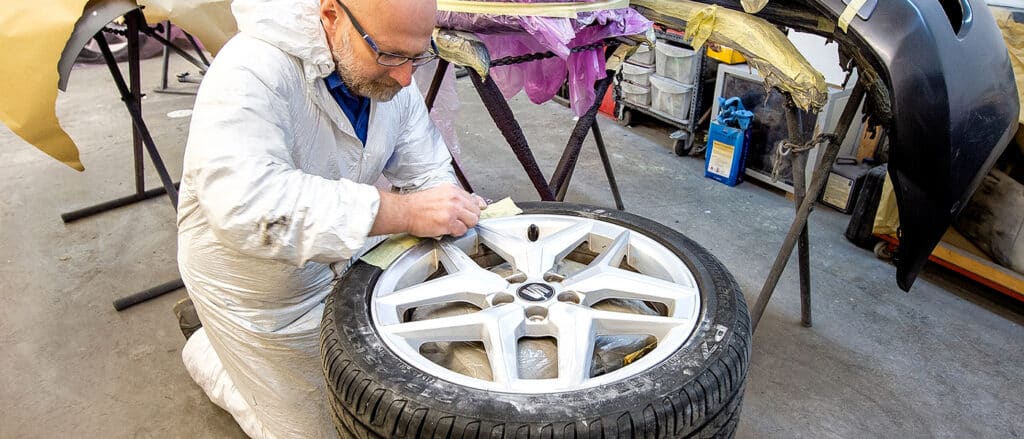
Rim refinishing is usually sold as a single service: drop the car off and “get the wheels done”. In the workshop it is not one job. It is a group of different repairs, and the right one depends on how deep the damage has gone into the wheel. A haze in the clear coat, a scratch down to bare aluminium, a kerb gouge with missing metal and a bent inner barrel can all look like “a damaged rim” from the kerb. Each one is fixed in a different way, and refinishing only solves some of them.
This guide explains how rim refinishing works for each type of wheel damage, from light scuffs and scratches to kerb rash and bends. It covers why each type of damage happens, what a proper refinish does to fix it, where refinishing stops and structural repair has to take over, how the wheel’s finish changes the method, and how to stop the damage coming back. It is a general guide for any car with alloy wheels, with extra detail for luxury and performance cars.
If you want prices, see our guide to rim repair cost in Dubai. If you are not sure whether your wheel is damaged at all, read when you need professional rim repair. For cracks and slow leaks, see whether a cracked rim should be repaired or replaced and our guide to corroded rims causing air leaks.
What Rim Refinishing Means and What It Does Not Cover
Rim refinishing means restoring the surface of the wheel. The old or damaged finish is removed, the surface underneath is repaired, and a new finish is applied. That new finish can be paint, powder coat, a re-machined diamond-cut face, polish or plating, depending on the wheel.
Rim repair in the structural sense is different. Straightening a bent rim, welding a crack and rebuilding a lip with new metal change the shape or the metal of the wheel. Refinishing does not.
Most damaged wheels need both, and the order matters. Structural work always comes first, because there is no point refinishing a wheel that turns out to be bent beyond tolerance or cracked. A fresh coat of paint on a bent wheel still vibrates, and a fresh coat on a cracked wheel still leaks.
How an Alloy Wheel Finish Is Built
To understand why each type of damage is fixed differently, it helps to know what a factory wheel finish is made of.
A modern alloy wheel is cast, flow-formed or forged from aluminium alloy. Before any paint goes on, the bare metal is given a chemical pretreatment, a thin conversion layer that helps the coating stick and slows corrosion. On top of that, wheel makers usually build a three-layer coating system:
- Primer. Often a powder coat. It grips the pretreated metal, levels small casting marks and adds corrosion protection.
- Basecoat. The colour layer. On most wheels this is a liquid paint, because liquid paint gives better metallic and special-effect finishes than powder.
- Clear coat. The top layer that gives gloss or a matte sheen and protects the colour from UV, brake dust and cleaning chemicals. It can be powder or liquid.
Diamond-cut wheels add a twist. The wheel is primed and painted, then put on a lathe that machines the face back to bright bare aluminium. Only a clear coat protects that machined metal. This is why diamond-cut faces are so sensitive to chips and corrosion.
Chrome, PVD and polished wheels use different layers again, explained further down.
The point is simple. Damage that stays in the clear coat is the cheapest and quickest to fix. Each layer the damage passes through adds work. Damage that changes the shape of the metal needs a repair before any refinishing can start.
| Type of damage | Deepest layer reached | How refinishing fixes it | Work needed beyond refinishing |
|---|---|---|---|
| Light scuff or marring | Clear coat only | Machine polishing on gloss wheels, or a fresh clear coat | None |
| Scratch into the colour | Basecoat | Spot repair and blend, or a full face respray | None |
| Scratch to bare metal | Aluminium surface | Strip past the corrosion, prime, colour and clear | Check for corrosion under the nearby finish |
| Kerb rash with missing metal | Aluminium lost from the lip | Fill or build up, reshape the lip, then refinish | Tyre removal, flange and bead seat check |
| Bend or flat spot | Shape of the wheel | Refinish only after straightening | Runout measurement, balancing, alignment check |
| Damage on a diamond-cut face | Machined face | Re-machine on a CNC lathe, then clear coat | Check how much metal is left on the face |
Rim Scuffs: How Light Surface Damage Is Refinished
What a rim scuff is
A scuff is damage that stays in the top layer. It shows up as a dull patch, a haze, fine scratches that catch the light, or a light grey mark where the wheel brushed a kerb without biting into it. The clear coat is marked, but the colour underneath is intact.
Why rim scuffs happen
Most scuffs come from contact and cleaning, not impacts:
- Automatic brush car washes. Hard brushes drag sand and grit across the wheel face.
- Wheel cleaning with dirty brushes or sponges. Brake dust contains iron particles, and rubbing it around the face works like fine sandpaper.
- Kerb kisses. A gentle touch against a kerb or a car park ramp edge marks the clear coat without removing metal.
- Sand in the air and on the road. In the UAE, fine sand settles on wheels and is ground in by every wash and wipe.
- Tyre fitting. Metal mounting heads and tyre levers can mark the rim edge if the machine is not fitted with protectors.
How refinishing fixes a scuff
On a gloss wheel, a scuff that is only in the clear coat can often be removed by machine polishing with a fine compound, the same way light marks are corrected on body paint. Polishing removes a very thin layer of clear to level the surface. A simple check is to wipe the mark with a damp cloth or panel wipe. If it almost disappears while wet, it is in the clear coat. If you can catch it with a fingernail, it is probably deeper.
If the scuff is too deep to polish without cutting through the clear, the face is sanded smooth and a fresh clear coat is applied over the existing colour.
Where scuff repair stops
Not every finish can be polished:
- Matte and satin wheels cannot be polished, because polishing turns the matte surface glossy in patches. The face has to be re-cleared to match the sheen.
- PVD bright wheels have a very thin metal layer under the clear coat. Some car makers, including General Motors, advise against abrasive polishes on their bright PVD wheels, so the wheel maker’s care advice should be followed.
- Chrome wheels have no clear coat to polish back. Marks in chrome are in the plating itself.
A scuff on the rim lip that has broken through the clear coat is no longer a scuff. Once moisture reaches the metal, it should be treated as a scratch.
Scratched Rims: How Scratches Through the Clear Coat Are Fixed
A scratch goes through the clear coat into the layers below. There are two kinds, and the difference matters.
Why scratches happen on rims
- Stones and road debris thrown up by other cars
- Kerb contact that bites through the clear but does not remove metal
- Wheel bolts, sockets and tools dropped against the face during tyre work
- Car lifts and jacks touching the rim edge
- Keys, bags and shopping trolleys in car parks
Scratches into the colour coat
When a scratch reaches the colour but not the metal, the wheel can usually be fixed with a spot repair, sometimes called a SMART repair. The area is sanded flat, primed if needed, painted in the matching colour, blended into the surrounding paint and clear coated.
Spot repairs work well on solid colours such as black, white and grey. They are harder on metallic silver. In a metallic paint, tiny aluminium flakes reflect the light, and the angle they settle at depends on how the paint is sprayed. A small patch can look slightly lighter or darker than the rest of the wheel from some angles. For that reason, many refinishers repaint the whole wheel face instead of patching a metallic wheel.
Colour matching also matters. Factory wheel colours are not the same as body colours, and the same “silver” can differ between car makers and model years. A good refinisher works from the wheel’s colour code where one exists, or measures the colour, and sprays a test card to compare before painting the wheel.
Hyper silver and other very bright silvers are layered finishes. They are usually built over a darker base, with the bright silver on top and a clear coat to finish. A single-coat silver cannot reproduce them, so a hyper silver wheel needs the full layered process to match.
Scratches down to bare aluminium
Once a scratch reaches bare aluminium, the repair becomes urgent. Aluminium does not rust like steel, but it corrodes when salt and moisture reach it. Corrosion can creep sideways under the clear coat as fine white threads, known as filiform corrosion. It is especially common on diamond-cut faces and at the rim edge.
That changes the repair. The refinisher has to strip back past the visible scratch until no corrosion is left, then prime the bare metal before colour and clear go on. Painting over a scratch that has already started to corrode only traps the corrosion, and the finish lifts again within months. Our guide to why car paint peels explains the same failure on body panels, and our article on corroded rims causing air leaks shows what happens when corrosion reaches the bead seat.
Scratches on gloss black wheels
Gloss black is the least forgiving wheel finish. It shows every scratch, swirl and uneven patch of paint. Refinishing gloss black takes more preparation than silver, because any low spot or sanding mark under the paint shows through. Gloss black wheels also show brake dust burns quickly in the UAE heat, so the clear coat quality matters as much as the colour.
Kerb Rash Repair: How Gouges With Missing Metal Are Refinished
What kerb rash is
Kerb rash (curb rash) is grinding damage on the outer rim lip, caused by the wheel scraping along a kerb or a ramp edge. Light kerb rash only marks the finish. Heavier kerb rash removes metal and leaves gouges, burrs and flat spots on the lip.
Why kerb rash is so common in Dubai
On many modern luxury cars, the rim lip sits wider than the tyre sidewall, so the metal touches the kerb before the rubber does. Low-profile tyres on 21, 22 and 23-inch wheels give almost no protection. Spiral ramps in mall and residential car parks, raised edges at valet points, high kerbs at drop-off areas and parallel parking all add to it. Most kerb rash in the city happens at walking speed, not on the open road.
How kerb rash is repaired and refinished
A proper kerb rash repair starts with the tyre off the wheel. The flange, the raised edge that holds the tyre bead in place, has to be checked, and filler or paint must not end up on the bead seat where the tyre seals.
- Light kerb rash is sanded smooth and shaped back to the original lip profile, then refinished.
- Deeper gouges are filled with a metal-based filler and shaped back to the lip profile before priming and painting.
- Heavy metal loss is built up with aluminium TIG welding, then filed or machined back to shape. This is structural work, and the rest of the wheel should be checked for bends at the same time.
- Diamond-cut wheels with kerb rash on the face edge are re-machined on a lathe after the damage is repaired. More on this below.
- Polished lips are re-polished and sealed after the gouges are repaired.
Where kerb rash repair stops
Kerb rash is not always cosmetic. A sharp, deep gouge on the rim lip can be the starting point of a crack, and a flange with metal missing may not hold the tyre bead evenly, which leads to slow leaks. A good refinisher checks deep gouges with dye penetrant before covering them with paint. If a crack is found, our guide to cracked rim repair or replacement explains the next decision.
A rubber coating or peelable paint sprayed over kerb rash hides it but does not repair it. Moisture can sit under the coating against the damaged metal. Peelable paint is a good way to change the colour of a sound wheel, as our comparison of car wrap vs peelable paint explains, but it should go over a properly repaired surface.
Bent Rims: Why Refinishing Alone Cannot Fix a Bend
What a bent rim is
A bent rim is a wheel that no longer runs perfectly round or flat. The bend can be on the outer lip where you can see it, on the inner barrel behind the spokes where you cannot, or across a short section as a flat spot. A bent rim usually causes vibration at highway speed, a slow leak at the bead, or uneven tyre wear. Our guide to professional rim repair explains these signs in detail.
Why rims bend
- Potholes, broken manhole covers and raised expansion joints. The edge of the hole usually strikes the inner side of the wheel hardest.
- Speed bumps taken too fast, especially the steep ones in residential communities.
- Low-profile and run-flat tyres, which pass more of the impact into the rim.
- Under-inflated tyres. Pressure rises when tyres are hot. Letting air out of a hot tyre leaves it under-inflated when it cools, and the rim then reaches the road during an impact.
- Desert driving, when aired-down tyres meet a rock or a hard ridge.
Why straightening must come before refinishing
Refinishing restores the surface. It cannot move metal back into shape. A bent wheel must be straightened first. The tyre is removed, the wheel is mounted on a straightening machine, and runout is measured. The bend is then pushed back in small steps with hydraulic rams, measuring after each step, until the wheel runs true within the car maker’s limit.
Straightening often cracks or lifts the paint around the bend. On the inner barrel this may only need a touch of primer and paint to protect the metal. On the outer lip, the straightened area is refinished to match the rest of the wheel.
Why heat control matters for straightening and refinishing
This is the part of rim refinishing that most owners never hear about.
Most cast alloy wheels are made from an aluminium alloy called A356 and heat treated to a condition called T6. The final step of that treatment, known as artificial ageing, holds the wheel at roughly 150 to 160°C for a few hours. That step gives the alloy much of its strength.
Many standard powder coatings cure at around 175 to 200°C. A short cure at that temperature is used across the wheel industry and is generally considered safe. The risk comes from too much heat for too long, or from heat cycles stacking up. A straightened wheel has often already been warmed. If it then goes through a long pre-bake and a hot powder cure, the alloy can over-age, which reduces its fatigue strength even though the wheel looks perfect.
A careful refinisher controls oven temperature and time, or chooses a finish that cures at a lower temperature. Low-cure powder coatings that cure at around 120°C are available, and two-pack liquid paints cure at much lower temperatures than standard powder. It is reasonable to ask a workshop what temperature it cures at and for how long.
When a bend hides a crack
A bend and a crack often come from the same impact, and sometimes a crack only opens while the bend is being straightened. This is why a responsible shop checks a straightened wheel with dye penetrant before any refinishing starts. Cracks in the spokes, the centre or near the bolt holes mean the wheel should be replaced, not refinished.
What to check after a bent rim is refinished
An impact hard enough to bend a rim can also knock out the alignment or bend a suspension part. After the wheel is straightened, refinished and balanced, it is worth checking the alignment and the suspension. Our guides on how wheel alignment protects your tyres in Dubai, professional wheel alignment for luxury cars and the signs your car needs new suspension parts explain why. If a vibration remains after the wheel work, our pages on Mercedes vibration repair, Range Rover vibration repair and Porsche vibration repair explain how other causes are separated.
How the Wheel Finish Changes the Refinishing Method
The same scratch is fixed differently on a painted wheel, a diamond-cut wheel and a chrome wheel. Before quoting, a refinisher needs to know which finish the wheel has.
Painted silver, grey and gunmetal wheels
These are the simplest and most common finishes. Damage can be spot repaired or the whole face repainted. The main challenge is matching the metallic effect, which is why a full face respray often gives a better result than a patch.
Gloss black and colour-painted wheels
Solid colours spot repair more easily than metallics, but gloss black needs very careful preparation, because every flaw shows. Colour-painted wheels in bright shades need an exact colour match across all four wheels.
Matte and satin wheels
Matte and satin finishes get their look from a clear coat that scatters light. They cannot be polished or blended. Any damage means the whole face is re-cleared, and the refinisher has to match the sheen level as well as the colour. A satin wheel refinished in a slightly glossier clear stands out next to the other three.
Diamond-cut and two-tone wheels
A diamond-cut wheel is refinished in a fixed order. Damage is repaired, the face is painted in the darker colour on two-tone designs, and the wheel is then mounted on a CNC lathe. The lathe maps the face profile and a cutting tool machines a thin layer of aluminium off the face, exposing bright fresh metal. The wheel is then clear coated straight away to protect the bare machined surface.
Every re-cut removes metal. A single pass can take only a fraction of a millimetre, but the cuts add up, and many refinishers will only re-cut a wheel two or three times in its life. Before re-machining, a good workshop checks whether the wheel has been cut before. Deep kerb damage on the face edge can also be deeper than a safe cut can remove, in which case the face cannot be restored to a diamond-cut finish.
Diamond-cut faces need a lathe, so they cannot be properly refinished by a mobile van at the roadside. A quick paint-over in silver changes the look completely and does not protect the machined metal in the same way.
Polished and brushed aluminium wheels
Polished wheels have no colour layer, only a clear coat or sealant over bright aluminium. Damage is sanded out, the metal is polished back to a mirror shine by hand and machine, and the surface is sealed. The price depends heavily on labour time. Brushed finishes are refinished in the same way but with a grained final pass instead of a mirror polish.
Chrome-plated wheels
Chrome wheels cannot be spot repaired. Chrome is a plated metal layer, not paint. A damaged chrome wheel has to be chemically stripped, repaired underneath and re-plated as a whole, which is normally done by a specialist plating shop. Turnaround is longer and the cost is higher than any painted finish.
PVD bright wheels
PVD stands for physical vapour deposition. It is a process that applies a very thin metallic layer to the wheel to give a chrome-like look, then seals it under a clear coat. Marks in the clear coat may be improved, but any damage that breaks through to the metallic layer is permanent. A damaged PVD finish usually has to be stripped completely and either re-coated by a PVD specialist or changed to a painted finish. Acid-based wheel cleaners can permanently stain PVD wheels, so they should never be used.
Powder-coated wheels
Many refinished wheels are powder coated, and some factory wheels use powder for the primer or clear coat. Powder coating is tough and thick, but it cannot be spot repaired. A chip in powder coat cannot be blended in, and moisture under a chip can make the coating lift around it. A damaged powder-coated wheel is normally stripped and fully recoated.
Powder Coating vs Paint for Rim Refinishing
Owners in Dubai often ask whether powder coating or paint is better for refinishing rims. Neither is better in every case. Each suits different wheels and different damage.
Powder coating is a dry powder sprayed onto the wheel and melted into a hard film in an oven. It gives a thick, tough, chip-resistant finish in solid colours and many satin and gloss blacks. Its weak points are heat and repairability. Cast aluminium wheels contain tiny pores from the casting process, and air and contamination trapped in those pores can escape during curing and blow small pinholes through the powder. This is called outgassing. Refinishers prevent it either by pre-baking the wheel at a temperature above the cure temperature before coating, or by using powders made to resist outgassing. Pre-baking adds another heat cycle, which is one more reason oven control matters on a wheel that has been straightened.
Liquid paint usually means a two-pack primer, basecoat and clear coat system, like the one used for body repairs. It gives the best match for factory metallics, hyper silvers and special colours, it can be blended for spot repairs, and it cures at much lower temperatures than standard powder. It is thinner than powder, so the quality of the preparation and the clear coat decides how long it lasts.
Many factory wheels use both. A powder primer, a liquid colour coat and a powder or liquid clear coat is a common combination. A good refinisher chooses the system to suit the wheel’s finish, its history and how it will be used, not the system that is easiest for the shop.
Inside a Proper Rim Refinishing Job
A refinish that lasts follows the same logic every time, whatever the damage.
Inspection with the wheel off the car
The wheel is removed and cleaned on both sides. The inner barrel is where most hidden bends, cracks and corrosion are found. The wheel is spun to check runout, and suspicious marks are tested with dye penetrant. This is the point where the workshop should say whether the wheel can be refinished at all.
Tyre, TPMS sensor and balance weight removal
The tyre comes off so the whole rim can be worked on. The tyre pressure (TPMS) sensor is removed, because it cannot go through stripping chemicals or a curing oven. Old balance weights are removed.
Stripping the old finish
The old coating is removed by chemical stripping, media blasting or both. The choice of blast media matters on aluminium. Fine, softer media such as plastic, glass bead or fine aluminium oxide, or wet blasting, clean the surface without eating into the metal. Steel or iron grit should not be used on an aluminium wheel, because particles can embed in the surface and later corrode under the new finish.
Surface repair
Straightening and welding are already done by this point. Kerb damage is filled or built up and shaped back to the original profile. Corrosion pits are removed down to sound metal.
Cleaning, pretreatment and masking
The bare wheel is degreased and given a pretreatment or an etch primer so the new coating bonds to the aluminium. Then the parts of the wheel that must not be coated are masked:
- The hub mounting face, the bolt seats and the centre bore. Paint or powder in these areas compresses under the wheel bolts, which reduces clamping force and can let the bolts loosen.
- The valve hole, so the TPMS sensor or valve seals properly.
- The bead seats, which are left smooth with only a thin coating, because a thick or rough coating where the tyre seals can cause a slow leak.
Coating, curing and machining
Primer, colour and clear coat are applied and cured at a controlled temperature. On diamond-cut wheels, the wheel goes to the lathe after the colour has cured, then straight to clear coat.
Refitting, balancing and torque
A new TPMS valve seal kit is fitted, the tyre is mounted with proper fitting paste, and the wheel is balanced with stick-on weights placed on clean, coated metal. The wheel goes back on the car with clean hub faces and is tightened in a star pattern with a torque wrench to the car maker’s figure. The bolts are re-checked after the first 50 to 100 km. Our auto tyre services handle this tyre, TPMS and balancing work alongside rim refinishing, and our guide to spotting the best tyre shop in Dubai explains what correct fitting looks like.
Why Some Refinished Rims Fail Within Months
A refinished wheel should last for years. When a refinish fails early, the cause is almost always one of these:
- Corrosion left under the new finish. White threads reappear along the edge of the repair, usually on the rim lip or a diamond-cut face.
- Painting over the old finish without stripping it. The new coat is only as strong as the old one underneath, and it peels when the old layer lets go.
- No pretreatment or primer on bare aluminium. The coating has nothing to grip and chips easily.
- Outgassing pinholes on cast wheels that were powder coated without a pre-bake or an outgassing-resistant powder.
- Coating on the hub face and bolt seats, which can lead to loose wheel bolts.
- A thick or rough coating on the bead seat, which causes slow leaks after the refinish.
- Aerosol paint and one-pack clear. These are softer than two-pack or powder finishes, and brake dust burns into them quickly in summer.
- Too much heat, which can weaken the alloy without any visible sign.
- Harsh acidic cleaners used on a fresh finish, which attack the clear coat before it has fully hardened.
These failures are also why a cheap refinish often costs more in the end. Our car scratch repair guide and article on mobile car scratch repair explain the same trade-off between quick fixes and proper preparation on bodywork.
Mobile Rim Refinishing vs Workshop Refinishing
Mobile rim repair is popular in Dubai because the technician comes to the car. For light scuffs and light kerb rash on painted wheels, a skilled mobile technician can give a good result with the wheel still on the car.
Mobile work has clear limits. Without removing the tyre, the inner barrel and bead seat cannot be inspected or refinished. A mobile van cannot straighten a bent rim, weld a gouge or re-machine a diamond-cut face. It also cannot fully strip and pretreat a corroded wheel. For anything beyond surface damage on a painted wheel, the wheel needs to go to a workshop.
How to Prevent Scuffs, Scratches and Bends on Your Rims
Protect the wheel finish from heat, dust and chemicals
Clean the wheels with a pH-neutral wheel cleaner and a soft brush, and rinse well. Avoid strong acidic cleaners, and never spray cleaner onto hot wheels or let it dry in the sun. Avoid automatic brush car washes, which grind sand into the face. Clean brake dust off regularly before the heat bakes it on, and ask about lower-dust pads at your next brake pad replacement.
A ceramic coating on the wheels makes brake dust easier to wash off and gives the clear coat an extra barrier against heat and chemicals. Our guides on ceramic coating vs PPF and how long ceramic coating lasts in the UAE explain the options. Our car detailing service and guide to choosing a car detailing workshop in Dubai cover safe wheel cleaning.
Avoid kerb rash
Leave a gap when parking next to kerbs, take car park ramps slowly and wide, and use the side camera view as well as the top view. Rim protector strips fitted to the outer lip take kerb contact instead of the wheel, and they are cheap compared with a refinish. They are available through our tyre services.
Avoid bends
Set tyre pressure cold, in the morning or after the car has been parked in shade, using the figure on the door frame label, and never let air out of a hot tyre. Correct pressure also saves fuel, as our guide on how to reduce fuel consumption in cars explains. Cross speed bumps straight and slowly, and slow down through road works. After desert driving, re-inflate to road pressure before driving on tarmac.
Wheel size matters too. A slightly smaller wheel with a taller tyre sidewall protects the rim better on city roads. Tyre choice and load rating are covered in our guides to choosing the right tyres and the SUV tyre load index. Any change of wheel size, offset or finish must follow the car modification rules in Dubai, and our car modification team can confirm fitment. Our posts on custom rims and tinting and luxury car customization trends in Dubai show what a wheel upgrade involves.
Fix small damage early
A lacquer chip or a light scuff is the cheapest rim damage to fix. Left alone, moisture gets under it and corrosion spreads, which turns a polish or a spot repair into a full strip and refinish.
Have the wheels checked regularly
Inner barrel bends and early corrosion cannot be seen from outside. A check during routine servicing or a car inspection catches them early. Wheel and tyre condition is also checked at the RTA vehicle test. Our guides on caring for a luxury car in Dubai’s harsh climate and luxury car maintenance schedules in the UAE show where wheel checks fit into regular care.
Rim Refinishing for Luxury and Performance Cars
Luxury and performance car wheels add a few points to the refinishing decision.
- Forged wheels on Rolls-Royce, Bentley, Lamborghini and AMG Mercedes-Benz models often have thin spokes and complex machined faces, which make stripping, masking and refinishing slower.
- Staggered wheel sets, with wider rear wheels, cannot be swapped front to rear. If one wheel is refinished, it can look brighter than the other three. Many owners refinish all four for an even finish.
- Diamond-turned and two-tone designs, common on Range Rover, Audi and BMW models, need a lathe and a check of how much metal is left on the face.
- Centre-lock wheels need the correct socket, torque and procedure when they come off for refinishing, as our Ferrari tyre change page explains.
- Carbon fibre wheels cannot be structurally repaired by a wheel shop. Only cosmetic work on the clear coat is possible.
- Air suspension cars must be put into the correct jacking mode before the wheels come off.
Most car makers approve cosmetic refinishing of the paint coatings, but not straightening, welding or other structural work on their wheels. This affects manufacturer warranty claims and some insurance policies, as explained in our guide to professional rim repair. For the full picture of how wheel and body damage are restored together after an accident, see our luxury car denting and painting guide.
Rim Refinishing at Carzilla, Al Quoz Dubai
At Carzilla in Al Quoz Industrial Area 2, every damaged wheel is inspected off the car with the tyre removed before anything is quoted. We measure runout, check the inner barrel and bead seats, and test suspicious marks before we decide whether the wheel needs refinishing, structural repair first, or replacement. Structural work is always done before the finish. The finish is matched to the original, whether the wheel is painted, hyper silver, gloss black, satin, polished or diamond-cut.
Wheel refinishing is carried out through our car painting service and auto body shop, with tyre fitting, TPMS, balancing and alignment handled in the same visit through our auto tyre services. Any suspension or steering faults found after an impact are handled by our car suspension repair and car steering repair teams. Our earlier post on how a wheel rim is repaired gives a short overview of the basics.
We refinish wheels for Mercedes-Benz, BMW, Audi, Porsche, Range Rover, Bentley, Rolls-Royce, Lamborghini and Ferrari owners, along with all the other luxury car brands we specialise in. See our full list of car services in Dubai.
Every job comes with a clear estimate before work starts, Warranty on Repair and Free Pickup and Delivery* across Dubai. For larger jobs, Carzilla also offers pay-later options with Tabby. To book a rim inspection or a refinishing quote, contact Carzilla or call 056 684 9665.