
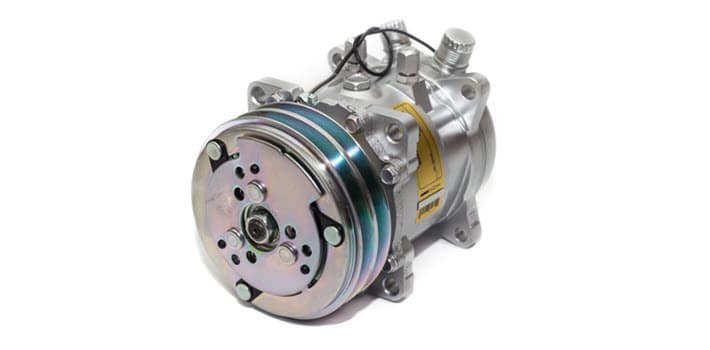
The aircon compressor is the most expensive part of a car’s air conditioning system, and it works harder in Dubai than almost anywhere else. Summer highs regularly pass 45°C. The National Centre of Meteorology’s Dubai station has recorded peaks of around 48°C in July and August. Every hour in traffic at those temperatures pushes the compressor close to its limits.
A warm-blowing AC does not always mean the compressor is finished. Many faults that look like compressor failure are actually:
- a worn clutch
- a noisy pulley bearing
- a stuck control valve
- a slipping belt
- a weak cooling fan
- a condenser blocked with sand
These can be repaired for a fraction of the cost of a new compressor. When the compressor does need replacing, how the job is done decides whether the new one lasts.
This guide explains how car aircon compressors fail in Dubai, which faults can be repaired, when replacement is necessary, what the work costs, and how to prevent the problem coming back. For every other type of air conditioning fault, see our car AC repair service in Dubai.
What a Car Aircon Compressor Does
The compressor draws in low-pressure refrigerant vapour from the evaporator behind the dashboard. It compresses the vapour into a hot, high-pressure gas and pushes it to the condenser at the front of the car, where the heat is released. The refrigerant then passes through an expansion valve or orifice tube, cools sharply, and returns to the evaporator to absorb heat from the cabin air.
Two facts explain most compressor failures:
- The compressor has no oil supply of its own. Its lubricating oil travels around the system mixed with the refrigerant. About half of the system’s oil sits in the compressor. The rest is spread through the evaporator, condenser, pipes and drier.
- The compressor can only compress gas. Liquid refrigerant or a slug of oil reaching the cylinders causes instant internal damage.
Types of Car AC Compressors
- Clutch-type compressors. An electromagnetic clutch on the front pulley switches the compressor on and off. These are common on Japanese cars, American SUVs and pickups.
- Variable displacement compressors with a clutch. These have a clutch, but an internal valve changes the piston stroke to match the cooling demand.
- Clutchless variable displacement compressors. These are standard on most German and European luxury cars. The pulley turns whenever the engine runs. An electronic control valve, commanded by the engine or climate control module, decides how hard the compressor works. Instead of a clutch, the pulley has a damper limiter that breaks deliberately if the compressor locks, protecting the drive belt.
- Electric compressors. These are used on hybrids and electric cars. A high-voltage motor drives the compressor, and it needs a special insulating oil.
The compressor type matters because each type has different repairable parts and different faults. A car AC mechanic needs to know which one is fitted before diagnosing it.
Why Dubai Conditions Are Hard on AC Compressors
Several local conditions work against the compressor at the same time:
- Extreme ambient heat. The hotter the outside air, the harder it is for the condenser to release heat. System pressure rises and the compressor works against a heavier load. Condensers are built to handle internal pressures of up to around 34 bar.
- Long idling in traffic. At idle there is no natural airflow through the condenser. It depends entirely on the electric cooling fan.
- Sand and dust. Fine sand packs into the gap between the condenser and the radiator, where it cannot be seen from the front grille. Airflow drops and pressure rises.
- Near year-round use. Most Dubai cars run the AC for eleven or twelve months of the year, so wear builds up faster.
- Humidity. Coastal humidity means any leak or poorly evacuated system lets moisture in. Moisture mixes with the oil and forms acids.
- Summer storage. Cars parked for weeks while owners travel lose oil film on the compressor seals, and leaks start on the first hot drive.
Signs Your Car Aircon Compressor Needs Attention
A failing compressor usually gives warning signs before it stops completely. The table below shows what common symptoms usually point to. It also shows why a proper diagnosis matters before any part is ordered.
| Symptom | What it usually points to | Is the compressor itself faulty? |
|---|---|---|
| Cold while driving, warm at idle or in traffic | Weak cooling fan, condenser blocked with sand, or a control valve fault | Usually not |
| Cold in the morning, warm after 20 to 30 minutes in afternoon heat | Clutch air gap too wide, clutch slipping when hot, or a thermal cut-out | Often a clutch repair |
| Click when the AC switches on but no cold air | Low refrigerant, slipping clutch, or internal wear | Needs testing |
| Rumble or whine with the engine running and the AC off | Worn compressor pulley bearing, belt tensioner or idler pulley | Bearing, not the pump |
| Grinding or knocking that starts only with the AC on | Internal compressor wear or damage | Often yes |
| Belt squeal when the AC engages | Slipping belt, weak tensioner, or a stiff compressor | Needs testing |
| AC stopped, belt intact, pulley spinning freely | Broken damper limiter pulley on a clutchless compressor | The compressor may have locked |
| Oily, dust-caked ring around the front of the compressor | Shaft seal leak | Usually means replacement |
| AC fuse keeps blowing | Shorted clutch coil or damaged wiring | Clutch or wiring |
| Regas makes no difference | Control valve fault or worn compressor | Needs testing |
If the AC blows cold on the motorway but warm at traffic lights, check the cooling fan and condenser first. This is one of the most common car AC complaints in Dubai, and the compressor is usually not the cause.
Common Causes of Car AC Compressor Failure in Dubai
Low Refrigerant and Oil Starvation
The oil travels with the refrigerant, so a system that is low on gas is also low on oil returning to the compressor. Small leaks at O-rings, hose crimps, the condenser or the evaporator leave the compressor running nearly dry. Internal wear speeds up until output falls or the compressor seizes. Repeated top-ups without finding the leak only delay this.
Blocked Condenser and High System Pressure
A condenser clogged with sand, dust and insects cannot release heat. System pressure and temperature rise, the compressor works harder and the oil breaks down faster. Old rubber hoses also shed fine particles that block the condenser’s small internal channels from the inside. Neither type of blockage shows from the front of the car.
Cooling Fan and Electrical Faults
The electric cooling fan has the same effect as a blocked condenser when it fails. The cause can be a weak motor, a failed fan control module or a faulty relay. Fan faults are explained in our guide to why a Maserati cooling fan can’t keep up with Dubai heat.
Electrical faults can also stop the compressor from being commanded at all:
- a failed pressure sensor
- a damaged connector
- low battery voltage
How low voltage switches off non-essential systems is covered in our guide to Mercedes electrical system warnings.
Wrong Oil, Too Much UV Dye and Leak-Stop Additives
Contaminated or incorrect oil is one of the most common reasons compressors fail:
- Universal oil. Universal (PAO) oils do not mix properly with the PAG oils used in most car compressors. They leave a thin oil film between piston and cylinder, which leads to seizure. Denso reports that in a quarter of its compressor warranty claims, the correct PAG oil had not been used.
- Too much UV dye. UV leak dye should be limited to a small amount, typically 3 to 5 ml for a system holding up to 1,000 g of refrigerant.
- Leak-stop products. Leak-stop additives in DIY regas cans form a gel that blocks the control valve and the oil passages. Once leak-stop has been added, a flush cannot remove it. Every part of the system must be replaced.
Liquid Lock From Overcharging
A compressor is designed to pump vapour. Liquid refrigerant or too much oil in the cylinders bends or breaks the internal valves and damages the swash plate. Common causes:
- overcharging the system
- charging liquid refrigerant into the low-pressure side
- a faulty expansion valve
- too much oil added during a previous repair
Drive Belt and Engine Faults
A worn belt tensioner, a seized alternator pulley, a failing idler pulley or crankshaft damper, or a worn dual-mass flywheel makes the belt flutter. Each flutter hits the compressor pulley with a shock load. This is a leading reason damper limiter pulleys break on clutchless compressors.
Rough engine running from an engine misfire has the same effect. So does extra torque from engine tuning, which is relevant to cars that have had car modification work.
Moisture and Contamination
Moisture enters through leaks or a system that was not properly vacuumed. It reacts with the oil and refrigerant to form acids, which attack seals, hoses and internal compressor parts. A receiver drier that has been in place too long can no longer absorb moisture.
Long Periods Without Use
The compressor shaft seal relies on oil to stay supple. When a car sits unused, or the AC is not run for weeks, the seal dries out and starts to leak. Summer storage cars in Dubai often develop compressor leaks on the first long drive after the owner returns.
Car AC Compressor Repair: Faults That Can Be Fixed Without a New Compressor
When the compressor body still pumps properly, the fault is often in a part that can be repaired on its own. This is where an honest diagnosis saves the most money.
AC Compressor Clutch Repair and Air Gap Adjustment
On clutch-type compressors, a small air gap separates the clutch plate from the pulley when the AC is off. Depending on the make, it is usually between about 0.35 mm and 0.8 mm. Each engagement wears the friction faces, so the gap slowly grows. Once it is too wide, the clutch cannot pull in reliably, especially when hot. This is why many cars cool well in the morning and turn warm in the afternoon.
The gap is measured with a feeler gauge at several points and corrected by adding or removing thin shims behind the clutch plate. If the gap varies widely around the plate, the plate is warped and must be replaced.
Clutch Coil, Relay, Fuse and Thermal Fuse Faults
The clutch coil is an electromagnet that pulls the clutch plate in. It can fail open or short internally. A shorted coil often blows the AC fuse once it warms up.
Many clutch coils also contain a thermal fuse. If the clutch slips for too long, the fuse melts and permanently cuts power to the coil to protect the belt. A blown thermal fuse means the coil must be replaced. Some cars instead have a resettable thermal protector on the compressor body that cuts out when hot and reconnects when cool.
Relays, fuses and wiring should always be tested before the clutch or compressor is blamed. Weak battery voltage also reduces clutch pull-in, which is common on cars that stand unused. See our guide to Lamborghini battery replacement in Dubai.
AC Compressor Pulley Bearing Replacement
The pulley spins on a sealed bearing pressed onto the front of the compressor. On most cars the pulley turns whenever the engine runs, even with the AC off. A worn bearing therefore makes a constant rumble or whine with the engine running. Engine bay heat, sand and an over-tight belt shorten bearing life.
On many clutch-type compressors, the pulley and bearing can be replaced without opening the refrigerant circuit. This is much cheaper than a new compressor, as long as the bearing seat on the compressor is not worn.
Damper Limiter Pulley Replacement
On clutchless compressors, a broken damper limiter leaves the pulley spinning freely and the AC dead while the engine runs normally. If the compressor turns freely by hand and tests healthy, a new damper pulley can be fitted. The cause must be fixed first, or the new pulley will snap again:
- belt drive faults
- rough engine running
- overcharging
- too much oil
- the engine being started while the system was under vacuum during service
If the compressor is stiff or locked, it needs replacing.
Control Valve Replacement on Variable Displacement Compressors
On externally controlled compressors, a faulty control valve holds the compressor at low output. The pulley turns and the gas charge is correct, but the vents blow lukewarm air, especially at idle. This fault is often mistaken for a dead compressor.
A car AC specialist confirms it with a scan tool:
- Read the commanded duty cycle and the pressure sensor value.
- Command the valve in steps and watch whether the pressures respond.
- Check the valve’s resistance and wiring.
On many compressors, the control valve can be replaced separately after the refrigerant is recovered.
O-Rings, Service Valves and Pressure Relief Valve
Leaks at compressor pipe connections and service valves are usually caused by hardened O-rings, which are simple to replace. Many compressors also have a pressure relief valve that vents refrigerant if system pressure climbs to dangerous levels. On many systems this happens at around 35 to 41 bar, typically on a 45°C day with a blocked condenser or failed fan. The real repair is fixing the cause of the high pressure.
Shaft Seal Leaks
A leaking compressor shaft seal shows as an oily, dirty ring around the clutch or pulley. Shaft seal kits exist for some older compressors. Most modern compressors have no serviceable shaft seal, so a seal leak normally means compressor replacement. Regassing a car with a leaking shaft seal only buys a few weeks.
When AC Compressor Replacement Is Necessary
Repair is no longer the right choice when:
- the compressor has seized or is stiff to turn by hand
- it cannot build the required pressure difference between the high and low sides
- grinding or knocking comes from inside the compressor
- the old oil contains metal particles or black sludge
- the shaft seal or housing is leaking on a unit that cannot be resealed
- the compressor has already been repaired once and the fault has returned
How a Proper AC Compressor Replacement Is Done
A new compressor fitted into a dirty system, or with the wrong oil quantity, can fail within weeks. A correct replacement includes the following steps.
- Confirm the cause of the failure. The workshop must find out why the old compressor failed. Possible causes include a leak, a blocked condenser, a failed fan, an electrical fault, a belt drive problem or incorrect oil. Without this, the new compressor will fail the same way.
- Recover the refrigerant and measure the oil. The oil recovered with the refrigerant, and the oil drained from the old compressor, is measured. These amounts decide how much oil the system needs.
- Inspect the old oil and the compressor ports. These show how far the damage has spread and therefore the scope of the job:
- Clean, correct oil means the rest of the system can stay.
- Wrong oil or too much dye means a flush is needed.
- Black particles mean a flush plus replacement parts.
- Black sludge, metal or leak-stop means every part of the system must be replaced.
- Flush the system and replace parts that cannot be flushed. The pipes and evaporator are flushed to remove debris and old oil. The receiver drier or accumulator and the expansion valve or orifice tube cannot be flushed and must be replaced. Modern parallel-flow condensers also cannot be flushed clean, so they are replaced when debris has passed through them.
- Set the correct oil quantity. New compressors arrive filled with oil, but not always the right amount for the car. Where no flush is done, the usual method is:
- Subtract the oil drained from the old compressor from the oil in the new one.
- Remove the difference from the new compressor.
- Example: a new compressor holding 120 ml, replacing one that drained 50 ml, needs 70 ml removed.
After a full flush, the full specified quantity goes in. The oil type must match the compressor label and the vehicle specification.
- Prime the compressor and fit new O-rings. The new compressor is turned by hand around ten times to spread the oil evenly before it is fitted. Every O-ring disturbed is replaced and lubricated with the correct oil.
- Vacuum and leak test. The system is evacuated to a deep vacuum and held to prove there is no leak and no moisture. The engine must never be started while the system is under vacuum.
- Charge by weight through the high-pressure side. The exact refrigerant weight on the car’s label is charged through the high-pressure service port. Charging through the low side can send liquid into the compressor. The workshop must use the correct refrigerant, R134a or R1234yf, as shown on the bonnet label.
- Follow the run-in procedure. With the temperature set to maximum cooling and the blower on high, the AC runs at idle for at least five minutes without raising engine speed. This spreads the oil through the system before the compressor works hard.
- Test the repair. The final check covers:
- system pressures
- vent temperature
- cooling fan operation
- compressor control data
- noise
- fault codes
Our separate guide to car AC compressor repair in Dubai explains how each of these steps protects the new compressor.
Electric AC Compressor Repair on Hybrid and Electric Cars
Hybrids and electric cars use an electric compressor driven by a high-voltage motor and inverter. There is no belt, pulley or clutch. In many models the same compressor also cools the high-voltage battery, so a fault can limit charging and driving power as well as cabin cooling. This link is explained in our guide to BYD Atto 3 battery cooling issues in UAE heat.
Electric compressors have their own repair rules:
- High-voltage safety first. The high-voltage system must be made safe by a qualified technician before any work starts.
- Insulating oil only. The motor windings sit in the oil, so the compressor uses a special non-conductive oil (usually POE). Even small amounts of ordinary PAG oil reduce the insulation and can trigger insulation fault codes. Many standard UV dyes contain PAG oil.
- No oil adjustment. Electric compressors are usually supplied with the full system oil quantity and no drain plug, so the rest of the system must be clean and oil-free before fitting.
- Separate equipment. A workshop should use a recovery machine and oil supply kept only for hybrid and electric cars, to avoid cross-contamination.
See our BYD repair service in Dubai for electric and hybrid car work.
Car AC Compressor Repair Cost in Dubai
AC compressor repair costs in Dubai depend on the car, the compressor type, the part chosen and how far any contamination has spread. The ranges below are typical across the Dubai market. The final price is always confirmed after diagnosis.
| Repair | Typical cost in Dubai (AED) |
|---|---|
| AC diagnosis and pressure test | 100 – 350 |
| AC gas refill after leak repair | 150 – 400 |
| Clutch, coil, relay or wiring repair | 250 – 800 |
| Compressor seal or O-ring leak repair | 350 – 1,200 |
| Compressor replacement, Japanese and Korean cars | 1,200 – 2,000 |
| Compressor replacement, European and luxury cars | 2,000 – 4,000+ |
| Full system overhaul after contamination (compressor, condenser, drier, valve, flush) | 2,500 – 6,500+ |
High-end and exotic cars can cost more than these ranges. Compressor parts cost more, and some cars need the bumper or undertray removed for access. SUVs with rear aircon have a second evaporator and longer pipes, so they need more refrigerant, more oil and a longer flush.
What affects the price:
- Compressor type. Clutch, clutchless variable displacement and electric compressors are priced very differently.
- Part choice. The options are a genuine part, an OE-supplier unit from the same maker (Denso, Sanden, Hanon, Valeo or Mahle), a quality aftermarket unit or a remanufactured unit.
- Contamination. A clean system needs fewer extra parts than one with debris or leak-stop.
- Refrigerant type. R1234yf costs more than R134a.
- Access and labour time.
The cheapest quote is not the cheapest repair if it skips the flush, the drier or the correct oil balance. Those shortcuts are the main reason compressors fail a second time.
How Long Does AC Compressor Repair Take?
- Diagnosis: usually within an hour.
- Clutch, bearing or control valve repair: often the same day.
- Compressor replacement: typically three to six hours on most cars, and longer on large SUVs.
- Contaminated systems: a full day or more, especially where the condenser must also be replaced or the bumper removed.
- Parts availability: can add time for less common luxury models.
Why a New AC Compressor Fails Again
A replacement compressor that fails within weeks is rarely a faulty part. The usual causes are:
- debris left in the condenser, pipes or expansion valve
- the original cause never fixed, such as a blocked condenser, weak fan, leaking hose or overcharge
- too much or too little oil, or the wrong oil type
- the compressor not turned by hand before first start
- refrigerant charged as liquid through the low side
- the engine started while the system was under vacuum
- the drier and expansion valve not replaced
- the run-in procedure skipped and engine speed raised straight away
- belt drive faults left unrepaired
Climate-adjusted servicing catches many of these issues early. See our luxury car maintenance schedules for the UAE.
How to Prevent Car Aircon Compressor Problems in Dubai
- Clean the condenser stack. Have the condenser and radiator inspected and cleaned before every summer, and after desert driving or a sandstorm. The radiator shares its airflow with the condenser, as explained in our car radiator repair cost guide.
- Fix leaks rather than topping up. A system that needs regassing every season is losing oil as well as gas.
- Avoid DIY regas cans, especially those containing leak-stop or sealant.
- Run the AC regularly, even in cooler months. This keeps the shaft seal oiled. Using the demist setting also runs the compressor, as explained in how to demist your car windscreen.
- Replace the cabin filter on time. A clogged filter reduces airflow across the evaporator. See engine air filter or cabin filter: what Dubai dust does.
- Keep the belt drive and battery healthy. Check the belt and tensioner at every service. Our guide to major and minor car service explains what each includes.
- Keep the engine cooling system healthy. Overheating and AC problems often share a root cause. See our guides to Land Rover Defender cooling system repair and Nissan Patrol overheating.
- Reduce heat load. Park in shade, use a windscreen sunshade and let hot air out before setting maximum cooling. This also helps reduce fuel consumption.
- Run the car regularly during summer storage, or have the AC system checked before the first long drive.
- Check the AC before buying a used car. Compressor work on a luxury SUV is a major cost, so include it in a pre-purchase car inspection.
For a wider look at how heat affects the whole car, read how Dubai heat damages car engines.
How to Choose a Car AC Compressor Repair Workshop in Dubai
Before approving compressor work, ask the garage:
- What test confirmed that the compressor itself has failed, and not the clutch, control valve, fan or wiring?
- Can the clutch, bearing, pulley or control valve be repaired separately on this compressor?
- Was contamination found in the old oil, and which parts does that make necessary?
- Will the drier and expansion valve be replaced, and is the condenser included?
- How will the oil quantity be set, and which oil type will be used?
- Will the system be vacuum-tested and charged by weight with the correct refrigerant?
- Is the compressor genuine, OE-supplier, aftermarket or remanufactured?
- What warranty covers the repair?
A workshop that answers these clearly, in writing, is working from a proper diagnosis. More advice is in our guide on how to find the best car mechanic in Dubai.
Car Aircon Compressor Repair at Carzilla Auto Service, Al Quoz
Carzilla Auto Service is a luxury car AC repair workshop in Al Quoz Industrial Area 2. Every job starts with a full AC inspection and a written quote before any work begins.
- Repair first where possible. Our AC mechanics test the clutch, bearing, pulley, control valve, wiring, fan and condenser before recommending a new compressor.
- Full procedure when replacement is needed. Compressor replacements follow the full sequence: cause found, contamination checked, system flushed, drier and valve replaced, oil balanced, vacuum tested, charged by weight and run in.
- Both refrigerants. Our garage handles R134a and R1234yf systems.
- All compressor types. We work on clutch-type and variable displacement compressors, and on electric compressors in hybrids and EVs.
Our AC specialists work on all the luxury brands we specialise in, including:
- Mercedes, BMW and Range Rover
- Porsche, Bentley and Rolls-Royce
- McLaren, Maserati and Jaguar
- Aston Martin, GMC and Dodge
Brand-specific AC services include:
Brand-specific AC guides include:
- Lamborghini air conditioner maintenance
- Common Rolls-Royce Wraith AC problems in Dubai
- Porsche Cayenne AC repair
To see how our AC service centre works, read Carzilla Auto Service: the best car AC repair centre in Dubai.
What you get at Carzilla:
- Free Pickup and Delivery*
- Warranty on Repair
- AC inspection and written quote before any work
- Flexible payment with Tabby
If you are looking for a car AC compressor specialist near you in Dubai, contact our workshop to book a compressor diagnosis. You can also browse all our car repair services and the brands we specialise in.
Frequently Asked Questions About Car Aircon Compressor Repair in Dubai
Can a car AC compressor be repaired instead of replaced?
Yes, in many cases. Some faults can be repaired without a new compressor:
- the clutch, clutch coil, pulley bearing or damper limiter pulley
- the control valve on a variable displacement compressor
- leaking O-rings and wiring
Replacement is needed when the compressor has seized, has internal damage, contains metal debris, or leaks from a shaft seal that cannot be serviced.
Can I drive with a faulty AC compressor?
If the compressor has simply stopped cooling and the belt and pulley are fine, the car can usually be driven with the AC switched off. If there is grinding, smoke, a burning smell, a squealing or damaged belt, or a charging or temperature warning, stop driving and arrange an inspection. On many cars the same belt drives the alternator and water pump.
How much does AC compressor replacement cost in Dubai?
Typical compressor replacement costs in Dubai are:
- Japanese and Korean cars: around AED 1,200 to 2,000
- European and luxury cars: AED 2,000 to 4,000 or more
- Contaminated systems that need a full overhaul: AED 2,500 to 6,500 or more
The exact price depends on the compressor type, the part chosen and the diagnosis.
How long does a car AC compressor last in the UAE?
There is no fixed lifespan. A compressor in a sealed, clean and correctly charged system can last many years. In the UAE, small leaks, blocked condensers, wrong oil and DIY regas cans are what usually shorten its life. Annual pre-summer AC checks catch most of these early.
Will an AC gas refill fix a compressor problem?
No. A refill only helps when the charge is low, and the leak must be found and repaired first. If the compressor clutch, control valve or internal parts are faulty, adding gas will not restore cooling. Overcharging can also damage the compressor.
Why does my car AC work when driving but not at idle?
This usually points to poor airflow through the condenser at idle, not a compressor fault. A weak cooling fan, a fan control fault or sand packed between the condenser and radiator are the usual causes. A control valve fault on a variable displacement compressor can cause a similar symptom.
Should the condenser be replaced with the compressor?
If the old compressor shed metal debris, yes. Modern parallel-flow condensers cannot be flushed clean, and leftover debris will damage the new compressor. If the old compressor failed cleanly with no contamination, the condenser can usually stay once it has been inspected.
How long does AC compressor replacement take?
Most compressor replacements take three to six hours. Large SUVs, cars that need bumper removal, contaminated systems and hard-to-source parts can extend this to a full day or more.