
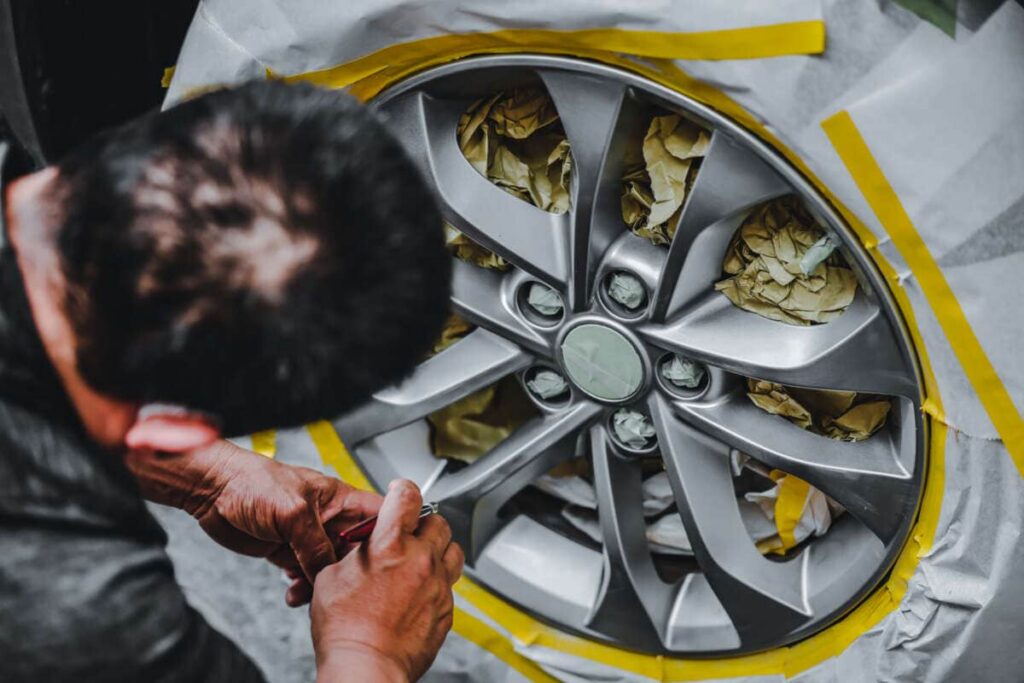
A damaged rim does not always look damaged. A pothole on a service road, a steep speed bump or a scrape against a car park ramp can bend the inner barrel, crack the metal or spoil the bead seat where the tyre seals. The outside of the wheel can still look perfect.
This guide explains when you need professional rim repair, covering the signs you can see, feel and measure. It also explains why rim damage happens, how a proper workshop repair fixes it, when a wheel should be replaced instead, and how to prevent rim damage on Dubai roads. It is a general guide for any car with alloy wheels, with extra detail for luxury and performance cars on large, low-profile wheels.
For prices, see our guide to rim repair cost in Dubai. For specific problems, read whether a cracked rim should be repaired or replaced and our guide to corroded rims causing air leaks.
What Is Professional Rim Repair?
Professional rim repair means the tyre is taken off and the wheel is inspected inside and out. The technician measures how true it runs, and the wheel is repaired with workshop equipment: a straightening machine, a TIG welder where welding is safe, a CNC lathe for diamond-cut faces and a proper refinishing process. The job ends with the tyre refitted, the wheel balanced and the bolts torqued correctly.
That is different from the other options owners usually come across.
| Option | What it can fix | What it cannot fix |
|---|---|---|
| DIY rim repair kit | Light scuffs on a painted silver or grey wheel face | Bends, cracks, missing metal at the rim edge, bead seat damage, diamond-cut or chrome finishes |
| Mobile rim repair (smart repair) | Cosmetic scuffs and light kerb rash on painted wheels | Bent or buckled rims, cracks, bead seat leaks, most diamond-cut work, damage on the inner barrel |
| Workshop rim repair | Bends, flat spots, kerb damage with metal loss, many lip and barrel cracks, bead seat corrosion, diamond-cut re-machining, full refurbishment | Cracks in spokes, the centre or bolt holes, wheels already repaired in the same area, structural damage on forged or carbon wheels |
| Wheel replacement | Any damage | Nothing. It is the safe answer when repair is not |
The question for every owner is simple. Has the damage gone past the paint? If the metal has moved, broken or lost material, or if the tyre is leaking, the wheel needs a workshop.
Signs You Need Professional Rim Repair
The table below sums up the main warning signs. Each one is explained in the sections that follow.
| Warning sign | What it usually means | How urgent |
|---|---|---|
| Steering wheel shake at 80 to 120 km/h | Bent front rim, or a tyre or balancing fault | Book a check this week |
| Vibration through the seat or floor | Bent rear rim | Book a check this week |
| One tyre loses air every week, no puncture | Bent rim lip, crack, or bead seat corrosion | Do not ignore. Check within days |
| TPMS warning keeps coming back | Slow leak at the rim | Check within days |
| Dent or flat spot on the rim lip | Shape damage. The inner barrel may be worse | Check before highway driving |
| Deep kerb rash with metal missing | Flange damage that can affect the tyre seal | Check soon |
| Tyre sidewall bulge next to a rim mark | Pinch impact. Tyre is finished, rim needs checking | Stop. Fit the spare or call recovery |
| Hairline crack on the rim | Broken metal | Stop driving at speed |
| Patchy wear on one tyre only | Wheel wobble, or alignment or damper fault | Check soon |
| Brake judder after new discs | Wheel runout or hub face problem | Check soon |
| Pull or off-centre steering after an impact | Bent rim and/or suspension or alignment damage | Check before highway driving |
1. Steering Wheel Vibration at Highway Speed
A bent rim on the front axle usually shows up as a shake through the steering wheel. It often starts somewhere between 80 and 120 km/h and fades above or below that band. If the rim is no longer round, the wheel pushes the suspension up and down once every revolution. If it no longer spins flat, the wheel wobbles side to side.
Wheel balancing cannot fix this. Balancing corrects how weight is spread around the wheel, not the shape of the wheel. A bent rim that has been balanced will usually still vibrate. If a shop keeps adding weights and the shake keeps coming back, the rim needs to be measured.
Vibration can also come from a tyre fault, worn suspension joints, a wheel bearing or brake discs. Our pages on Range Rover vibration repair, Mercedes vibration repair, Porsche vibration repair and Lamborghini vibration repair explain how each cause is separated.
2. Vibration Through the Seat or Floor
A bent rear wheel is felt more through the seat and floor than through the steering wheel. A rim that is out of round tends to cause an up-and-down bounce, while one that wobbles tends to cause a shimmy. Rear wheels on many luxury and performance cars are wider and run lower-profile tyres than the fronts, so they are more likely to bend in a pothole.
3. Tyre Losing Air With No Puncture
A tyre that needs air every week, with no nail or cut in the tread, is one of the clearest signs of rim damage. When the rim lip or bead seat is bent, the tyre bead cannot seal evenly against it and air slowly escapes. The same symptom also comes from a hairline crack in the inner barrel, or from corrosion on the bead seat.
A slow leak at the bead after a recent impact usually turns out to be a bent wheel. Most of these leaks are on the inner side of the wheel, where you cannot see them without taking the wheel off. That is why owners often blame the tyre for months.
Topping up the air or injecting tyre sealant only hides the leak. The tyre keeps running slightly under-inflated, which builds heat and damages it. Our guide to corroded rims causing air leaks explains how a rim leak is found in a water tank and fixed properly.
4. TPMS Warning Light Keeps Coming Back
A tyre pressure warning that returns a few days after the tyre was inflated is the same slow leak showing on the dashboard. A TPMS is not designed to catch small losses. Under the US standard FMVSS 138, which many car makers build to, the system only has to warn when a tyre is 25 percent or more below its recommended cold pressure. By the time the light comes on, the tyre may have been running low for a while.
5. A Dent, Flat Spot or Bend on the Rim Lip
Any visible dent or flat spot on the outer lip means the metal has moved, so the tyre bead cannot seal evenly at that point. It also tells you the impact was hard. In a pothole strike, the edge of the hole usually hits the inner side of the wheel hardest, so a dent you can see on the outside often means worse damage on the inner barrel. Any visible dent is a reason for rim straightening and a runout check.
6. Deep Kerb Rash With Missing Metal
Light kerb rash (curb rash) on the face of a painted wheel is cosmetic. It becomes a job for a professional when:
- The gouge has removed metal from the rim flange, leaving a step or a missing chunk
- The edge feels sharp or burred
- The damage runs onto the flange where the tyre bead sits
- The kerb strike also scraped the tyre sidewall
The flange holds the tyre bead in place. A deep kerb strike can damage the seal and lead to a slow leak, and a sharp, deep gouge is a weak point where a crack can start. Restoring the flange profile needs the tyre off. Filler applied from outside does not restore it.
7. A Bulge in the Tyre Sidewall Next to a Mark on the Rim
A bulge on the sidewall next to a fresh mark on the rim lip is a typical pinch impact. The tyre was squeezed between the rim and the edge of a pothole or kerb hard enough to break the cords inside it. The tyre must be replaced, because a sidewall bulge cannot be repaired and can lead to a blowout. The rim took the same blow, so it needs to be checked for bends and cracks before a new tyre goes on.
8. Cracks, Hairlines or Bubbling Near the Rim Edge
A crack is broken metal, and it does not stay the same size. Every time the wheel turns, the crack is loaded and unloaded, and it can grow. Cracks usually appear on the inner barrel or at the edge of the rim lip. Any crack, however fine, means the wheel needs a workshop inspection before it is used at speed.
White powder or bubbling paint near the rim edge is a different problem: corrosion under the finish. Left alone, it creeps towards the bead seat and causes slow leaks.
9. Uneven or Patchy Wear on One Tyre Only
A wheel that is not round does not put the tyre down flat. This can leave cupped or scalloped wear around the tread of one tyre while the others look normal. The same pattern can come from worn shock absorbers or alignment, so it is worth comparing all four tyres. Our article on the signs of bad shock absorbers shows how damper wear looks on the tread.
10. Brake Judder That New Discs Did Not Fix
A shake under braking is usually blamed on warped brake discs. A wheel that wobbles, or one that does not sit flat on the hub because of corrosion or a thick coating on its mounting face, can cause the same feeling. If new discs and pads have been fitted and the judder returns, the wheels need checking. Our article on Porsche brake noise and our car brake repair service explain how wheel faults are separated from brake faults.
11. The Car Pulls or the Steering Wheel Is Off-Centre After an Impact
An impact hard enough to bend a rim can also knock out the alignment or bend a suspension part. If the car pulls or the steering wheel sits off-centre after a pothole or kerb strike, both the wheel and the suspension need checking. Read how wheel alignment protects your tyres in Dubai, our guide to professional wheel alignment for luxury cars and the signs your car needs new suspension parts.
12. Any Damage on Diamond-Cut, Chrome or Matte Wheels
Some finishes cannot be repaired by hand, so even light damage needs a workshop.
- Diamond-cut wheels have a machined face protected by a thin lacquer. Once the lacquer is broken, the face has to be re-machined on a CNC lathe and lacquered again. A mobile van cannot do this properly. Each re-cut removes a thin layer of metal, so a wheel can only be re-machined a limited number of times.
- Chrome wheels cannot be spot repaired. The plating is stripped and the wheel is re-plated.
- Matte and satin wheels cannot be polished or blended, so the whole face is refinished to match the sheen.
13. Signs of an Old or Poor Rim Repair
A wheel that was repaired badly before has an unknown history. Watch for filler that has cracked or lifted, overspray on the tyre, a colour that does not match the other wheels, a thick rough coating on the bead seat, grinding marks or weld beads inside the barrel, and paint on the hub mounting face or bolt seats. These signs matter most when buying a used car. Our Range Rover pre-purchase inspection checklist and BMW pre-purchase inspection checklist show where wheels fit into a used-car check.
How to Tell If Your Rim Is Bent: What a Workshop Measures
Symptoms point to a problem, but they do not prove the rim is the cause. A thrown balance weight, a tyre with a shifted belt or a worn bearing can feel exactly like a bent wheel. A proper workshop confirms rim damage with measurements.
Wheel Runout
Runout is how far a wheel moves away from spinning perfectly true. It is measured with the tyre off, using a dial gauge or electronic arm on the bead seat while the wheel turns.
- Radial runout means the wheel is out of round. It is usually felt as a bounce.
- Lateral runout means the wheel wobbles side to side. It is usually felt as a shimmy in the steering.
Factory service manuals set the runout limit for an alloy wheel somewhere between about 0.3 mm and 0.8 mm, depending on the car maker. Several manufacturers, including General Motors, use 0.76 mm (0.030 inch) for both radial and lateral runout on aluminium wheels. As a rough guide from wheel specialists:
| Runout reading | What the driver usually feels | What it means |
|---|---|---|
| Up to about 0.75 mm | Usually nothing | Within most factory limits |
| About 0.75 to 1.5 mm | Vibration in a speed band, getting worse with speed | Bent. Needs straightening |
| Over about 1.5 mm | A shake that is hard to ignore, fast tyre wear | Badly bent. Short, slow drive to a workshop only |
A good workshop records the reading before and after straightening and shows it to the owner.
Road Force Balancing
A road force balancer presses a roller against the spinning tyre to simulate the road, then measures how the tyre and wheel behave together under load. It separates a bent rim from a faulty tyre and can often cancel a small vibration by rotating the tyre on the rim. General Motors’ service guidance treats about 8 kg (18 lb) of radial force variation as the limit for a passenger car tyre and wheel assembly, and about 11 kg (24 lb) for an SUV.
Dye Penetrant and Water Tank Testing
Dye penetrant is a red liquid that seeps into surface cracks and shows them against a white developer, including the fine end of the crack that cannot be seen by eye. A water tank test shows exactly where air is escaping: at the bead, through a crack, through the metal or at the valve.
Where the Damage Is Decides Rim Repair or Replacement
The location of the damage matters more than how bad it looks. Each part of the wheel does a different job.
| Part of the wheel | Typical damage | Usual outcome |
|---|---|---|
| Outer lip and flange | Kerb rash, dents, small cracks | Usually repairable |
| Inner lip and inner barrel | Pothole bends, flat spots, short cracks | Bends usually repairable. A short single crack may be repairable on a cast wheel |
| Bead seat | Dents, corrosion, pitting | Repairable if the profile can be restored |
| Valve hole area | Cracks, corrosion | Cracks here mean replacement |
| Spokes and wheel face | Bends, cracks | Replace. These carry the car’s load |
| Centre, bolt holes and hub bore | Cracks, distorted bolt seats | Replace |
A wheel should also be replaced when it has more than one crack, when it has already been straightened or welded in the same area, when runout cannot be brought back within the factory limit, or when a forged, multi-piece or carbon wheel on a high-performance car has structural damage. Our guide on whether a cracked rim should be repaired or replaced explains each zone in detail.
Is It Safe to Drive With a Bent or Damaged Rim?
It depends on where the damage is and how bad it is.
- A small bend on the inner lip with no air loss, no crack and an undamaged tyre can usually be driven carefully to a workshop. It should still be repaired soon, because the vibration wears the tyre, wheel bearing and suspension joints, and a stressed bend can crack.
- A bend that causes a strong shake should only be driven slowly over a short distance to a workshop.
- A crack anywhere, a bend in the spokes or face, a tyre that will not hold air, or a sidewall bulge means the car should not be driven at speed. Fit the spare or arrange recovery. Our guide to choosing a roadside assistance service in Dubai explains what to look for.
Heat makes this more serious in the UAE. An under-inflated tyre on a leaking rim flexes more and runs hotter, and summer road temperatures add to that. Dubai Police treat damaged and unfit tyres as a road safety offence. Driving with damaged, worn or unfit tyres carries an AED 500 fine, four black points and a seven-day vehicle impoundment.
Why Rim Damage Happens: Common Causes in Dubai
Large Wheels and Low-Profile Tyres
Many luxury SUVs and sports cars in the UAE run 21, 22 or 23-inch wheels with 30 or 35-profile tyres. The shorter the sidewall, the less rubber there is to absorb a hit, so the rim takes most of the force. Bigger wheel upgrades, covered in our look at luxury car customization trends in Dubai, make this worse.
Potholes, Speed Bumps and Road Works
Steep speed bumps in residential communities, sharp-edged potholes on service roads, broken manhole covers, raised expansion joints and temporary diversions in construction zones all deliver short, hard impacts. When a tyre drops into a pothole, the leading edge of the hole strikes the inner side of the wheel hardest. That is why the inner lip and barrel are the most common places for a bent or cracked rim.
Kerbs and Car Park Ramps
Tight spiral ramps in malls and residential towers, high kerbs at drop-off points and parallel parking are behind most kerb rash in the city. On many modern wheels, the rim lip sits wider than the tyre, so the metal touches the kerb first.
Wrong Tyre Pressure in the Heat
Tyre pressure rises as the tyre heats up. Some drivers let air out of hot tyres when the reading looks high, which leaves the tyres under-inflated once they cool. An under-inflated tyre lets the rim reach the road during an impact. Pressure should always be set cold, using the figure on the door frame label. Correct pressure also saves fuel, as our guide on how to reduce fuel consumption in cars explains.
Desert Driving
Aired-down tyres protect the car on sand but leave the rim lip exposed to rocks and hard ridges. Driving back onto tarmac before re-inflating puts heavy load on the rim edge.
Corrosion From Humidity, Brake Dust and Harsh Cleaners
Coastal humidity, salt in the air, iron-rich brake dust baked on by heat and strong acidic wheel cleaners attack the wheel finish. Once the finish breaks, the aluminium corrodes, and corrosion at the bead seat causes leaks. Our guide to brake pad replacement explains how pad choice affects brake dust.
Poor Tyre Fitting and Over-Tightened Wheel Bolts
Metal mounting heads on tyre machines scratch the rim flange. Impact guns over-tighten bolts and damage bolt seats. On air suspension cars, lifting without switching to jack mode can damage the air springs, as our guide to Range Rover air suspension failure explains. Our guide on how to spot the best tyre shop in Dubai shows what correct fitting looks like.
Collisions
A wheel damaged in a collision is often only part of the damage. Mercedes-Benz advises that any wheel near collision damage should be thoroughly examined. In the UAE, Article 41 of the Federal Traffic Law (Federal Law No. 21 of 1995) states that a vehicle with signs of an accident cannot be repaired without approval from the licensing authority, which in practice means a police report. Collision-related wheel damage is handled with the rest of the car, as described in our article on how common car damage is fixed and our Audi accident repair guide.
DIY Rim Repair Kit vs Mobile Rim Repair vs Workshop Repair
When a DIY Rim Repair Kit Is Enough
A DIY kit contains filler, sandpaper, paint and sometimes lacquer. It is a reasonable choice only for shallow scuffs on a painted silver, grey or gunmetal face, away from the rim edge, on a wheel that is straight, holds air and does not vibrate.
Kits are the wrong choice for bends, cracks, missing metal at the flange, anything near the bead seat, corrosion, or a diamond-cut, chrome or matte finish. Filler cannot restore the shape of a flange that holds a tyre bead, and filler on the bead seat stops the tyre sealing. Aerosol colours also rarely match factory wheel paint exactly.
When Mobile Rim Repair Is Enough
Mobile rim repair is popular in Dubai because the technician comes to you. It works well for scuffs and light kerb rash on painted wheels. Mobile services generally limit themselves to cosmetic work. They cannot straighten a buckled wheel, cannot weld or test a crack, usually do not remove the tyre so the inner barrel is never seen, and in most cases cannot re-machine a diamond-cut face because that needs a lathe. Many also do not work on centre-lock or multi-piece wheels.
When You Need Workshop Rim Repair
Any shape or metal damage, any slow leak, any diamond-cut or chrome finish, and any wheel on a heavy SUV or performance car with doubtful damage should go to a workshop where the tyre comes off and the wheel is measured.
How Professional Rim Repair Fixes the Damage
Rim Straightening
The tyre is removed and the wheel is mounted on a straightening machine. Runout is measured, and the bent section is pushed back in small steps with hydraulic rams, re-measuring after each step until the wheel is back within the factory limit.
Heat is the critical point. Most alloy wheels are heat treated to a condition called T6, which gives them most of their strength. Aluminium resists bending when cold, so shops often warm the bend to make it move. Too much heat for too long over-ages the alloy and leaves it permanently weaker, even though the wheel looks perfect. A good workshop uses limited, controlled heat or none at all, and can explain how it controls the temperature. Some large tyre chains refuse to straighten aluminium wheels at all for this reason.
Crack Welding
A crack is ground out to sound metal, TIG welded with aluminium filler, machined back to the rim profile and tested again with dye penetrant and a leak test. Welding weakens the metal around the weld. The international wheel standard ISO 14400 advises against repair welding, and the European wheel manufacturers’ association (EUWA) advises against repairing wheels with heat, welding or added material. In the repair trade, welding is accepted only for short single cracks on the lip or barrel of a cast wheel, never on spokes, the centre or near the bolt holes. Our cracked rim guide covers this in full.
Kerb Rash and Lip Restoration
Gouges are cleaned back, missing material is built up where needed, and the lip is shaped back to its original profile so the tyre bead sits correctly. The area is then refinished to match the rest of the wheel.
Diamond-Cut Re-Machining
The face is painted on two-tone wheels, then machined on a CNC lathe to restore the bright cut, and sealed with clear lacquer. The workshop should check how much material is left if the wheel has been re-cut before.
Refinishing, Curing and Masking
Old coating and corrosion are stripped back to clean metal before primer, paint or powder coat goes on. Two details separate a safe refinish from a risky one:
- Cure temperature. The factory ageing step for the A356 alloy used in most cast wheels runs at around 150 to 160°C for a few hours. Many standard powder coatings cure at around 180 to 200°C. A careful refinisher controls oven time and temperature, or uses low-cure powders or paint, so the wheel’s heat treatment is not affected.
- Masking. The hub mounting face, the bolt seats and the centre bore must be left free of paint. Tesla’s repair procedures, for example, require these surfaces to be masked before refinishing, and General Motors says paint and clear coat must not be present on them. Coating in these areas compresses under the bolts, which loses clamping force and lets the wheel bolts loosen.
Bead Seat, TPMS, Balancing, Torque and Alignment
The bead seat is cleaned and left smooth so the tyre seals. The TPMS sensor gets new seals and a correct valve core. The tyre is mounted with proper fitting paste, the wheel is balanced, and the bolts are tightened in a star pattern with a torque wrench to the car maker’s figure, then re-checked after the first 50 to 100 km. If the impact was hard, the alignment is checked as well. Our auto tyre services cover fitting, balancing and alignment alongside rim work, and our earlier post on how a wheel rim is repaired gives a short overview.
What Car Makers Say About Rim Repair
Most car makers only approve cosmetic wheel repairs.
- Mercedes-Benz approves only surface sanding and cosmetic refinishing that removes and replaces paint coatings. It states that reconditioned wheels do not meet its production specifications.
- Jaguar Land Rover does not approve reconditioned wheels or any process that claims to restore damaged wheels, and says it has no engineering-approved refinish method.
- Tesla does not allow welding, crack repair, straightening, heating, bending, machining or chrome plating on its wheels.
- Ford and Nissan also reject re-machining, welding, bending, straightening or added material.
An industry review of 25 car makers’ published statements found that all of them were either against reconditioned wheels or limited repairs to minor cosmetic work.
For owners in the UAE, this does not make rim repair illegal, and many repaired wheels give years of trouble-free service. But it does affect manufacturer warranty claims, some insurance and agency-repair policies, and how a car is judged at a pre-purchase inspection. A good workshop explains this before quoting, and recommends replacement when the damage is in a structural zone.
Rim Repair for Luxury and Performance Cars
Luxury cars bring extra factors into the repair decision.
- Run-flat tyres on many BMW and MINI models have stiff sidewalls that pass more impact into the rim and can hide a slow leak.
- Staggered setups, with wider rear wheels, cannot be swapped front to rear, and a single replacement wheel can take weeks to arrive.
- Forged wheels on Rolls-Royce, Lamborghini, Ferrari and McLaren models tend to bend rather than crack and straighten better than cast wheels, but only at a specialist.
- Carbon wheels cannot be repaired structurally by a wheel shop.
- Centre-lock wheels need the correct socket, torque and procedure, as covered in our Ferrari tyre change page.
- Heavy SUVs such as the Range Rover, Mercedes G-Class, Bentley Bentayga and Lamborghini Urus put more load through each wheel. The margin for a compromised repair is smaller.
- Air suspension cars must be put into jack mode before lifting, as our guide to Rolls-Royce Ghost air suspension repair explains.
Tyres matter too. A damaged tyre on a luxury car may need a matching OE-marked replacement and the correct load rating. Our guides to choosing the right tyres and the SUV tyre load index explain these details.
How to Prevent Rim Damage
- Check tyre pressure cold. Check every two weeks in summer, in the morning or after the car has been parked in the shade, using the door frame label. Never let air out of a hot tyre.
- Slow down for speed bumps and broken roads. Cross speed bumps straight and slowly, and drop speed through road works.
- Leave space at kerbs. Use the side camera view when parking, and take car park ramps slowly and wide.
- Fit rim protectors. Alloy rim protector strips take kerb contact instead of the wheel and are available through our tyre services.
- Choose wheel sizes sensibly. A slightly smaller wheel with a taller sidewall protects the rim on city roads. Any change must follow the car modification rules in Dubai, and our car modification team can confirm fitment. Our post on custom rims and tinting shows what a wheel upgrade involves.
- Re-inflate after the desert. Pump back up to road pressure before driving on tarmac.
- Clean and protect the finish. Use a pH-neutral wheel cleaner and a soft brush, and never let cleaner dry on a hot wheel. A wheel ceramic coating helps, as our guides on ceramic coating vs PPF and how long ceramic coating lasts in the UAE explain. Our car detailing service and guide to choosing a detailing workshop in Dubai cover safe wheel cleaning.
- Fix small damage early. A lacquer chip or light scuff is cheap to repair. Left alone, corrosion spreads under it, as our car scratch repair guide and article on why car paint peels explain.
- Insist on correct wheel fitting. Ask for clean hub faces, the correct bolts, torque-wrench tightening and a re-check after 50 to 100 km.
- Have the wheels checked at every service. Inner barrel bends and early cracks cannot be seen from outside. Include the wheels in a car inspection and before the RTA vehicle test. Our guides on luxury car maintenance schedules in the UAE, caring for a luxury car in Dubai’s harsh climate and why early suspension inspection saves you thousands show where wheel checks fit.
Frequently Asked Questions About Professional Rim Repair
How do I know if my rim needs professional repair?
You need professional rim repair if the wheel vibrates at speed, loses air with no puncture, keeps triggering the TPMS warning, has a dent or flat spot on the lip, has kerb damage with missing metal at the edge, shows any crack, or has a diamond-cut, chrome or matte finish that is damaged. A workshop confirms the damage by measuring runout with the tyre off.
Can a bent rim cause vibration?
Yes. A rim that is out of round or wobbles pushes the suspension once every revolution, causing vibration that usually appears in a speed band between about 80 and 120 km/h. Balancing cannot fix it, because balancing corrects weight, not shape.
Can kerb rash cause an air leak?
Light kerb rash on the wheel face does not. Deep kerb damage that removes metal from the rim flange, or a kerb strike that bends the lip, can stop the tyre bead sealing and cause a slow leak.
Is it safe to drive on a bent rim?
A small inner-lip bend with no crack, no air loss and an undamaged tyre can usually be driven carefully to a workshop. A crack, a bend in the spokes or face, a tyre that will not hold air or a sidewall bulge means you should not drive at speed.
Should I repair or replace a bent rim?
Bends on the lip or barrel of most wheels can be straightened if the wheel comes back within its factory runout limit. Replace the wheel if the bend is in the spokes, face or centre, if there is a crack outside the lip or barrel, or if the wheel has already been repaired in the same place.
Can a mobile service repair a bent rim?
Mobile rim repair is mainly cosmetic. It suits scuffs and light kerb rash on painted wheels. Bent rims, cracks, bead seat leaks and diamond-cut faces need a workshop with a straightening machine, a lathe and tyre equipment.
Does rim repair affect my car’s warranty?
It can. Most car makers approve only cosmetic refinishing and do not approve welded, straightened or heated wheels. Repaired wheels may not be covered under the manufacturer’s warranty, and some insurance and agency-repair policies only pay for a new genuine wheel.
How much does rim repair cost in Dubai?
It depends on the damage, wheel size and finish. See our full guide to rim repair cost in Dubai for prices by damage type and wheel size. Carzilla also offers pay-later options with Tabby.
Professional Rim Repair in Dubai at Carzilla
Carzilla is a luxury and exotic car workshop in Al Quoz Industrial Area 2, Dubai. Every damaged wheel is inspected off the car with the tyre removed. We measure runout, check the inner barrel and bead seats, and use dye penetrant and water tank testing where needed. We tell owners clearly whether a wheel should be repaired or replaced. Tyre, TPMS, balancing, alignment, suspension and steering checks are handled in the same visit, and wheel refinishing is carried out through our car painting service and auto body shop.
We work on wheels for Mercedes-Benz including the S-Class, BMW, Audi, Porsche, Range Rover, Bentley, Rolls-Royce, Maserati, McLaren, Lamborghini and Ferrari. See all the luxury car brands we specialise in and our full list of car services in Dubai. Owners can also check a car’s original wheel specification with our UAE VIN check.
Every job comes with a clear estimate before work starts, Warranty on Repair and Free Pickup and Delivery* across Dubai. To book a rim inspection, contact Carzilla or call 056 684 9665.