Every car picks up scratches, and in Dubai they arrive faster than in most places. Sand, tight parking and daily dust wiping all mark the paint over time. Car scratch repair is not one job, though. The right fix depends on three things: how deep the scratch goes into the paint, what the panel is made of, and what type of paint finish the car has. This guide explains how car paint is built, why scratches happen, how each type of scratch is repaired, and how to prevent new ones. If you already know your car needs work, our car scratch repair service in Dubai covers everything from light polishing to full panel respray.
How Car Paint Is Built: The Layers Behind Every Scratch
To understand scratch repair, you first need to understand what is being scratched. A modern factory paint finish is a layered system, usually 100 to 180 microns thick in total. That is about the thickness of two sheets of paper.
From the metal outward, the layers are:
- E-coat (electrocoat): a thin corrosion-protection layer bonded directly to the steel or aluminium.
- Primer: builds a smooth, even surface and helps the colour coat stick.
- Basecoat: the actual colour layer, often only 12 to 20 microns thick.
- Clearcoat: a transparent protective layer of roughly 40 to 50 microns that gives the gloss and absorbs most everyday damage.
Every scratch repair decision comes down to one question: which of these layers has been cut through? A mark that stays in the clearcoat can often be removed completely. A scratch that reaches bare metal needs repainting.
How to Check How Deep a Car Scratch Is
Professional body shops measure depth, but there are simple signs any owner can read.
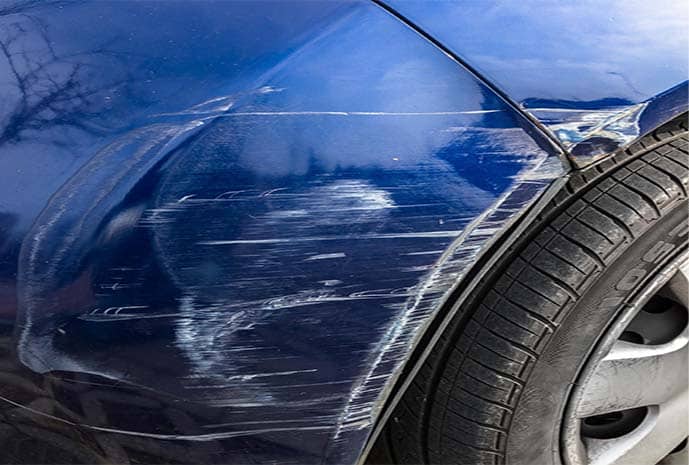
The fingernail test. Run a fingernail gently across the scratch. If your nail glides over it, the damage is usually in the clearcoat. If your nail catches, the scratch has likely gone into the basecoat or deeper.
The colour test. A scratch that looks white or lighter than the paint is usually in the clearcoat. If you see a different colour underneath, such as grey primer or shiny silver metal, the colour layer has been cut through.
The wet test. Spray a little water on the scratch. If it nearly disappears while wet, it is a shallow clearcoat scratch.
At a workshop, a technician uses a paint depth gauge to measure the remaining film thickness around the scratch. This matters because clearcoat can only be removed so many times before there is nothing left to polish. Paint readings are also how buyers spot past repairs. That is why a professional car inspection in Dubai includes them, and why pre-purchase guides such as our Range Rover pre-purchase inspection checklist treat uneven paint depth as a warning sign. A UAE VIN check alongside the gauge readings gives a fuller picture of a car’s accident history.
Why Car Scratches Happen So Often in Dubai
Most scratches on UAE cars come from a small number of repeat causes.
Sand and dust abrasion. Desert sand is mostly silica, which is much harder than automotive clearcoat. When dust is wiped off a dry car with a cloth or hand, those grains are dragged across the surface like fine sandpaper. This is the biggest cause of swirl marks and light scratches in Dubai.
Automatic brush washes and poor wash technique. Rotating brushes and dirty wash mitts trap grit and move it across the paint. The result is a web of fine circular scratches that shows up in direct sunlight. We explain the difference in our guide on car detailing vs car washing.
UV and heat damage to the clearcoat. High UV levels slowly break down the UV absorbers in clearcoat. Aged clearcoat becomes more brittle, scratches more easily and cracks rather than flexes when struck. Our article on caring for a luxury car in Dubai’s harsh climate covers the wider effects of heat and sun.
Parking and door contact. Mall car parks, tight residential spaces and trolley contact cause door-edge chips, bumper scuffs and key scratches.
Road debris. Stones thrown up on highways chip the front bumper, bonnet and mirror caps. These chips often go straight to primer or metal.
How Clearcoat Scratch Repair Works: Machine Polishing and Paint Correction
Light scratches, swirl marks and wash marks that sit only in the clearcoat are repaired by paint correction. This does not fill the scratch. It levels the clearcoat around the scratch so the edge of the groove no longer catches the light.
The process works like this:
- The car is washed and decontaminated with clay to remove bonded grit.
- Paint depth is measured on each panel.
- A machine polisher with a cutting compound removes a few microns of clearcoat until the scratch floor is reached.
- A finer polish restores full gloss and removes any haze from the cutting stage.
- The surface is protected with sealant, ceramic coating or paint protection film.
A skilled technician removes only 2 to 5 microns per correction stage. Heavy-handed polishing can burn through thin clearcoat on edges and body lines, which turns a polishing job into a repaint. On a luxury car, paint correction should be done as part of professional paint correction and car detailing with the paint measured first. If you are comparing workshops, our guide on what to consider when choosing a car detailing workshop in Dubai explains what to ask.
Important exception: matte and satin paint finishes cannot be polished. Polishing adds gloss to matte paint and leaves a permanent shiny patch. Scratched matte panels usually need a panel respray or a matte film.
How Basecoat Scratch and Stone Chip Repair Works
When a scratch cuts into the colour layer but not through the primer, polishing alone will not remove it. The missing colour has to be replaced.
For small stone chips and narrow scratches, technicians use precision touch-up and level sanding:
- The chip is cleaned and degreased.
- Colour-matched basecoat is applied in thin layers inside the chip only.
- Clearcoat is built up slightly above the surface.
- Once fully cured, the repair is wet-sanded flat with very fine abrasive and polished to blend with the surrounding finish.
Done properly, this makes chips almost invisible from normal viewing distance. Done badly, it leaves raised blobs of paint that look worse than the chip.
How Deep Scratch Repair Works: Spot Repair and Panel Respray
Scratches that reach primer or bare metal need a paint repair in a booth. Roadside fixes rarely hold up on this kind of damage. We explain why in our article on whether mobile car scratch repair can fix deep scratches. There are two main workshop approaches.
Smart Repair (Spot Repair)
For damage in a small area, such as a bumper corner scuff, a smart repair repaints only the damaged section. The area is sanded, filled if needed and primed. Colour and clear are then applied and faded into the surrounding paint. This saves time and cost and keeps more factory paint on the car.
Panel Respray and Colour Blending
Longer key scratches or damage across a large area need a full panel respray and car painting service. The key steps are:
- Colour matching: the paint code is taken from the vehicle, then checked with a spectrophotometer and spray-out test cards. Factory colours vary slightly between production batches, so the code alone is not enough.
- Blending: colour is faded into the neighbouring panels so there is no visible line where old paint meets new.
- Curing: the clearcoat is baked in a booth so it reaches full hardness.
Three-stage pearl and tri-coat colours, common on luxury cars, are harder to match because the pearl mid-coat changes how the colour looks at different angles. When scratches cover most of the car, a full car repaint in Dubai can be the better value.
Bare-metal scratches should not be left for long. Exposed steel starts to corrode, and once rust spreads under the paint edge, the repair gets bigger. Aluminium panels, used widely on Range Rover, Rolls-Royce and many Mercedes models, do not rust red but can corrode under the paint and must be kept away from steel dust during repair. A scratch that comes with a dent is a combined repair, covered in our luxury car denting and painting guide. Structural or collision damage should always go through a full auto body shop in Al Quoz rather than a cosmetic fix. You can see how different types of damage are handled in how common car damage is fixed at an expert body shop.
Scratch Repair on Luxury and Exotic Cars
High-end cars add a few extra points to the repair.
- Brand-specific paint systems. Factory finishes on Ferrari, Lamborghini and Porsche models often need low-bake curing and careful colour work. See our Lamborghini paint and repaint guide for an example.
- Hand-finished and multi-stage paint. Bespoke Rolls-Royce paint and coachlines need specialist matching. Our guide on choosing a Rolls-Royce body shop in Dubai explains why. Mercedes designo and MANUFAKTUR finishes are covered in our Mercedes-Benz body shop guide.
- Aluminium body panels. Scratch and panel repairs on aluminium-intensive SUVs follow different rules, as explained in our Range Rover accident repair article.
- Carbon fibre and composite parts. Clear-coated carbon can be corrected carefully, but deep scratches may need re-clearing. Parts from a carbon fibre body kit or aftermarket car body kits often use a softer clearcoat that scratches more easily.
- Bumpers with sensors and radar. Parking sensors, cameras or radar may need recalibration if the bumper is removed for paint work.
Scratched Alloy Wheels and Headlight Lenses
Not every scratch is on painted metal. Kerb rash on alloy wheels is repaired by filling, machining or refinishing the rim, as covered in our guide on how wheel rim repair works. Scratched or hazy headlights are polycarbonate, not paint, and need a different process. Our headlight restoration guide explains how it works.
How to Prevent Car Scratches in Dubai
Most scratches are preventable with a few simple habits.
- Never dry-wipe dust off the paint. Rinse first, or use a proper waterless wash spray with a clean microfibre towel.
- Use the two-bucket wash method and a clean wash mitt, and avoid automatic brush washes.
- Protect the paint. Paint protection film (PPF) on the bonnet, bumper and mirrors stops stone chips. Ceramic coating makes washing easier and reduces fine wash marks, but it does not stop deep scratches. Our comparison of PPF vs wrap in UAE conditions explains which suits your car.
- Consider a removable layer. Peelable car paint changes the colour while protecting the factory paint underneath.
- Allow fresh paint to cure. After a respray, wait 30 to 90 days before applying ceramic coating or PPF so the paint can finish releasing solvent.
- Park smart. Choose end bays and shaded spots where possible to reduce door contact and UV exposure.
- Fix chips early. A small chip repaired today prevents corrosion and a bigger repair later.
Get Car Scratch Repair Done Properly at Carzilla
Car scratch repair ranges from a simple polish to a full panel respray. The correct method depends on scratch depth, paint type and panel material. At Carzilla in Al Quoz, every scratch repair starts with measuring the paint and identifying the right fix, so we remove only what is needed and keep as much factory finish as possible. Explore our full range of car repair services or contact our Al Quoz workshop to book a free paint inspection.