
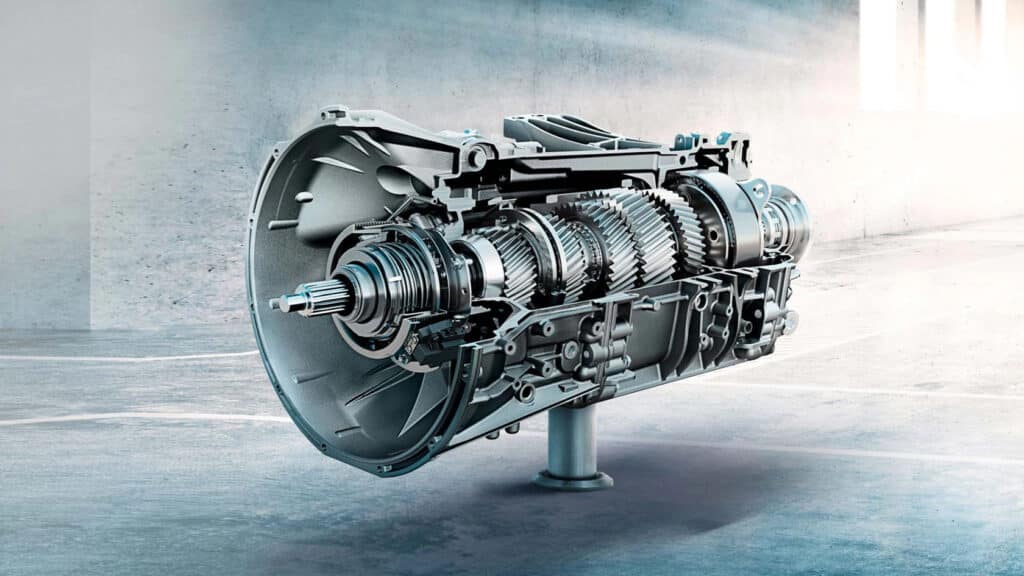
Mercedes-Benz automatic transmissions are some of the most refined gearboxes on the road, but they are also some of the least forgiving when the fluid inside them is neglected. Many owners are told their car has a “lifetime fill” and never think about the transmission oil again, until the car starts to slip, shudder or drop into limp mode.
This guide explains how often Mercedes transmission fluid should really be changed, how the interval differs between the 5G-Tronic, 7G-Tronic, 9G-Tronic, 7G-DCT and AMG gearboxes, why driving in Dubai and the UAE shortens fluid life, what goes wrong when the service is skipped, and how to prevent expensive Mercedes transmission repair.
The Short Answer: Mercedes Transmission Fluid Change Interval
For most Mercedes-Benz automatic transmissions driven in the UAE, the transmission fluid and filter should be changed every 60,000 km or every 4 years, whichever comes first. Older 5G-Tronic and early 7G-Tronic gearboxes, dual-clutch 7G-DCT units, AMG models and cars that tow, drive in the desert or sit in heavy traffic every day are better served by a shorter interval of 40,000 to 50,000 km.
Mercedes’ own factory intervals are longer than this on newer gearboxes. The reason specialists recommend a shorter interval for this region is heat. Transmission fluid wears out mainly through oxidation, and oxidation speeds up sharply with temperature. A Mercedes that spends its summers crawling along Sheikh Zayed Road at 45°C ambient is not working its fluid the same way as a car driven in a European climate the service schedule was written around.
Is Mercedes Transmission Fluid Really “Lifetime Fill”?
Not in the way most owners understand it. When Mercedes introduced the 722.6 five-speed automatic in the late 1990s, it was promoted as maintenance-free, with no dipstick and no scheduled fluid change. Mercedes later reversed this and added a fluid and filter change to the schedule at around 39,000 miles (roughly 60,000 km), and the original 722.6 fluid was eventually withdrawn and replaced by a newer specification.
The same pattern repeated with later gearboxes. “Lifetime” in manufacturer language usually means the expected life of the car under its first owner and warranty period, not the 200,000 to 300,000 km that a well-built Mercedes can actually cover. Fluid that is acceptable at 80,000 km is often badly degraded by 150,000 km, and by then the damage to the valve body, solenoids and clutch packs has already started.
The practical rule is simple: if you plan to keep your Mercedes beyond its warranty, or you bought it used, treat the transmission fluid as a service item, exactly like engine oil, coolant and brake fluid.
How Does Transmission Fluid Wear Out in a Mercedes?
Automatic transmission fluid (ATF) in a modern Mercedes does far more than lubricate gears. It is the hydraulic medium that applies every clutch, the coolant that carries heat away from the torque converter and clutch packs, and the friction-control fluid that decides how smoothly each gear change feels. It wears out in four main ways.
Oxidation from heat. ATF chemically breaks down when it runs hot. A widely used industry rule of thumb is that fluid life roughly halves for every 10°C rise in average operating temperature above about 80°C. Oxidised fluid thickens, darkens, smells burnt and leaves varnish inside the valve body.
Friction modifier depletion. Mercedes ATF contains friction modifiers that control how the clutch plates grip and release. As these additives are used up, shifts become harsher, the torque converter lock-up clutch starts to judder, and the transmission control unit has to keep correcting its adaptations.
Shear and viscosity loss. The fluid is constantly sheared in the torque converter, pump and clutch packs. Over time the viscosity drops below what the hydraulic circuits were designed for, so pressures become less stable.
Contamination. Every shift wears a microscopic layer from the clutch friction material and steel plates. That debris stays suspended in the fluid and is caught by the filter and the magnets in the pan. When the filter loads up and the fluid is saturated, the debris starts circulating through the tiny passages and solenoids of the valve body.
Changing the fluid and filter resets all four of these at once, which is why it is one of the most cost-effective services you can do on a Mercedes gearbox.
Mercedes Transmission Fluid Change Interval by Gearbox Type
Mercedes has used several very different transmissions over the past 25 years, and each has its own fluid specification and service interval. Knowing which gearbox your car has is the first step to servicing it correctly.
| Gearbox | Common name | Fluid specification | Typical factory guidance | Recommended interval in the UAE |
|---|---|---|---|---|
| 722.6 | 5G-Tronic (5-speed) | MB 236.14 (red) | Added later at approx. 60,000 km | 40,000–50,000 km |
| 722.9 (to mid-2010) | 7G-Tronic | MB 236.14 (red) | Approx. 40,000 miles (≈64,000 km) | 40,000–50,000 km |
| 722.9 Plus (from mid-2010) | 7G-Tronic Plus | MB 236.15 (blue) | Approx. 70,000 miles (≈112,000 km) | 60,000 km |
| 725.0 / 725.1 | 9G-Tronic | MB 236.17 (yellow/gold) | Approx. 96,000–125,000 km depending on market | 60,000 km |
| 724.0 | 7G-DCT dual-clutch | MB 236.21 DCT fluid | Approx. 60,000 miles or 6 years | 40,000–60,000 km |
722.6 5G-Tronic Five-Speed Automatic
Found in most Mercedes models from the late 1990s to the mid-2000s, including the W203 C-Class, W211 E-Class, W220 S-Class, W163 and W164 ML and the W463 G-Class of that era. The 722.6 uses a dipstick tube without a fitted dipstick; the level is checked with a special measuring tool at a fluid temperature of around 80°C. Its biggest weakness is the 13-pin electrical connector sleeve, which can leak ATF and wick fluid up the wiring loom into the control unit. Clean fluid and a fresh connector sleeve and filter at each service go a long way on these cars. In the UAE, change the fluid every 40,000 to 50,000 km.
722.9 7G-Tronic and 7G-Tronic Plus
The seven-speed 722.9 replaced the 722.6 from the 2004 model year and was fitted to a very wide range of cars, from the C-Class and E-Class to the S-Class, ML, GL and G-Class. The transmission control unit is built into the valve body as part of the conductor plate, which makes clean fluid even more important because contaminated ATF and heat both attack that electronic assembly.
There are two versions of this gearbox, and they use different fluids that must never be mixed:
- Early 722.9 (red fluid): built up to around June 2010, uses ATF to MB 236.14. Mercedes guidance for these units was approximately every 40,000 miles.
- 722.9 7G-Tronic Plus (blue fluid): built from mid-2010 onwards, carries option code A89, and uses low-friction ATF to MB 236.15. The interval was extended to approximately 70,000 miles. The blue fluid is not backward compatible with the early gearbox, and the red fluid is not suitable for the Plus version.
The 722.9 has no dipstick. The fluid level is set by the overflow method through the drain plug with the transmission at a specific temperature, usually checked live with diagnostic equipment. Not every 722.9 has a torque converter drain plug, and the oil pan and overflow pipe changed several times over the production run, so the correct parts must be matched to the exact transmission number.
For UAE driving, the early red-fluid 722.9 should be serviced every 40,000 to 50,000 km and the 7G-Tronic Plus every 60,000 km.
725.0 9G-Tronic
The nine-speed 9G-Tronic arrived in 2013 and is now found in almost every rear- and four-wheel-drive Mercedes, including the C-Class, E-Class, S-Class, GLC, GLE, GLS and newer G-Class models. It uses MB 236.17 fluid (earlier units 236.16), a low-viscosity fuel-economy ATF that must not be replaced with the older red or blue fluids. The oil filter is integrated into the plastic oil pan, so the pan itself is replaced at each service. The 9G-Tronic also uses an electric auxiliary oil pump to keep hydraulic pressure available during engine stop-start.
Depending on market and model year, Mercedes service sheets place the first 9G-Tronic fluid change at roughly 96,000 to 125,000 km. Many independent transmission specialists recommend changing it far earlier, at 60,000 to 80,000 km, because contaminated oil and wear debris block the fine hydraulic channels and lead to expensive mechatronic failures. In Dubai heat, 60,000 km is a sensible interval. If you drive a Mercedes GLS or GLE that carries a full family load or tows, stay at the lower end. Owners noticing an early torque converter shudder on a 9G gearbox can read more in our guide to Mercedes GLS transmission repair symptoms and costs.
7G-DCT and AMG Dual-Clutch Gearboxes
Front-wheel-drive-based compact models such as the A-Class, B-Class, CLA, GLA and GLB use the 724.0 7G-DCT seven-speed dual-clutch transmission. This is a completely different design: two wet clutches instead of a torque converter, a dedicated DCT fluid, and two oil filters (one in the pan and an external pressure filter) that must both be changed together. The US maintenance schedule calls for a transmission oil and filter change every 60,000 miles or six years. In UAE traffic, where a dual-clutch gearbox spends much of its life slipping its clutches at crawling speeds, 40,000 to 60,000 km is a safer interval. The high-performance AMG 45 models use their own AMG dual-clutch gearbox with its own fluid and should be serviced on the shorter end of this range.
If you drive a Mercedes CLA and feel judder when pulling away in traffic, old DCT fluid is often part of the cause.
AMG SPEEDSHIFT MCT and AMG 9G Gearboxes
Many AMG 63 models, such as the E63 and later C63, use the AMG SPEEDSHIFT MCT 9G. It is based on the 9G-Tronic but replaces the torque converter with a wet start-off clutch that runs in the same ATF. That clutch adds friction material to the fluid with every launch, so these cars should be serviced every 40,000 km, or sooner on cars that are driven hard. The G63 uses an AMG 9G gearbox with a torque converter (SPEEDSHIFT TCT), but the extra torque and the weight of the car still justify the shorter interval. Read more about keeping these cars healthy in our guide to Mercedes-AMG maintenance in Dubai, or see our Mercedes C63 AMG repair and Mercedes G63 AMG repair pages.
How to Find Which Gearbox Your Mercedes Has
The transmission type is recorded on the VIN data card, which lists the gearbox number (for example 722.906 or 725.011) and option codes such as A89 for the 7G-Tronic Plus. It is also stamped on a plate on the transmission housing and readable through dealer-level diagnostics. A workshop using XENTRY can confirm the exact unit in minutes, which removes any guesswork about red, blue or gold fluid.
Why Mercedes Transmission Fluid Wears Out Faster in Dubai and the UAE
The UAE puts a Mercedes transmission through conditions that the standard service schedule does not fully account for. Our article on how Dubai heat damages car engines explains the engine side; the gearbox suffers from the same causes.
High ambient temperature. Summer air temperatures above 45°C, combined with heat radiating from the road surface, raise the baseline temperature of every fluid in the car. Because oxidation roughly doubles with each 10°C increase, a few extra degrees over a whole summer adds up to a much shorter fluid life.
Stop-and-go traffic. Slow traffic on Sheikh Zayed Road, Al Khail Road and in Downtown Dubai keeps the torque converter slipping with little airflow through the front of the car. This is the hottest condition a conventional automatic ever sees, and in a dual-clutch gearbox it means constant clutch slip.
Sand and dust in the cooling stack. Most Mercedes transmissions are cooled through a heat exchanger connected to the engine cooling system or a separate oil cooler at the front of the car. When fine sand packs into the radiator and coolers from behind, heat rejection drops and ATF temperature climbs. A radiator and coolant service is part of transmission care, and a weak cooling system often shows up first as a flashing Mercedes coolant warning light.
Desert driving and towing. Dune driving in a G-Class, GLE or GLS, or towing a boat or jet-ski trailer, keeps the transmission under heavy load in low gears for long periods. Both count as severe use.
Short trips and cars that sit. Cars that do short school runs never get the fluid fully up to temperature, while cars that sit for weeks during summer travel collect moisture and let the fluid age without being used. Time matters as well as distance, which is why a 4-year limit applies even to low-mileage cars.
What Happens If You Never Change Mercedes Transmission Fluid?
Leaving the original fluid in a Mercedes gearbox rarely causes a sudden failure. Instead, it causes a slow chain of wear that ends in a repair costing many times more than the service would have.
Valve body and conductor plate damage. Varnish and debris make the shift solenoids stick and the pressure regulators behave unpredictably. On the 722.9, heat and contaminated fluid are a leading cause of conductor plate and speed sensor failures, which then need replacing and coding to the car.
Torque converter shudder. As friction modifiers are used up, the torque converter lock-up clutch begins to judder at steady speeds, often between 60 and 90 km/h. Many owners mistake this for an engine fault; our guide to Mercedes engine misfire symptoms explains how to tell the two apart.
Clutch pack wear and slipping. Degraded fluid lets the clutch packs slip during shifts, which generates more heat and more debris, which degrades the fluid further. Once the clutches are glazed or burnt, no fluid change will bring them back.
Limp mode and warning messages. Eventually the transmission control unit detects slip ratios or pressures out of range and locks the gearbox in a fixed gear to protect it. At this stage, the car usually needs a full diagnosis and often a gearbox repair, valve body replacement or rebuild.
For a full breakdown of how these failures develop, read our article on Mercedes transmission failure in Dubai.
Signs Your Mercedes Transmission Fluid Needs Changing
Because there is no dipstick on most Mercedes gearboxes, owners have to rely on how the car drives. These are the most common signs that the fluid is overdue:
- Harsher or delayed shifts, especially the 1–2 and 2–3 upshifts when the car is warm
- A thump or delay when selecting Drive or Reverse
- A shudder or vibration at light throttle at cruising speed
- Flare in engine revs between gears
- Hesitation or judder when pulling away in traffic (common on 7G-DCT models)
- A burnt smell after driving, or reddish fluid spots under the car
- Transmission warning messages, a “Visit workshop” message or limp mode
Some of these symptoms overlap with other faults. A clunk on take-off can come from worn engine or gearbox mounts, which we explain in Mercedes engine mount failure symptoms. A whine or howl from the rear is more often a differential issue, covered in our guide to Mercedes rear differential noise. Low battery voltage can also cause erratic shifting and false transmission faults; see Mercedes electrical system warning causes. This is why a proper diagnostic scan should come before any transmission work.
Which Transmission Fluid Does a Mercedes Need?
Using the correct fluid is just as important as changing it on time. Mercedes approves fluids against specific sheet numbers, and each gearbox family needs its own:
- MB 236.14 (red): 722.6 five-speed and early 722.9 seven-speed up to mid-2010
- MB 236.15 (blue): 722.9 7G-Tronic Plus from mid-2010 onwards
- MB 236.17 (yellow/gold): 725.0 and 725.1 9G-Tronic and AMG 9G variants
- MB 236.21: 724.0 7G-DCT dual-clutch transmissions
These fluids are not interchangeable. The low-friction fluids used in the 7G-Tronic Plus and 9G-Tronic are formulated with very specific friction characteristics, and a “universal” multi-vehicle ATF can upset shift quality, torque converter lock-up and the adaptation values the control unit relies on. Mixing old and new specifications is equally harmful. Always use genuine Mercedes fluid or a product that carries the exact MB approval for your gearbox.
Transmission Fluid Change vs Transmission Flush on a Mercedes
A standard fluid and filter change drains the oil pan and, where fitted, the torque converter, replaces the filter and pan gasket (or the complete pan on the 9G-Tronic), and refills with fresh fluid. On gearboxes without a torque converter drain plug, a single drain replaces only part of the total fluid, so some workshops do a second drain-and-fill after a short drive to bring the fresh-fluid percentage up.
A machine flush pushes fluid through the transmission under pressure. Mercedes does not use pressure flushing as a standard procedure, and on a high-mileage gearbox with neglected fluid it can dislodge debris into the valve body. The safer approach is a correct drain and refill using the factory procedure, repeated if needed, rather than a high-pressure flush.
How a Mercedes Transmission Fluid Service Is Done Properly
A correct Mercedes transmission service is more involved than an engine oil change. At a specialist Mercedes workshop it should include:
- Diagnostic scan first. Read the transmission control unit for stored faults, check adaptation values and look at live fluid temperature before any work starts.
- Drain and inspect. Drain the pan and torque converter where possible, and inspect the magnets and filter for clutch material, metal particles or signs of overheating.
- Replace the filter and seals. Fit a new filter and pan gasket, or a new integrated pan and filter on the 9G-Tronic, and on the 722.6 a new connector sleeve if it is leaking.
- Fill with the correct approved fluid. Use the exact MB specification for the gearbox and the correct adapter for the fill point.
- Set the level at the correct temperature. On 7G-Tronic and 9G-Tronic gearboxes the level is set using the overflow method within a narrow fluid temperature window, read through XENTRY. Setting the level cold or by guesswork almost always results in an overfilled or underfilled gearbox, and both cause problems.
- Check for leaks and road test. Confirm the pan, cooler lines and electrical connector are dry and that the car shifts correctly.
- Reset or relearn adaptations where required. On some gearboxes, resetting adaptations after a fluid change lets the control unit relearn shift pressures with the fresh fluid.
You can see what is included in a full service in our Mercedes service in Dubai page, and how a transmission service fits into a full schedule in major car service vs minor service.
Is It Safe to Change Transmission Fluid on a High-Mileage Mercedes?
A common belief is that changing the fluid on a high-mileage gearbox that has never been serviced will make it fail. The reality is more nuanced. A gearbox that is already slipping badly has worn clutch packs, and the old fluid may simply be masking that wear; a fluid change will not cause the failure, but it will not cure it either.
For a high-mileage Mercedes that still shifts well, a gentle drain-and-fill with the correct fluid, a new filter and a correct level check is safe and beneficial. Where the fluid is very dark and contaminated, two or three partial changes spaced a few hundred kilometres apart introduce fresh fluid gradually. What should be avoided is a pressure flush on a neglected gearbox, and changing to a non-approved fluid.
If you are buying a used Mercedes, ask for proof of the last transmission service. If there is none, budget for one straight away and have the gearbox checked as part of a pre-purchase car inspection.
How Much Does a Mercedes Transmission Fluid Change Cost in Dubai?
A Mercedes transmission fluid and filter change in Dubai typically costs between AED 1,200 and AED 2,600. The price depends on the gearbox (the 9G-Tronic integrated pan and the 7G-DCT dual filters cost more than a 722.6 filter), the amount of fluid required, whether the torque converter can be drained, and whether a second drain-and-fill is needed. AMG models sit at the upper end.
Compare that with the cost of what it prevents. A conductor plate with coding, a valve body or a torque converter replacement each costs several times more, and a full rebuild or replacement transmission runs into five figures. Regular fluid changes are also part of keeping running costs predictable, as explained in our guide to luxury car maintenance schedules in the UAE.
How to Prevent Mercedes Transmission Problems
Changing the fluid on time is the single most important step, but a few other habits make a real difference to how long a Mercedes gearbox lasts in the UAE:
- Follow a heat-adjusted interval. Change the fluid every 60,000 km or 4 years for most models, and every 40,000 to 50,000 km for 722.6, early 722.9, 7G-DCT and AMG gearboxes or cars used for towing and desert driving.
- Keep the cooling system clean. Have the radiator and transmission cooler stack cleaned of sand and dust, and keep the coolant in good condition. Our guide to car radiator repair cost in Dubai covers what to expect if parts are needed.
- Fix leaks early. Oil around the 722.6 electrical connector, the pan gasket or the cooler lines lowers the fluid level and lets the gearbox run hot. Mercedes oil leaks are common on older models, as our Mercedes CLS coolant and oil leakage repair article shows.
- Maintain the battery. Low voltage confuses the transmission control unit and can wipe adaptation values. Summer heat shortens battery life, as explained in why car batteries drain faster in UAE summer.
- Do not ignore warning messages. A transmission fault stored early is far cheaper to fix than one driven on for weeks. Regular scans are covered in why regular car diagnostics prevent expensive repairs, and dashboard faults in why your Mercedes engine warning light is on.
- Drive with mechanical sympathy. Let the car warm up for a minute before heavy load, avoid holding the car on the throttle against the brakes, and come to a complete stop before selecting Reverse or Drive.
- Use the right workshop. Correct fluid specification, a temperature-controlled level check and XENTRY diagnostics are what separate a proper Mercedes transmission service from a quick drain. Our guide to choosing the right Mercedes-Benz garage in Al Quoz explains what to look for.
If the gearbox has already started slipping or shifting harshly, a fluid change alone may not be enough. Our article on gearbox repair in Dubai explains the next steps, and if the car cannot be driven safely, see our guide to choosing a roadside assistance service in Dubai.
Mercedes Transmission Fluid Service in Dubai at Carzilla
Carzilla Auto Service is a specialist Mercedes repair garage in Dubai based in Al Quoz, working on every Mercedes gearbox from the 722.6 5G-Tronic to the 9G-Tronic, 7G-DCT and AMG SPEEDSHIFT transmissions. Every transmission service starts with a XENTRY diagnostic scan, uses fluid to the exact MB approval for your gearbox, and finishes with a temperature-controlled level check and road test.
We service the full range, including the Mercedes S-Class, E-Class, GLE, GLC, G-Class and Maybach models. When a gearbox needs more than a service, our team handles Mercedes engine repair, transmission diagnosis, valve body and torque converter work in-house.
- Dealer-level XENTRY diagnostics
- Genuine and MB-approved transmission fluids
- Free Pickup and Delivery*
- Warranty on Repair
Contact Carzilla to book a Mercedes transmission fluid service or a gearbox health check.