
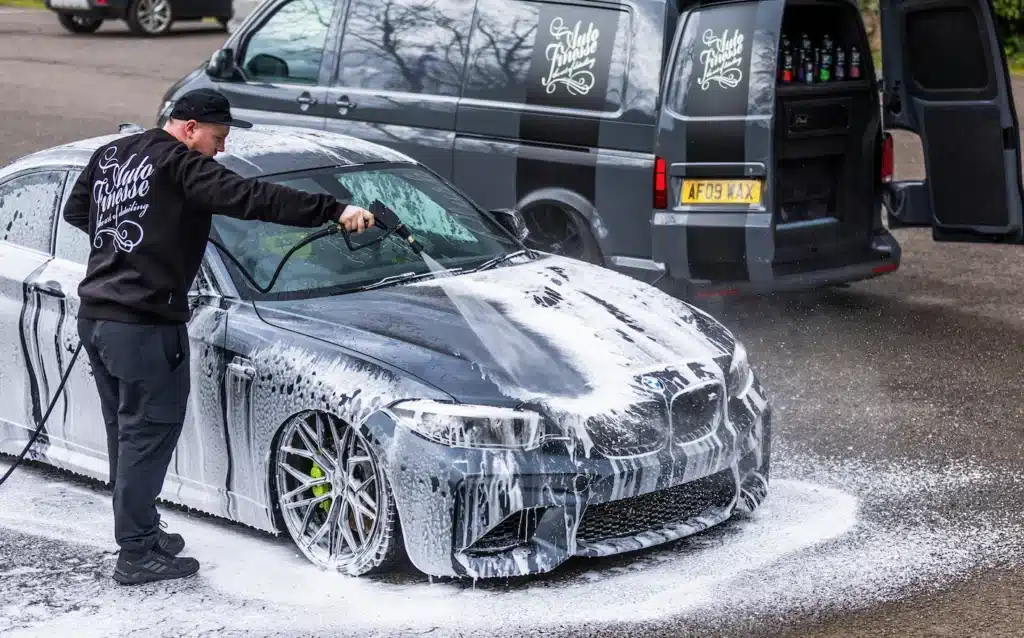
An exotic car is not a normal car with a bigger price tag. The paint is often softer, large parts of the body may be bare carbon fibre, the brakes can be carbon-ceramic, the cabin is trimmed in Alcantara and semi-aniline leather, and the car itself sits a few centimetres off the ground with a battery that drains quickly when it is not driven. Every one of those details changes how the car must be washed, corrected, protected and handled.
In Dubai, the climate adds another layer. Strong UV, summer heat, fine desert sand and mineral-heavy irrigation water all attack the same surfaces, and they do it faster than in Europe, where most of these cars were designed and tested. In our workshop, most of the cosmetic damage we see on supercars is not caused by driving. It is caused by washing, polishing and “protecting” the car the wrong way.
This guide walks around an exotic car surface by surface. For each one, it explains what goes wrong, why it happens, how a professional car detailing center in Dubai should fix it, and how to stop it coming back. It finishes with what the best exotic car detailing workshop should have in place before you hand over the keys.
What Makes Exotic Car Detailing Different From Regular Car Detailing
Regular detailing assumes a steel body, a hard factory clearcoat, iron brake discs and leather or fabric seats. An exotic car breaks most of those assumptions at once.
A Ferrari or Lamborghini may combine gloss paint, matte paint, satin carbon, gloss carbon, paint protection film and anodised or magnesium parts on a single side of the car. A McLaren is built around a carbon fibre tub, so the way it is lifted matters. A Rolls-Royce or Bentley brings lambswool mats, open-pore wood veneers and hand-painted coachlines into the job.
The other difference is the cost of a mistake. A wrong wheel cleaner on a regular car may dull a rim. On a car with carbon-ceramic brakes, it can contaminate parts that cost more than a family car to replace. A rotary polisher used carelessly on a regular car leaves light holograms. On a matte supercar, it leaves a permanent shiny patch that only a panel refinish will remove. That is why exotic car detailing in Dubai is a specialist job, and why the detailer needs to understand the car mechanically as well as cosmetically.
Swirl Marks and Holograms on Supercar Paint
Swirl marks are fine circular scratches in the clearcoat that show up as a spider-web pattern under direct sun or LED lighting. Holograms are the buffer trails left behind by poor machine polishing. On dark exotic paint, both are easy to see and hard to ignore.
Why soft supercar clearcoat scratches so easily
Many Italian and British exotics leave the factory with a clearcoat that is noticeably softer than the hard ceramic-type clears used on most German cars. Soft clear has a deep, wet look, but it marks easily and holds every wash scratch. Dubai sand makes this worse, because fine silica dust sitting on the paint is far harder than the clearcoat. If a wash mitt touches the car before that dust is removed, the mitt drags the dust across the paint and every wash adds more swirls.
Automatic brush washes, dusty drying towels, “quick wipe” waterless washes on a sandy car, and dusters used in car parks are the most common causes we see. Rental and photoshoot cars in Dubai often show the worst swirls because they are wiped down several times a day.
How paint correction on an exotic car should be done
Proper paint correction starts with measurement, not polishing. A paint depth gauge reading on every panel shows how much clearcoat is left, and it also reveals panels that have been resprayed before, which is common on imported and pre-owned supercars. Repainted panels often behave differently from factory paint under the pad.
The correction itself should use the least aggressive method that removes the defect. On soft supercar clear, that usually means a dual-action polisher, a fine polish and a soft finishing pad rather than a heavy compound and a rotary machine. The panel temperature must be watched closely, because soft clear on a car parked in the Dubai sun heats up quickly and can haze or burn on edges and body lines. A good detailer will tape off edges, rubber trim, badges and carbon parts before starting, and will finish the paint in stages rather than chasing every deep scratch, because removing too much clear on a single visit shortens the life of the paint.
Deep scratches that have gone through the clearcoat cannot be polished out. They need a paint repair, which is covered in our guide on how car scratch repair works. On Lamborghini and other exotic paint, refinishing is a specialist job, as explained in our article on Lamborghini paint and repaint service in Dubai, and it is carried out through a proper car painting service rather than a detailing bay.
How to prevent swirls on exotic car paint
Rinse the whole car before any mitt touches it, use a foam pre-wash to lift sand, wash with two buckets and grit guards, and dry with filtered air or a clean, dedicated drying towel. Never dust or dry-wipe a sandy supercar. If the paint already shows lifting or flaking rather than swirls, the problem is adhesion, not polishing, and our guide on why car paint peels explains the difference.
Matte and Satin Paint Care for Exotic Cars in Dubai
Matte and satin finishes are popular on Lamborghini, Ferrari, Mercedes-AMG and many custom builds in Dubai. They look simple, but they are the least forgiving finish on any car.
Why matte paint gets shiny patches and stains
Matte paint gets its flat look from a micro-textured surface that scatters light. Anything that flattens or fills that texture makes the area shine. That includes polish, compound, cleaner waxes, glazes and even firm rubbing with a towel in one spot. Once the texture is flattened, it cannot be brought back by cleaning.
Matte paint also stains more easily, because bird droppings, insect remains and water minerals sit in the texture instead of on a smooth surface. In Dubai heat, organic stains bake into matte paint within hours, and because the finish cannot be polished, the usual gloss-paint fix is not available.
How a professional detailer fixes matte paint problems
On matte paint, correction in the normal sense does not exist. A professional detailer will use matte-specific shampoos, low-pressure foam and soft mitts, and will dab rather than wipe when drying. Contamination is removed chemically wherever possible, and protection is added with a matte-safe sealant or coating that does not add gloss.
If a matte panel already has a shiny patch, a deep scratch or etching, the honest answer is a panel refinish by a body shop that knows matte systems. Touch-up paint and spot polishing will make it worse. This is work for an experienced auto body shop, and our guide on how common car damage is fixed at an auto body shop explains how panel repairs are planned.
How to protect matte and satin paint long term
Satin paint protection film is the strongest option for owners who want to keep a factory matte finish safe, because the film takes the stone chips and stains and can be replaced. Owners who want the matte look without committing the original paint often choose a wrap or a peelable finish instead. Our comparisons of car wrap or paint and car wrap vs peelable paint cover how each lasts in Dubai heat, and Carzilla also offers peelable car paint for owners who want a reversible colour change.
Exposed Carbon Fibre Detailing: Yellowing, Haze and Clear Coat Failure
Bare carbon fibre is everywhere on modern supercars: mirror caps, front splitters, side skirts, diffusers, roofs, engine covers and full carbon packs. It is also one of the surfaces that suffers most in the UAE.
Why carbon fibre turns yellow, cloudy or blotchy
The carbon weave itself does not yellow. What fails is the resin and clear layer on top of it. UV radiation breaks down that layer over time, and once it starts breaking down, the damage keeps building as long as the part stays in the sun. Lower-grade resins and clears on aftermarket parts can start to discolour within a year or two.
Heat speeds this up. Carbon conducts heat well, so a carbon roof or bonnet in the Dubai sun gets very hot, and water left standing on it can boil and spot the surface. Carbon parts near the engine, such as engine bay covers on mid-engine cars, see temperatures the clear was never designed for. Abrasive paste waxes, harsh degreasers and careless machine polishing remove what is left of the protective layer and speed up failure.
Satin and forged carbon add another problem. Like matte paint, satin carbon cannot be polished without turning glossy, so stains and wipe marks on it need careful chemical cleaning only.
How a detailing center restores carbon fibre parts
The first job is to work out how deep the damage goes. Light haze and surface oxidation on gloss carbon can usually be removed by careful hand polishing or a very soft machine pass with a fine polish, followed by UV protection. If the clear has gone milky, cracked or started to peel, or the weave underneath has changed colour, polishing will not fix it. The part needs to be sanded back carefully and re-cleared with a UV-stable clear, or replaced. Sanding too far exposes the fibres and ruins the part, so this is a body shop job, not a detailing job.
Owners fitting new carbon parts should check the quality of the clear and resin before buying. Our carbon fibre kit and car body kits pages explain the material differences, and our guide to luxury car customization trends in Dubai covers why carbon upgrades are so common here.
How to prevent carbon fibre yellowing in the UAE
Keep carbon parts out of direct sun wherever possible, never let water dry on hot carbon, and add a sacrificial UV layer with a quality ceramic coating or carbon-specific sealant. On satin carbon, use only matte-safe products. On the most exposed parts, such as splitters and roofs, clear or satin PPF gives the strongest protection.
PPF on Supercars: Lifting Edges, Yellowing and Trapped Dirt
Full-body paint protection film is now common on exotic cars in Dubai, and for good reason. It takes the stone chips, sand blasting and car park scuffs that would otherwise damage soft supercar paint. But PPF brings its own set of problems.
Why PPF fails early on exotic cars
Supercar bodies are full of sharp creases, deep air intakes and complex aero shapes. Film stretched too far over these shapes wants to pull back, which shows up as lifting edges, small bubbles and dirt lines along the edges a few months after fitting. High-pressure washers held close to film edges, strong solvents and tar removers used on the film, and wax or polish build-up along the edge all speed this up.
Yellowing and staining are the other common complaints, especially on white and light-coloured exotics. Our detailed article on why PPF turns yellow explains the nine causes we see in UAE heat, from film quality to contamination baked into the top layer.
How PPF problems are fixed
Small lifting edges can sometimes be cleaned and re-set, but in most cases the right fix is replacing the affected panel of film. Old or failed film must be removed carefully, with controlled heat and the right technique, so the paint underneath is not lifted with it. Our guide on whether PPF damages paint when removed explains what makes removal safe or risky.
The quality of the film and the installation decide how long it lasts. Our buyer’s guide to the best PPF in Dubai and our look at 3M PPF in Dubai compare the main options.
How to look after PPF on an exotic car
Keep pressure washer nozzles well away from film edges, avoid solvent-based cleaners on the film, and add a coating made specifically for PPF rather than one designed for paint. If you are still deciding between film and coating, our comparison of ceramic coating vs PPF explains which suits which owner.
Water Spots and Sprinkler Etching on Exotic Cars in Dubai
Water spots are one of the most common problems we correct on supercars in Dubai, and one of the most avoidable.
Why water spots form and why they etch
Water itself does not damage paint. The minerals and impurities dissolved in it do. When a droplet dries, it leaves those minerals behind as a ring or a cloudy patch. At first, the spot sits on top of the surface and can be removed with a gentle cleaner. If it stays there, especially on a hot panel in direct sun, it can etch into the clearcoat and leave a dimple that needs machine polishing.
In Dubai, the worst spots usually come from landscape sprinklers in villa communities and building car parks. Irrigation water often carries a much higher mineral load than tap water, and a car parked within reach of a sprinkler gets sprayed every day and then baked in the sun. Washing a car in direct sun and letting it air-dry causes the same problem on a smaller scale.
Matte paint, satin carbon and gloss black exotics show water spots the most, and matte surfaces are the hardest to fix because they cannot be polished.
How a detailer removes water spots safely
A professional detailer will first check whether the spots are sitting on the surface or have etched into it. Surface minerals are removed with a dedicated water spot remover or mild acidic cleaner, used on a cool panel and neutralised properly. Etched spots on gloss paint need careful machine polishing. On matte paint, etched spots are often permanent, which is why prevention matters so much on those cars.
How to prevent water spots on a supercar
Never let a wet car dry by itself in the sun. Dry it straight after washing, ideally with filtered air to clear water from mirrors, grilles, badges and carbon weaves. A final rinse with deionised water helps a lot. Park away from sprinkler heads. A ceramic coating makes water bead and roll off faster, which reduces spotting, but it does not make a car immune to water left to bake on it. Our guide on how long ceramic coating lasts in the UAE explains what coatings can and cannot do in local conditions.
Exotic Car Wheel Detailing and Carbon-Ceramic Brake Cleaning
Wheels and brakes on exotic cars are where a wrong product does the most expensive damage.
Why exotic wheels and brakes get damaged during cleaning
Many supercars run carbon-ceramic brake discs. These do not like strong acids or strong alkaline cleaners, and iron-reactive wheel cleaners made for steel brake dust are not suitable for them. The painted calipers and the coatings on wheel finishes are also more delicate than most owners expect. Satin, diamond-cut, polished and some forged finishes can stain, haze or lose their clear when acidic wheel cleaners are left on them or not rinsed away completely.
Tyre dressing and silicone-heavy products sprayed carelessly can drift onto brake discs and pads, which is the last place any lubricant should be. Another common problem is physical: carbon-ceramic discs can chip at the edges if a wheel is knocked against them during removal or refitting.
How a professional detailing center cleans exotic wheels
For exotic cars, a pH-neutral wheel cleaner, soft brushes and plenty of rinsing do almost all the work. Carbon-ceramic brakes produce far less dust than steel brakes, so heavy chemicals are rarely needed. For a full wheels-off detail, a skilled technician uses a wheel guide pin so the wheel never touches the disc, and torques the bolts correctly on refitting. Tyre dressing is applied by hand with an applicator, never sprayed near the brakes.
If cleaning reveals worn pads, scored discs, cracked calipers or warning lights, the car should go to a proper brake repair service rather than being polished and handed back.
Kerb damage, corrosion and tyre condition
A deep wheel clean is often when kerb rash, bends and corrosion are spotted. Our guides on alloy wheel refinishing for scuffs, scratches and bends, when you need professional rim repair in Dubai, corroded rims causing air leaks and rim repair cost in Dubai explain the next steps. For tyre checks on performance tyres, see our auto tyre services and our guide on how to spot the best tyre shop in Dubai for luxury and performance cars.
Engine Bay Detailing on Mid-Engine and Front-Engine Supercars
On many exotic cars, the engine is part of the design. Glass or polycarbonate engine covers, louvred panels and carbon trim put the engine bay on show, so owners want it clean. It is also one of the easiest places to cause damage.
Why exotic engine bays get dirty and why cleaning them is risky
Mid-engine cars pull air and sand through side intakes and louvres, and that dust settles on a hot engine with fine oil mist from breathers and seals. In Dubai summer heat, the mixture bakes onto surfaces. Under-bonnet heat also dries out rubber hoses, plastic covers and wiring insulation.
The risk comes from water and pressure. Spraying a pressure washer into an engine bay can force water into electrical connectors, sensors, alternators and intake areas. Cleaning a hot engine with cold water or strong degreaser can stain alloy parts and crack plastics.
How engine bay detailing should be done on an exotic car
A professional engine bay detail is done on a cold engine, with sensitive electrical parts and intakes covered, using low-moisture cleaning, soft brushes, controlled steam where suitable and very little water. Plastics and rubber are then treated with a non-greasy, heat-resistant dressing that does not attract dust.
A clean engine bay also shows problems that a dirty one hides. Fresh oil around cam covers, coolant crust around hoses and wet patches under the engine are easier to spot after a careful clean. If they appear, the car needs mechanical attention, not just detailing. Our guide to Ferrari oil leak symptoms, causes and solutions is a good example of what to look for, and our car engine repair team handles the fixes. The sand that reaches the engine bay also reaches the filters, as explained in our article on what Dubai dust does to your engine air filter and cabin filter.
Interior Detailing for Exotic Cars: Alcantara, Leather, Carbon Trim and Screens
The interior of an exotic car is usually where the most expensive materials are, and where heat does the most damage. A car parked outside in a Dubai summer can reach cabin temperatures far above the outside air, and UV through the glass works on every surface the sun reaches.
Alcantara steering wheels and seats
Alcantara is a microfibre material, mostly polyester with polyurethane, not a type of leather. It looks worn and shiny on steering wheels mainly because skin oils, sweat and sunscreen press the fibres flat and glue them together. Wet cleaning, leather conditioners and silicone products make it worse, and soaking it can leave it stiff and patchy once it dries.
The fix is a gentle, low-moisture clean with an Alcantara-safe cleaner, blotting the dirt out with a microfibre towel, letting it dry fully, then brushing the fibres back up with a soft brush. Regular light cleaning keeps a wheel looking new far longer than one heavy clean a year.
Semi-aniline and Nappa leather
Many exotic and ultra-luxury cars use semi-aniline or soft Nappa leather that has only a thin protective topcoat. Harsh all-purpose cleaners, alcohol wipes and magic erasers remove that topcoat, and Dubai heat then dries and cracks the leather. Light-coloured leather also picks up dye transfer from jeans. A professional interior detail uses a pH-balanced leather cleaner, a soft brush, and a protective product suited to that leather type. Seat bolsters that are already cracked or worn through need restoration by a specialist in car upholstery.
Carbon trim, piano black and touchscreens
Interior carbon and piano black trim scratch very easily, and dry wiping with a dusty cloth is the most common cause. Touchscreens and digital clusters often have anti-glare coatings that ammonia-based glass cleaners can damage. A careful detailer uses separate clean microfibres for these surfaces and only screen-safe cleaners.
Headliners, lambswool mats and Starlight roofs
On Rolls-Royce and Bentley interiors, lambswool mats, open-pore wood and the Rolls-Royce Starlight headliner need specific care. Headliners in particular must never be soaked, because the adhesive behind them can let go and cause sagging. Spot-cleaning only, with very little moisture, is the rule.
Cabin air and odours
Bad smells in an exotic car interior often come from the AC system rather than the seats. Our guide to dirty cabin air filter symptoms explains the signs, and persistent musty smells may need a proper car AC repair inspection rather than air freshener.
Convertible Roofs, Door Seals and Aero Parts
Fabric soft tops on Spyder and convertible models
Fabric roofs on convertibles such as the Huracán Spyder, Bentley Continental GTC and Rolls-Royce Dawn fade, stain and lose their water repellency in strong sun. Brush washes and strong degreasers damage the weave and the stitching. A fabric roof should be cleaned with a dedicated soft-top cleaner and a soft brush, rinsed gently, dried fully, and then treated with a fabric protector that adds UV and water resistance. Hard-top and folding-roof mechanisms should never be washed with high pressure into their drains and hinges. Owners of open-top Lamborghinis can find model-specific service information on our Lamborghini Huracán Spyder service page.
Rubber seals on scissor, butterfly and dihedral doors
Exotic door designs rely on large rubber seals that work harder than seals on a normal car. In Dubai heat, those seals dry out, shrink and start to let in wind noise and dust. A good detail cleans the seals and treats them with a non-silicone rubber conditioner. Greasy tyre-style dressings should never be used, because they attract sand and transfer onto clothes and paint.
Active aero, grilles and intakes
Active wings, flaps and deep grilles collect sand and are easy to damage with a towel or a pressure washer. These parts should be cleaned by hand with soft brushes, and moving aero parts should be operated through the car’s own controls, not forced by hand.
How Exotic Cars Get Damaged During Detailing: Lifting, Ground Clearance and Battery Voltage
Some of the costliest detailing damage has nothing to do with paint or products. It comes from how the car is moved and handled.
Low front splitters and ramps
Many supercars have very little ground clearance at the front. Steep workshop entrances, standard car lifts and wash bay kerbs can crack front splitters and scrape carbon lips. A detailing center that handles exotic cars should have low-angle ramps, use the front-axle lift function where the car has one, and plan its route through the workshop before moving the car.
Lifting points on carbon tub cars
Cars built around a carbon fibre tub, such as McLaren and the larger Lamborghini models, must be lifted only at the manufacturer’s specified points with the correct pads. Lifting in the wrong place can damage underbody panels or structural parts. If a car needs to go on a lift for a wheels-off detail, this should be done by technicians who know the model, not by a general car wash team.
Battery drain and electrical faults
A full exotic detail can take many hours with doors open, interior lights on and the ignition cycled for screen cleaning. Exotic cars already drain their batteries faster than normal cars, and low voltage can bring up fault messages, upset frameless window positioning and leave the car unable to start. A professional detailing center connects a battery support unit for the whole job. If the battery is already weak, our guides on Lamborghini battery replacement in Dubai and Ferrari battery replacement explain what to expect.
What the Best Exotic Car Detailing Center in Dubai Should Have
With all of the above in mind, the right choice is not the shop with the shiniest photos. It is the workshop that has the facility, tools and knowledge to avoid the problems described in this guide.
A covered, controlled working environment
Detailing an exotic car in an open car park or under direct sun is a risk in Dubai. Products flash off too fast, panels get too hot to polish safely, and wind blows sand onto a freshly washed car. The best detailing centers work indoors, in a covered and cooled bay, with proper inspection lighting that shows swirls and holograms before the car is handed back.
The right tools and measurement
A paint depth gauge, dual-action and rotary polishers in skilled hands, filtered air dryers, deionised water, battery support units, wheel guide pins and low-angle ramps are basic equipment for exotic car work. A detailer who cannot tell you how much clearcoat your car has before polishing is guessing.
Brand and material knowledge
The detailer should be able to explain how your specific car’s paint, carbon, brakes and interior materials should be treated before starting. That includes knowing which panels are matte, which are satin carbon, which are under film, and whether the brakes are carbon-ceramic.
Mechanical support under the same roof
Detailing often uncovers problems: oil leaks, worn brakes, damaged wheels, failing seals or warning lights after a battery dip. A detailing center that is part of a specialist workshop can deal with these straight away instead of sending the car elsewhere. It can also carry out a full car inspection before a sale, a purchase or an RTA test.
Honest advice and clear records
The best detailers explain what can and cannot be fixed. They tell you when a mark is too deep to polish, when matte paint needs refinishing, or when PPF should be replaced rather than patched. They photograph the car on arrival and record paint readings, wheel condition and any existing damage, so there is no argument later.
Safe collection and delivery
Moving an exotic car across Dubai is part of the job. Collection should be done by trained drivers or by flatbed where needed, with the car’s low clearance and value in mind.
How to Protect an Exotic Car Between Professional Details in Dubai
Most of the problems in this guide are prevented by habits, not products.
Wash in the shade or early morning, never on a hot panel. Rinse thoroughly before any contact, use a foam pre-wash to lift sand, and use the two-bucket method with clean mitts. Dry straight away with filtered air or a clean drying towel, and pay attention to carbon, mirrors and grilles where water hides. Avoid automatic washes completely, especially brush washes. Our guide on car detailing vs car washing explains where a maintenance wash ends and detailing begins.
Remove bird droppings, insects and sprinkler spots as soon as you see them, because heat turns a simple clean into an etch within hours. Park indoors or in shade, and keep the car away from irrigation sprinklers. Indoors, a soft breathable cover keeps dust off. Outdoors, a cover can trap sand against the paint and rub it in as the wind moves the fabric, so it often does more harm than good.
Inside the car, use a sunshade, keep Alcantara clean with light regular care rather than occasional heavy cleaning, and treat leather and door seals before summer. Window tint helps protect the interior from UV, but it must stay within UAE legal limits, which are covered in our guide to car modification rules in Dubai.
Finally, drive the car regularly or keep it on a battery maintainer. Exotic cars that sit for weeks in Dubai heat suffer battery, tyre and seal problems that no detail can fix, and they still need regular servicing. Our guide on major car service vs minor service explains what each one covers.
Exotic Car Detailing at Carzilla Auto Service, Al Quoz Dubai
Carzilla Auto Service is a specialist luxury and exotic car workshop in Al Quoz Industrial Area 2, Dubai. Our car detailing service covers paint correction, ceramic coating, PPF, interior detailing, engine bay detailing and wheel care for supercars and ultra-luxury cars, carried out by technicians who also repair these cars mechanically. That means your car’s paint, carbon, brakes, interior and electronics are handled by a team that understands how each one is built.
We work on all the luxury and exotic brands we specialise in, including Ferrari, Lamborghini, McLaren, Rolls-Royce, Bentley, Aston Martin, Porsche and Maserati. Our article on why owners choose Carzilla car care for detailing explains our approach in more detail.
Free Pickup and Delivery* is available across Dubai. To book an exotic car detail or ask about your car’s paint, carbon or interior, contact our Al Quoz workshop.