
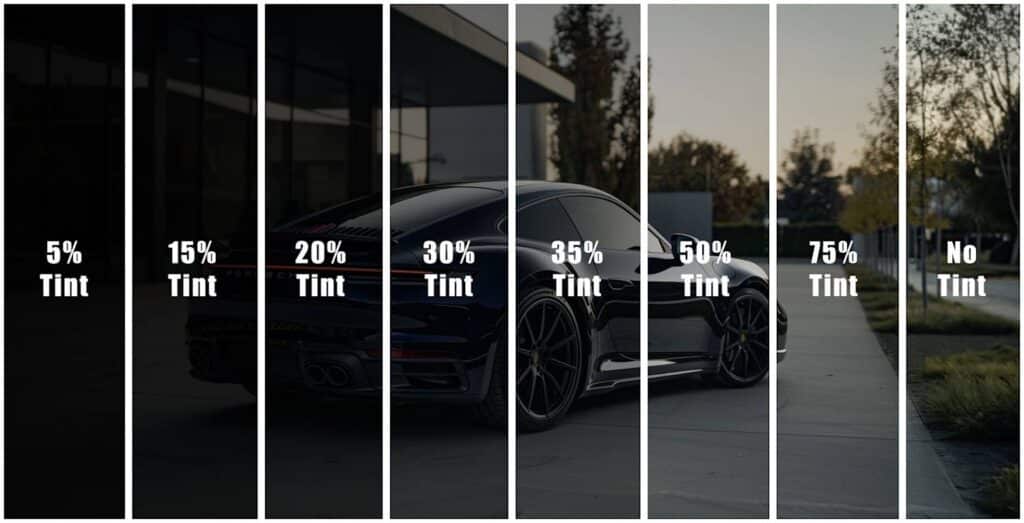
Window tint is one of the most common changes people make to a car in Dubai, and also one of the most common reasons a car gets stopped, fined or held back at the registration test. Most of these problems are not caused by drivers deliberately breaking the law. They come from a misunderstood number (“50%”), from film stacked on top of glass that was already tinted at the factory, from rules that changed years ago but still circulate as advice, and from company vehicles where nobody is sure who is responsible for the glass.
This guide explains the current UAE window tinting rules as they apply in Dubai, how tint is actually measured, what changes for company cars, fleet vehicles and rental cars, why tint problems happen in the first place, how they are fixed, and how to keep a car compliant for as long as you own it. It is written from the workshop side: what we see on cars that come in after a fine, and what a correct, legal tint job looks like on a modern luxury car.
What the UAE Window Tint Law Allows in 2026
Window tinting in the UAE is controlled at federal level, so the same basic limit applies in Dubai, Abu Dhabi, Sharjah and the other emirates. The rule has been stable since 1 July 2017, when the federal traffic regulations raised the permitted tint level from 30% to 50%. That change still drives most of the confusion today, because plenty of installers, used car sellers and even company HR policies are still working from the old 30% rule or from even older restrictions.
The main points of the current UAE tint law are:
- Side windows and the rear windscreen may carry tint up to the 50% level.
- The front windscreen may not be tinted with aftermarket film.
- Reflective, mirror-finish and coloured films are not accepted.
- Trucks and taxis are not eligible for window tint at all.
- Private cars, rental cars and company-owned cars all fall under the same 50% allowance.
- Exceeding the limit, or tinting a vehicle that is not allowed to be tinted, carries a federal fine of AED 1,500.
- In Dubai, excessive tint or a tinted front windscreen without a permit can also lead to the car being impounded, with a release fee of AED 10,000.
The UAE replaced its federal traffic law with Federal Decree-Law No. 14 of 2024, which came into force on 29 March 2025. The 50% limit and the AED 1,500 fine remain the reference figures used by police, but penalties are reviewed from time to time, so it is always worth checking the current figures with Dubai Police or the Ministry of Interior before you fit new film. The same caution applies to other cosmetic and mechanical changes, which are covered in our guide to car modification rules in Dubai and the separate guide to engine and exhaust modification rules in Dubai.
Window Tint Rules for Each Window on Your Car
The law treats different pieces of glass differently, and most fines come from getting one specific window wrong. Here is how the rule applies around the car.
| Glass position | What is allowed in the UAE | Practical note |
|---|---|---|
| Front windscreen | No aftermarket tint film | Keep only the factory shade band; do not add strips or clear heat film without written approval |
| Front side windows (driver and passenger) | Tint up to the 50% limit | Factory glass already blocks some light, so the film must be lighter than the label suggests |
| Rear side windows | Tint up to the 50% limit | Many SUVs already have dark factory privacy glass here |
| Rear windscreen | Tint up to the 50% limit | Contains heating elements and often radio antennas, so film choice and removal method matter |
| Sunroof and panoramic roof | Not part of the driver’s vision zone | Clear heat-rejection film is the sensible choice here |
Front Windscreen Tint Rules in Dubai
The front windscreen is the strictest area. Aftermarket tint across the windscreen is not allowed, and in Dubai, tinting the windscreen without a permit is one of the offences that can lead to impoundment.
There has been mixed messaging on the top shade strip over the years. In 2018, Dubai Police clarified that a band of up to 15 cm (about 5.5 inches) at the top of the windscreen was acceptable. In 2023, Umm Al Quwain Police issued an advisory saying no part of the windscreen should be tinted and nothing should be placed on it that blocks the driver’s view, including a tinted sunshade used while driving. With that inconsistency in mind, the safest approach for any car registered or driven in Dubai is simple: keep the windscreen exactly as it left the factory, including the factory-printed shade band, and do not add a sun strip.
There is also a technical reason to leave the windscreen alone on a modern car. The area behind the rear-view mirror houses the forward camera, rain and light sensor, and on many cars a heads-up display projection zone. Film or a deep sun strip over that area can affect lane-keeping assistance, automatic high beam, traffic sign recognition and rain-sensing wipers. Many luxury cars also use an infrared-reflective (athermic) windscreen with a metal-oxide coating and a small uncoated patch for toll tags. If the Salik tag is moved or covered, it may stop reading reliably, which shows up later as missed toll records. You can check your account using the Salik balance check tool. If your windscreen ever needs replacing, the windshield replacement guide explains why the glass specification, camera bracket and coatings must match the original.
Front Side Window Tint
The front side windows are where police checks usually happen, because this is the glass an officer looks through and the glass that matters most for the driver’s side view, mirror visibility and blind-spot checks at night. These windows can carry tint up to the 50% limit, but this is also where most cars go over the limit without the owner realising, for reasons explained in the next section.
On many luxury cars, the front side windows are laminated acoustic or security glass rather than plain tempered glass. Film bonds to it the same way, but laminated glass usually lets slightly less light through to begin with, which reduces the margin before the combined reading drops below the limit.
Rear Side Windows and Rear Windscreen
Rear side windows and the rear windscreen follow the same 50% rule. The rear windscreen deserves extra care because it carries the heated defroster grid and, on many cars, printed FM, DAB, GPS or TV antenna lines. A film with metal content can weaken reception through those antennas, and careless removal can cut the defroster lines permanently.
Sunroof and Panoramic Roof Glass
Roof glass is not part of the driver’s field of view, and most panoramic roofs already have a dark factory tint and a sunblind. Owners mainly want to cut the heat coming through the roof in summer. A clear or very light heat-rejection film works well here and reduces the load on the air conditioning without changing how the car looks.
What “50% Tint” Means: VLT, Tint Meters and Factory Glass
The single biggest cause of illegal tint in Dubai is a misunderstanding of what the percentage refers to.
Window film is rated by Visible Light Transmission (VLT), which is the percentage of visible light that passes through. A film labelled “70” lets 70% of light through and is very light. A film labelled “20” lets only 20% through and is very dark. The UAE rule is commonly expressed as “50% tint”, which means the window should not block more than half of the visible light. In practical terms, the measured light transmission through the window should stay at or above the 50% mark.
The problem is that some installers describe film by darkness rather than by VLT. A customer who asks for “50% tint” can easily leave with a film that lets through far less light than intended.
How Police Measure Window Tint
Traffic patrols and inspection centres use a tint meter that clamps over the glass and measures how much light passes through the complete window, meaning the glass and the film together. The number printed on the film box does not matter at the roadside. Only the meter reading on the finished window does. This is why any reputable installer should take a meter reading on each window after fitting, and why you should ask for that reading before you pay.
Why Factory Glass Changes the Result
Automotive glass is never perfectly clear. Standard side glass on most cars already blocks a part of the visible light because of its green or grey body tint and any coatings. VLT values also multiply rather than add.
As a simple example, if a front side window lets 75% of light through on its own, and a film rated at 50% VLT is applied to it, the finished window lets through roughly 37% (75% × 50%). The owner believes they have legal 50% film, but the meter shows a reading well below the limit. To stay on the right side of the rule on that window, the film needs to be noticeably lighter than 50% VLT.
This is also why “lighter film, better technology” is the correct approach in the UAE. Modern ceramic and multilayer films can reject a large share of solar heat at high light transmission, so a car can stay legal and still feel much cooler.
Factory Privacy Glass on SUVs
Many SUVs, including the Range Rover, Mercedes G-Class, GLS, BMW X7, Cadillac Escalade and Nissan Patrol, come with dark factory privacy glass on the rear side windows and rear windscreen. That glass is deep-tinted within the glass itself, not with film. Adding aftermarket film on top of it pushes the combined reading down sharply. If your SUV already has privacy glass at the rear, the only film that makes sense on those windows is a clear heat-rejection film. Owners customising a Mercedes G-Class or a Range Rover often want the full “blacked-out” look, and examples such as our G63 wrap, tinting and paint protection project and the black edition look for the Rox show that the look can be achieved with trim, wheels and wrap choices rather than by going darker on the glass.
Window Tint Rules for Company Cars, Fleet Vehicles and Rental Cars in the UAE
Company vehicles raise more questions than private cars, mainly because ownership, driving and responsibility are split between different people.
Can Company Cars Be Tinted in the UAE?
Yes. Company-owned cars and rental cars are allowed to use tint up to the same 50% limit as private cars. Dubai Police confirmed this in 2018, citing Article 9 of the traffic regulations introduced in 2017. The vehicles that remain excluded are taxis and trucks.
Why Many Companies Still Think Company Cars Cannot Be Tinted
Before the 2017 change, the limit was 30%, and the Roads and Transport Authority stated at the time that window tint was not permitted on company-owned vehicles. That older position still appears in fleet policies, procurement documents and online forums, so many fleet managers either ban tint completely or, at the other extreme, assume rules for company cars are not enforced. Neither is correct today. Company cars may be tinted, but only within the same limit, and they are checked the same way.
Who Pays the Fine on a Company Car
Traffic fines in the UAE are recorded against the vehicle’s traffic file, and a company car is registered to the company’s trade licence. A tint fine therefore sits on the company’s file, and an impounded company car has to be released by the company. Many employers then recover the cost from the employee under their internal driver policy, but that is a contractual arrangement between employer and employee, not something the traffic authority decides.
The practical risk for a business is larger than the fine itself. In Dubai, an impounded vehicle means a release fee of AED 10,000, a car off the road, and an employee without transport. If the same vehicle is impounded again within a year, the release fee doubles.
Leased Company Cars and Lessor Approval
Many company cars in Dubai are leased rather than owned. In that case, the registered owner is the leasing company, and most lease contracts restrict modifications. Fitting film without the lessor’s written approval can lead to removal charges and damage claims at the end of the lease, especially if old film has been pulled off roughly and the rear defroster grid is damaged. Before tinting a leased vehicle, check the contract and get written approval for the film type and light transmission level.
Rental Cars and Imported Cars
Rental companies generally fit tint within the legal limit, but it is worth checking any car you hire for a long period, because the fine follows the vehicle and can delay your deposit refund. Cars imported from markets with different rules, including other GCC countries where limits and enforcement differ, can arrive with film that is too dark for UAE registration. A UAE VIN check and a proper car inspection in Dubai before purchase should include a tint meter reading on every window. The same applies when buying a used luxury SUV, as covered in the Range Rover pre-purchase inspection checklist.
Branding Stickers and Vinyl on Company Vehicles
Many company cars carry logos, phone numbers or advertising on the doors and rear glass. Writing phrases or placing stickers on a vehicle without a permit is a separate violation, which Abu Dhabi Police lists at AED 500. Perforated vinyl on the rear windscreen also reduces light transmission and can push that window below the tint limit even when no film has been fitted. Commercial branding should be permitted, kept off the front side glass, and checked with a meter if it covers the rear windscreen.
A Simple Window Tint Policy for Fleet Managers
A clear fleet tint policy prevents most problems before they reach the traffic file:
- Approve one film type and one light transmission level per vehicle model, chosen after metering that model’s factory glass.
- Use one approved installer or workshop and require a meter reading on every window, written on the job card.
- Keep the invoice and film specification with the vehicle documents.
- Do not allow drivers to arrange their own tinting on company vehicles.
- Check tint during routine fleet servicing and again before each registration renewal.
- Remove or replace non-compliant film before a vehicle is sold, returned to a lessor or transferred to another driver.
Tint checks fit naturally into scheduled maintenance. A fleet already following a structured plan, like the one described in our guide to luxury car maintenance schedules in the UAE, can add a five-minute meter check to every visit.
Window Tint Fines, Vehicle Impound and RTA Inspection in Dubai
The AED 1,500 Tint Fine
The federal fine for tint beyond the permitted level, or for tinting a vehicle that is not allowed to be tinted, is AED 1,500. Applying film to the windscreen and using reflective or non-approved film fall under the same type of violation.
Dubai Impound and the AED 10,000 Release Fee
Dubai applies its own impoundment rules on top of the federal fine. Under Dubai Decree No. 30 of 2023, exceeding the permitted tint level or tinting the front windscreen without a permit is one of the offences that carries a vehicle release fee of AED 10,000. If the same car is impounded again within one year, the release fee doubles. Once the impound period ends, the vehicle has to be collected, otherwise a daily storage charge is added.
Tint Checks at Registration Renewal
Window tint is checked during the vehicle test before registration renewal. A car with film that is too dark will not pass until the film is removed or replaced, which is why many owners only discover the problem on the day of renewal. If your renewal is coming up, a quick meter check beforehand saves a second trip. Our RTA vehicle inspection page explains how to prepare a car for the test.
Tint and Car Insurance
A modification that breaks traffic rules can complicate an insurance claim, especially when visibility is relevant to how an accident happened. Keeping the tint within the legal limit and keeping the installer’s invoice and meter reading removes that question entirely.
Why Cars End Up With Illegal Window Tint
In our workshop, cars with non-compliant tint almost always arrive for one of these reasons:
- Film labelled by darkness instead of light transmission. The owner asked for “50%” and received film that blocks well over half the light.
- Film applied over factory-tinted glass. The film itself may be close to the limit, but combined with the factory body tint or privacy glass, the window fails the meter.
- New film fitted over old film. Layering two films to save the cost of removal makes the window much darker and causes adhesion problems.
- Cars bought second-hand or imported. The previous owner’s tint was never checked, and the new owner inherits the problem at the first renewal.
- Do-it-yourself kits. Retail film kits rarely state the finished light transmission on your specific glass, and the result is usually uneven.
- Windscreen strips that are too deep. A strip cut low enough to block the sun also blocks the camera and sensors and breaks the windscreen rule.
- Old rules repeated as advice. The 30% limit and the old company car ban still circulate, so drivers either go too dark or avoid tint completely when a legal option exists.
Types of Window Tint Film and How They Perform in UAE Heat
Choosing the right film is what allows a car to be both legal and comfortable in a Dubai summer. Darkness and heat rejection are not the same thing. Most of the sun’s heat arrives as infrared energy, which you cannot see, so a light film with good infrared control can keep a cabin cooler than a dark film without it.
| Film type | How it controls heat | Behaviour in UAE conditions |
|---|---|---|
| Dyed film | Absorbs light with dye; the glass gets hot and passes heat inward | Cheapest option; dye breaks down under strong UV and turns purple; weak heat rejection |
| Metallised film | Thin metal layers reflect heat | Good heat rejection but can look reflective and can interfere with phone, GPS, keyless entry and glass antennas |
| Carbon film | Carbon particles absorb and block light | Matte finish, colour-stable, no signal interference; moderate heat rejection |
| Ceramic (nano-ceramic) film | Non-conductive ceramic particles absorb infrared | Strong heat rejection at lighter shades, colour-stable, no signal interference; the best fit for staying within the 50% limit |
| Multilayer optical film | Many thin polymer layers reflect infrared selectively | Very light, near-clear appearance with high heat rejection; suits windscreen-adjacent areas, roofs and cars with privacy glass |
When comparing films, three specifications matter more than the shade name:
- VLT (Visible Light Transmission): how much light passes through the film. This decides legality once combined with your glass.
- TSER (Total Solar Energy Rejected): the share of total solar energy kept out. This is the most honest single number for heat performance.
- UV rejection: good films block around 99% of ultraviolet light, which protects leather, Alcantara and dashboard plastics from fading and cracking.
Be careful with “IR rejection” figures. Some brands quote infrared rejection measured over a narrow band of wavelengths where their film performs best, which can make a modest film look exceptional. TSER gives a fairer comparison.
The right film also takes load off the air conditioning. A cabin that heat-soaks less in a car park cools down faster, and the compressor works shorter cycles. If your AC is struggling in summer, tint will help, but it will not fix a weak system. The guides on car AC maintenance and car AC repair cost in Dubai explain what to check first, and our car AC repair team can test refrigerant pressures and vent temperatures. Lower AC load also has a small effect on fuel use, as covered in how to reduce fuel consumption in cars.
UV protection is the other major benefit for luxury interiors. Leather and dashboard surfaces that sit in direct UAE sun dry out and fade, and once that happens the repair is a re-trim, which our car upholstery team handles, or a full colour change like the one described in changing the interior colour on a Lamborghini Urus. Good film, combined with the wider habits in how to take care of your luxury car in Dubai’s harsh climate, slows that damage considerably.
Common Window Tint Problems: Why They Happen and How They Are Fixed
Even legal tint can fail. These are the faults we see most often, what causes them and how each is corrected.
Bubbles and Blisters in Window Tint
Why it happens: Small water pockets and a slight haze in the first days after fitting are normal. Film is installed with a slip solution, and the remaining moisture needs time to evaporate through the film. This usually clears within a few days in summer and can take longer in the humid coastal months. Bubbles that appear weeks or months later are a different problem. They are caused by dust or sand trapped under the film during installation, poor squeegee technique, or adhesive breaking down under heat, which is common with low-grade film.
How it is fixed: Early moisture pockets need nothing but time, with the windows kept closed for the first few days. Late bubbles cannot be pressed out permanently, because the adhesive has already failed. The film has to be removed, the glass cleaned back to bare, and new film fitted in a clean, enclosed bay rather than an open car park where wind carries sand onto the adhesive.
Purple or Faded Window Tint
Why it happens: Purple tint is a dyed film that has been broken down by UV. The dye loses its other colour components first, leaving a purple cast, and the film also loses most of whatever heat rejection it had.
How it is fixed: Faded film cannot be restored. It has to be removed and replaced. Replacing it with a carbon or ceramic film prevents the same fault from returning, because those films do not rely on dye for their colour.
Peeling Edges on Frameless Doors
Why it happens: Coupes and convertibles with frameless doors, such as the Porsche 911, BMW 8 Series, Mercedes-Benz coupes and convertibles, and the Rolls-Royce Wraith and Dawn, drop the window a few millimetres each time the door opens and raise it into the roof seal when it closes. If the film runs right to the top edge, or the edge was not finished correctly, the seal catches it on every cycle and lifts it. Ammonia-based glass cleaners also attack the film’s protective layer and adhesive over time.
How it is fixed: The window is re-filmed with a correctly finished top edge that clears the seal path. Owners should clean tinted glass with ammonia-free cleaner and a soft microfibre cloth. Our car detailing services use products that are safe for film, and the guide to choosing a car detailing workshop in Dubai explains what to ask before a detailer works on tinted glass.
Haze, Distortion and Scratches
Why it happens: Long-term haze comes from adhesive that has aged and clouded, or from the film’s scratch-resistant top layer being worn by sand. Window seals and felts carry fine sand, and every time the window moves, that sand drags across the film. Cheap film without a proper hard coat scratches within months in UAE conditions.
How it is fixed: The film is replaced, and the window seals and felts are cleaned out so they stop acting like sandpaper. Hazy film is a safety issue, particularly at night, because it scatters headlight glare from oncoming traffic.
Phone, GPS and Key Signal Problems
Why it happens: Metallised films block or weaken radio signals. Drivers notice weaker mobile reception, slower GPS position lock, reduced keyless entry range and poor radio reception through antennas printed in the rear glass.
How it is fixed: The metallised film is removed and replaced with ceramic or carbon film, which do not interfere with signals. If problems remain after the film is gone, the antenna amplifier or wiring may be at fault, which needs proper electrical diagnosis. Our article on finding a reliable car electrician in Dubai for modern luxury cars explains how those faults are traced.
Damaged Rear Defroster Lines
Why it happens: The rear windscreen heating grid is a set of thin conductive lines printed on the inside of the glass. When old film is scraped off with a blade or peeled off cold, the lines lift or break, and the rear demister stops working in sections. This matters more in the UAE than people expect, because winter mornings and heavy AC use both cause misting, as explained in how to demist your car windscreen.
How it is fixed: Small breaks can be repaired with conductive paint, but extensive damage usually means replacing the rear glass. The best fix is prevention: removing film with steam and controlled heat so the adhesive releases with the film rather than tearing the grid.
How to Remove Illegal or Failed Window Tint Safely
Removing tint looks simple, but on a luxury car it involves more than peeling film. A correct removal follows this approach:
- Protect the interior first. Door cards, speaker grilles, window switches, headliner fabric and the parcel shelf are covered, because steam and adhesive remover can stain Alcantara and damage electronics.
- Soften the adhesive. Steam or controlled heat warms the film so it peels in one piece and takes most of the adhesive with it. Overheating can crack glass in cold conditions or damage trim.
- Peel slowly and evenly. Especially on the rear windscreen, the film is pulled back at a low angle so the defroster lines are not lifted.
- Clean the remaining adhesive. A film-safe adhesive remover is used on the side glass. No metal blades are used on the rear windscreen.
- Check the glass. The defroster is tested, antennas are checked for reception, and the bare glass is metered before any new film goes on.
If the reason for removal is a failed registration test, the car can be re-metered with new compliant film the same day and then booked back in for the test.
Medical and Security Exemptions for Darker Window Tint
The UAE allows darker tint in limited cases, but only with prior written approval from the traffic authority. Approvals are handled case by case for people with genuine medical needs, supported by a medical report from a licensed doctor. Requests linked to personal security are also considered individually. These approvals are rare, they apply only to the specific vehicle named, and the permit should be kept in the car at all times.
An exemption is not something a tint shop can grant. If an installer offers darker film “because you can apply for a permit later”, the film is illegal until the permit is actually issued. For drivers who are sensitive to sunlight but do not qualify for an exemption, a high-performance ceramic or multilayer film with 99% UV rejection at a legal shade provides most of the protection they need.
How to Stay Within UAE Window Tint Rules Long Term
Most tint problems can be prevented with a few habits:
- Ask for the finished meter reading, not the film number. Request a light transmission reading on each window after fitting and keep it with the invoice.
- Choose film by heat rejection, not darkness. Compare TSER and UV rejection, and go lighter on glass that is already tinted.
- Leave the windscreen as the factory supplied it. No strips, no added film, and keep the Salik tag in its correct position.
- Never fit new film over old film. Remove the old layer completely first.
- Use non-metallic film on cars with glass antennas and keyless entry. Ceramic and carbon films avoid signal problems.
- Clean tinted glass with ammonia-free products. Use a soft microfibre cloth and keep window seals free of sand.
- Meter the windows before registration renewal or sale. It takes minutes and avoids a failed test or an awkward negotiation with a buyer.
- For company cars, follow a written fleet policy. One approved film, one approved installer, and a tint check during every scheduled service.
Tint is one part of how a car is protected in this climate. Many owners combine it with paint protection film or ceramic coating on the bodywork. The articles on ceramic coating vs PPF, the best PPF in Dubai and why PPF turns yellow explain how film quality affects long-term results, and the same principle applies to window film: cheap material fails faster under UAE heat and UV. Owners planning a wider change of look can also read car wrap or paint, luxury car customization trends in Dubai and how to choose the best car modification shop in Dubai, so that every change stays within the rules from the start.
Window Tint Checks and Compliant Film Fitting at Carzilla Al Quoz
At Carzilla, window tint is handled with the same approach we take to any car modification in Dubai: it has to be legal, it has to suit the car’s glass and electronics, and it has to last in UAE conditions. Our team in Al Quoz Industrial Area 2 meters every window before and after fitting, removes old or illegal film without damaging defroster lines or antennas, and fits ceramic and multilayer films selected to stay within the UAE tint limit on your specific glass. We work on private luxury cars and on company and fleet vehicles, from Mercedes-Benz, BMW and Porsche to Rolls-Royce and Range Rover, and the full range of work is listed on our services page.
If your car has failed a test for tint, if you have bought a car and are unsure whether its film is legal, or if you manage a fleet and want a single compliant film specification for every vehicle, contact our workshop for a tint check. Free Pickup and Delivery* is available, so the car can be collected, metered, corrected and returned without disrupting your day.