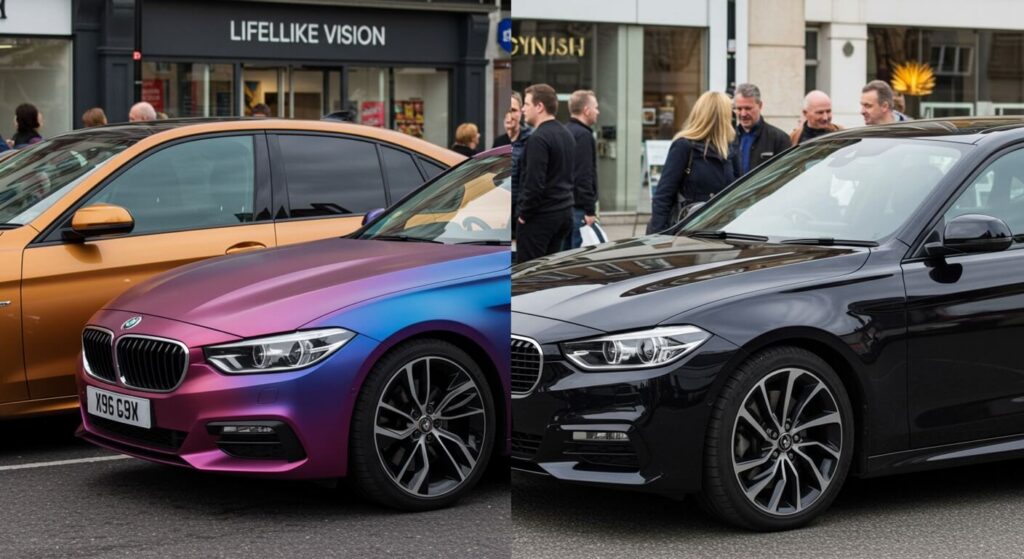
A car wrap and peelable paint are both used to change a car’s colour without touching the factory paint, and both can be removed later. From a few metres away, a well-done wrap and a well-done peelable paint job can look almost the same.
The similarity ends there. A car wrap is a ready-made plastic film, produced in a factory to a fixed thickness, that is laid onto the car in sheets and held by adhesive. Peelable paint (also called liquid wrap, removable paint or rubber paint) is a liquid coating that is sprayed onto the car in many coats until it builds up into a continuous rubber-like skin. One is a product that arrives finished. The other is made on the car, and its quality depends almost entirely on how it was sprayed.
That single difference explains why the two finishes look different up close, why they fail in different ways, why one peels off in large sheets and the other sometimes tears into small flakes, and why they need different care in UAE heat. This guide explains how each finish works, what goes wrong with each, why it happens, how it is fixed and how to prevent it.
What Is a Car Wrap?
A colour-change car wrap is a thin sheet of PVC (vinyl) film with a pressure-sensitive acrylic adhesive on the back. A typical premium wrap film is about 90 microns thick without adhesive and about 110 microns with it, roughly the thickness of one sheet of office paper. The adhesive surface has tiny air-release channels so trapped air can escape while the film is being laid. Many gloss films also come with a clear protective layer that is peeled off after installation.
Wrap films for full cars are cast films. They are made by pouring liquid vinyl onto a casting sheet and curing it flat, so the film holds very little internal stress and stays where it is stretched. Cheaper calendered films are rolled out under pressure and keep trying to shrink back, which causes lifting and cracking in heat. Our article on car wrap vs car paint explains film grades in more detail.
There is also a thicker category called colour paint protection film. It is made from thermoplastic polyurethane (TPU) rather than PVC, is around 200 microns thick, and many grades self-heal light scratches with heat. It changes colour like a wrap but protects like PPF. Our guides to the best PPF in Dubai and PPF vs wrap for G-Wagon protection cover that option.
What Is Peelable Paint?
Peelable paint is a sprayable elastomer, a rubbery polymer carried in either a solvent or water base. It is sprayed directly onto clean factory paint with no primer and no sanding. As the carrier evaporates, the polymer forms a flexible film.
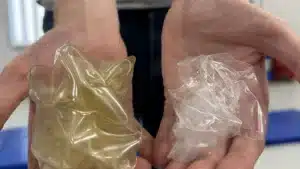
The important point is that peelable paint is designed to stick weakly. It clings to the glossy clear coat but does not bond chemically to it. What holds it together is the strength of the film itself. When the film is thick enough, it hangs together as one sheet and peels off cleanly. When it is too thin, it does not have enough body to hold together and tears into small pieces.
There are two very different levels of peelable paint:
- Aerosol (spray can) peelable paint – sold for wheels, badges and small parts. Manufacturers typically ask for at least four to six coats, and at least one major brand rates its aerosol coating for a service life of only about six months.
- Professional peelable paint systems – sprayed with HVLP spray guns in a booth, in layers: base coats for build, colour or effect coats (metallic, pearl, candy, colour-shift) and a gloss, satin or matte topcoat that adds UV resistance and a harder outer surface. A properly built professional system is usually in the region of 100 to 200 microns or more.
A full car in peelable paint is only as good as the second category. Carzilla’s peelable car paint service in Dubai uses professional spray equipment and a controlled booth for this reason.
The Core Difference: A Film That Is Laid vs a Skin That Is Built
Almost every practical difference between a wrap and peelable paint comes from how each finish gets its thickness and how it holds on.
Thickness. A wrap film is the same thickness everywhere because the factory made it that way. Peelable paint is only as thick as the painter makes it. Two cars sprayed in the same colour can have very different film builds, and that decides how long the coating lasts and how easily it comes off. Thin areas usually appear on edges, sharp body lines and lower panels, the same places that take the most wear.
How it holds on. A wrap is held by an adhesive layer that grips harder over time, especially in heat. Peelable paint is held mainly by cling and by its own film strength. This is why a badly aged wrap can leave glue behind, while badly aged peelable paint does not leave glue but can become difficult to peel.
Seams and edges. A wrap is laid in sheets about 1.5 metres wide, so very large or complex panels may need a seam or an inlay. Edges are wrapped around the panel and tucked behind it. Peelable paint is sprayed as one continuous layer, so there are no seams across a panel. It still has edges, though: wherever the masking stopped, such as inside door shuts, around rubber seals and at trim. Those edges are where peelable paint usually starts to lift.
Repairability. Damaged wrap is replaced panel by panel with new film. Damaged peelable paint can be re-sprayed on that panel and blended, because it is a liquid.
Keep these four points in mind. They come up again in every section below.
How a Car Wrap Is Installed vs How Peelable Paint Is Sprayed
Car wrap installation
A professional wrap starts with a paint inspection. Installers check every panel, often with a paint depth gauge, to find repainted panels, thin clear coat or failing paint. The car is then washed, decontaminated with clay and wiped with a panel-prep solvent so no wax, sealant or ceramic coating remains, because wrap adhesive will not bond properly to these.
Door handles, badges, mirror caps, lights and sometimes bumpers are removed so the film can be wrapped around panel edges. The film is laid one panel at a time, squeegeed down and warmed so it can be stretched into curves. Professional installers cut with knifeless tape, a filament laid under the film that cuts from below, instead of running a blade over the paint.
The most important finishing step is post-heating. Every stretched area, recess and edge is heated to the temperature the film manufacturer specifies, which removes the film’s “memory” of its flat shape. A full colour-change wrap usually takes around three to five working days, and the car should stay indoors and unwashed for a short period afterwards while the adhesive builds its bond.
Peelable paint application
Peelable paint also starts with inspection and decontamination, for the same reasons. Instead of removing parts, the painter masks everything that must not be coated: glass, lights, rubber seals, door shuts, the engine bay, parking sensor faces and radar areas. Some items such as badges, grilles and emblems can be sprayed over, which is one of peelable paint’s advantages.
The coating is then built in layers. The first coat is light so it grips without running. Each following coat goes on wetter and heavier, with a short flash time between coats, until the film has enough build to peel cleanly. The colour or effect layer goes on next, then the topcoat. The painter checks build on edges and lower panels, because those are where thin spots appear.
Conditions matter more for peelable paint than many people expect. Manufacturers give temperature and humidity windows for spraying, and one widely sold product lists roughly 10–32°C and humidity below 65%. An outdoor Dubai summer is well outside that range. Spraying in a temperature-controlled booth is not a luxury for peelable paint in the UAE; it is the only way to get a smooth, properly built finish. Masking tape is pulled while the last coat is still fresh, so the edge breaks cleanly instead of tearing later.
Peelable paint is usually touch-dry within an hour, but it keeps curing for days. It should not be washed for at least the first day, and it should not see a pressure washer or a machine wash for about a week.
Finish and Appearance: Seams, Edges, Gloss and Texture
A wrap has a factory-made surface, so the colour and finish are perfectly even across the car. Wraps can also do things that no sprayed product can copy: real brushed metal, carbon-fibre texture, mirror chrome and printed designs. On the downside, a wrap may need seams or inlays on very wide bonnets, bumpers and roofs of large SUVs. Door shuts usually stay in the original colour unless the owner pays for jamb wrapping, so the old colour shows when a door is opened.
Peelable paint has no seams across a panel and flows into places film struggles with: honeycomb grilles, badges, emblems, wheels, brake calipers and heavily shaped bumpers. It can be mixed to almost any colour, including metallic, pearl, candy and colour-shift effects, and can be colour-matched to OEM paint codes. The gloss level depends on the topcoat. A good gloss topcoat looks close to paint, but peelable paint is softer than paint, may show slight orange peel, and cannot be cut and polished to a show finish the way 2K paint can. True chrome and real textures are not possible.
Door shuts are a similar story for both. Peelable paint can be sprayed slightly into the jambs, but the coating has to stop at a masking line somewhere, and the further into the jamb it goes, the harder that area is to peel later.
Matte and satin finishes deserve a special note. Matte wrap and matte peelable paint both get their look from a microscopically rough surface. Neither can be polished, waxed with filler waxes or machine-corrected without turning shiny in patches. This is the same rule that applies to factory matte paint.
How Long Does a Car Wrap Last vs Peelable Paint in UAE Heat?
Both finishes wear out fastest on horizontal surfaces: the roof, bonnet, boot lid and the tops of the wings. These panels face the sun directly, sit hottest and collect sand, dust and bird droppings. Wrap film manufacturers rate horizontal surfaces separately for this reason. One leading cast film carries a warranty of up to eight years on vertical surfaces but only up to three years on horizontal surfaces, and that is under normal climate conditions.
In the UAE, a premium cast wrap on a car that is parked outdoors usually gives around three to five years before the roof and bonnet start to fade, crack or chalk. Specialty films wear faster. Chrome film, for example, is rated by its maker for only about one year of expected life on a vertical surface. Garaged cars with covered parking last much longer than cars parked in open lots.
Peelable paint life depends almost completely on the type of product and the film build:
- Aerosol peelable coatings are temporary products. Manufacturers talk about months, not years, and recommend removal within that window.
- Professional peelable paint systems with a UV-stable topcoat and correct build last several years, and longer on cars kept in shade.
There is an important difference in how the two finishes age. A wrap tends to fail visibly: it fades, cracks or lifts, so the owner knows it is time to remove it. Peelable paint can still look acceptable while slowly becoming drier, harder and less elastic underneath. If it is left too long, it stops peeling in sheets and has to be broken up and dissolved off. With peelable paint, the right removal time is decided by the coating’s condition, not just its appearance.
For more on how UAE heat ages exterior finishes, see our guides on how long ceramic coating lasts in the UAE, why PPF turns yellow and taking care of a luxury car in Dubai’s harsh climate.
Which Protects the Factory Paint Better: Wrap or Peelable Paint?
Both finishes protect the paint underneath from UV, light scratches, wash marring, tree sap and bird droppings, because those things attack the top layer instead of the clear coat.
Neither is a stone-chip product. A 90-micron vinyl wrap stops very little impact energy, and a stone that hits hard enough will mark the paint under it. A thick, well-built layer of peelable paint is rubbery and absorbs light impacts slightly better than thin vinyl, but its surface is softer and scuffs more easily. Proper chip protection comes from clear PPF or colour PPF, which is around twice as thick as a vinyl wrap and made from a tougher material. Our ceramic coating vs PPF guide and 3M PPF in Dubai article explain how those products compare.
Both finishes also share one hidden risk. Neither can protect paint that is already weak. If a panel has been repainted badly, or the clear coat has started to fail, the wrap adhesive or the peelable film can pull that weak paint off during removal. Our guide on why car paint peels explains how to recognise paint that is not safe to cover.
Living With Each Finish: Washing, Fuel, Sand and Bird Droppings
Washing
Hand washing with the two-bucket method and a soft mitt is the safest method for both. The main differences are in pressure washing and chemicals.
On a wrap, a pressure washer held too close, or aimed straight at an edge or seam, can lift the film. Keep the nozzle well back from the surface and spray across edges, not into them. On peelable paint, the same applies even more strongly at masking lines and panel edges, because there is no adhesive holding those edges down. Brush car washes are best avoided for both. Our article on car detailing vs car washing covers safe wash methods.
Fuel and solvents
This is one of the biggest practical differences. Vinyl wrap tolerates a small fuel splash if it is wiped off quickly. Most peelable paints are softened by petrol, thinners and strong solvents, so a fuel drip at the filler cap can leave a soft, stained or wrinkled patch. Tar removers, glue removers and some strong degreasers have the same effect. Owners of peelable paint cars should wipe fuel drips immediately and check the label of any cleaner before using it.
Sand and dust
Sand is very hard compared with vinyl or rubber coatings. Wiping a dusty car with a dry cloth drags that sand across the surface and leaves fine scratches in a gloss wrap and scuff marks in peelable paint. Always rinse loose dust off first.
Bird droppings
Bird droppings contain uric acid, and heat speeds up the damage. On a hot panel in a Dubai afternoon, a dropping can mark a finish within hours. On gloss paint, light etching can often be polished out. On a matte wrap or matte peelable paint, polishing is not possible, so the mark is usually permanent until that panel is redone. Remove droppings by soaking them with a wet cloth or detail spray, never by scrubbing them dry.
Protection products
Many sealants and coatings are made specifically for vinyl and matte finishes, and they make both finishes easier to clean. Products with fillers, waxes or polishing compounds should not be used on matte surfaces. Ask your installer which products suit the exact film or coating on the car.
Common Car Wrap Problems: Why They Happen and How They Are Fixed
Edges lifting and corners peeling back
Why it happens: The edge was not post-heated properly, the paint was not fully cleaned of wax or ceramic coating, the film was cut too short instead of being wrapped around the panel edge, or a pressure washer was aimed at the edge. Heat makes all of these worse because the film tries to shrink back to its original shape.
How it is fixed: If the lift is small and clean, the area can be cleaned, re-heated and pressed down, sometimes with an edge-sealing primer the film maker approves. If dirt has got under the edge or the film has shrunk, the panel’s film is replaced.
Bubbles and film pulling out of recesses
Why it happens: Small bubbles in the first days are usually trapped air that works out through the adhesive channels. Bubbles that appear later, or film that “tents” across door-handle cups and bumper recesses, are caused by over-stretching and missed post-heating. The stretched film remembers its flat shape and slowly pulls back out of the recess.
How it is fixed: Trapped air can sometimes be released with a fine pin and pressed out. Film that has pulled out of a recess cannot be pushed back in permanently, because it has already been over-stretched. That section is replaced and post-heated correctly.
Fading, cracking and chalking on the roof and bonnet
Why it happens: UV breaks down the vinyl and its pigment, and constant heat cycling makes the film lose its plasticisers, so it becomes brittle. This is normal ageing, but it happens sooner in the UAE, sooner on dark colours, and much sooner with calendered film or specialty finishes.
How it is fixed: Aged film cannot be restored. The horizontal panels are re-wrapped, or the whole wrap is removed before it becomes brittle enough to come off in tiny pieces.
Knife marks and cut lines in the paint underneath
Why it happens: Some installers trim the film on the car with a blade. Even light blade pressure scores the clear coat, and those lines show up when the wrap is removed. On steel panels, deep cuts can reach primer or metal.
How it is fixed: Light marks are wet-sanded and polished out of the clear coat. Deeper cuts need a scratch repair or a panel refinish by a professional car painting service.
Paint coming off with the wrap during removal
Why it happens: The paint under the wrap was already weak. This is usually a previous repaint with poor adhesion, failing clear coat, or a panel that was wrapped too soon after painting, before the paint had fully cured. Pulling cold film fast or at a steep angle adds to the force on the paint.
How it is fixed: The affected area is repaired by refinishing the panel. To avoid it, a paint depth reading before wrapping shows which panels have been repainted, and fresh paint is given enough time to cure before any film goes on.
Adhesive residue left behind
Why it happens: Old, sun-baked film loses its strength faster than its adhesive, so the face film tears away and leaves the glue behind. This is common on wraps that stayed on well past their rated life.
How it is fixed: The glue is softened with a paint-safe adhesive remover and gentle heat, then wiped off, followed by a wash, clay and polish. It is slow work, which is why late removal costs more.
Common Peelable Paint Problems: Why They Happen and How They Are Fixed
Peelable paint tearing into small pieces instead of peeling
Why it happens: The film is too thin. This is the most common peelable paint problem by far, and it almost always comes from too few coats, coats sprayed too dry, or thin build on edges and lower panels.
How it is fixed: Thin areas are removed with a peelable-paint dissolver, applied, left to soften the coating and then rinsed with a pressure washer held at a safe distance, repeated until clean. An alternative used by some professionals is to spray extra coats over the thin area to build it up, then peel everything off together as one thicker sheet.
Peeling or lifting at masking lines and panel edges
Why it happens: Edges are the weakest part of a sprayed coating. The film is thinnest there, it has no adhesive to hold it down, and water from washing gets under any small break. Tape pulled too late, after the coating has cured, tears the edge instead of leaving a clean line.
How it is fixed: The loose edge is trimmed back to solid coating, the area is cleaned and the panel edge is re-sprayed and blended. Repeat lifting on the same edge usually means the film build there is too low.
Softening and stains around the fuel filler
Why it happens: Petrol and solvent-based products soften most peelable coatings. Drips around the filler cap, or a tar or glue remover used on the body, leave soft, wrinkled or stained patches.
How it is fixed: The damaged section is peeled or dissolved off and the panel is re-sprayed. To prevent it, wipe fuel drips immediately, avoid solvent cleaners, and consider having the filler area given extra build.
Dull, chalky or stained patches
Why it happens: UV ageing of the topcoat, hard-water spots baked on by the sun, bird droppings left on a hot panel, or dyes from dirty water and road grime. Light colours and matte finishes show this most.
How it is fixed: Light marks on gloss topcoats may come off with a dedicated cleaner for coated finishes. Marks that have entered the coating need the panel to be re-sprayed. Applying a fresh topcoat over aged peelable paint can refresh the look, but it adds more film that will eventually need removing.
Runs, orange peel and dust in the finish
Why it happens: Spraying too heavy, too close or in poor conditions. Heat and low humidity make the coating dry before it can flow out, which causes heavy orange peel. Spraying outdoors or in an unsealed workshop traps dust in the finish.
How it is fixed: Unlike paint, peelable coatings cannot be sanded and polished smooth. A panel with runs or heavy texture is peeled and re-sprayed in proper booth conditions.
Overspray on seals, glass, sensors and door shuts
Why it happens: Poor masking. Fine mist settles on rubber seals, glass, headlight lenses, door shuts and engine-bay parts. A coating built over parking sensor faces or radar areas can affect how those sensors read.
How it is fixed: Overspray on glass and seals is peeled or dissolved off carefully. Sensor faces are cleaned back to their original surface. On cars with front radar or camera systems, if a coated bumper or emblem has been removed for cleaning, the system may need checking afterwards.
Peelable paint that has become too hard to peel
Why it happens: The coating was left on long after its useful life. Years of heat cycling and UV make it drier and less elastic, and metallic and pearl coatings can be more stubborn because of the flakes in them.
How it is fixed: Removal becomes a dissolver-and-pressure-wash job panel by panel instead of a simple peel. This takes much longer and must be done carefully around edges, trims and badges so the paint underneath is not damaged by the pressure.
Removing a Car Wrap vs Removing Peelable Paint
A wrap is removed by warming each panel to soften the adhesive, then pulling the film back slowly at a low angle. Film still within its life usually comes off in large pieces with little residue. Aged film comes off in small pieces and leaves glue that has to be cleaned off by hand. Parts removed for the installation, such as handles, badges and lights, are removed again.
Peelable paint is removed by lifting an edge and peeling slowly, keeping the peel low to the panel. A well-built coating still within its life comes off in big sheets in a few hours for the whole car. Thin or aged areas need dissolver and rinsing, as described above. Badges, grilles and wheels coated with peelable paint take the most time because the coating has to be picked out of small gaps.
After either removal, the car should be washed, clayed and inspected under good light. The paint that was covered is usually in very good condition, but small differences can show: a slight colour or gloss difference between covered panels and areas that were always exposed (such as door shuts), and any marks left by blade cuts or by sand that got trapped under lifted edges. A light machine polish evens these out in most cases. If the car is being sold, this is the right moment for a paint depth check and a car inspection. Carzilla’s car detailing services include post-removal decontamination and polishing.
Can You Wrap Over Peelable Paint, or Spray Peelable Paint Over a Wrap?
No, neither combination is a good idea.
Wrap adhesive needs a smooth, hard and clean surface. Peelable paint is soft, slightly textured and weak by design, so a wrap applied over it bubbles, lifts and, when removed, tears the peelable paint apart under it. Peelable paint sprayed over vinyl is also a poor match. The solvents can attack the film and its adhesive, and the result cannot be removed cleanly as one layer.
The same rule applies to ceramic coatings. A ceramic or glass coating makes the paint so slick that wrap adhesive and peelable coatings cannot grip it properly. If the car has a ceramic coating, it has to be polished off before either finish is applied.
The right approach is always to remove the old finish completely, decontaminate, inspect the paint and start again.
Car Wrap vs Peelable Paint Cost in Dubai
The two finishes overlap in price, and the final figure depends more on the car and the preparation than on which finish is chosen. At Carzilla, peelable paint for partial coverage such as the bonnet, roof, mirrors, calipers or accent panels starts from AED 2,000, and a full-body peelable paint colour change is typically AED 6,000–12,000 depending on car size and finish. Exotic and supercar jobs are quoted after inspection.
Full colour-change wraps in Dubai cover a much wider range. Market prices commonly start around AED 3,500–8,000 for a sedan in standard cast film and rise for SUVs, specialty films and luxury cars. Chrome, colour-shift, textured films and colour PPF can go well beyond AED 20,000 on a large vehicle.
Several things move the price of both finishes more than the material itself:
- Preparation work, including paint correction and ceramic coating removal before application
- Removing an old wrap or old peelable paint before the new finish goes on
- Door shuts and jambs, which add a lot of labour for either finish
- Removing parts such as bumpers, handles and lights for a cleaner wrap
- The finish chosen, with effect colours and specialty films costing more
- The size and shape of the car, with deep bumpers and complex grilles taking longer
It also helps to think in cost per year, not just the upfront price. A cheaper job that has to be redone or professionally removed early often costs more over the same period than a properly built finish that lasts its full life. Carzilla accepts Tabby for paint and repair work; our article on fix my car now, pay later with Tabby explains how it works.
RTA Rules for a Car Colour Change With a Wrap or Peelable Paint in Dubai
In Dubai, a change of the car’s colour needs approval whether it is done with paint, a wrap or peelable paint. The registered colour on the Mulkiya has to match the car. The usual process is:
- Apply for a colour change NOC from Dubai Police before the work is done.
- Have the colour change carried out.
- Take the car for inspection at an RTA testing centre.
- Update the Mulkiya with the new colour.
When the wrap or peelable paint is later removed and the car goes back to its original colour, the registration has to be updated again. Changing only the finish in the same colour, such as gloss white to matte white, may be treated differently, so check with the RTA before the work. Clear PPF does not change the colour and does not need this process. It is also sensible to inform the car’s insurer of a colour change.
Personal cars in Dubai are limited to colour changes. Text, logos or advertising need commercial approval. Our guides to car modification rules in Dubai and car engine and exhaust modification rules explain approvals in more detail, and Carzilla can help with RTA vehicle inspection and car modification.
Wraps, Peelable Paint and Buying or Selling a Car in the UAE
Because both finishes are reversible, they are popular on leased cars and on luxury cars where the owner wants to keep the factory paint for resale. Returning a leased car or selling a car usually means removing the finish first and restoring the original colour on the registration.
For buyers, a wrapped or peelable-painted car needs extra care. The covering hides the condition of the paint underneath, including previous accident repairs, repainted panels and scratches. Before buying, ask for paint depth readings on any uncovered areas, check the car’s history with a UAE VIN check, and arrange a full pre-purchase inspection. Our Range Rover pre-purchase inspection checklist and Rolls-Royce pre-purchase inspection guide show what a thorough body and paint check covers.
How to Prevent Car Wrap and Peelable Paint Problems
Most wrap and peelable paint problems are decided before the first sheet of film or first coat goes on. Preventing them comes down to three stages.
Before the work
Start with the paint, not the colour choice. Have every panel checked for repaints, thin clear coat, chips and peeling. Repair any chips, scratches or failing clear coat first, because covering weak paint is the main cause of paint damage on removal. If a panel has been freshly painted, give it time to cure before covering it. Remove any ceramic coating, wax or sealant. Choose the right product for the job: cast film rather than calendered film for a wrap, and a professional sprayed system rather than aerosol cans for a full car in peelable paint.
During the work
For a wrap, the work should be done indoors, with parts removed where needed, edges wrapped around panels rather than cut short, knifeless tape instead of blades on the paint, and full post-heating of every stretched area. For peelable paint, the work should be done in a temperature-controlled booth with thorough masking of glass, seals, sensors and jambs, enough coats to reach full build, extra attention to edges and lower panels, and masking removed while the last coat is fresh.
After the work
Leave the car unwashed for the curing period the installer gives. Hand wash rather than using brush car washes, keep pressure washers away from edges, and never wipe a dusty car dry. Remove bird droppings quickly by soaking, not scrubbing. With peelable paint, wipe fuel drips immediately and avoid solvent cleaners. Park in shade or under cover when possible, since the roof and bonnet take most of the damage. Finally, plan removal before the finish reaches the end of its life, while a wrap still comes off cleanly and peelable paint is still elastic enough to peel.
Our guides to choosing a car detailing workshop in Dubai and luxury car detailing in Dubai cover ongoing exterior care.
Car Wrap or Peelable Paint: Which Is Right for Your Car?
The right choice depends on what the finish needs to do, how long it needs to last and how the car is used.
A car wrap is usually the better choice when the owner wants a finish that cannot be sprayed, such as chrome, brushed metal, carbon texture or a printed design, or when the goal is a uniform factory-made colour that lasts several years. It is also more tolerant of fuel splashes and everyday chemicals.
Peelable paint is usually the better choice for parts with complex shapes such as wheels, brake calipers, grilles, emblems and badges, for a seamless finish across large panels, for a custom-matched or effect colour, and for owners who want a lower-cost reversible colour change on a leased or luxury car. Our article on Range Rover peelable paint in Dubai shows a typical use.
Colour PPF or clear PPF is the better choice when real protection against stone chips and sand is the priority, since neither vinyl wrap nor peelable paint is made for that. Our guide on whether PPF damages paint when removed explains how that product comes off.
A professional respray is the better choice when the colour change is meant to be permanent, or when the existing paint is too damaged to cover safely. See our guides to the best car repaint service in Dubai and luxury car denting and painting.
Many owners combine finishes: peelable paint on wheels and calipers, a wrap or colour PPF on the body, and clear PPF on the front end. The rule for combining them is simple: each finish goes directly onto clean paint, never on top of another.
Peelable Paint, Paint Inspection and Repaint at Carzilla in Al Quoz
Carzilla’s paint team in Al Quoz Industrial Area 2 inspects the paint before any colour change, repairs chips, scratches and weak panels first, and applies peelable car paint in a controlled booth with proper film build and masking. When a car needs more than a colour change, the same workshop handles auto body shop repairs, car painting and car detailing and paint protection, along with luxury-brand mechanical work for marques such as Range Rover, Mercedes-Benz, Rolls-Royce and Lamborghini.
Carzilla offers Free Pickup and Delivery* anywhere in Dubai, a free inspection and quote, and Warranty on Repair. To discuss a wrap, peelable paint or a full colour change, contact Carzilla or call 056 684 9665.