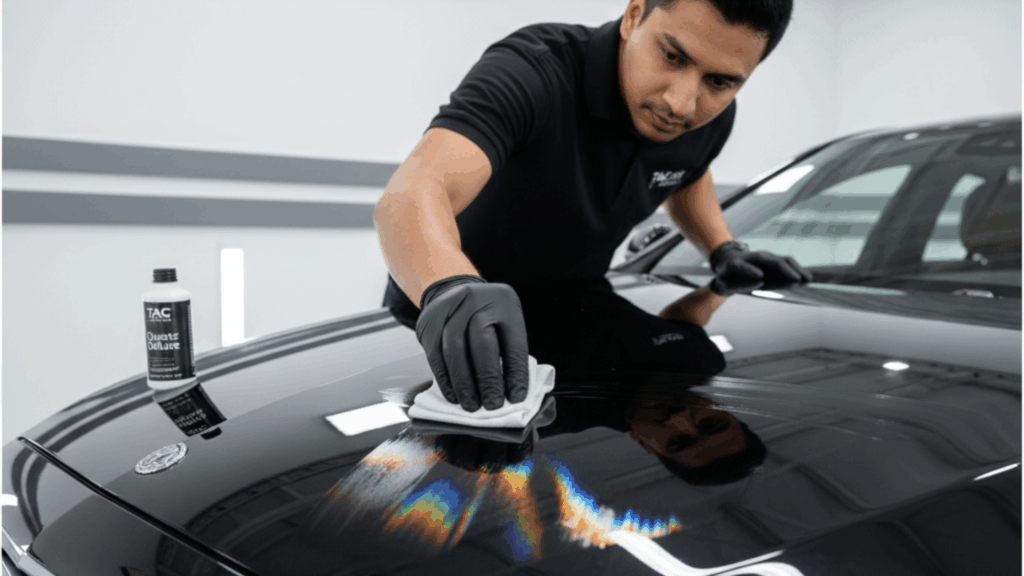
A professional ceramic coating usually lasts 3 to 5 years in the UAE, provided it is applied indoors on properly corrected paint and maintained correctly. The same coating on a car that is parked in open sun and washed at brush car washes can lose most of its protection in 12 to 18 months. Spray-on “ceramic” products from retail shelves last only weeks to a few months.
The years printed on a coating bottle describe the product. How long the coating actually lasts on your car depends on three things: the product, how it was applied, and how the car is washed and parked afterwards. In the UAE, the last two matter more than the first.
This guide explains what a ceramic coating is made of, why it wears faster in UAE conditions, how long it lasts on each part of the car, how to tell whether yours is wearing off or only clogged, how worn coatings are fixed, and how to make a coating last as long as possible in Dubai heat.
What Ceramic Coating Is and What “Lasting” Really Means
A ceramic coating is a liquid based on silicon dioxide (SiO2) or polysilazane chemistry. It is wiped onto the paint and reacts with moisture in the air. Over one to two weeks it cross-links into a hard, glass-like film bonded to the clear coat. That film is only about 1 to 3 microns thick. The clear coat under it is usually 40 to 50 microns thick. So a ceramic coating is a very thin sacrificial layer on top of a layer that is already thin.
When owners ask how long ceramic coating lasts, they usually mean how long the water keeps beading. That is only one of three things a coating does, and the three wear at different rates:
- Water behaviour (hydrophobic effect). The water-repelling top surface is the first thing to fade. It is also the easiest to restore.
- Slickness and gloss. These come from the cured film and from polymers in the coating. They fade more slowly. On a worn panel, a clean microfibre cloth starts to drag instead of gliding.
- The protective layer itself. This is the glass-like film that resists chemical etching and UV, and it is the last thing to go. Once it has worn through, the paint is exposed again and starts picking up wash marks and etching like uncoated paint.
A coating that has stopped beading water may still be there. A coating that has worn through on the roof may still look fine on the doors. Both are explained below.
Why Ceramic Coating Wears Faster in the UAE
Coating manufacturers test their products in conditions far milder than a UAE summer. Several local factors work on the coating every day.
Extreme UV and Paint Surface Temperature
The UAE sees a UV index of 10 or higher for much of the year. On a summer afternoon, a dark roof or bonnet parked in direct sun can go well past 70°C. Every day the panel heats up and cools down again. Pure inorganic silica handles this well. But most professional coatings are hybrids that also contain organic resins and polymers, and those give the coating its slickness and much of its water repellency. Heat and UV break down that organic part first. This is why a coated car often keeps its gloss but loses its beading after one or two summers.
Fine Sand and Dust
Desert sand is mostly silica (quartz). It is harder than clear coat, and in practice it wears through a few microns of coating quickly. The sand on its own does not do much damage. The damage happens when a dusty car is touched. Every time a mitt, towel or brush is moved across a sandy panel, the grit drags across the coating and wears it down a little more. Sandstorm days and the dusty months of the shamal season add a layer of very fine dust that settles into every surface.
Sprinkler Water and Hard Water Spots
Many landscaped areas, roundabouts and residential communities in Dubai are irrigated with recycled treated water. That water carries more dissolved salts and minerals than tap water. When sprinkler spray lands on a hot panel, the water evaporates within minutes and the minerals stay behind.
Water spots develop in three stages:
- Mineral deposits sit on top of the coating and wash or wipe off.
- Etched spots have chemically marked the coating’s surface.
- Deep etching has gone through the coating into the clear coat.
A coating slows this down, but a car parked under sprinklers every night will lose its coating on the most exposed panels long before the rest of the car.
Bird Droppings, Tree Sap and Insects
Bird droppings are acidic. On a hot panel they bake on and start attacking the surface within hours. A good coating gives you time to remove them before they reach the paint, but it is not unlimited. Droppings left on a roof for several days in summer can etch through the coating and mark the clear coat underneath.
Coastal Humidity and Morning Dew
In coastal areas, summer nights are humid. Dew forms on the car and mixes with the dust that has settled overnight, leaving a thin film of muddy residue by morning. Wiping that film off dry, with a cloth or with the windscreen wipers on the glass, is the same as polishing the coating with fine sand.
Washing and Care Habits That Shorten Coating Life
Most coatings that fail early in Dubai are not failures of the product. The coating was used up by the way the car was washed.
Automatic Brush Car Washes
Rotating brushes pick up sand and grit from every car before yours and drag it across the panels at speed. On a coated car, they wear the coating quickly and then start putting swirl marks into the paint. Our guide to car detailing vs car washing explains why this type of wash causes so much damage.
Waterless Washes in Building Car Parks
Waterless washing is very common in residential towers in Dubai. A worker sprays a product onto a dusty car and wipes it off with a cloth. Done by an expert with plenty of clean towels on a lightly dusty car, it can be acceptable. Done quickly with the same few cloths on every car, it works sand into the coating every few days, and the coating wears away within months.
Harsh Wash Chemicals
Silica is chemically stable against most things, but it dissolves slowly in strongly alkaline solutions. Many busy car washes use high-pH pre-wash chemicals (traffic film removers) because they cut through grime fast. Used on a coated car week after week, these chemicals slowly break down the coating. Strong acidic wheel cleaners and aggressive water-spot removers do the same in the other direction. A coated car should be washed with a pH-neutral shampoo, with stronger chemicals saved for occasional, controlled decontamination.
Wax and Filler Products on Top of the Coating
Putting carnauba wax or a glaze on top of a ceramic coating hides the coating’s own water behaviour and attracts dust. It does not damage the coating, but it makes the car look and behave like a waxed car, and owners often decide the coating has failed when it is just buried.
Pressure Washing Too Close
A pressure washer nozzle held a few centimetres from the paint concentrates force on a very small area. On coated panels this is less of a concern than on PPF or wrap edges, but on panels where the coating is already thin it speeds up wear. Keep the nozzle at least 30 cm away.
Ceramic Coating Lifespan by Coating Type
Not every product sold as a “ceramic coating” is a true coating. This table shows realistic life in UAE conditions for a car that is parked outdoors part of the time and washed correctly.
| Coating type | What it is | Realistic life in the UAE |
|---|---|---|
| Ceramic spray sealant | A spray-on SiO2 product, usually applied after a wash | 1 to 3 months |
| Consumer bottle coating (DIY) | A diluted coating designed to be easy to apply at home | 6 to 12 months |
| Professional single-layer coating | A concentrated SiO2 or polysilazane coating applied after paint correction | 2 to 3 years |
| Professional multi-layer system | A base coating plus one or more top layers | 3 to 5 years |
| Graphene-enhanced professional coating | A professional coating with graphene oxide added, aimed at better heat tolerance and fewer water spots | Rated up to around 7 years on some products, but just as dependent on maintenance |
Extra layers add durability mainly by giving the coating more thickness to wear through, and each extra layer adds less than the one before it. Two well-applied layers on correctly prepared paint will outlast three layers over badly prepared paint.
The “9H” marked on most professional coatings is a pencil hardness rating. It describes resistance to light scratching in a controlled test. It does not mean the coating stops stone chips, and it does not tell you how many years the coating will last. Our ceramic coating vs PPF guide explains the difference between hardness and impact protection.
How Long Ceramic Coating Lasts on Each Part of the Car
A ceramic coating does not wear evenly. Some panels lose their coating years before others. The coating on the doors may still be close to new when the roof has nothing left.
Roof, Bonnet and Boot Lid
Horizontal panels face the sun all day, get the highest surface temperatures, collect bird droppings, and hold water from sprinklers and dew. They are always the first to lose beading. On a car parked outdoors, the roof and bonnet can be worn down within one or two summers while the sides are still strong. These panels need maintenance toppers more often than the rest of the car.
Doors and Side Panels
Vertical panels get less direct sun and do not hold water, so the coating lasts longest here. If the doors stop beading, the coating on the rest of the car is almost always worn too.
Front Bumper, Mirrors and Leading Edges
These areas take sand blasting at highway speed. A coating makes it easier to clean off bug residue and tar, but it does nothing against impacts. Stone chips go straight through a coating only a few microns thick. If your car does regular highway driving, the front end is better protected with paint protection film. Our guides to the best PPF in Dubai and 3M PPF in Dubai cover this in detail.
Lower Sills and Behind the Wheel Arches
The lowest parts of the car collect road film, tar, sand and grime thrown up by the tyres. This build-up masks the coating quickly, so these areas stop beading early even when the coating is still there. They also take the most abrasion during washing, because that is where most of the dirt is.
Alloy Wheels and Brake Calipers
Wheels are the hardest surface for a coating. They take brake heat, iron dust from the pads and discs, and strong wheel cleaners. A wheel coating typically lasts 6 to 18 months, depending on how hard the brakes are used and what cleaners are used on the wheels. Wheels coated off the car, with the barrels and inner spokes done as well, hold up better than wheels where only the faces are coated. When the wheels come off for tyre work is a good time to recoat them.
Windscreen and Glass
Glass coatings make rain and washer fluid run off, but on the windscreen the wipers wear them down with every use. A windscreen coating usually lasts a few months, and side and rear glass last longer. Glass coating is a separate product from paint coating and should never be applied over camera or sensor windows unless the product is approved for them.
Plastic Trim and Headlights
Unpainted black plastic trim fades to grey in the UAE sun. A trim-specific coating slows this down for roughly a year before it needs reapplying. Headlights are polycarbonate with a factory hard coat. Once that hard coat has failed and the lens has turned yellow, a ceramic coating alone will not fix it. The lens has to be restored first, then protected. Our car detailing service includes headlight restoration for this reason.
Application Mistakes That Make a Coating Fail Early
Some coatings never had a chance to reach their rated life because of how they were applied.
Coating Over Paint That Was Not Prepared Properly
A ceramic coating has to bond directly to clean clear coat. Polishing compounds, wax, silicone from tyre dressing and leftover oils all sit between the coating and the paint. The coating then bonds to that residue instead of the paint, and it can start to come away within months. Proper preparation is a wash, an iron remover, a clay treatment, machine polishing, and then a panel wipe that removes every trace of oil before the coating goes on.
Coating Applied in Heat or Outdoors
Every coating has an application temperature range set by its manufacturer, and for most products it is well below a Dubai summer afternoon. On a hot panel, the solvent flashes off in seconds. The coating does not level out evenly, high spots form, and solvent can be trapped in the film. Dust and sand blowing onto a wet coating outdoors also cure into it permanently. A professional coating should be applied indoors, out of the sun, on a panel that is cool to the touch.
High Spots and Uneven Layers
If excess coating is not levelled within its flash time, it cures as dark, smeary patches called high spots. They look like oily marks under light. They do not wash off, and they have to be machine polished out and that area recoated.
No Time to Cure
Most coatings cure using moisture from the air, but liquid water on the surface too early disrupts that process. The car should stay dry for at least the first 24 to 48 hours. It should not get its first wash for around a week, and the coating takes one to two weeks to fully cure. A coated car that goes through a car wash two days later, or sits under sprinklers the first night, may never reach full hardness on the affected panels.
Coating Over Fresh Paint
New paint keeps releasing solvents for 30 to 90 days after it is applied. If a coating goes on too early, the paint cannot release those solvents properly. The result can be haze, poor bonding or soft spots. Cars that have just come out of the auto body shop after car painting or accident repair should wait until the paint has fully cured.
Skipping Paint Correction
A coating is clear. It locks in whatever is under it, including swirl marks, scratches and water spots. This does not shorten the coating’s life, but owners often blame the coating for defects that were in the paint before it was applied.
Signs Your Ceramic Coating Is Wearing Off
These are the most common signs that a coating needs attention:
- Water sheets off slowly or sits flat on the panel instead of forming tight beads
- A clean microfibre cloth drags across the paint instead of gliding
- The car gets dirty faster and dust clings to it after a light breeze
- Water spots appear on panels that never used to hold them
- The roof and bonnet look duller than the doors
- Fine swirl marks start appearing after washing, which means the coating has worn through and the clear coat is now taking the marks
Is the Coating Worn Out or Just Clogged?
In Dubai, a coating that seems to have stopped working is very often still on the car. It is covered by a thin layer of road film, bonded dust, mineral deposits and iron particles, and that layer hides the coating’s water behaviour.
The way to tell is to decontaminate before you judge. Wash the car with a pH-neutral shampoo, use an iron remover on the paint and let it rinse off, then dry the car and check again. If the water behaviour comes back strongly, the coating was clogged, not worn. If the doors bead well after this but the roof and bonnet still sheet flat, the coating on the horizontal panels is worn, which is the normal pattern in the UAE.
A professional detailer can go one step further by wiping a small test area with a panel-prep solvent. This removes any toppers and shows what the base coating is doing on its own.
How to Fix a Worn or Failing Ceramic Coating
The right fix depends on whether the coating is clogged, partly worn, damaged in spots, or gone.
Decontamination and a Maintenance Topper
For a clogged coating, a full decontamination wash followed by an SiO2 maintenance spray (often called a topper) usually brings back the water behaviour and slickness. This should be part of normal care every few months anyway.
A Maintenance Layer Over the Existing Coating
When the base coating is still present but thinning, especially on the roof and bonnet, a professional maintenance layer can be applied over it after a thorough decontamination. This adds thickness back on the panels that wear fastest without stripping the whole car.
Spot Repair of Etching, High Spots and Water Spots
Etched water spots, bird dropping marks and high spots are dealt with locally. The affected area is machine polished until the marks are gone, which removes the coating in that area. The panel is then wiped clean and recoated. Done properly, the repaired area blends in with the rest of the coating.
Full Strip, Paint Correction and Recoat
When the coating has worn unevenly across the whole car, or the paint has picked up swirls through a worn coating, the most effective fix is a full reset. The remaining coating is removed by machine polishing, the paint is corrected, and a new coating is applied.
Before any polishing, the paint thickness should be measured on every panel with a paint depth gauge. Every polish removes a few microns of clear coat, and clear coat cannot grow back. Cars that have already been polished several times, or that have repainted panels, need a careful approach. A car inspection with paint readings shows how much clear coat is left before any work starts.
When the Problem Is the Paint, Not the Coating
A coating cannot fix failing paint. If the clear coat is cloudy, cracked or lifting, the problem is in the paint itself, and no amount of recoating will help. Our guide on why car paint peels and how to fix it explains how clear coat failure develops. Deep scratches through the clear coat need scratch repair or a panel respray before any new coating is applied.
How to Make Ceramic Coating Last Longer in the UAE
A coating’s life is decided after it leaves the workshop. These habits make the biggest difference in UAE conditions.
Wash by hand, every one to two weeks. Rinse the car thoroughly first so loose sand is carried off by water, not by a mitt. If you can, use a pH-neutral snow foam and let it dwell to lift dust before any contact. Then use the two-bucket method with a pH-neutral shampoo and a clean microfibre mitt.
Dry the car, do not let it air-dry in the sun. Use a soft drying towel or an air blower. Water left on a hot panel turns into mineral spots in minutes.
Never wipe a dusty car dry. After a sandstorm or a dusty night, rinse first. A dry wipe with a cloth, or a quick pass with a duster, drags grit across the coating.
Avoid brush car washes and rushed waterless washes. If a hand wash is not possible, a touchless wash is the better option, but ask what pre-wash chemicals are used.
Remove bird droppings, sap and bug residue the same day. Soften them with a quick detailer or water and lift them off with a clean microfibre cloth. Never scrub them off dry.
Park away from sprinklers. In communities with evening and early-morning irrigation, even a few metres can make a difference.
Use shade and covered parking where you can, especially from May to October. If you use a car cover, use a breathable one and put it only on a clean car. A cover on a dusty car rubs the dust into the paint every time the wind moves it.
Top up the coating every two to three months. Use a coating-safe SiO2 topper, and do the roof and bonnet more often than the sides.
Decontaminate every three to six months. An iron remover and a careful clay treatment, done by a detailer who knows the car is coated, clears the bonded layer that clogs the coating.
Book a coating inspection once a year. A professional check under proper lighting shows which panels need a maintenance layer before they wear through to the paint.
Our guides to luxury car detailing in Dubai and caring for a luxury car in Dubai’s climate cover exterior care routines in more depth.
Ceramic Coating on New, Repainted, Matte and Exotic Cars
New Cars
New paint is not always perfect paint. Transport, storage and the pre-delivery wash at the dealer often leave light swirls, transport film residue and water spots. Even a new car usually needs a light correction before coating. Coating a new car early, before it has been through a UAE summer and dozens of washes, gives the paint the most protection over its life.
Repainted Cars and Cars After Accident Repair
Wait 30 to 90 days after any respray before coating, depending on the paint system and how it was baked. Repainted panels can also behave differently from factory paint during correction, so they should be measured first. Our luxury car denting and painting guide explains how paint repairs are done and why curing time matters.
Matte and Satin Paint
Matte paint cannot be polished, so a standard gloss coating should never be used on it. It needs a matte-specific coating that protects the finish without adding shine. It also cannot be corrected later if water spots or bird droppings etch it, which makes protection even more important. For factory matte paint on high-value cars, matte PPF with a matte coating on top is the safest combination.
Cars With PPF, Wraps or Peelable Paint
Paint protection film, vinyl wraps and peelable paint each need coatings made for that surface, not paint coatings. A coating on top of PPF makes the film easier to clean and slows staining. Our comparisons of car wrap vs paint and PPF vs wrap for the G-Wagon explain how each film behaves in UAE heat.
Exotic and Soft-Paint Cars
Some paints, including many Italian factory finishes, are softer than typical German clear coats. They mark easily during washing, so a coating is especially useful as a sacrificial layer. They must also be corrected gently, with less aggressive pads and compounds. Cars from Ferrari, Lamborghini, McLaren and Maserati need a detailer who knows these paints. The same applies to cars fitted with carbon fibre kits or aftermarket body kits, where exposed carbon and composite parts need their own coating approach.
Used Cars With an Existing Coating
If you are buying a used car that the seller says is ceramic coated, ask for the warranty card and the service records. Check how the water behaves after a proper wash. A pre-purchase inspection with paint depth readings shows whether panels have been repainted, which matters for both coating and resale. Our Range Rover and BMW pre-purchase checklists show what a full inspection covers.
What a Ceramic Coating Warranty Usually Covers
A coating’s rated lifespan is not a guarantee that it will last that long. Most coating warranties come with conditions. Typically they require maintenance inspections at set intervals, often at the same workshop, and correct washing in between. They normally cover the coating failing to bond or wearing off early under correct care. They do not cover stone chips, scratches, damage from brush car washes, bird dropping etching left for days, accident damage or paint defects underneath the coating.
Before you choose a coating, ask what the warranty requires from you, what happens if you miss an inspection, and whether it is registered to the car so it carries over if you sell. Our guide to choosing a car detailing workshop in Dubai lists the questions worth asking before you book.
Ceramic Coating and Paint Protection at Carzilla, Al Quoz
At Carzilla, ceramic coating is done by the same team that handles car painting, the auto body shop and full luxury car repair at our workshop in Al Quoz Industrial Area 2. Every coating starts with a paint check and correction. Our ceramic coating package includes a full pre-detail preparation, two-stage paint correction, 9H ceramic coating, wheel face coating and a glass hydrophobic coat. It starts from AED 899 for a sedan, and SUVs and 7-seaters add AED 100 to 200.
We coat and maintain cars from every major luxury brand, including Mercedes, BMW, Porsche, Range Rover, Rolls-Royce and Bentley. See the full list of brands we specialise in and our complete car services. You can read more about why owners choose Carzilla car care, and spread the cost with our pay-later option through Tabby.
Free Pickup and Delivery* is available across Dubai, with Warranty on Repair. Contact Carzilla to book a coating inspection or get a ceramic coating quote for your car.