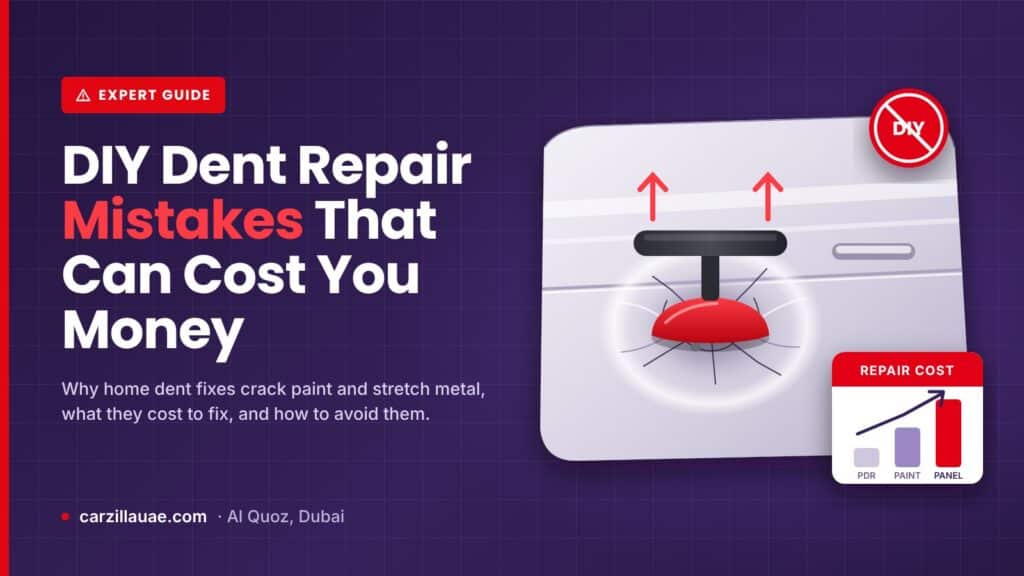
A dent repair kit costs less than a car wash, and online videos make DIY dent removal look like a two-minute job. In a body shop, the reality looks very different. Many dents that end up needing filler, primer and a panel respray started as small dents with intact paint that a paintless dent repair (PDR) technician could have fixed in an hour. The extra cost came from the DIY attempt, not from the original damage.
This guide explains the most common DIY dent repair mistakes, why each one happens, what it does to the metal, paint and hidden parts of the car, how a professional car body workshop fixes it, and how to prevent dents and dent repair damage in the first place. It is written for drivers in Dubai and the UAE, where accident repair rules, summer heat and fine dust add risks that most DIY dent repair advice never mentions.
Why DIY Dent Repair Often Makes a Dent Worse
Most DIY dent removal mistakes come from one assumption: that a dent is simply metal pushed in, and pulling it back out will restore the panel. Two facts explain why that rarely works.
How a Car Dent Stretches the Metal
When a panel is hit hard enough to stay dented, the metal has gone past the point where it can spring back on its own. The impact pushes the centre of the dent down and stretches the metal around it, leaving a raised ring around the low area. The low spot and the raised ring are locked together under tension.
A trained dent technician relieves that tension in a planned sequence, lifting the low areas and tapping down the high areas in very small steps while reading the panel under a striped reflection light. Most DIY tools do the opposite. They pull hard from the centre in one go. The usual results are:
- High spots, where the centre is pulled past flat and becomes a bump.
- Snap-back, where the dent pops out and immediately pops back in.
- Oil canning, where stretched metal becomes unstable and flexes in and out when pressed.
- Work hardening, where repeated bending makes the metal stiffer and more likely to crack.
Stretched metal does not go back by pulling. It has to be shrunk with controlled heat or special tools, which is body shop work.
Why Factory Paint Cracks During DIY Dent Removal
Factory paint is a layered system: a corrosion-protection coat bonded to the metal, primer, colour coat and clear coat. On most modern cars the total thickness is roughly 100 to 150 microns, and the clear coat is only about 40 to 50 microns of that. At the factory, this paint is baked at around 140°C, which gives it a very strong bond and enough flexibility to move slightly with the metal during a careful paintless dent repair.
That flexibility has limits. Fast pulls, sudden temperature changes and repeated attempts push the paint past what it can take, and it cracks in a fine spider-web pattern or lifts away from the metal. Once the paint is broken, paintless dent repair is no longer possible. The job becomes filler, primer and paint, and that is usually where the repair cost jumps several times over.
13 DIY Dent Repair Mistakes That Raise Your Repair Bill
1. Repairing an Accident Dent Before Getting a Police Report
This is the most expensive DIY dent repair mistake in the UAE, and it has nothing to do with tools. Under Article 41 of UAE Federal Law No. 21 of 1995, a garage may not repair a vehicle showing signs of an accident without approval from the licensing authority. In practice, that means a police report. Insurers also will not process a claim without one.
If a dent came from another car, a car park knock or an unknown driver, a DIY attempt before reporting it can:
- Make it impossible for the insurer to assess the original damage, which can lead to a reduced or refused claim.
- Turn a repair that insurance would have covered into a bill paid entirely by the owner.
- Leave the car with partly repaired accident damage that a legitimate garage cannot work on until a report exists.
For damage from an unknown driver, the Dubai Police app has an option for reporting it. Our guide to how an expert auto body shop in Dubai fixes common car damage explains what happens once the report is in place, and the Audi accident repair guide shows how collision repair works on a premium car.
How to avoid it:
- Report accident damage first, even if the dent looks minor.
- Photograph the damage before anything touches it.
- Get a professional assessment before choosing a repair method.
2. Not Checking the Dent Type Before Using a Dent Repair Kit
Different dents need different repair methods, and DIY dent repair kits are designed, at best, for one type: a shallow, round, soft dent in a flat, open area. They are the wrong tool for:
- Crease dents: long, sharp lines where the metal is stretched along the fold.
- Body line dents: dents on the sharp styling lines of a door or wing, the stiffest part of the panel.
- Edge dents: dents near the folded, double-thick edge of a door, bonnet or boot lid.
- Small, sharp dings: small but deep, and often stretched.
- Dents with chipped or cracked paint: these already need paint work, and pulling makes the paint damage worse.
Panel material matters as much as dent shape. Range Rover, Jaguar, Audi A8, Rolls-Royce and most Ferrari models use aluminium for most or all of their outer body, and many other premium cars use aluminium bonnets, wings, doors or tailgates. Aluminium work-hardens faster than steel and is more likely to develop fine cracks when it is straightened. Carbon fibre and composite panels on supercars and carbon fibre body kits do not dent like metal at all, and an impact mark on carbon can hide cracked resin underneath.
How to avoid it:
- Check with a magnet. A magnet does not stick to an aluminium panel.
- Leave creases, body line dents, edge dents and any dent with paint damage to a professional.
- Never push or pull on carbon fibre or composite panels.
3. Using a Suction Cup Dent Puller on the Wrong Dent
Suction cup dent pullers and household plungers can sometimes lift a large, shallow dent on a flat steel panel. Outside that narrow range, they cause predictable damage:
- They cannot grip a narrow crease or a small, sharp dent, so owners pull harder and harder, stressing the paint without moving the metal.
- They pull across a broad area with no control over where the metal actually moves, which leaves distortion around the dent even when it “pops”.
- When the cup loses its seal and slides, fine sand trapped under the rim scratches the paint. In Dubai, dust settles on a parked car within hours.
How to avoid it:
- Wash and dry the panel completely before any tool touches it.
- Stop if the dent does not move with gentle pressure. More force will not help.
4. Over-Pulling and Creating High Spots
The most common outcome of a DIY dent puller is a high spot: the centre comes out too far and becomes a bump. A high spot is harder to fix than the original low spot. It has to be tapped down carefully, and on stressed paint, that tapping can crack the finish. Working the same area for a long time also work-hardens the metal, making it stiffer, less responsive and more likely to crack.
How to avoid it:
- Use many small, light pulls rather than one strong pull.
- Check the panel from several angles after every pull, ideally against a reflected straight line such as a fluorescent tube.
- Stop as soon as progress stops or the paint shows any stress marks.
5. Glue Pull Dent Repair on Repainted Panels, PPF or Wraps
Glue pulling is a genuine professional technique, and when it is done properly it is one of the least invasive ways to remove a dent. Retail glue pull kits contain the same basic parts, but the method depends on details the kits leave out.
- Repainted panels. Refinish paint is usually cured at around 60°C in a body shop booth, far below the factory bake, so its bond is weaker. Professional PDR technicians avoid glue pulling on repainted panels because the glue can peel the paint off with the tab. A paint thickness gauge shows a likely repaint: factory paint usually reads around 100 to 150 microns, and a panel reading well above 200 microns, or much higher than its neighbours, has probably been refinished.
- PPF and vinyl wraps. Glue can lift or tear protection film and wraps instead of pulling the dent, and the film may take paint with it. Our guide on whether PPF damages paint when removed explains why film needs careful handling.
- Ceramic coatings and old, faded paint. Coatings can stop glue from bonding, and oxidised paint can lift with the glue.
- Wrong solvent. Glue residue should come off with high-strength isopropyl alcohol. Acetone and thinners can soften clear coat and stain trims and rubber seals.
How to avoid it:
- Never glue pull on a panel that has been repainted, touched up, wrapped or covered in PPF.
- Do not glue pull any area where the paint is chipped, faded or cracked.
6. Using Boiling Water on a Bumper With Sensors Behind It
Pouring boiling water over a plastic bumper and pushing the dent out from behind is one of the most shared DIY bumper dent repair tips. On a simple bumper with a fresh, shallow dent and intact paint, it sometimes works. On a modern luxury car bumper, it carries real risks:
- Sensors and radar. Parking sensors, blind spot radar and the front radar for adaptive cruise control sit behind the bumper skin. Hot water and steam can get into connectors, and pushing the bumper can change a sensor’s angle.
- Radar rules. Carmakers set strict rules for bumpers that cover radar. GM, for example, requires the bumper to be replaced if there is a crack, dent or gouge in the radar’s emission area. Tesla limits total paint thickness over its radar area to 300 microns. A DIY push or repaint in that zone can mean a new bumper and a full calibration.
- Distortion and broken mounts. Plastic softened unevenly can ripple or bulge, and pushing from behind without removing the bumper often cracks the mounting tabs and brackets.
How to avoid it:
- Do not attempt DIY repair on any bumper area near a sensor, radar or camera.
- After any bumper impact, watch for parking sensor or driver-assistance warnings and get the system checked.
7. Overheating Paint and Aluminium With a Heat Gun
Controlled heat is part of professional dent repair. Technicians measure panel temperature with an infrared thermometer and keep it within a narrow range. Without that measurement, heat becomes guesswork. A hair dryer is usually too weak to help, so owners switch to a heat gun and overdo it. The common results are:
- Blistered, dulled or discoloured clear coat, especially on whites, pearls and light metallics.
- Burnt or warped plastic trims, badges and bumper edges, and softened adhesive behind mouldings.
- Damage to wiring, sensors and rubber seals behind the panel that the owner cannot see.
- On aluminium, carmaker repair manuals warn of a marked loss of panel strength if the metal is heated past the specified limit.
How to avoid it:
- Do not use a heat gun on paint without a way to measure the panel temperature.
- Never use heat on aluminium, carbon or composite panels at home.
8. Trying the Dry Ice or Compressed Air Dent Trick
The idea is to heat the dent, then shock it with dry ice or an upside-down can of compressed air so the metal contracts and pops out. On anything but the shallowest dent, it rarely works. The sudden temperature drop stresses the paint and can leave fine cracks in the clear coat that open up later in the sun. Dry ice also causes cold burns on bare skin. It gives the panel all the stress of a thermal shock with almost no control over how the metal moves.
How to avoid it:
- Skip this method completely. It is not used in professional dent repair.
9. Pushing Dents Out From Inside the Door
PDR technicians work from behind the panel with long, shaped steel rods, guided by a reflection board that shows movements of a fraction of a millimetre. DIY copies of this usually involve a screwdriver, a broom handle or a pry bar forced through a window gap, a drain hole or a removed door card. The damage this causes goes well beyond the paint:
- Side airbag sensors. Many modern cars, including Mercedes-Benz, BMW, Audi and Volkswagen models, trigger the side airbags using a pressure sensor inside the front door cavity. Audi and Volkswagen repair manuals state that the sensor is matched to the volume of air inside the door, and that deforming the door impairs its function. A damaged or disturbed sensor, or a door that no longer seals, can affect airbag deployment and bring on an airbag warning light.
- Window and lock parts. Glass, window regulators, lock mechanisms, wiring and speakers sit in the same space.
- Trim damage. Door cards removed without the right tools break clips and crack mounting points.
- Pressure marks. A pointed tool leaves sharp high spots that show clearly in the reflection and often crack the paint.
How to avoid it:
- Do not remove door trims or push from inside a door at home.
- If an airbag or SRS warning light comes on after any door repair, get it scanned straight away.
10. Drilling Holes to Pull a Dent
Some old DIY guides suggest drilling holes in the dent, screwing in self-tapping screws and pulling with a slide hammer, or drilling the door shell for tool access. On a modern car, this is a serious mistake. Drilling breaks through the paint and corrosion protection, so rust can start from the inside even if the holes are filled. On doors with pressure sensors, extra holes let air escape and weaken the sensor’s ability to detect a side impact, which is why BMW prohibits drilling holes for paintless dent repair. Tesla’s body repair manual allows PDR on its panels only as long as no holes are drilled for tool access.
How to avoid it:
- Never drill a panel or door shell to reach or pull a dent.
11. Filling the Dent With Too Much Body Filler
Body filler is meant to be a thin final skim over metal that has already been brought almost back to shape. Body filler makers cap the thickness: 3M’s technical sheet for its premium filler sets a maximum of a quarter of an inch, and industry guidance often keeps local fills to about 3 mm. Good body shops aim far thinner. DIY repairs often use filler to fill a dent that was never pulled. The results:
- Cracking and dropping out. Thick filler shrinks, cracks under vibration and can drop out.
- Shrink rings. Poorly cured filler keeps shrinking after painting, and the outline of the repair appears weeks later in strong sun.
- Moisture under the paint. Filler is slightly porous, so moisture can get in and cause bubbling if it is not sealed properly.
- Wrong surface. Standard filler does not bond properly to bare aluminium or plastic bumpers without the correct products and preparation.
Poor preparation under the paint is also one of the main reasons repaired panels peel later. Our guide to why car paint peels and how it is fixed explains this in detail.
How to avoid it:
- Do not use filler to make up for a dent that has not been straightened.
- Leave filler and paint work to a body shop with a proper spray booth.
12. Finishing With Aerosol Touch-Up Paint
Spray cans look like an easy way to finish a home repair. On a modern car, the result almost never matches, for several reasons:
- Batch variation. Colour matching is not just the paint code. The same code varies between production batches, and paint fades differently depending on how much sun the car has seen. Body shops use a spectrophotometer and spray test cards before painting.
- Metallic and pearl paint. The metallic flakes settle differently depending on how the paint is sprayed, so a spray-can patch looks lighter or darker from some angles.
- Specialist finishes. Tri-coat pearls, candy colours and many luxury brands’ special colours need a layered process that a can cannot reproduce. Matte and satin finishes cannot be touched up or polished at all.
- 1K clear coat. Most aerosol clears are single-component (1K). They dry only by solvent evaporation and stay soft enough for heat and UV to break them down. Factory and professional refinish clears are two-component (2K) and harden chemically, which is why spray-can repairs fade, cloud and peel much sooner in UAE sun.
- Overspray. Spray drifts onto glass, trim, rubber seals and neighbouring panels.
A professional refinish blends the new colour into the neighbouring panels so the edge of the repair cannot be seen. That is the work of a proper car painting service. For marks that do not need a full repaint, our guide to how car scratch repair works explains when polishing is enough.
How to avoid it:
- Do not spray-paint a dented or filled area at home.
- Do not machine-polish over a repair. Clear coat is thin, and it is thinnest on edges and body lines.
13. Leaving a Dent With Chipped Paint Too Long
After a failed attempt, many owners give up and leave the dent. If the paint inside it is chipped or cracked, bare metal is exposed. Bare steel can start to rust within days, and the rust spreads under the paint around it. Aluminium corrodes as white powder and bubbling under the paint. Coastal humidity in Dubai, Abu Dhabi and Sharjah speeds this up. A dent with paint damage costs less to repair the sooner it is handled.
How to avoid it:
- Get chipped or cracked paint in a dent assessed promptly, even if the dent itself is small.
Why DIY Dent Repair Is Riskier in Dubai’s Heat and Dust
Almost all DIY dent repair advice online is written for cooler countries. UAE conditions make several of the mistakes above more likely and more expensive:
- Panel temperature. Glue pulling works best with the panel at roughly 24°C to 35°C, according to glue pull system makers. In a UAE summer, car surfaces in direct sun can reach 80°C to 90°C. Hot glue cannot set properly at those temperatures, so the pull fails and owners pull harder.
- Hot-to-cold shock. Working on a sun-heated panel and then cooling it with water, air or an air-conditioned garage puts the paint through the same thermal stress as the dry ice trick.
- Fine dust. Any tool placed on an unwashed panel, whether a suction cup, glue tab or polishing pad, drags dust across the paint.
- Strong UV. UV breaks down 1K aerosol clear coat, cheap touch-up paint and badly prepared repairs far faster than in milder climates.
- Humidity. Coastal humidity affects glue adhesion and filler curing, and it speeds up corrosion wherever bare metal is exposed.
The same heat and UV also affect protection layers. Our guides on how long ceramic coating lasts in the UAE and why PPF turns yellow explain how these products behave in local conditions.
How Much a DIY Dent Repair Mistake Can Cost in Dubai
The real cost of a DIY dent repair mistake is the difference between the repair the dent needed and the repair it needs after the attempt. The ranges below are typical of prices published by Dubai workshops in 2025 and 2026 for mainstream cars. Luxury and exotic cars cost more, especially for aluminium panels, specialist paint and parts.
| Repair the dent needs | When it applies | Typical Dubai price range |
|---|---|---|
| Paintless dent repair, small dent | Paint intact, metal not stretched | AED 150 to 300 |
| Paintless dent repair, medium or crease dent | Paint intact, larger or creased dent | AED 250 to 800 |
| Traditional dent repair with filler and paint | Paint cracked, filler or a respray needed | AED 800 to 2,500+ |
| Panel or bumper replacement and paint | Cracked aluminium, torn metal, drilled panels, radar-zone damage | Often several times the traditional repair cost |
Most of the mistakes in this guide move a dent from the first or second row into the third or fourth. Over-pulling, glue pulling a repaint, heat damage and drilling usually add paint work. Pushing on a sensor zone or cracking an aluminium panel can add a new part and calibration.
How a Body Shop Fixes a Failed DIY Dent Repair
Most failed home dent repairs can still be put right. The method depends on what the DIY attempt did to the metal and the paint.
Paintless Dent Repair After a DIY Attempt
If the paint is still intact and the metal is not badly stretched, paintless dent repair is often still possible. The technician first taps down any high spots created by over-pulling, then works the low areas up with rods from behind or controlled glue pulling from the front, reading the panel under a lined light board. The DIY attempt adds time, because the over-pulled areas have to be corrected first, but it is still far cheaper than a respray.
Shrinking Stretched Metal
When the metal has been stretched and the panel oil cans, it has to be shrunk. On steel, this is done with a shrinking disc or controlled spot heat. On aluminium, the process is slower and needs dedicated tools and tight temperature control. Once the panel is stable, it is finished with the thinnest possible skim of filler and refinished.
Refinishing the Panel Properly
If a DIY repair used thick filler, aerosol paint or 1K clear, the panel is stripped back to sound material. The metal is straightened, treated against corrosion and primed with products suited to the panel material. The colour is matched with a spectrophotometer and test cards, blended into the neighbouring panels, and finished with a 2K clear coat cured in a booth. This is the standard process at a professional auto body shop in Dubai.
Bumper Sensor and Radar Checks
After any bumper dent repair, sensor mounts are checked, paint thickness over radar areas is measured against the carmaker’s limits, and driver-assistance systems are recalibrated where required. On premium brands such as Mercedes, BMW, Audi and Range Rover, this is part of the repair, not an optional extra.
When the Panel Has to Be Replaced
Some DIY attempts leave a panel that cannot be repaired economically: cracked aluminium, drilled or torn metal, separated composite layers, or bumpers damaged inside the radar zone. The panel is then replaced, painted and blended. On cars such as Rolls-Royce, Ferrari, Lamborghini and McLaren, parts can take weeks to arrive. Our article on Lamborghini paint and repaint service in Dubai shows how much care exotic finishes need once a panel has to be painted.
How a Failed DIY Dent Repair Affects Resale Value in the UAE
The UAE used car market relies heavily on inspections. Buyers, dealers and inspection centres check every panel with a paint thickness gauge, look at panel gaps and examine the paint under bright light. A dent removed by paintless dent repair leaves the factory paint untouched, so the panel still reads as original. A DIY attempt that ended in filler and a respray leaves a permanent record on the panel, and buyers usually read it as accident damage. A pre-purchase car inspection and a UAE VIN check are how buyers find this, and badly aligned panels or faulty lights can also cause problems at the RTA vehicle inspection.
Which Car Dents Are Safe to Fix at Home
A small number of dents are reasonable candidates for a careful DIY attempt, but only if all of these are true:
- The dent is shallow, round and soft, with no sharp crease.
- It is in a flat, open area, away from body lines and panel edges.
- The panel is steel, not aluminium, carbon fibre or composite.
- The paint is factory original, with no chips, cracks, touch-ups, PPF or wrap.
- It is not near a sensor, radar, camera or door airbag sensor area.
- The dent is not accident damage that needs a police report.
Even then, the safe approach is gentle and gradual, in the shade, on a clean panel, stopping at the first sign of a high spot or paint stress. For everything else, a professional assessment usually costs less than fixing a failed attempt.
How to Prevent Car Dents and Avoid Costly Repairs
- Park with care. End spaces, spaces beside a wall on the driver’s side, and spaces away from trolley bays reduce door dings.
- Park straight and centred so neighbouring doors have room to open.
- Fold the mirrors in tight car parks and narrow streets.
- Fit door edge protection so the car’s own doors do not chip against walls.
- Use paint protection film on high-risk areas. PPF on doors, the front end and the rear bumper absorbs light scuffs and chips. Compare options in our guides to the best PPF in Dubai, 3M PPF in Dubai and ceramic coating vs PPF.
- Consider a wrap or peelable paint as a protective layer. See our comparisons of car wrap vs paint and car wrap vs peelable paint, our guide to choosing a car wrapping service in Dubai, and our peelable car paint service.
- Fix dents early. A fresh dent with intact paint is the cheapest kind to repair.
- Check paint before buying a used car so a later dent repair does not run into hidden filler or repaint.
- Look after wheels too. Kerb strikes often come with lower door and bumper scuffs. Our guide to alloy wheel refinishing for scuffs, scratches and bends explains how wheel damage is repaired.
- Use detailing visits to spot damage early. Regular car detailing and exotic car detailing are a good time to catch new dents and chips before they spread.
DIY Dent Repair FAQs
Can DIY dent repair damage car paint?
Yes. Over-pulling, glue pulling on repainted or faded paint, uncontrolled heat, sudden cooling and pointed tools can all crack the clear coat or lift paint. Once the paint is broken, paintless dent repair is no longer possible and the panel needs paint work.
Does boiling water fix car dents?
It sometimes works on a fresh, shallow dent in a plastic bumper with intact paint. It does not work on metal panels. On modern bumpers it risks water in sensor connectors, distorted plastic, broken mounts and sensor misalignment.
Are suction cup dent pullers safe?
They can lift some large, shallow dents on flat steel panels. They are not suitable for creases, sharp dings, body lines, edges or aluminium panels, and they often over-pull or scratch the paint when they slip.
Can a car dent get worse if left alone?
The metal usually stays the same, but chipped or cracked paint lets moisture reach the metal, and rust or corrosion spreads under the paint. A second knock in the same area also makes the repair harder.
Can I fix a dent in Dubai without a police report?
Garages in the UAE may not repair accident damage without a report, and insurers need one for any claim. Dents from accidents, including unknown drivers hitting a parked car, should be reported through the Dubai Police app before any repair.
Can paintless dent repair fix aluminium panels?
Often yes, but aluminium needs specialist tools, controlled heat and experience, because it work-hardens and cracks more easily than steel. DIY attempts on aluminium carry a high risk of cracking.
Can a dent be repaired on a car with PPF or a wrap?
Yes, many dents can be repaired with rods from behind without removing the film. Glue pulling is usually avoided on film-covered panels because it can lift the film or paint.
How much does dent repair cost in Dubai?
Typical published prices for mainstream cars run from about AED 150 to 300 for a small paintless dent repair, up to about AED 800 for larger or creased dents, and roughly AED 800 to 2,500+ when filler and paint are needed. Luxury and exotic cars cost more.
Professional Dent Repair at Carzilla, Al Quoz Dubai
Carzilla’s body shop in Al Quoz assesses every dent before choosing a repair method. Our team checks the panel material, paint thickness, dent type and what sits behind the panel, then recommends the least invasive repair that restores the car to factory condition. Where the paint is intact, we use paintless dent repair to keep the original finish. Where a DIY attempt has already damaged the paint or stretched the metal, we straighten, refinish and colour-match the panel in a climate-controlled spray booth, and check sensors and driver-assistance systems whenever a bumper is involved.
We repair luxury and premium cars including Porsche, Jaguar, Mercedes, Range Rover, Rolls-Royce and Ferrari, with a free inspection, a written estimate, Warranty on Repair and Free Pickup and Delivery* across Dubai. See our auto body shop services and full list of car repair services, or contact our Al Quoz workshop to have a dent assessed before a small repair becomes a big bill.