Most of the paint damage seen on cars in the UAE is done between May and September. The sun is at its strongest, panels get hot enough to soften the clear coat, the summer shamal carries sand across the highways, and bird droppings and sprinkler water bake onto the paint in minutes instead of hours. The clear coat that protects the colour on a modern car is only about 40 to 50 microns thick, and every summer takes some of it away.
Paint protection film (PPF) is the strongest protection available against that damage, but the timing of the installation matters almost as much as the film itself. PPF fitted in the cooler months goes onto paint that has not yet been marked by summer, is installed in the temperature range the film makers specify, and has weeks to bond fully before the heat arrives. PPF fitted in July, after the first desert drive, seals in whatever damage is already there.
This guide explains what the UAE summer does to car paint and why, why paint protection film should go on before summer, which panels need it most, how to fix paint damage that is already there, and how to look after PPF through the hottest months.
What the UAE Summer Does to Car Paint
Factory car paint is a layered system: an electro-coat for corrosion protection, a primer, the base colour, and a clear coat on top. The base colour carries the look of the car, but it is the clear coat that does the protective work. It contains UV absorbers and light stabilisers that are slowly used up over the life of the paint. Once they are gone, the clear coat itself starts to break down.
A Dubai summer attacks the clear coat in six different ways at the same time.
UV Radiation and Clear Coat Breakdown
The UV index in Dubai regularly reaches 11 to 12 in June, which sits in the “extreme” band. UV light breaks the chemical bonds in the clear coat resin and uses up the UV absorbers built into it. The early signs are a loss of gloss and a slightly chalky look, especially on red, black and dark blue paint. Later, the clear coat micro-cracks, turns cloudy, and eventually lifts away from the base coat, which is the peeling seen on older cars parked outdoors. We explain that later stage in detail in our guide on why car paint peels and how to fix it.
UV damage is worst on horizontal surfaces, because the sun hits them almost straight on for most of the day. The roof, bonnet and boot lid usually fade years before the doors and bumpers.
Panel Heat and Day-to-Night Thermal Cycling
A dark bonnet parked in the Dubai sun can go above 70°C. At that temperature the clear coat softens and expands. At night it cools and contracts again. This happens every day for four months, and the repeated movement puts stress on the weakest points in the paint, such as the edges of old stone chips, panel edges and areas that have been resprayed.
Heat also speeds up every chemical reaction on the surface. A contaminant that would take days to mark paint in a cooler climate can do the same damage in a few hours in July. The same heat that affects the paint also works on the rest of the car; we cover the mechanical side in how Dubai heat damages car engines.
Sand, Dust and the Summer Shamal
The summer shamal is a hot, dry north-westerly wind that typically starts around the end of May and dies down by mid-August, with its strongest winds around midday. Dust events across the UAE are most frequent between June and September.
Silica sand is harder than automotive clear coat. At 120 km/h on the E11 or E311, every grain that hits the front of the car acts like a tiny abrasive blast. Over a summer this sandblasts the front bumper, the leading edge of the bonnet, the mirrors and the A-pillars, and the tyres throw sand and small stones at the rocker panels and the area in front of the rear wheels. Sand that settles on the paint does a second kind of damage when it is wiped off or washed with a dirty mitt, leaving fine swirl marks across the whole car.
Bird Droppings and Tree Sap in High Heat
Most people think bird droppings damage paint because they are acidic. Research by the UK car care company Autoglym found that heat is the bigger factor. In the sun, the clear coat softens and expands while the dropping dries and hardens on top of it. As the paint cools in the evening, it contracts and hardens around the grainy texture of the dropping, leaving a dull, permanent imprint. The test results showed that the texture of the dropping mattered more than its acidity.
This is why bird dropping marks are so much worse in summer. In July, the damage can be permanent within a few hours. Tree sap from trees in residential compounds bakes on in the same way and is just as hard to remove once it has set.
Sprinkler Water and Hard Water Spots
Garden sprinklers in villa communities and car parks spray water that is high in minerals. On a hot panel, the water evaporates in minutes and leaves calcium and magnesium deposits behind. If these are left, the minerals etch into the clear coat and leave rings that do not wash off. Washing a car in direct sun and letting it air-dry causes exactly the same problem.
Road Tar, Roadworks and Summer Debris
Road bitumen softens on hot tarmac and is picked up by the tyres and thrown onto the lower doors, sills and rear bumper. Road resurfacing and construction zones scatter loose aggregate that chips the front of the car. Removing tar properly takes a solvent and careful work, and rubbing at it on a hot panel adds scratches on top of the stain.
Why Summer Paint Damage Is Hard to Reverse
The clear coat is a fixed budget. Most paint damage can be polished out, but polishing works by removing a thin layer of clear coat until the surface is level again. A typical machine polishing stage removes a few microns. Light swirls and fresh water spots take very little. Deep bird dropping etches and mineral rings may need wet sanding, which takes much more. Once the damage goes through the clear coat, the only fix is a respray.
On some cars, polishing is not an option at all. Matte and satin factory finishes cannot be machine polished, because polishing would make them glossy in patches. Any etch or scratch in a matte clear coat is permanent. Many Italian supercar finishes are softer than German clear coats and mark more easily in the heat; our Lamborghini paint and repaint guide explains why soft paint needs extra care.
A respray also affects resale value. Buyers of luxury cars in the UAE routinely check paint depth with a gauge, and a pre-purchase car inspection will show every repainted panel. Original factory paint is worth protecting for that reason alone. If a panel does need refinishing, our guides on how car scratch repair works and how to choose the best car repaint service in Dubai explain what a correct repair involves.
How Paint Protection Film Protects Car Paint in Summer
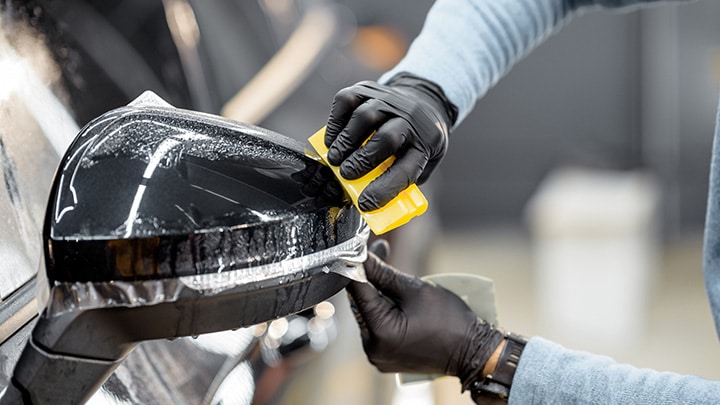
Paint protection film is a clear thermoplastic polyurethane (TPU) film, usually around 150 to 200 microns thick. That is several times thicker than the factory clear coat. It is built in layers: a self-healing top coat, the TPU body that absorbs impacts, a pressure-sensitive acrylic adhesive, and a release liner that is removed during fitting.
In summer conditions, PPF does four things that no wax, sealant or coating can do:
- It absorbs sand and stone impacts. The thick TPU layer takes the energy of grit and small stones that would otherwise chip or sandblast the clear coat.
- It keeps UV off the clear coat. Quality films contain UV inhibitors, so the paint underneath stays protected from the radiation that breaks it down.
- It self-heals light marks. The top coat on most premium films reflows when warm. In Dubai the sun often does this on its own, so light wash marks and fine scratches disappear after the car sits outside or is rinsed with warm water.
- It is sacrificial and replaceable. If a bird dropping etches the film or a stone cuts through it, the film on that panel is replaced and the factory paint underneath stays untouched.
PPF does not make the car maintenance-free. Mineral spots can still form on the surface of the film, and a low-grade film can turn yellow or crack within one or two summers. The film type matters, which is covered further down. If you are still deciding between protection types, our guides on ceramic coating vs PPF and how long ceramic coating lasts in the UAE explain where each one fits.
Why the Best Time to Install PPF in Dubai Is Before Summer
PPF can be fitted at any time of year in a properly equipped workshop, but installing it in the cooler months gives a better result and a much wider margin for error. There are five reasons for this.
PPF Film and Adhesive Work Best in Moderate Temperatures
Film manufacturers publish an installation temperature range for each product. 3M recommends roughly 16 to 30°C for its Series 100 film, LLumar lists 15.5 to 32°C for its Platinum film, and some TeckWrap films specify 18 to 24°C. These ranges exist because heat changes how both the film and the adhesive behave.
When a car arrives at the workshop heat-soaked from the summer sun, the slip solution used to position the film evaporates too quickly and can leave a soapy haze under the film. The adhesive grabs before the installer has the panel aligned, and the warm film stretches too easily around curves, which can thin it and leave stretch marks or edges that pull back later. A good installer will cool the car down in an air-conditioned bay before starting, but the working window is narrower, and the car still goes straight back out into 45°C heat afterwards.
The Adhesive Needs Time to Build Its Bond
PPF adhesive does not reach full strength the moment the film is squeegeed down. The bond builds over the following days and weeks as the remaining moisture under the film evaporates. Film makers such as 3M and LLumar advise waiting at least 72 hours, or three days, before the first wash.
A car fitted in February or March gets several weeks of mild weather for the adhesive to settle, and any small lifted edge can be corrected at the follow-up check before summer begins. A car fitted in late May may face a sandstorm, a sprinkler soaking and a pressure wash within its first fortnight, which is when edge lifting most often starts.
Paint Correction Must Come Before the Film
PPF locks in whatever is underneath it. Swirl marks, water spots and old etches left on the paint will be visible under the film for its whole life. A proper installation starts with a full decontamination wash, iron and tar removal, clay, and machine polishing matched to the paint type. This takes time, and doing it before summer means the paint being corrected is in its best condition of the year, not freshly marked by the summer heat.
Fresh Paint Needs 30 to 90 Days to Outgas
Repainted panels release solvents for roughly 30 to 90 days after they are sprayed. If PPF goes onto paint that is still outgassing, the trapped solvents form bubbles and haze under the film, and the film has to be removed and fitted again once the paint has cured.
This matters because many owners want stone chips touched up or a bumper refinished before they fit film. If that work is done at the auto body shop or through a car painting service in December or January, the paint has cured by the time the film goes on in March. If the same work is left until May, the car either goes through summer unprotected or the film goes on too early.
Damage Done Before Fitting Is Sealed In for Good
A single long summer drive can put dozens of small chips in a front bumper. Film fitted after that drive protects the bumper from that point onwards, but the chips underneath stay visible for as long as the film is on the car. Fitting PPF before the car’s first full summer is the only way to keep the paint under it in factory condition.
Pre-Summer PPF Planning Timeline for UAE Drivers
The UAE summer runs from roughly June to mid-September, with the summer shamal starting in late May. Working back from that gives a simple plan:
| When | What to do | Why it matters |
|---|---|---|
| November to January | Have the paint inspected with a depth gauge and good lighting. Book any chip repairs or panel refinishing. | Leaves enough time for repainted panels to cure. |
| December to February | Complete any body or paint repairs. | Fresh paint needs 30 to 90 days before film can go on. |
| February to March | Decontamination, paint correction and PPF installation. | Moderate temperatures inside the film makers’ recommended range. |
| March to April | First careful washes and a follow-up check two to four weeks after fitting. | Any lifted edge or trapped dust is fixed before the heat arrives. |
| April to May | Ceramic coating on unfilmed panels, headlight protection, window tint check. | The whole car is ready before the shamal and peak UV. |
| June to September | Summer aftercare routine (covered below). | Keeps the film clear and the edges sealed. |
If you buy a new car during the summer, have the film fitted straight away in a climate-controlled bay, before the first highway drive, rather than waiting for the weather to cool. The risk of chipping new paint on the first trip is far greater than the extra installation care needed in summer. Before any tint work in spring, check the UAE car window tinting rules so the car stays legal.
Which Panels Need PPF Most for a Dubai Summer
A standard front kit is designed around stone chips. Summer damage in the UAE also comes from UV, heat and sand thrown up by the tyres, so a coverage plan built for summer looks slightly different.
Front Bumper, Bonnet, Front Wings and Mirrors
These take the direct hits from sand and stones at highway speed and are the first priority on any car. A full bonnet is better than a partial strip on dark paint. With a partial bonnet, the exposed paint behind the film line fades and sandblasts while the protected part does not, and after a few summers the edge of the film becomes visible as a line across the bonnet.
Roof, Bonnet and Boot Lid
These horizontal surfaces take the most UV, get the hottest, and collect most of the bird droppings. Roofs are often left out of PPF packages, but for a car that is parked outdoors through the summer, the roof is one of the panels most likely to fade and etch.
Rocker Panels, Lower Doors and Rear Arches
The tyres throw sand, stones and soft tar at the sills, the bottom of the doors and the area in front of the rear wheels. On SUVs that do long highway runs or drive on sand tracks, these areas take heavy damage, and a thicker grade of film is often used here. This is common on Range Rover, Mercedes G-Class and Lamborghini Urus models.
Door Edges, Door Handle Cups and the Boot Loading Lip
These are everyday wear points rather than summer-specific ones, but rings, keys and luggage cause scratches that the heat then makes harder to polish out. Small pieces of film here cost little and prevent a lot of marks.
Headlights, Carbon Fibre Parts and Body Kits
Polycarbonate headlight lenses yellow under UV in the same way paint fades, and clear film over the lenses slows this down; see our guide to headlight restoration and paint protection. Exposed carbon fibre has a clear lacquer that suffers from UV and chips just like paint, so mirror caps, splitters and diffusers from carbon fibre kits and body kits benefit from film as well.
When Full-Body PPF Makes Sense
For supercars and high-value cars that will be kept for several years, full-body film is usually the better choice, because it protects the whole car evenly and keeps every panel original. This is the common setup on Ferrari, Lamborghini, McLaren, Porsche, Rolls-Royce and Bentley models in Dubai. For more on caring for these finishes, see our guide to exotic car detailing in Dubai.
Choosing a Paint Protection Film That Survives UAE Heat
Not every clear film is built for a Gulf summer. The points that matter most are:
- Film material. Quality PPF uses aliphatic TPU, which stays clear under strong UV. Aromatic TPU, PVC and TPH hybrid films are cheaper and look similar on day one, but they harden, yellow and crack much faster in the UAE sun. Our article on why PPF turns yellow explains the causes in detail.
- Adhesive heat resistance. The adhesive has to hold on a 70°C bonnet without lifting or clouding. Good brands publish heat-ageing and peel-adhesion tests on their technical data sheet.
- Finish. Matte and satin paint must be protected with matte film, because a gloss film changes the look and an unprotected matte clear coat cannot be polished.
- Thickness by area. A thicker grade on the sills and lower panels and a standard grade elsewhere gives the best balance between impact protection and a neat fit around curves.
- Top coat. A film with a built-in hydrophobic top coat lets dust and water rinse off more easily, which helps in sandy conditions.
- Genuine, registered film. The exact film line should be named on the invoice, and the film warranty should be registered with the manufacturer against the car’s VIN.
Our best PPF in Dubai guide compares the main film brands sold in the UAE, and we also have a dedicated article on 3M PPF in Dubai.
How to Fix Summer Paint Damage Before Fitting PPF
If the car has already been through one or more summers, the paint needs to be brought back to good condition before film goes on. The correct order of work is:
- Inspection and measurement. The paint is checked under strong lighting and measured with a paint depth gauge. This shows how much clear coat is left on each panel and which panels have been repainted, which decides how much correction is safe.
- Decontamination. A thorough wash, then iron fallout remover, tar remover and a clay treatment to lift bonded contamination from the surface.
- Water spot removal. Mineral deposits are removed with a dedicated water spot remover before polishing, so the polish is not working against hard deposits.
- Machine paint correction. One or more polishing stages remove swirls, light scratches and shallow etches. The number of stages depends on the damage and the paint depth readings.
- Wet sanding for deep etches. Isolated bird dropping etches and deep mineral rings may need careful wet sanding before polishing, but only where the depth gauge shows enough clear coat.
- Chip repair. Stone chips are filled and levelled so they do not show as craters under the film.
- Refinishing where needed. Panels where the clear coat has failed or the damage goes through to the base coat are resprayed, and the film is fitted only after the 30 to 90 day curing period.
- PPF installation. The film goes on clean, corrected and fully cured paint.
For more on how body and paint damage is repaired, see our guide to how common car damage is fixed at an expert auto body shop. Wheels are not covered by PPF, so kerb and sand damage to alloys is handled separately; our guide to alloy wheel refinishing explains the process.
What to Expect From New PPF in Its First Summer
Some changes in new film are completely normal, and some are early warning signs that need attention.
Normal Behaviour
Small water pockets under the film in the first days after fitting are normal. They are leftover slip solution and clear as the moisture evaporates through the film. Light wash marks that disappear after the car sits in the sun are the self-healing top coat working as it should. A very slight texture, similar to the orange peel in factory paint, is also normal on most films.
Edges Lifting
Cause: Edges cut flush rather than wrapped, film overstretched near the edge, or a pressure washer used too close. Fix: A small, clean lift can be pressed back down with gentle heat. If sand or dirt has got under the edge, that piece of film should be replaced. Prevention: Wrapped edges wherever the panel allows, and a follow-up check before summer.
Bubbles Appearing Weeks After Fitting
Cause: Usually solvent outgassing from a recently repainted panel. Fix: The film on that panel is removed, the paint is allowed to cure fully, and new film is fitted. Prevention: Wait 30 to 90 days after any respray before fitting film.
Yellowing or Cloudiness in the First Year
Cause: Almost always a low-grade or non-genuine film, or an adhesive that is not rated for high heat. Fix: Yellowing that runs through the film cannot be cleaned or polished out. The film has to be removed with heat or steam and replaced. Prevention: Use a genuine aliphatic TPU film with a manufacturer warranty registered to the car.
Stains and Water Spots on the Film Surface
Cause: Bird droppings, sprinkler water or shampoo left to dry on hot film. Fix: Fresh marks wash off with a pH-neutral shampoo or a water spot remover approved by the film maker. Many light marks also relax out of the top coat with heat. Prevention: Remove contaminants quickly and dry the car after every wash.
If film ever needs to be removed, it should be done slowly with heat so the paint underneath is not damaged; our article on whether PPF damages paint when removed covers safe removal.
How to Look After PPF Through a Dubai Summer
Good aftercare is what keeps paint protection film clear and the edges sealed through a hot summer:
- Wash in the early morning or evening, when the panels are cool. Washing a hot car makes shampoo dry on the surface and leaves spots.
- Rinse the sand off first. Use plenty of water before anything touches the film, so grit is not dragged across the surface.
- Use a pH-neutral shampoo and the two-bucket method, with a clean microfibre mitt.
- Dry the car with a soft microfibre towel. Never leave it to air-dry in the sun.
- Avoid automatic brush car washes. They drag grit across the film and can catch the edges. The difference is explained in our guide on car detailing vs car washing.
- Keep pressure washer nozzles at least 30 cm from film edges.
- Remove bird droppings and sap the same day. Soak the spot with a quick detailer for a minute so it softens, then lift it off. Do not scrub a dry dropping.
- Park away from sprinklers and in the shade where possible.
- Use a car cover only on a clean car. A cover put over a dusty car rubs sand into the surface every time the wind moves it. If you use one, choose a soft, breathable cover that fits properly.
- Do not use cutting compounds, strong solvents or harsh degreasers on the film. Use only film-safe products and coatings.
- Have the film checked once a year, ideally alongside routine servicing in line with luxury car maintenance schedules for the UAE.
For a professional clean before or after summer, see how to choose the best luxury car detailing in Dubai.
When PPF Is Not the Right Choice Before Summer
Paint protection film is not the answer for every car or every situation:
- The paint is already failing. If the clear coat is peeling or cracking, film will not hold properly and removing it later can pull loose paint away with it. The panel needs to be refinished first.
- A panel has just been repainted. The film has to wait until the paint has fully cured. In the meantime, careful washing, shade parking and quick removal of contaminants are the best protection.
- The budget is limited or the car will be sold soon. A front kit on the high-impact areas combined with a ceramic coating on the rest of the car gives most of the benefit for much less.
- You want a colour change. A vinyl wrap or peelable paint changes the look for less money, though it protects less than PPF. Our guides on car wrap or paint, car wrap vs peelable paint and how to choose a car wrapping service in Dubai compare the options, and our peelable paint service is available in Al Quoz. A change of body colour has to be recorded with the RTA, so check the car modification rules in Dubai first.
PPF Installation Before Summer at Carzilla, Al Quoz
At Carzilla, paint protection film is fitted by the same team that handles car painting, body repair and detailing at our Al Quoz workshop. That means paint inspection, chip repair, panel refinishing, paint correction and PPF installation can all be planned in the right order, with enough time for repaired panels to cure before the film goes on.
Every PPF job includes:
- Paint depth gauge inspection to find repainted panels and measure the clear coat
- Decontamination and paint correction before the film goes on
- Plotter-cut patterns fitted in a closed, climate-controlled bay
- Edges wrapped wherever the panel allows
- Film warranty registered with the manufacturer
- A follow-up check after fitting
- Warranty on Repair
- Free Pickup and Delivery* across Dubai
PPF front kits start from AED 4,999. You can see current packages on our car detailing services page, and spread the cost with our pay-later option through Tabby.
While the car is with us before summer, it is also a good time to have the car AC checked and the rest of the car prepared for the heat. You can browse all of our car services or contact Carzilla to book a paint inspection and PPF quote before the summer heat arrives.